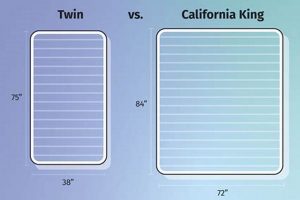
A specialized bedding product, sized specifically for recreational vehicles, provides a sleeping surface comparable in width to a standard king mattress but with a reduced length. This dimensional adaptation allows the inclusion of a large sleeping area within the often-constrained spatial parameters of mobile living environments. For example, the dimensions commonly measure approximately 72 inches wide by 75 inches long.
Optimal sleep quality is paramount for individuals engaging in travel and outdoor activities. These mattresses contribute significantly to restorative rest, mitigating fatigue and enhancing overall well-being. Historically, sleeping solutions in RVs were often rudimentary and uncomfortable. The development of tailored mattresses represents a considerable advancement, offering enhanced comfort and support previously unavailable.
The subsequent sections will explore various aspects of these specialized mattresses. Discussion will include considerations for selecting appropriate models, analysis of common materials and construction methods, and guidance on maintaining the product for longevity. Furthermore, practical advice on optimizing sleep comfort within the RV environment will be presented.
Selecting a Suitable RV King Mattress
Optimal comfort within a recreational vehicle is heavily dependent on the chosen mattress. Careful consideration should be given to specific factors to ensure appropriate selection and longevity of the product.
Tip 1: Measure Available Space Accurately: Precise measurements of the sleeping area are crucial before purchasing. Ensure the selected mattress dimensions accommodate the existing space without compromising surrounding functionality.
Tip 2: Prioritize Material Quality: Investigate mattress materials, opting for high-density foam, memory foam, or hybrid constructions. These materials offer improved support, pressure relief, and durability compared to lower-quality alternatives.
Tip 3: Evaluate Firmness Level: Firmness should align with individual sleep preferences and physical needs. Consider testing different firmness levels, if possible, or consulting reviews to gauge the appropriate support level.
Tip 4: Consider Weight Restrictions: Recreational vehicles have weight limitations. Research the weight of the mattress to prevent exceeding the vehicle’s capacity and potentially affecting fuel efficiency.
Tip 5: Assess Breathability: Mattresses with enhanced breathability, such as those incorporating gel-infused foam or ventilated designs, minimize heat retention, promoting a more comfortable sleep environment.
Tip 6: Explore Motion Isolation Features: For couples, motion isolation is a significant factor. Mattresses with independent coil systems or high-density foam reduce motion transfer, minimizing sleep disturbance.
Tip 7: Check for Certifications: Look for certifications such as CertiPUR-US, which indicate the mattress has been tested for harmful substances and meets specific standards for content, emissions, and durability.
Adhering to these recommendations will facilitate the selection of a mattress that promotes restful sleep and contributes positively to the overall recreational vehicle experience.
The subsequent discussion will focus on maintaining the chosen mattress and optimizing the surrounding sleep environment to maximize comfort during travel.
1. Dimensions

The dimensional specifications of a mattress directly dictate its suitability for installation within a recreational vehicle. Unlike standard residential mattresses, those designed for RVs frequently require non-standard dimensions to accommodate the limited and often uniquely shaped spaces available. Failure to accurately assess the available space and match it to mattress dimensions results in incompatibility, necessitating returns, modifications, or compromised sleeping arrangements. For instance, a mattress that is too long may obstruct access to adjacent areas or prevent the closure of doors, while a mattress that is too wide may not fit within the designated sleeping platform.
The relationship between RV size and mattress dimensions is a key consideration during the design and manufacturing process. Manufacturers strive to maximize sleeping surface area within the constraints imposed by common RV floorplans. This frequently leads to mattresses with widths similar to standard king-sized beds but reduced lengths. Accurate dimensional data, published by manufacturers and verified by consumers, provides the necessary information for ensuring a precise fit. Furthermore, understanding these dimensions is critical for selecting appropriate bedding, such as sheets and mattress protectors, that conform to the specific shape and size of the RV mattress.
In summary, precise dimensional specifications are a critical determinant of an mattress’s functionality and suitability for a recreational vehicle. Ignoring these dimensions risks incompatibility and compromised comfort. Accurate measurement and careful comparison of mattress dimensions against available space are therefore essential steps in the mattress selection process. The challenge lies in balancing the desire for a larger sleeping surface with the physical limitations imposed by the RV’s internal architecture.
2. Material Composition

The material composition of a mattress significantly impacts its performance, comfort, and longevity, particularly within the constraints and demands of a recreational vehicle environment. Careful selection of materials is essential for ensuring a restful and durable sleeping surface.
- Foam Density and Type
Foam density, measured in pounds per cubic foot, determines the support and resilience of the mattress. High-density foams offer greater support and resistance to compression over time, crucial for maintaining comfort during extended travel. Types of foam, such as memory foam, latex foam, and polyurethane foam, each possess unique characteristics. Memory foam conforms to the body, providing pressure relief, while latex foam offers responsiveness and breathability. Polyurethane foam serves as a cost-effective option for base layers.
- Coil Systems (If Applicable)
For hybrid mattresses incorporating coil systems, the gauge and configuration of the coils are important. Higher gauge coils are thinner and more flexible, providing enhanced contouring, while lower gauge coils are thicker and firmer, offering greater support. Coil systems can be individually pocketed, minimizing motion transfer between sleeping partners, a valuable feature in the confined space of an RV.
- Cover Fabric
The cover fabric impacts breathability, moisture management, and overall comfort. Natural fibers, such as cotton or bamboo, are breathable and absorbent, promoting a cooler sleeping environment. Synthetic fabrics, such as
polyester, are durable and resistant to wear and tear, essential for withstanding the rigors of travel. Some covers incorporate antimicrobial treatments to inhibit the growth of bacteria and mold, important in environments with varying humidity levels. - Flame Retardants
Federal regulations mandate that mattresses meet certain flammability standards. Flame retardants are incorporated into mattress materials to reduce the risk of fire. However, the type of flame retardant used is important. Consumers should seek mattresses that utilize flame retardants that are considered safer, such as silica or plant-based materials, rather than potentially harmful chemicals.
In conclusion, the interplay of various materials directly shapes the performance characteristics of an . Optimizing for density, support, breathability, and safety ensures a superior sleep experience within the challenging environment of a recreational vehicle. Selection requires a balance between comfort preferences, durability needs, and environmental concerns.
3. Firmness Level

The firmness level of a mattress designed for recreational vehicles is a crucial determinant of sleep quality and overall comfort. Due to space limitations and unique usage patterns associated with RV travel, selecting an appropriate firmness is paramount.
- Spinal Alignment and Support
Mattress firmness directly impacts spinal alignment during sleep. A mattress that is too soft may result in excessive sinking, leading to spinal curvature and potential back pain. Conversely, a mattress that is too firm may fail to provide adequate contouring, placing undue pressure on specific points along the spine. Optimal firmness ensures proper alignment, minimizing discomfort and promoting restful sleep. For example, individuals with back pain often benefit from a medium-firm mattress that provides adequate support while conforming to the body’s natural curves.
- Pressure Point Relief
Firmness influences the distribution of body weight across the mattress surface. A mattress with insufficient firmness may concentrate pressure on areas such as the shoulders, hips, and knees, leading to discomfort and potential circulatory issues. A more compliant surface distributes weight more evenly, reducing pressure points and improving circulation. Consider a mattress incorporating a comfort layer with a lower firmness level atop a firmer support core to achieve a balance between support and pressure relief.
- Accommodation of Sleeping Position
Preferred sleeping position dictates the ideal firmness level. Side sleepers typically require a softer mattress to allow the shoulders and hips to sink in comfortably, maintaining spinal alignment. Back sleepers generally benefit from a medium-firm mattress that provides support to the lower back. Stomach sleepers often prefer a firmer mattress to prevent excessive sinking of the midsection, which can lead to back strain. Understanding individual sleeping preferences is essential for selecting a mattress with appropriate firmness characteristics.
- Impact of Weight and Body Type
Body weight and type significantly influence the perceived firmness of a mattress. Individuals with higher body weight may find a medium-firm mattress to feel softer than someone with lower body weight. Similarly, individuals with broader shoulders or hips may require a softer mattress to accommodate these body contours. Adjusting firmness level according to individual body characteristics ensures optimal comfort and support. Trial and error, along with consulting mattress firmness guides, can assist in determining the most appropriate firmness for specific needs.
The interplay between spinal alignment, pressure point relief, sleeping position, and body type collectively shapes the ideal firmness for an . Therefore, meticulous evaluation of these factors, coupled with a thorough understanding of individual sleep preferences, is critical for optimizing the sleep experience within a recreational vehicle.
4. Weight Limitations

Weight limitations are a critical consideration when selecting a mattress for a recreational vehicle. Exceeding the specified weight capacity of an RV can compromise its structural integrity, handling characteristics, and fuel efficiency. The mattress, as a significant component of the RV’s payload, must be carefully chosen to remain within these limitations.
- Impact on Fuel Efficiency
Increased weight directly correlates with reduced fuel efficiency. Every additional pound contributes to the energy required to propel the vehicle, resulting in higher fuel consumption. Selecting a lightweight mattress can mitigate this effect, optimizing fuel economy during travel. For instance, opting for a high-density foam mattress over a heavier innerspring model may yield noticeable fuel savings over extended trips.
- Effects on Vehicle Handling
Excessive weight can negatively impact the vehicle’s handling and stability, particularly during turns, braking, and adverse weather conditions. A heavier mattress, especially if coupled with other overloaded components, can shift the vehicle’s center of gravity, making it more susceptible to swaying and rollovers. Maintaining a balanced weight distribution is crucial for safe and predictable handling.
- Strain on Suspension and Tires
The RV’s suspension system and tires are designed to support a specific weight range. Overloading these components can lead to premature wear and tear, increasing the risk of mechanical failures. A heavy mattress contributes to this overall load, potentially compromising the vehicle’s structural integrity and safety. Routine inspections and adherence to weight restrictions are essential for preventing such issues.
- Considerations for Mattress Construction
Mattress construction directly influences its weight. Innerspring mattresses tend to be heavier due to the presence of steel coils. Foam mattresses, particularly those made with lightweight memory foam or latex, offer a lighter alternative. Careful consideration of the materials and construction methods used in the mattress is essential for minimizing its weight without sacrificing comfort or support.
Therefore, the weight limitations imposed by the recreational vehicle necessitate careful selection of a mattress. Evaluating the weight of prospective mattress models and ensuring compliance with the vehicle’s specifications is paramount for maintaining safety, fuel efficiency, and overall vehicle performance. This element is essential in optimizing mattress choices within the RV context.
5. Breathability

Breathability, as a characteristic of bedding materials, directly influences the comfort and sleep quality experienced on a mattress. In the context of an , this attribute is of heightened importance due to the often-confined spaces and fluctuating temperature conditions inherent in recreational vehicle environments. The mattresss ability to dissipate heat and moisture significantly affects the sleeper’s thermal regulation throu
ghout the night. Materials lacking breathability trap heat, leading to discomfort, increased perspiration, and potentially disrupted sleep. Conversely, materials that facilitate airflow promote a cooler, drier sleep environment, enhancing overall restfulness.
The composition of a mattresss internal layers directly affects its breathability. Open-cell foam structures, in contrast to closed-cell foams, permit greater airflow, enabling heat to dissipate more effectively. Similarly, natural fibers, such as cotton or bamboo, used in mattress covers demonstrate superior breathability compared to synthetic alternatives like polyester. Manufacturers often incorporate design features to enhance airflow, including ventilation channels or gel infusions within the foam layers. Real-world examples include mattresses utilizing perforated latex or those incorporating phase-change materials to regulate temperature fluctuations. The choice of materials and design can mitigate the risk of overheating, particularly in warmer climates or during periods of high humidity.
In summary, breathability represents a critical factor in the selection of an . Insufficient breathability can compromise sleep quality, leading to discomfort and reduced rest. By prioritizing mattresses constructed with breathable materials and incorporating design features that promote airflow, users can significantly enhance their sleep experience, particularly within the often-challenging thermal environment of a recreational vehicle. The challenges lie in balancing breathability with other important factors such as support and durability, requiring a holistic approach to mattress selection.
6. Motion Isolation

Motion isolation refers to a mattress’s ability to minimize the transfer of movement from one area of the sleeping surface to another. Within the confined space of a recreational vehicle, particularly when occupied by two individuals, this characteristic becomes paramount. A mattress lacking sufficient motion isolation transmits disturbances caused by one sleeper’s movements to the other, potentially disrupting sleep cycles. Therefore, mattress selection directly affects sleep quality and the overall travel experience. For example, if one individual frequently changes position during the night, a mattress with poor motion isolation will cause the other individual to experience noticeable movement, resulting in fragmented sleep.
Several factors contribute to a mattress’s motion isolation capabilities. Individually pocketed coils, wherein each coil is encased in fabric, restrict movement to the immediate area of compression. High-density memory foam and latex materials also excel at absorbing motion and preventing its propagation across the mattress surface. Conversely, traditional innerspring mattresses, with interconnected coils, tend to exhibit less effective motion isolation. Practical applications include selecting mattresses with independent coil systems to reduce partner disturbance or choosing memory foam models specifically designed for minimizing motion transfer. Regular mattress rotation may also help equalize wear and maintain motion isolation performance over time.
Effective motion isolation is an integral component of a well-designed mattress intended for use in recreational vehicles. Without this characteristic, sleep quality is inevitably compromised, particularly for couples sharing the limited sleeping space. Choosing materials and construction methods that prioritize motion isolation represents a proactive strategy for enhancing comfort and ensuring restful sleep during travel. Challenges remain in balancing motion isolation with other desirable mattress attributes, such as support and temperature regulation, requiring careful consideration of individual needs and preferences.
Frequently Asked Questions
The following section addresses common inquiries regarding mattresses sized for recreational vehicles. Clarification on specific aspects is provided to assist in informed decision-making.
Question 1: What distinguishes dimensions from those of a standard king mattress?
mattresses are typically shorter in length than standard king mattresses. This dimensional adaptation accommodates the spatial constraints inherent in most recreational vehicles. Width dimensions often remain comparable.
Question 2: Are mattresses compatible with all recreational vehicles?
Compatibility depends on the specific dimensions of the sleeping platform within the RV. Precise measurements of the available space are necessary to ensure proper fit. Universal compatibility is not guaranteed.
Question 3: What types of materials are commonly used in mattresses?
Common materials include memory foam, high-density polyurethane foam, latex foam, and innerspring systems. Hybrid models combining multiple materials are also prevalent. Material selection impacts comfort, support, and durability.
Question 4: How does mattress weight affect fuel efficiency in recreational vehicles?
Increased weight directly reduces fuel efficiency. Lighter mattresses minimize the overall payload of the RV, optimizing fuel economy during travel. Consideration of mattress weight is advisable.
Question 5: What considerations are relevant to motion isolation in mattresses?
Motion isolation minimizes the transfer of movement across the mattress surface. Individually pocketed coils and high-density foam are effective at reducing motion transfer, enhancing sleep quality for multiple occupants.
Question 6: How should mattresses be maintained for longevity?
Regular rotation and cleaning are recommended. The use of a mattress protector shields against spills and stains. Adherence to manufacturer guidelines promotes extended lifespan and optimal performance.
Careful consideration of these factors contributes to informed mattress selection and enhanced comfort within the recreational vehicle environment.
The subsequent discussion will address optimizing the sleeping environment within the RV setting to complement the chosen mattress.
RV King Mattress
The preceding analysis has explored critical facets of the RV king mattress, encompassing dimensional considerations, material composition, firmness level, weight implications, breathability, and motion isolation. Each of these elements contributes directly to the overall quality of sleep experienced within the demanding environment of a recreational vehicle. A nuanced understanding of these factors is paramount for making informed purchasing decisions and optimizing the sleep experience.
The selection of an appropriate RV king mattress transcends mere comfort; it is an investment in well-being, safety, and the overall enjoyment of the recreational vehicle lifestyle. Continued advancements in materials science and design principles promise further refinements in mattress technology, enhancing both comfort and durability. Prioritizing informed decision-making ensures that the chosen mattress effectively supports the demands of travel and contributes to a restful and rejuvenating sleep experience.
![Ultimate Tempur-Pedic King Size Mattress [Guide & Review] | Organic & Natural Mattress Buyer’s Guide: Non-Toxic Sleep Solutions](https://mattressworldpa.com/wp-content/uploads/2025/07/th-8395-300x200.jpg "Ultimate Tempur-Pedic King Size Mattress [Guide & Review] Organic & Natural Mattress Buyer’s Guide: Non-Toxic Sleep Solutions")