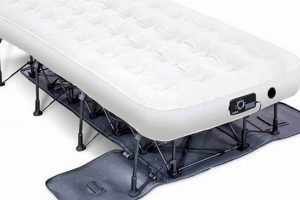
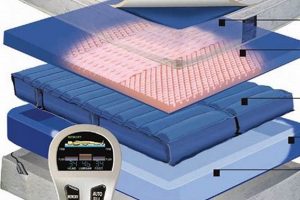
A specialized support surface designed for individuals with medical conditions, particularly those at risk of pressure ulcers, utilizes alternating or low air loss technology. This device distributes weight and reduces pressure on bony prominences. An example includes a powered system placed atop a standard bed frame, providing continuous pressure redistribution for patients with limited mobility.
The importance of such a device lies in its ability to prevent and treat pressure injuries, improving patient comfort, and reducing the need for more intensive medical interventions. Historically, these surfaces have evolved from simple static air mattresses to sophisticated systems with adjustable pressure settings and moisture management features. This advancement reflects an increasing understanding of pressure injury etiology and the benefits of proactive prevention strategies.
This article will further explore the different types available, their clinical applications, maintenance requirements, and considerations for selecting the appropriate surface for specific patient needs. It will also address the current research and technological advancements in this area, as well as relevant regulatory standards and safety protocols.
Considerations for Effective Utilization
This section outlines essential considerations for the appropriate and effective utilization of specialized support surfaces in healthcare settings. Adherence to these guidelines can optimize patient outcomes and minimize potential complications.
Tip 1: Pressure Mapping Assessment: Prior to deployment, conduct a thorough pressure mapping assessment to identify areas of high pressure and customize surface settings accordingly. This proactive approach allows for personalized pressure redistribution based on individual patient needs.
Tip 2: Appropriate Weight Capacity Adherence: Ensure that the patient’s weight is within the specified weight capacity of the support surface. Exceeding the maximum weight limit can compromise the integrity of the device and render it ineffective.
Tip 3: Regular Inspection and Maintenance: Implement a routine inspection and maintenance schedule to detect and address any potential issues such as leaks, damage, or malfunctioning components. Prompt attention to these issues ensures optimal performance and extends the lifespan of the device.
Tip 4: Proper Inflation and Deflation Protocols: Adhere strictly to the manufacturer’s recommended inflation and deflation protocols. Incorrect inflation levels can negate the pressure redistribution benefits and potentially cause harm to the patient.
Tip 5: Education and Training of Healthcare Staff: Provide comprehensive education and training to all healthcare personnel involved in the operation and maintenance of the support surface. Proper training ensures consistent and effective utilization across all care settings.
Tip 6: Skin Assessment and Monitoring: Conduct regular skin assessments to monitor for any signs of pressure injury development. Early detection allows for timely intervention and prevents further deterioration of skin integrity.
The careful consideration and consistent application of these guidelines are crucial for maximizing the therapeutic benefits and minimizing the risks associated with specialized support surfaces. Patient safety and optimal clinical outcomes are predicated on diligent adherence to these best practices.
The following sections will delve into specific clinical applications and emerging technologies within the field of pressure injury prevention and management.
1. Pressure redistribution effectiveness
Pressure redistribution effectiveness is a foundational principle in the design and application of specialized support surfaces. Its direct correlation to patient outcomes, particularly in the prevention and management of pressure injuries, necessitates a comprehensive understanding of its various facets.
- Alternating Pressure Therapy
Alternating pressure therapy employs cyclical inflation and deflation of air cells to systematically redistribute pressure away from bony prominences. This dynamic approach minimizes prolonged periods of localized pressure, crucial for maintaining tissue perfusion. For example, a patient immobilized following surgery benefits from the constant pressure variation, reducing the risk of developing pressure ulcers over the sacrum and heels. Failure of this system results in sustained pressure and potential tissue breakdown.
- Low Air Loss Technology
Low air loss technology involves the continuous flow of air through small perforations in the mattress surface. This creates a microclimate that reduces moisture buildup and friction, key contributors to pressure injury development. Consider a patient with excessive perspiration; the continuous airflow helps to wick away moisture, preventing skin maceration and reducing the risk of shear forces that can damage fragile tissue. Insufficient airflow can exacerbate moisture-related skin damage.
- Immersion and Envelopment
Immersion and envelopment refer to the ability of a support surface to conform to the patient’s body shape, distributing weight over a larger surface area. This reduces peak pressures on bony prominences. A patient with a complex spinal curvature requires a surface capable of conforming to their unique body contours. Inadequate immersion and envelopment will result in localized pressure points and an increased risk of pressure injury formation.
- Weight Capacity and Stability
The weight capacity of a support surface directly impacts its pressure redistribution effectiveness. Exceeding the specified weight limit compromises the integrity of the system, rendering it incapable of providing adequate pressure relief. For instance, if a patient exceeding the weight capacity is placed on the surface, the air cells may bottom out, resulting in direct contact with the underlying mattress and negating any pressure redistribution benefits. Moreover, mattress stability, or lack thereof, leads to shearing effect and more skin injuries.
These facets of pressure redistribution effectiveness underscore the importance of selecting the appropriate specialized support surface for each patient. The effectiveness is highly dependent on diligent maintenance and adherence to manufacturer’s guidelines. Optimal pressure redistribution significantly reduces the incidence of pressure injuries, improving patient comfort and reducing healthcare costs. Neglecting this relationship, and thus the selection or maintenance of an apt supportive surface, can lead to otherwise preventable medical and financial hardships.
2. Air cell technology
Air cell technology forms the core of many spec
ialized support surfaces employed in medical settings. Its design and functionality are critical to pressure redistribution, a primary objective in preventing and managing pressure injuries.
- Individual Cell Inflation Control
Individual cell inflation control allows for precise adjustment of pressure within each air cell. This capability is crucial for tailoring the support surface to the specific needs of a patient, addressing variations in body weight distribution and bony prominence. For example, in areas of high pressure, such as the sacrum or heels, air cells can be deflated or set to a lower pressure to alleviate concentrated force. Malfunctioning or improperly adjusted individual cell control can lead to localized areas of high pressure and increased risk of tissue damage.
- Cell Material and Durability
The material composition and durability of air cells directly affect the long-term performance and reliability of the support surface. Durable materials, such as polyurethane or reinforced nylon, resist puncture and degradation from repeated use and cleaning. A ruptured air cell compromises the pressure redistribution capabilities of the system, requiring immediate repair or replacement. Compromised cell material thus puts patients at risk.
- Alternating Pressure Mechanism
The alternating pressure mechanism, a common feature in specialized support surfaces, cyclically inflates and deflates air cells to simulate movement and relieve pressure. This dynamic process helps to maintain tissue perfusion and prevent prolonged periods of localized pressure. In the absence of a functional alternating pressure mechanism, tissues remain compressed, leading to ischemia and subsequent pressure injury development. Precise timing of the alternation and cycle frequency are integral to this technology.
- Connectivity and Sensor Integration
Modern air cell technology increasingly incorporates connectivity and sensor integration. Sensors embedded within the air cells monitor pressure distribution and transmit data to a central control unit, providing real-time feedback on the effectiveness of the support surface. This data can be used to optimize pressure settings and alert caregivers to potential issues. Lack of connectivity or sensor malfunction can hinder the ability to proactively manage pressure redistribution and prevent pressure injuries.
The effective application of air cell technology in specialized support surfaces hinges on careful consideration of these facets. Accurate cell pressure, material durability, reliable alternating pressure mechanisms, and modern integrated sensor technology are critical factors influencing patient outcomes. Integration of these facets is vital for modern patient care when prevention of pressure injuries is desired.
3. Microclimate management

Microclimate management, within the context of specialized medical support surfaces, directly addresses the skin’s immediate environment. A key function is regulating temperature and humidity at the skin-mattress interface. Uncontrolled, this microclimate can foster conditions conducive to skin maceration, a state of increased susceptibility to pressure injuries. The medical support surface utilizes various methods to achieve this control, often involving low air loss technology or specialized fabric designs. For example, a patient with limited mobility and impaired skin integrity, when placed on a support surface without adequate microclimate control, may experience increased perspiration and subsequent skin breakdown. The support surface actively mitigates this by promoting air circulation and moisture evaporation.
The importance of microclimate management within a medical air mattress extends beyond simple comfort. It directly impacts the skin’s biomechanical properties, influencing its resistance to shear and friction forces. A humid environment weakens the skin’s barrier function, increasing its vulnerability to damage. Practical applications include the use of moisture-wicking fabrics and integrated ventilation systems within the mattress design. These features prevent moisture accumulation and maintain a stable, cool skin temperature, reducing the risk of skin damage. Failure to effectively manage the microclimate can negate the benefits of pressure redistribution, rendering the specialized surface less effective.
In summary, microclimate management is an indispensable component of medical air mattress technology. Its effectiveness directly influences the skin’s integrity and resistance to pressure, shear, and friction. Challenges remain in adapting microclimate control to individual patient needs and environmental conditions. Further research is needed to optimize existing technologies and develop new strategies for maintaining a healthy skin microclimate, ultimately improving patient outcomes and reducing the incidence of pressure injuries. The integration of sensor technology to continuously monitor and adjust the skin microclimate is a promising area for further development.
4. Weight capacity adherence

Weight capacity adherence is a critical parameter governing the safe and effective operation of specialized medical air mattresses. Exceeding the stated weight limit compromises the structural integrity of the device and negates its intended pressure redistribution properties, potentially leading to adverse patient outcomes.
- Structural Integrity and Mattress Performance
Adhering to the specified weight capacity ensures that the mattress maintains its structural integrity, allowing it to effectively distribute pressure across the support surface. For example, if a mattress with a 350-pound weight limit is subjected to a 400-pound patient, the air cells may become overstressed, leading to uneven pressure distribution or even mattress failure. This compromises the device’s ability to prevent pressure injuries, increasing the risk of skin breakdown and related complications.
- Air Cell Pressure and Redistribution Efficiency
Weight capacity directly influences the air pressure within the mattress’s individual air cells. When weight limits are exceeded, the air cells may not be able to maintain the correct pressure levels, resulting in localized areas of high pressure. In clinical settings, this can manifest as increased pressure readings over bony prominences, such as the sacrum or heels, despite the presence of the air mattress. The diminished pressure redistribution efficiency undermines the primary purpose of the specialized support surface.
- Mattress Lifespan and Maintenance
Consistent adherence to weight capacity guidelines extends the lifespan of the medical air mattress and minimizes the need for frequent repairs or replacements. Overloading the mattress places undue stress on its components, accelerating wear and tear and potentially leading to premature failure. Proper adherence translates into reduced maintenance costs and improved long-term value of the medical equipment.
- Patient Safety and Liability
Failing to adhere to weight capacity guidelines creates a direct patient safety risk. Overloaded mattresses may not provide adequate support, leading to instability and potential falls. Furthermore, healthcare facilities that knowingly exceed weight limits may be held liable
for resulting patient injuries. Implementing strict weight capacity protocols is therefore essential for minimizing both patient harm and legal liabilities.
These multifaceted considerations underscore the vital importance of weight capacity adherence in the context of medical air mattress utilization. Consistent monitoring and enforcement of weight limits are essential for ensuring patient safety, maximizing the effectiveness of pressure redistribution, and maintaining the long-term integrity of the medical equipment. In light of these connections, healthcare facilities must prioritize comprehensive training and robust protocols regarding weight capacity management for all specialized support surfaces.
5. Infection control measures
Infection control measures are integral to the safe and effective use of medical air mattresses. These mattresses, designed to prevent pressure injuries, are frequently used by patients with compromised immune systems or open wounds, increasing their susceptibility to infection. Inadequate infection control practices can transform these supportive devices into reservoirs for pathogenic microorganisms, leading to healthcare-associated infections (HAIs). For instance, failure to properly disinfect a mattress between patients can facilitate the transmission of organisms such as Methicillin-resistant Staphylococcus aureus (MRSA) or Clostridium difficile, resulting in severe complications and prolonged hospital stays.
Effective infection control protocols for medical air mattresses encompass several key elements. First, selection of mattresses constructed from impermeable, easy-to-clean materials is paramount. Second, rigorous cleaning and disinfection procedures must be implemented between each patient use, adhering to established guidelines from organizations such as the Centers for Disease Control and Prevention (CDC). This includes the use of appropriate disinfectants with proven efficacy against a broad spectrum of pathogens. Third, regular inspection and maintenance of the mattress are necessary to identify and address any damage or wear that could compromise its integrity and facilitate microbial growth. A tear in the mattress surface, for example, provides an entry point for fluids and microorganisms, making thorough disinfection difficult, if not impossible. Finally, healthcare staff must receive comprehensive training on proper cleaning, disinfection, and handling procedures to ensure consistent adherence to infection control protocols. The absence of such training increases the risk of procedural errors and subsequent contamination.
In conclusion, infection control measures are not merely an ancillary consideration, but an essential component of medical air mattress utilization. Diligent implementation of robust cleaning, disinfection, and maintenance protocols is critical for minimizing the risk of HAIs and ensuring patient safety. Ongoing research into innovative materials and disinfection techniques is needed to further enhance the effectiveness of infection control practices and address the evolving challenges posed by emerging pathogens. The success and usefulness of a medical air mattress is significantly diminished without careful consideration and application of infection control measures.
Frequently Asked Questions
This section addresses commonly asked questions concerning medical air mattresses, providing clarity on their functionality, application, and maintenance.
Question 1: What constitutes a medical air mattress?
A medical air mattress is a specialized support surface designed to redistribute pressure and minimize the risk of pressure injuries in individuals with limited mobility or those at high risk for skin breakdown. It typically comprises inflatable air cells and a control unit that regulates air pressure.
Question 2: How does a medical air mattress differ from a standard air mattress?
While both types utilize air-filled chambers, medical air mattresses are engineered with specific features to promote therapeutic benefits. These features may include alternating pressure cycles, low air loss technology for microclimate control, and adjustable pressure settings to accommodate individual patient needs. Standard air mattresses lack these advanced functionalities and are primarily intended for recreational use.
Question 3: What are the primary benefits of utilizing a medical air mattress?
The principal benefits include pressure redistribution to prevent and treat pressure ulcers, enhanced comfort for patients with limited mobility, microclimate control to minimize skin maceration, and potential reduction in healthcare costs associated with pressure injury management.
Question 4: Are there specific contraindications for the use of a medical air mattress?
Contraindications may include unstable spinal fractures, certain types of traction, or situations where a firm, stable surface is medically necessary. Individual patient needs and medical conditions should be carefully evaluated before initiating use.
Question 5: How should a medical air mattress be cleaned and disinfected?
Cleaning and disinfection protocols should adhere to the manufacturer’s instructions and established infection control guidelines. Typically, the mattress surface should be cleaned with a mild detergent solution, followed by disinfection with an appropriate healthcare-grade disinfectant. Air cells should be inspected for damage, and damaged cells should be promptly replaced.
Question 6: What factors should be considered when selecting a medical air mattress?
Key considerations include patient weight capacity, level of pressure redistribution required, presence of microclimate control features, ease of cleaning and disinfection, durability, and compliance with relevant safety standards. A thorough assessment of the patient’s needs and the mattress’s capabilities is essential.
Proper understanding and application of this information is crucial for the effective and safe implementation of medical air mattresses in healthcare settings.
The next section will address emerging trends and technological advancements in the field of pressure injury prevention.
Conclusion
This article has explored the multifaceted nature of the specialized support surface used in healthcare settings, designed to mitigate pressure injuries. The discussion encompassed fundamental aspects such as pressure redistribution effectiveness, air cell technology, microclimate management, weight capacity adherence, and infection control measures. Careful consideration of these factors is crucial for optimizing patient outcomes and minimizing complications associated with prolonged immobility.
The continued advancement of medical support surface technology holds significant promise for improving patient care. Ongoing research and development efforts should focus on enhancing pressure redistribution capabilities, refining microclimate control mechanisms, and implementing robust infection control protocols. A commitment to evidence-based practice and continuous improvement is essential to realizing the full potential of these devices and ensuring the well-being of vulnerable patients. Diligence in the utilization of medical support surfaces is imperative for effective healthcare delivery.