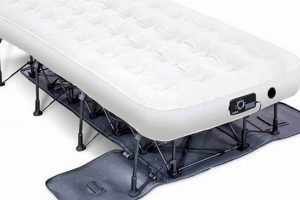
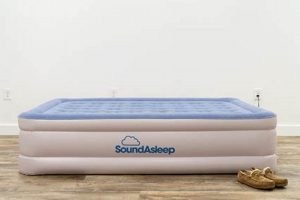
The capacity of inflatable sleeping surfaces to support mass varies significantly. This range is dictated by factors such as the construction material, internal support structure, and overall size of the product. For example, a single-sized, basic model might have a limit of 300 pounds, whereas a queen-sized, more robust unit could potentially accommodate up to 600 pounds or more.
Understanding the maximum load a particular inflatable bed can bear is crucial for ensuring user safety and preventing damage to the product. Exceeding this limit can result in seam rupture, material stress, and ultimately, a compromised sleeping surface. The rise in popularity of these portable beds has led to increased attention on accurate load specifications, typically found on product packaging or manufacturer websites. This information empowers consumers to make informed choices.
Therefore, a detailed examination of the factors influencing the weight capacity of different air mattress types is warranted. This includes exploring materials, construction techniques, and the implications of exceeding stated limitations. Subsequent sections will delve into specific models, warranty considerations, and best practices for maintaining the structural integrity of these widely used sleeping solutions.
Tips for Adhering to Inflatable Bed Load Limits
Proper usage and maintenance are essential for ensuring the longevity and safety of inflatable sleeping surfaces. Observing the manufacturer’s specified load limit is paramount to prevent damage and ensure user well-being.
Tip 1: Consult the Manufacturer’s Specifications: Prior to use, carefully review the product packaging or manufacturer’s website for the stated load limit. This information is typically provided in pounds or kilograms and represents the maximum weight the item is designed to support.
Tip 2: Distribute Weight Evenly: Avoid concentrating weight in a single area. Distributing weight across the entire surface minimizes stress on any one point and helps to prevent localized damage.
Tip 3: Account for All Occupants and Objects: The stated load limit applies to the total weight on the surface, including all occupants and any items placed upon it, such as bedding or personal belongings.
Tip 4: Monitor for Signs of Overload: Regularly inspect the surface for signs of strain, such as bulging or seam distortion. These indicators suggest the load limit may be exceeded.
Tip 5: Avoid Sharp Objects: Sharp objects can puncture the material, compromising its structural integrity and reducing its weight-bearing capacity.
Tip 6: Consider a Higher Capacity Model: If anticipated usage frequently approaches the stated limit, consider investing in a model with a higher stated weight capacity to provide a safety margin.
Tip 7: Maintain Proper Inflation: Ensure the product is inflated to the manufacturer’s recommended pressure. Under-inflation can reduce support, while over-inflation can increase stress on the seams.
Adhering to these guidelines helps to optimize the performance and extend the lifespan of inflatable sleeping surfaces, while also safeguarding against potential injuries.
The following section will discuss the implications of exceeding the load limit and explore potential warranty considerations related to misuse.
1. Material Tensile Strength

The tensile strength of the material directly dictates the maximum load an inflatable sleeping surface can withstand. Material tensile strength refers to the maximum stress that a material can endure before it begins to fracture or deform permanently. In the context of inflatable beds, this characteristic determines the resistance of the surface to tearing, stretching, or rupturing under pressure exerted by weight. Higher tensile strength translates to a greater capacity to support substantial loads without compromising structural integrity. A weak material may exhibit premature failure even under moderate weight, leading to deflation and potential injury.
The relationship between material tensile strength and load capacity is further amplified by the internal support structure of the inflatable bed. Materials with inherent high tensile strength, such as reinforced PVC or specialized polymers, are frequently employed in high-capacity models. These materials are often combined with internal baffling systems or I-beam construction to distribute weight evenly across the surface, mitigating localized stress concentrations. For example, a premium inflatable bed designed for heavier individuals may utilize a multi-layered PVC material with a high tensile rating, coupled with strategically placed internal supports, to achieve a superior weight-bearing capability compared to a budget model using thinner, less durable material.
In conclusion, material tensile strength is a critical determinant of an inflatable bed’s load capacity. The selection of appropriate materials with sufficient tensile properties, coupled with thoughtful design and construction techniques, is paramount for ensuring user safety, product durability, and adherence to stated weight limitations. Understanding this connection empowers consumers to make informed purchasing decisions and utilize inflatable sleeping surfaces responsibly, minimizing the risk of damage or injury. Proper care and adherence to load limits will maximize the lifespan of the product and ensure continued reliable performance.
2. Internal support structure

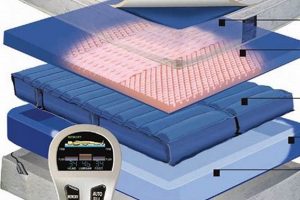
The internal support structure of an inflatable sleeping surface is a critical determinant of its load-bearing capacity. This structure, often consisting of I-beams, coils, or interconnected air chambers, is engineered to distribute weight evenly across the mattress surface. Without an adequate internal support system, the material would be prone to localized stress concentrations, leading to deformation, bulging, and eventual failure, even under loads significantly below the stated maximum.
The design and configuration of the internal supports directly influence the weight distribution efficiency. For example, a mattress employing a network of vertical I-beams will generally exhibit superior weight distribution compared to a simpler design with horizontal baffles. The I-beams act as load-bearing pillars, transferring weight to the underlying surface and minimizing stress on the outer material. Similarly, coil-beam construction mimics the support provided by traditional innerspring mattresses, offering enhanced stability and load capacity. Premium inflatable beds often incorporate multiple layers of internal support, combining I-beams with interconnected air chambers to achieve optimal weight distribution and overall durability. The absence of a robust internal support network explains why cheaper models tend to have lower load lim
its and a higher propensity for failure under heavy use.
In summary, the internal support structure is fundamental to an inflatable bed’s ability to bear weight. The design, materials, and configuration of these supports dictate how effectively weight is distributed across the surface, directly influencing the mattress’s load-bearing capacity and long-term durability. Careful consideration of the internal support system is therefore essential when assessing the suitability of an inflatable sleeping surface for specific weight requirements.
3. Size and construction

The dimensions and manufacturing techniques of an inflatable sleeping surface significantly influence its capacity to support weight. These factors dictate the distribution of stress and the overall structural integrity of the unit.
- Surface Area and Load Distribution
Larger mattresses, while providing more sleeping space, do not automatically equate to a higher weight capacity. The load must be distributed across a wider surface area, potentially requiring more robust internal support to prevent sagging or failure in specific zones. For example, a queen-sized bed designed for two occupants necessitates stronger internal baffling compared to a single-sized bed intended for one individual.
- Seam Welding and Material Joints
The quality of seam welding is crucial for maintaining air pressure and structural stability. Weak or poorly executed welds can rupture under stress, leading to deflation and a loss of support. Reinforced seams and multi-layered material joints are often found in models designed to withstand higher loads. High-Frequency welding is a commonly used method to ensure that this issue won’t happen.
- Internal Baffle Design
The configuration of internal baffles, or air chambers, dictates how weight is distributed throughout the structure. Vertical I-beam designs are known for their ability to provide consistent support across the entire surface, while horizontal baffle designs may be more prone to localized sagging under heavier loads. The more complex and reinforced the internal structure, the greater the overall weight capacity.
- Material Thickness and Density
The thickness and density of the PVC or other materials used in construction directly correlate with the mattress’s ability to resist stretching and tearing under pressure. Thicker, higher-density materials are inherently more durable and capable of supporting greater loads without compromising structural integrity. For instance, a heavy-duty inflatable bed intended for outdoor use would require a significantly thicker material gauge than a lightweight model designed for occasional indoor use.
In summary, both the size and method of constructing the product play essential roles in determining how much weight it can hold. A larger size may necessitate a more complex design to ensure even weight distribution. High-quality construction techniques, with reinforced seams and stronger materials, are crucial for maximizing overall load-bearing capabilities and durability.
4. Inflation pressure

Inflation pressure serves as a critical parameter influencing the capacity of an inflatable sleeping surface to support weight. Insufficient pressure reduces the structural rigidity of the unit, causing it to sag and deform under load. This deformation concentrates stress on specific points, potentially leading to material failure and a compromised weight-bearing capability. Conversely, excessive pressure can overstress seams and the material itself, increasing the risk of rupture. The optimal inflation level, typically specified by the manufacturer, represents a balance between structural support and material stress, maximizing the mattress’s ability to withstand a given load.
The relationship between inflation pressure and load capacity is not linear; it is influenced by factors such as material elasticity, internal support structure, and ambient temperature. For example, a mattress inflated to the lower end of the recommended pressure range may adequately support a single lightweight individual, but it could exhibit significant sagging when supporting two adults. Similarly, fluctuations in ambient temperature can affect air pressure within the mattress, requiring adjustments to maintain optimal support. Regularly monitoring and adjusting inflation pressure according to the manufacturer’s guidelines is essential for ensuring both comfort and adherence to the stated weight limits. Ignoring pressure recommendations can significantly reduce the life expectancy of the product and increase the risk of sudden failure.
Maintaining proper inflation pressure is therefore paramount for realizing the intended weight-bearing capability of any inflatable sleeping surface. Understanding the influence of factors such as load distribution, ambient temperature, and material properties further enhances the ability to optimize performance and minimize the risk of damage. Adhering to manufacturer specifications is not merely a recommendation; it is a necessary step in ensuring user safety and maximizing product longevity.
5. Weight distribution
The manner in which mass is distributed across an inflatable sleeping surface directly impacts the maximum load it can bear safely and effectively. Uneven weight distribution concentrates stress on specific areas, potentially exceeding the material’s tensile strength and leading to deformation or failure.
- Localized Stress Concentrations
When a disproportionate amount of weight is focused on a single point or area, the material in that region experiences elevated stress. This stress can surpass the material’s yield strength, resulting in permanent deformation or even rupture. For instance, sitting or kneeling in one spot can create a localized stress concentration, particularly in models with less robust internal support structures.
- Edge Loading and Seam Stress
Weight positioned near the edges of the inflatable bed places significant stress on the seams, which are often the weakest points in the construction. This “edge loading” effect can weaken the seam welds over time, increasing the likelihood of air leakage or catastrophic failure. For example, consistently sitting on the edge of the mattress can accelerate seam degradation.
- Impact of Multiple Occupants
When multiple individuals occupy an inflatable bed, their relative positions and movements significantly influence the overall weight distribution. Uneven distribution of mass, resulting from differing body weights or concentrated movements, can lead to asymmetrical stress patterns within the mattress. This is especially relevant for larger mattresses intended for multiple occupants.
- Role of Internal Support Structures
The design and effectiveness of the internal support system (e.g., I-beams, coils) directly affect the weight distribution capabilities. These structures are engineered to distribute weight evenly across the surface, mitigating stress concentrations. Inadequate or poorly designed support systems
can result in uneven weight distribution and a diminished load capacity. A well-designed internal support system, such as I-beams placed throughout the mattress, enhances even distribution of the weight, maximizing overall capacity.
Effective weight management is therefore paramount for maximizing the load-bearing potential of inflatable sleeping surfaces. Distributing mass evenly across the mattress minimizes stress concentrations, reduces the risk of material failure, and prolongs the lifespan of the product. Proper utilization, combined with adherence to manufacturer-specified weight limits, is essential for ensuring safe and reliable performance.
Frequently Asked Questions
The following addresses common inquiries regarding the mass-bearing capabilities of inflatable sleeping surfaces, offering practical insights and clarifying misconceptions.
Question 1: How does the stated weight limit relate to actual performance?
The stated mass threshold represents the maximum weight the manufacturer deems the mattress capable of supporting under ideal conditions. Exceeding this limit increases the risk of structural failure, seam rupture, or diminished support. Adherence to the specified limit is crucial for ensuring safety and product longevity.
Question 2: Does mattress size correlate directly with its ability to hold mass?
Increased dimensions do not automatically translate to a higher load-bearing capacity. The materials, construction techniques, and internal support design are more decisive factors. A larger mattress with inferior construction may have a lower limit than a smaller, more robustly built model.
Question 3: What constitutes “uneven weight distribution,” and why is it problematic?
Uneven mass distribution refers to a scenario where a disproportionate amount of weight is concentrated in a single area. This can occur when occupants are positioned asymmetrically or when heavy objects are placed on the surface. Such imbalances amplify stress, potentially leading to localized material failure or compromised support.
Question 4: Can temperature fluctuations impact the load capacity?
Significant temperature variations can affect the internal air pressure, influencing the firmness and support characteristics. High temperatures may cause overexpansion, increasing the risk of seam stress, while low temperatures may lead to under-inflation and reduced support. Monitoring and adjusting air pressure accordingly is advisable.
Question 5: Does the type of clothing or bedding influence maximum support?
The composition of bedding or clothing typically has negligible effect on the item’s ability to withstand weight. However, the presence of sharp or abrasive materials in direct contact with the surface can increase the risk of punctures or abrasion, ultimately reducing its overall lifespan.
Question 6: Are there warranty implications related to exceeding load limits?
Most manufacturer warranties explicitly exclude damage resulting from misuse or exceeding the specified mass threshold. Operating the item beyond its design limitations may void the warranty, leaving the user responsible for repair or replacement costs.
In summary, a comprehensive understanding of the contributing aspects is paramount for safe and effective utilization. Adherence to stated load limits, coupled with proper inflation and even mass distribution, are essential for maximizing product lifespan and minimizing the risk of damage or injury.
The subsequent section will delve into specific brands and models, providing comparative data on load capacities and construction features.
Assessing Inflatable Sleeping Surface Load-Bearing Capabilities
This exploration of “how much weight can an air mattress hold” has illuminated the critical factors that govern the load capacity of these widely used sleeping solutions. Material tensile strength, internal support structure, construction techniques, and proper inflation all play integral roles in determining the maximum weight a given product can safely accommodate. Exceeding the stated limits, or neglecting best practices for weight distribution, can compromise the structural integrity, leading to premature failure and potential injury.
Therefore, it is incumbent upon users to diligently consult manufacturer specifications, adhere to recommended inflation pressures, and ensure even mass distribution across the sleeping surface. Responsible usage not only maximizes product lifespan but also ensures a safe and comfortable experience. As technology advances, further innovations in materials and construction may yield inflatable beds with enhanced load-bearing capabilities, but fundamental principles of safe operation will remain paramount.