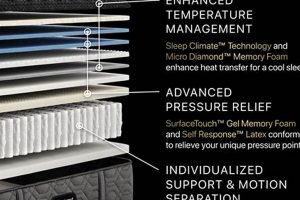
The action of increasing the support provided by a sleep surface, essentially reducing its compressibility, can be achieved through various methods. For example, placing a firm board between a box spring and a mattress will decrease the amount of give when weight is applied.
A more supportive sleep surface can alleviate pressure points, promote spinal alignment, and potentially enhance sleep quality. Historically, individuals have sought methods to modify the characteristics of their beds to meet specific comfort and health needs, ranging from simple adjustments to incorporating specialized materials.
The following sections will detail different techniques for achieving increased sleep surface support, exploring options from simple adjustments to more involved modifications, along with considerations for cost, comfort, and durability.
Techniques for Enhancing Mattress Firmness
Achieving a more supportive sleep surface often involves modifying the existing structure or adding supplemental components. The following techniques outline practical approaches to increasing the resistance of a mattress to compression.
Tip 1: Employ a Mattress Topper Designed for Support: Consider investing in a firm mattress topper constructed from materials such as high-density foam or latex. These toppers can provide an additional layer of support without requiring the purchase of an entirely new mattress.
Tip 2: Insert a Solid Platform Beneath the Mattress: Placing a rigid board, such as a sheet of plywood, between the mattress and its foundation (box spring or bed frame) can significantly reduce the amount of give. Ensure the board is adequately sized to fully support the mattress.
Tip 3: Rotate and Flip the Mattress Regularly: Consistent rotation and flipping (if the mattress design allows) distributes wear and tear evenly, potentially prolonging the firmness and preventing localized sagging.
Tip 4: Assess and Reinforce the Bed Frame or Foundation: A weak or sagging bed frame or foundation can contribute to the overall feeling of softness. Evaluate the support structure and reinforce it as needed with additional slats or a more robust frame.
Tip 5: Utilize Mattress Support Inserts: Specialized inserts are available that can be placed beneath specific areas of the mattress to provide targeted support where sagging is most pronounced.
Tip 6: Consider a Mattress Encasement: A tightly fitted mattress encasement can provide a slight increase in overall firmness and support by compressing the existing materials.
Implementation of these techniques can potentially improve sleep quality by promoting proper spinal alignment and reducing pressure points. The choice of method should be guided by individual needs, budget, and the existing mattress type.
The subsequent sections will address the potential drawbacks and long-term considerations associated with each of these approaches, ensuring a comprehensive understanding of mattress modification strategies.
1. Supportive topper selection

The selection of a supportive topper directly influences the achievable firmness of a mattress. A topper acts as an intermediary layer, altering the surface characteristics. Choosing a topper with inherently firm propertieshigh-density foam or latex, for exampledirectly counteracts the compressibility of an underlying mattress. Failure to select a supportive material renders the topper ineffective, potentially exacerbating the perceived softness. For instance, a low-density memory foam topper, while adding cushioning, might negate the effort to increase support. The choice must, therefore, align with the specific goal of enhancing firmness.
The effectiveness of supportive topper selection can be observed in various real-world scenarios. Individuals with back pain, often advised to sleep on firmer surfaces, may find relief by adding a high-density latex topper to a softer mattress. This modification provides targeted spinal support without the expense of a new mattress. Conversely, adding a plush, low-density topper would likely offer minimal, if any, therapeutic benefit in such cases. The practical significance lies in the ability to customize a sleep surface to individual needs and preferences, thus demonstrating the importance of mindful topper selection when the intention is to bolster firmness.
In summary, supportive topper selection is a critical component when the objective is to enhance mattress firmness. The success of this approach hinges on the material properties of the topper, directly influencing the degree of support provided. Challenges may arise in accurately assessing the density and firmness of toppers based solely on product descriptions; therefore, consumer reviews and independent testing reports can provide valuable insights. Ultimately, thoughtful selection is essential for achieving the desired firmness level and optimizing sleep quality.
2. Platform board insertion
Platform board insertion, the practice of placing a rigid board between a mattress and its foundation, constitutes a direct intervention aimed at mitigating mattress compressibility and enhancing overall support. This technique addresses the fundamental issue of insufficient firmness by creating a less yielding sleep surface.
- Direct Support Augmentation
The primary function of a platform board is to provide immediate, uniform support across the entire mattress surface. By minimizing the degree to which the mattress can compress into the underlying box spring or frame, the board effectively increases the perceived firmness. For example, an individual experiencing back pain on a softer mattress might find considerable relief after inserting a solid plywood platform. The board prevents the mattress from conforming excessively to the body’s contours, thus maintaining spinal alignment.
- Reduced Motion Transfer
The introduction of a rigid platform dampens motion transfer across the mattress surface. With less give in the sleeping surface, movements are less likely to propagate and disturb a sleeping partner. For instance, if one individual tosses and turns frequently, a platform board can help to isolate these movements, leading to a more restful sleep experience for both parties. This feature proves especially beneficial for couples who share a bed and have differing sleep patterns.
- Prevention of Sagging
Over time, mattresses may develop indentations or sagging, particularly in areas that bear significant weight. A platform board serves as a preventative measure against this issue. By distributing weight more evenly, the board reduces the strain on individual mattress components and helps to maintain its original shape and firmness. Regular use of a platform board can extend the lifespan of a mattress by decelerating t
he rate of degradation. - Foundation Reinforcement
The foundation of the bed, whether a box spring or a slatted frame, can contribute to the overall softness of the sleeping surface. Platform board insertion serves a secondary role of reinforcing a weak foundation. The solid surface of the board creates a more stable base for the mattress, effectively negating the impact of a sagging or overly flexible foundation. This combined effect provides a more consistent and supportive sleep surface than would be possible with either measure alone.
In conclusion, platform board insertion directly addresses the lack of mattress firmness by providing a solid, unyielding support structure. The technique’s benefits extend beyond mere firmness enhancement, encompassing motion isolation, sag prevention, and foundation reinforcement. Although the perceived comfort and long-term durability will depend on board material, thickness, and proper support size, platform board insertion delivers a tangible and relatively cost-effective method for transforming an unsupportive mattress into a firmer sleep environment.
3. Regular rotation schedule

A regular rotation schedule, in the context of optimizing sleep surface support, aims to mitigate localized compression and prolong the usable lifespan of a mattress, thereby indirectly maintaining a firmer feel over time. This practice addresses the tendency for mattresses to soften unevenly under consistent pressure.
- Even Weight Distribution
Rotation redistributes the points of maximum pressure across the mattress surface. Consistent sleeping positions lead to localized wear, causing indentations and softening in specific areas. Regular rotation counteracts this by shifting the primary support zones, allowing compressed materials time to recover. For example, an individual who consistently sleeps on one side of the bed will likely experience localized sagging on that side; rotation reallocates that pressure to less-used sections, promoting more uniform wear.
- Prolongation of Support Layer Integrity
Mattresses typically consist of multiple layers, including support cores (springs or foam) and comfort layers (padding). Uneven compression can compromise the integrity of both. Rotation prevents the premature breakdown of these layers by distributing stress. Consider a mattress with pocketed coils; consistent pressure in one area can weaken those coils over time, leading to sagging. Rotation helps maintain the structural integrity of the coils across the entire surface.
- Mitigation of Body Impressions
Body impressions, permanent indentations caused by prolonged compression, are a common indicator of mattress degradation. Regular rotation helps minimize these impressions by altering the points of pressure, giving the compressed materials a chance to rebound. For instance, a memory foam mattress is particularly susceptible to body impressions; consistent rotation helps prevent the formation of deep, permanent indentations, thus retaining a more even and firmer surface.
- Improved Air Circulation
Rotation can also improve air circulation within the mattress. Compressed areas tend to restrict airflow, which can contribute to material degradation. By rotating the mattress, previously compressed areas are allowed to breathe, promoting aeration and reducing the likelihood of moisture buildup. In humid climates, this can be especially beneficial in preventing mold and mildew growth, further extending the mattress’s lifespan and maintaining its structural integrity.
In conclusion, a regular rotation schedule contributes to a firmer mattress feel over the long term by promoting even wear, preserving support layer integrity, mitigating body impressions, and improving air circulation. While rotation alone cannot magically transform a soft mattress into a firm one, it serves as a critical maintenance practice to optimize the mattress’s inherent support characteristics and prolong its useful life, thereby maintaining the intended level of firmness for a greater duration.
4. Foundation reinforcement strategies

Foundation reinforcement strategies directly influence the perceived and actual firmness of a mattress. The support system beneath the mattresswhether a box spring, platform, or slatted framecontributes significantly to the overall sleep surface firmness. An inadequate or deteriorating foundation allows the mattress to sag, negating the intended firmness characteristics of the mattress itself. For instance, a box spring with weakened coils or a slatted frame with excessively spaced or broken slats will permit the mattress to conform excessively to the sleeper’s weight, creating a softer feel than the mattress’s inherent design intended. This effect underscores the importance of a stable, supportive foundation as a prerequisite for realizing the intended firmness of a mattress.
Practical applications of foundation reinforcement are diverse and often dictated by the type of foundation in use. Reinforcing a box spring might involve replacing or adding coils, or inserting supportive boards within the structure. For slatted frames, adding more slats or replacing existing slats with thicker, more robust materials provides increased support. Platform frames benefit from ensuring that the central support structure is adequately reinforced to prevent bowing or sagging under load. Real-world examples include individuals experiencing back pain on a seemingly firm mattress who find relief only after reinforcing their sagging box spring. The intervention prevents excessive sinking and supports proper spinal alignment, thus improving sleep quality and comfort.
In summary, foundation reinforcement strategies are integral to achieving and maintaining desired mattress firmness. Addressing deficiencies in the foundation is often a necessary step in optimizing the sleep surface. Challenges may arise in diagnosing the source of the problem, as both mattress and foundation issues can manifest similarly. A comprehensive assessment of both components is crucial. By understanding the interplay between mattress and foundation, individuals can effectively implement appropriate reinforcement strategies to achieve the desired level of sleep surface firmness and ensure long-term comfort and support.
5. Targeted support inserts

Targeted support inserts represent a localized approach to enhance mattress firmness, addressing specific areas of sagging or insufficient support. These inserts, typically constructed from dense foam or rigid materials, are strategically positioned beneath the mattress to counteract localized compression. The placement of these inserts directly influences the firmness of the sleep surface in the targeted area. For example, an individual experiencing lower back pain may insert a support wedge beneath the lumbar region of the mattress, increasing firmness and promoting spinal alignment. The practical effect is a reduction in pressure points and improved support for the affected area.
The importance of targeted support lies in its ability to
customize the mattress’s support profile without requiring a complete replacement. Sagging often occurs unevenly across the mattress surface, and targeted inserts allow for a tailored solution. For instance, if one side of a mattress has developed a noticeable indentation due to consistent use, strategic placement of inserts can restore the original firmness and prevent further deterioration. This method provides a cost-effective and efficient way to address specific areas of concern. The implementation, however, requires careful assessment of the mattress’s support needs and precise positioning of the inserts to achieve the desired effect.
In summary, targeted support inserts offer a practical and customizable method for enhancing mattress firmness in localized areas. They represent a strategic intervention to address sagging and promote proper spinal alignment. While the effectiveness of inserts depends on the accuracy of placement and the selection of appropriate materials, this approach provides a valuable tool for individuals seeking to optimize their sleep surface without the expense of replacing the entire mattress. The challenge lies in accurately identifying areas requiring additional support and selecting inserts with the appropriate density and dimensions.
Frequently Asked Questions
This section addresses common inquiries regarding methods to increase the support provided by a sleep surface, thereby altering its perceived firmness.
Question 1: What are the primary benefits of increasing mattress firmness?
Increased firmness can promote spinal alignment, reduce pressure points, and potentially alleviate back pain. A firmer surface generally offers greater resistance to compression, supporting the body more evenly.
Question 2: Is it possible to make a very soft mattress significantly firmer?
While some techniques can improve support, transforming an extremely soft mattress into a truly firm one may be unrealistic. The extent of achievable firmness depends on the mattress’s initial construction and materials.
Question 3: Does adding a firm mattress topper guarantee increased firmness?
Adding a firm topper typically increases surface firmness. However, the underlying mattress’s support structure remains unchanged. If the base mattress lacks adequate support, the topper’s effect may be limited.
Question 4: Can placing a board under a mattress damage it?
If the board is properly sized and positioned, it is unlikely to cause damage. Ensure the board fully supports the mattress and is free of sharp edges or splinters.
Question 5: How often should a mattress be rotated to maintain firmness?
Rotating a mattress every 3-6 months is generally recommended. This practice helps distribute wear evenly and prevent localized sagging.
Question 6: Are there specific types of mattresses that are more easily made firmer?
Mattresses with coil or innerspring support systems are often more amenable to firmness adjustments through methods like adding a board or a supportive topper. All-foam mattresses may be more challenging to modify significantly.
In conclusion, achieving increased mattress firmness requires a comprehensive approach, considering the mattress’s construction, foundation, and supplemental support methods. Results may vary depending on the specific circumstances.
The following section will explore potential drawbacks and long-term considerations associated with the various firmness enhancement strategies.
Concluding Remarks on Enhancing Mattress Firmness
The preceding exploration of methods to make mattress firmer has detailed a range of techniques, from simple adjustments to more involved modifications. The efficacy of each approach hinges on the specific characteristics of the existing mattress, the foundation upon which it rests, and the desired level of support. Strategies such as topper selection, platform board insertion, and foundation reinforcement each present unique advantages and limitations. A comprehensive understanding of these factors is essential for achieving optimal results.
The pursuit of a firmer sleep surface represents a significant investment in sleep quality and potential long-term health. Careful consideration of individual needs and a methodical application of appropriate techniques are paramount. Continued monitoring and adjustments may be necessary to maintain the desired firmness level over time. The ultimate goal remains the attainment of a supportive and comfortable sleep environment conducive to restorative rest.