Achieving a desired level of support from a bed is a common objective for many individuals. The firmness of a sleep surface significantly impacts spinal alignment, pressure point relief, and overall sleep quality. A surface that provides adequate resistance can contribute to a more restful and restorative sleep experience. For example, a mattress that initially felt supportive may soften over time, necessitating adjustments to restore its original feel.
The level of firmness is crucial for comfort and health. Historically, firmer mattresses were often recommended for individuals with back pain, promoting proper posture during sleep. While individual preferences vary, a well-supported spine can reduce strain and discomfort. Therefore, restoring or increasing the solidity of a bed can have a direct and positive impact on sleep quality and daytime comfort.
Various methods exist to address a sleep surface that has become too soft. These range from simple adjustments to more involved interventions. The following sections will explore practical techniques and solutions designed to enhance the support provided by a mattress, thereby improving sleep and overall well-being.
Enhancing Mattress Firmness
Several strategies can be implemented to increase the firmness of a mattress, addressing issues of sagging or insufficient support. These methods vary in complexity and cost, catering to different needs and resources.
Tip 1: Foundation Evaluation: Assess the condition of the bed’s foundation. A weak or damaged box spring or platform can contribute to a softer feel. Replacement or reinforcement of the foundation may provide immediate improvement.
Tip 2: Rotating and Flipping: Regularly rotate and flip the mattress (if applicable). This distributes wear evenly, preventing localized sagging and maintaining a more consistent firmness across the surface. Rotating is generally recommended every 3-6 months.
Tip 3: Mattress Topper Removal: If a soft mattress topper is in use, consider removing it. While toppers enhance comfort for some, they often reduce the overall firmness and support provided by the underlying mattress.
Tip 4: Plywood Support: Inserting a thin sheet of plywood between the mattress and the foundation can provide additional support. Ensure the plywood is properly sized and smooth to prevent damage to the mattress.
Tip 5: Temperature Regulation: Certain mattress materials, such as memory foam, can soften in warmer environments. Maintaining a cooler room temperature may help preserve the mattress’s firmness.
Tip 6: Mattress Encasement: A mattress encasement can provide additional support and structure. Choose an encasement designed to add firmness rather than simply protecting against allergens or bed bugs.
Tip 7: Consider a New Mattress: If the mattress is significantly old or damaged, achieving the desired firmness may not be possible through the above methods. In such cases, replacing the mattress may be the most effective solution.
By implementing these techniques, individuals can often enhance the firmness of their sleep surface, leading to improved sleep quality and reduced discomfort. However, if issues persist, professional evaluation or replacement of the mattress should be considered.
The concluding section will explore long-term strategies for maintaining mattress firmness and ensuring optimal sleep support.
1. Foundation Stability

The stability of a bed’s foundation exerts a direct influence on perceived mattress firmness. A stable foundation provides consistent support across the entire mattress surface, preventing localized sinking or sagging. Conversely, a compromised foundation, such as a broken box spring or warped platform, introduces uneven weight distribution. This unevenness creates pressure points and diminishes the overall support the mattress can provide, resulting in a softer or less supportive feel. The foundation acts as the structural base; its integrity is paramount to realizing the intended characteristics of the mattress.
For example, a high-density foam mattress designed for firm support will not perform as intended if placed on a sagging box spring. The compromised foundation allows the mattress to conform to the uneven surface, negating the inherent firmness of the foam. Similarly, a slatted platform with excessively wide gaps between slats can lead to premature wear and sagging in the areas of the mattress that lack direct support. In both scenarios, addressing the foundation issue is a prerequisite to effectively enhancing or maintaining mattress firmness. Replacement or reinforcement of the foundation is often a necessary first step.
In summary, foundation stability is a critical, often overlooked, component of achieving desired mattress firmness. A compromised foundation undermines the performance of even the highest-quality mattress. Addressing foundation issues, whether through repair or replacement, is crucial to realizing the intended support characteristics of the mattress and promoting proper spinal alignment during sleep. A stable foundation ensures uniform weight distribution and prevents premature sagging, maximizing both comfort and the lifespan of the mattress.
2. Support Layers

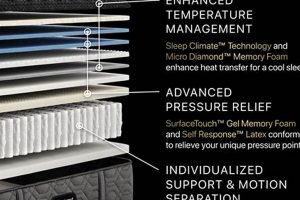
The internal architecture of a mattress, specifically the composition and arrangement of its support layers, directly influences its overall firmness. These layers provide the primary resistance to compression, dictating the degree to which the mattress yields under body weight. Understanding the role of these layers is essential to comprehending how a mattress achieves its firmness level.
- Core Density and Composition
The core layer, often constructed from high-density foam or innersprings, provides the foundational support. Higher density foams offer greater resistance to compression, contributing to a firmer feel. Similarly, innerspring systems with a higher coil count and thicker gauge wires provide more robust support. For example, a mattress utilizing a high-density polyurethane foam core will generally exhibit greater firmness than one employing a less dense, softer foam. The choice of core material and its density is a primary determinant of overall mattress firmness.
- Transition Layers
Transition layers, situated between the core and the comfort layers, serve to modulate the firmness gradient. These layers often consist of foams with varying densities and indentation load deflection (ILD) ratings. They prevent the abrupt transition from the firm core to the potentially softer comfort layers, creating a more progressive and supportive feel. A mattress lacking appropriate transition layers may feel either excessively firm or offer inadequate support, even if the core is adequately dense. An example of a transition layer would be a medium-density polyfo
am or a layer of microcoils. - Zoning and Targeted Support
Advanced mattress designs often incorporate zoning, where different areas of the support layers are engineered to provide varying levels of firmness. This is typically achieved through variations in foam density, coil gauge, or the addition of specialized support elements in specific regions of the mattress, such as the lumbar area. Zoning allows the mattress to provide targeted support to different areas of the body, promoting proper spinal alignment and pressure point relief. A mattress with enhanced lumbar support will often feel firmer in the midsection, contributing to overall perceived firmness.
- Material Degradation
Over time, the materials composing the support layers can degrade due to factors such as compression, humidity, and temperature fluctuations. Foam can lose its density and resilience, while innersprings can lose their tension. This degradation leads to a reduction in the mattress’s overall support and firmness. Regular rotation and proper maintenance can help to mitigate material degradation, but eventually, the support layers will lose their effectiveness, necessitating mattress replacement. Sagging or impressions in the mattress surface are telltale signs of compromised support layers.
In conclusion, the architecture of the support layers fundamentally determines a mattress’s ability to provide firm and consistent support. Factors such as core density, transition layers, zoning, and material degradation all play a crucial role. Understanding these aspects is critical to both selecting a mattress with the desired firmness level and assessing the potential causes of reduced firmness in an existing mattress. Adjustments to these layers, whether through the addition of a supportive topper or, ultimately, through mattress replacement, are often necessary to achieve optimal sleep support and spinal alignment.
3. Temperature Control

Temperature control plays a significant, though often overlooked, role in perceived mattress firmness. The materials used in mattress construction, particularly memory foam, exhibit temperature-sensitive properties that can influence their responsiveness and support characteristics.
- Memory Foam Viscoelasticity
Memory foam, a common component in mattresses, is a viscoelastic material. Its stiffness and damping properties are strongly temperature-dependent. At higher temperatures, memory foam becomes softer and more pliable, conforming more readily to the body’s contours. Conversely, at lower temperatures, it becomes firmer and less responsive. This temperature sensitivity can significantly impact the subjective feel of the mattress, potentially reducing its perceived firmness in warmer environments.
- Ambient Temperature Effects
The ambient temperature of the sleep environment directly affects the temperature of the mattress and, consequently, the properties of temperature-sensitive materials. In warmer climates or during summer months, memory foam mattresses may exhibit a greater degree of softening, leading to a perceived reduction in firmness. Maintaining a cooler room temperature can mitigate this effect, preserving the intended firmness level. Conversely, in colder environments, the mattress may initially feel firmer until body heat warms the material.
- Mattress Ventilation and Airflow
Mattress construction features that promote ventilation and airflow can help regulate temperature and minimize the softening effect on temperature-sensitive materials. Open-cell foam structures, breathable fabrics, and ventilation channels allow for better heat dissipation, preventing the mattress from becoming excessively warm. Mattresses with poor ventilation tend to retain heat, exacerbating the softening effect of temperature on materials like memory foam. The effectiveness of ventilation systems directly influences how temperature impacts perceived firmness.
- Phase Change Materials (PCMs)
Some mattresses incorporate phase change materials (PCMs) to regulate temperature and maintain a more consistent feel. PCMs absorb or release heat as they transition between solid and liquid states, helping to buffer temperature fluctuations and maintain a comfortable sleeping surface. By stabilizing the temperature of the mattress, PCMs can mitigate the softening effects associated with warmer temperatures and enhance the consistency of firmness, regardless of ambient conditions. These materials contribute to a more stable and controlled sleep environment.
In summary, temperature control is a critical factor in maintaining the desired firmness of a mattress, especially those containing temperature-sensitive materials like memory foam. Managing ambient temperature, promoting airflow, and incorporating technologies such as PCMs can all contribute to a more consistent and supportive sleep surface. Neglecting temperature considerations can lead to a perceived reduction in firmness and diminished sleep quality. Understanding these connections is crucial for maximizing the long-term comfort and support provided by a mattress.
4. Proper rotation

Proper rotation constitutes a fundamental, preventative measure in maintaining mattress firmness and prolonging its lifespan. Uneven weight distribution, concentrated in specific areas over prolonged periods, leads to localized compression and eventual sagging. Proper rotation aims to mitigate this effect by distributing wear more evenly across the entire mattress surface. Consequently, consistent rotation acts as a key component in efforts to maintain firmness.
Failure to rotate a mattress regularly results in accelerated degradation in frequently used areas. For instance, a side sleeper who consistently occupies the same portion of the mattress will inevitably create impressions and softening in that region. By rotating the mattress 180 degrees, the previously compressed area is now positioned at the foot of the bed, allowing it to recover somewhat as weight is shifted to a less-stressed section. Furthermore, mattresses designed to be flipped benefit from rotation as well as flipping, allowing for utilization of both surfaces to further extend the period before significant compression occurs. Without this practice, the lifespan and uniform firmness of the mattress are demonstrably reduced. Example: If an old mattress not be rotated properly the old spot will sagged and no firmness anymore.
In conclusion, proper rotation is not merely a maintenance task but an integral strategy for preserving and maximizing the firmness of a mattress. By evenly distributing weight and minimizing localized compression, consistent rotation prevents premature sagging and extends the usable life of the sleep surface. This simple act significantly contributes to maintaining the intended level of support and delaying the need for replacement, representing a practical and cost-effective approach to preserving mattress firmness. It is directly related “how to make mattress more firm”.
5. Material Density
Material density serves as a primary determinant of mattress firmness. It fundamentally inf
luences the degree to which a mattress resists compression under body weight. Higher density materials, measured as mass per unit volume, inherently offer greater resistance to deformation. Consequently, a mattress constructed from high-density foam or densely packed innersprings will generally exhibit greater firmness than one composed of lower density alternatives. The relationship is directly proportional: increased material density translates to increased resistance to pressure and, therefore, increased mattress firmness.
The practical significance of understanding material density lies in its implications for support and durability. A high-density foam core, for instance, will provide more consistent support over time, resisting sagging and maintaining its original firmness for a longer period. Conversely, a low-density foam core is more susceptible to compression and degradation, leading to a loss of firmness and potential discomfort. This principle extends to innerspring mattresses as well; higher coil counts and thicker gauge wires contribute to greater density and enhanced support. For example, a memory foam mattress with a density of 5 pounds per cubic foot will offer significantly more support and resist impressions more effectively than a similar mattress with a density of only 3 pounds per cubic foot. The specific materials used within the layers of the mattress and the density of those materials are significant contributors to the overall level of support a mattress can provide.
In summary, material density is a crucial consideration when evaluating and selecting a mattress with the desired firmness level. Its impact extends beyond immediate comfort, influencing long-term support and durability. A thorough understanding of material density allows for informed decision-making, ensuring that the chosen mattress will maintain its firmness and provide adequate support for years to come. Recognizing this connection is essential to optimizing sleep quality and maximizing the lifespan of the mattress. The correct material density can help “how to make mattress more firm”.
Frequently Asked Questions
This section addresses common queries regarding methods to increase the firmness of a mattress, providing clarity and practical information.
Question 1: Why does a mattress lose firmness over time?
Mattress materials, particularly foam and innersprings, degrade due to repeated compression, humidity, and temperature fluctuations. This degradation leads to a reduction in support and perceived firmness.
Question 2: Can a mattress topper make a mattress firmer?
While some toppers are designed to provide additional support, they generally do not significantly increase the firmness of a soft mattress. In some cases, a firmer topper might slightly improve the surface, but it is usually best to use a mattress encasement.
Question 3: How does temperature affect memory foam mattress firmness?
Memory foam is temperature-sensitive. Warmer temperatures soften the foam, potentially reducing firmness. Cooler temperatures cause it to stiffen, increasing perceived firmness. Regulating room temperature can therefore affect the feel of a memory foam mattress.
Question 4: Is it possible to repair a sagging innerspring mattress?
Minor sagging might be addressed by rotating the mattress or adding a supportive layer beneath it. However, significant sagging often indicates irreparable damage, necessitating mattress replacement.
Question 5: What is the ideal frequency for rotating a mattress to maintain firmness?
Rotating a mattress every 3-6 months is generally recommended. This practice distributes wear evenly, preventing localized compression and promoting consistent support across the surface.
Question 6: Does the foundation influence the firmness of a mattress?
Yes, a weak or damaged foundation can compromise the support provided by a mattress, leading to a softer feel. Ensure the foundation is stable and capable of adequately supporting the mattress’s weight.
Addressing mattress firmness involves understanding the underlying causes of softening and employing appropriate strategies to restore support. While some solutions offer temporary relief, significant issues often require more comprehensive interventions.
The subsequent section will delve into long-term maintenance strategies for preserving mattress firmness and maximizing sleep quality.
Conclusion
The preceding discussion has explored various factors contributing to a reduction in mattress firmness and presented techniques for addressing the issue. Methods range from foundation reinforcement and temperature regulation to material density considerations and rotation schedules. A multi-faceted approach, considering both the internal composition and external environment, is often necessary to effectively restore or maintain the desired level of support.
Achieving optimal sleep support is paramount for both physical well-being and restorative rest. While individual solutions may vary, consistent attention to the principles outlined herein can extend the lifespan of a mattress and enhance sleep quality. Continued diligence in monitoring mattress condition and implementing preventative measures represents a worthwhile investment in long-term health and comfort and “how to make mattress more firm”.