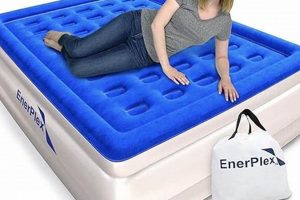
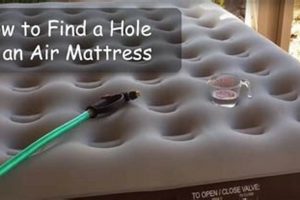
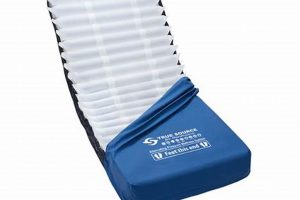
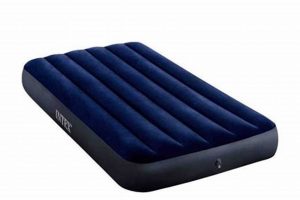
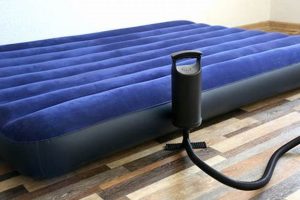
A portable inflatable bed designed to fit within the confines of a truck’s rear seating area provides a sleeping surface for rest or overnight stays. These mattresses often include features such as integrated air pumps for easy inflation and deflation, and are constructed from durable materials to withstand the rigors of vehicular use. For instance, a truck driver might employ this type of mattress during long-haul journeys to facilitate rest stops without requiring a motel stay.
The utility of such a product lies in its ability to transform otherwise unused space into a functional rest area. This can lead to cost savings by reducing reliance on traditional lodging options. Historically, individuals traveling long distances have sought creative solutions for comfortable rest; this represents a modern adaptation to that need, providing a convenient and relatively inexpensive alternative. Moreover, it offers a degree of privacy and security compared to resting at public rest stops.
The following sections will delve into considerations when selecting one of these mattresses, including material durability, inflation mechanisms, sizing specifications, and storage capabilities. Additionally, compatibility across different truck models and user reviews regarding comfort and longevity will be examined. Maintenance and repair strategies will also be addressed, ensuring informed purchasing decisions and extended product lifespan.
Essential Considerations for Utilizing an Air Mattress in a Truck’s Backseat
Maximizing the effectiveness and longevity of an inflatable sleeping surface within a truck’s cabin requires careful planning and execution. The following tips outline key considerations for optimal use and maintenance.
Tip 1: Measure the Available Space: Before purchasing, accurately measure the dimensions of the truck’s backseat area. This ensures the chosen mattress fits appropriately, preventing damage to the vehicle’s interior or compromising comfort.
Tip 2: Prioritize Durable Materials: Select a mattress constructed from puncture-resistant materials such as heavy-duty PVC or reinforced nylon. This minimizes the risk of leaks and extends the product’s lifespan, particularly under frequent use.
Tip 3: Evaluate Inflation Mechanisms: Consider the type of inflation system. Integrated electric pumps offer convenience, while manual pumps provide a backup option in the absence of power. Assess the pump’s inflation time and noise level.
Tip 4: Ensure Proper Ventilation: When using the mattress, maintain adequate ventilation within the truck’s cabin to prevent moisture buildup and discomfort. Cracking a window or utilizing a ventilation system is advisable.
Tip 5: Use Protective Bedding: Employ a fitted sheet or mattress protector to shield the surface from dirt, spills, and abrasion. This simplifies cleaning and preserves the integrity of the material.
Tip 6: Distribute Weight Evenly: Avoid concentrating weight in a single area. Distributing weight across the mattress surface prevents localized stress and reduces the likelihood of punctures or deformation.
Tip 7: Practice Proper Storage Techniques: When not in use, fully deflate the mattress, clean it thoroughly, and store it in a cool, dry place away from direct sunlight and sharp objects. This prevents material degradation and premature wear.
These guidelines ensure a safer, more comfortable, and more durable experience when utilizing an inflatable sleeping surface in a truck’s rear compartment. Adherence to these recommendations optimizes product performance and extends its usability.
The next section will address common issues encountered with these mattresses, providing troubleshooting solutions and repair strategies.
1. Size Compatibility

Size compatibility is a primary determinant of the utility and safety of an air mattress intended for use in the backseat of a truck. Accurate sizing ensures the mattress fits within the confined space, maximizing comfort and minimizing potential hazards.
- Vehicle-Specific Dimensions
Truck models vary significantly in backseat dimensions. Measuring the available spacelength, width, and heightis crucial. A mattress exceeding these dimensions may require folding or compression, potentially damaging the mattress or compromising comfort. An undersized mattress, conversely, offers inadequate support and usable surface area.
- Wheel Well Protrusions
Wheel wells often intrude into the backseat area, reducing usable space. Mattress designs must account for these protrusions, either by incorporating cutouts or relying on inflatable segments that conform to the irregular shape. Failure to consider wheel wells can result in an unstable or poorly fitting mattress.
- Seatbelt Accessibility
An appropriately sized mattress should not obstruct access to seatbelts or safety features. Occupants must be able to securely fasten their seatbelts while using the mattress. Overly large mattresses can impede this safety requirement, rendering them unsuitable for use while the vehicle is in motion or parked in potentially hazardous locations.
- Headroom Considerations
Mattress thickness affects available headroom. A thicker mattress may reduce headroom to an uncomfortable level, particularly for taller individuals. Evaluating the combined height of the mattress and occupants ensures sufficient space for comfortable rest or sleep within the truck’s cabin.
Effective size compatibility, therefore, represents a balance between maximizing usable sleeping space and maintaining vehicle safety standards. Prioritizing accurate measurements and considering vehicle-specific features ensures the selected air mattress provides a comfortable and secure rest environment within the confines of the truck’s backseat.
2. Material Durability
The correlation between material durability and the overall effectiveness of an air mattress intended for truck backseat use is direct and significant. The inherent conditions of truck travelvariations in temperature, potential abrasion from interior surfaces, and the possibility of sharp objectsplace considerable stress on the mattress material. Consequently, the lifespan and functional integrity of the product are heavily dependent on its ability to withstand these environmental factors. For instance, a mattress constructed from thin PVC may quickly develop leaks due to friction against seatbelt buckles or minor tears from shifting cargo, rendering it unusable. This necessitates a more robust material choice.
High-denier nylon or reinforced PVC represent viable alternatives, offering increased resistance to punctures, tearing, and stretching. These materials maintain air pressure more effectively ove
r extended periods and are less susceptible to degradation from exposure to sunlight or extreme temperatures often encountered within a vehicle. A practical example is the use of military-grade PVC in some premium models, which demonstrates superior performance in demanding conditions compared to standard consumer-grade materials. Furthermore, seams and valve construction play a critical role; reinforced seams prevent air leakage and valve integrity ensures efficient inflation and deflation over the mattress’s lifetime.
In conclusion, material durability is not merely a desirable attribute but a fundamental requirement for an air mattress designed for truck backseat use. Its selection dictates the product’s longevity, resistance to damage, and overall utility. Neglecting this aspect leads to premature failure, rendering the mattress ineffective and potentially unsafe for intended use. Therefore, prioritizing robust materials is essential for ensuring a reliable and durable solution for rest and overnight stays within a truck’s cabin.
3. Inflation Method

The means by which an air mattress is inflated directly impacts its practicality and convenience, especially within the confined space of a truck’s backseat. The choice of inflation method influences setup time, required accessories, and overall user experience.
- Integrated Electric Pumps
These pumps are built directly into the mattress, often powered by a 12V DC adapter compatible with the truck’s power outlet. This eliminates the need for external pumps and simplifies the inflation process. Inflation times are generally rapid, typically ranging from three to five minutes. The trade-off is reliance on a functioning power source and the potential for pump failure over time.
- External Electric Pumps
These pumps are separate units that connect to the mattress via a nozzle. They offer greater versatility, as they can be used for multiple inflatable items and may be powered by AC, DC, or batteries. However, they require additional storage space and add another component that can be misplaced or malfunction. Inflation times are comparable to integrated electric pumps.
- Manual Pumps
Foot pumps or hand pumps offer an inflation solution independent of electrical power. While reliable, they require physical effort and significantly increase inflation time, potentially taking 10-15 minutes or longer. Manual pumps are valuable as a backup option when electricity is unavailable or when integrated pumps fail.
- Self-Inflating Valves
Some air mattresses feature self-inflating valves combined with open-cell foam. Upon opening the valve, the foam expands and draws air into the mattress. While not fully self-inflating, these valves reduce the effort required for inflation. Supplemental air may still be needed to achieve desired firmness, often requiring a few breaths of air blown into the valve.
The optimal inflation method for an air mattress within a truck’s backseat depends on individual preferences and usage scenarios. Integrated electric pumps offer convenience for frequent use, while manual pumps provide a reliable alternative in the absence of power. Understanding the advantages and limitations of each method is crucial for selecting a product that meets specific needs and ensures a comfortable and practical rest environment.
4. Storage Efficiency

Storage efficiency constitutes a critical factor in evaluating the practicality of an air mattress specifically designed for the backseat of a truck. Given the typically limited space within a truck cabin, the ability to compactly store the mattress when not in use significantly enhances its overall utility. A bulky, difficult-to-store mattress can quickly become an impediment, negating the benefits of its comfort and convenience. Therefore, the design and materials used directly influence the storage footprint and ease of management.
- Deflated Size and Volume
The deflated size and resulting volume dictate the space required for storage. Mattresses that can be tightly folded or rolled into a compact package are preferable. Designs incorporating thinner, more flexible materials generally achieve smaller packed dimensions. For instance, a mattress using lightweight nylon might compress more effectively than one constructed from thick, rigid PVC.
- Integrated Storage Solutions
Some models incorporate integrated storage solutions such as attached straps or dedicated carrying bags. These features streamline the storage process and protect the mattress from damage during transport. A carrying bag with compression straps can further reduce the packed size and facilitate easier handling, particularly when space is at a premium.
- Weight Considerations
Although not directly related to volume, the weight of the deflated mattress impacts storage efficiency. A lighter mattress is easier to handle and store, especially in overhead compartments or confined areas. The choice of materials influences weight; lighter-weight nylon or thinner PVC contributes to a more manageable product.
- Ease of Folding and Rolling
The design should facilitate easy and intuitive folding or rolling. Mattresses with simple, symmetrical designs are generally easier to compress and store than those with complex shapes or multiple chambers. Clear instructions or integrated folding guides can further enhance the user experience and ensure consistent storage efficiency.
In summation, storage efficiency is an indispensable attribute of an air mattress intended for use in a truck’s backseat. The combination of compact deflated size, integrated storage solutions, manageable weight, and ease of folding contributes directly to the product’s practicality and convenience. By prioritizing these aspects, manufacturers can create a product that seamlessly integrates into the limited space and demanding conditions of truck travel, thereby maximizing user satisfaction and overall value.
5. Weight Capacity
Weight capacity serves as a fundamental parameter in determining the suitability of an inflatable mattress for use in a truck’s rear seating area. Exceeding the specified weight limit introduces the risk of material failure, leading to deflation, seam rupture, or irreversible damage to the internal structure. The consequences range from discomfort and interrupted rest to potential safety hazards if the mattress fails while the vehicle is in motion or parked on uneven terrain. For example, a mattress rated for 300 pounds supporting two adults weighing a combined 350 pounds increases the probability of premature wear and eventual failure, rendering it unsuitable for its intended purpose. This correlation underscores the significance of adhering to manufacturer guidelines regarding weight limitations.
The practical implications of weight capacity extend beyond immediate structural integrity. Prolonged overloading, even if not immediately apparent, can compromise the mattress’s long-term durability. This degradation may manifest as gradual air leakage, uneven support, or a reduced abilit
y to maintain its shape. Furthermore, the distribution of weight across the mattress surface influences its stability. Concentrated pressure points, often resulting from uneven weight distribution exceeding localized limits, accelerate wear and increase the likelihood of punctures or tears. Consequently, users must consider not only the total weight supported but also the manner in which that weight is distributed to ensure optimal performance and longevity. A real-world scenario involves placing heavy items, such as luggage, on the mattress alongside occupants; this concentrates weight in specific areas, potentially damaging the mattress even if the total weight remains within the specified limit.
In summary, understanding and respecting the weight capacity of an air mattress designed for a truck’s backseat is paramount for ensuring safety, comfort, and product longevity. Exceeding these limits leads to a cascade of potential issues, from immediate failure to gradual degradation. Adherence to manufacturer specifications, coupled with careful weight distribution, mitigates these risks and maximizes the value and utility of the inflatable sleeping surface. The challenge lies in accurately assessing the total weight supported and distributing it evenly across the mattress surface to prevent localized stress and ensure a stable and comfortable rest environment.
6. Cleaning Ease

Maintaining the cleanliness of an inflatable mattress used in the confined space of a truck’s backseat is paramount for hygiene, longevity, and overall user satisfaction. The inherent environment of a vehicle cabin, with its potential for spills, dust accumulation, and exposure to varying temperatures, necessitates designs that prioritize ease of cleaning. This aspect directly influences the product’s long-term usability and sanitary condition.
- Material Composition and Surface Treatment
The material from which the mattress is constructed and any applied surface treatments significantly impact cleaning ease. Non-porous materials, such as PVC or coated nylon, resist liquid absorption and facilitate quick wipe-down cleaning. Surface treatments, such as antimicrobial coatings, further inhibit bacterial growth and simplify maintenance. For example, a mattress with a textured, uncoated surface is more prone to trapping dirt and requiring more rigorous cleaning methods compared to a smooth, coated variant.
- Seam Construction and Design
The construction of seams influences the likelihood of dirt and debris accumulation. Flush seams or those with minimal crevices reduce the areas where contaminants can collect, simplifying cleaning efforts. Conversely, raised or intricate seam designs create pockets that trap dirt and require more detailed cleaning procedures, potentially involving brushes or specialized cleaning solutions. Heat-sealed seams offer an advantage over sewn seams in preventing moisture penetration and contaminant accumulation.
- Removable and Washable Covers
The inclusion of a removable and washable cover significantly enhances cleaning ease. This allows for convenient removal and laundering of the cover, addressing spills and stains without requiring cleaning of the entire mattress. Covers constructed from machine-washable fabrics, such as cotton blends or microfiber, further simplify the cleaning process. A cover also acts as a protective barrier, minimizing direct contact between the mattress surface and potential contaminants.
- Accessibility and Design Features
Design features that improve accessibility facilitate cleaning. For instance, a mattress with a simple, flat surface is easier to wipe down than one with complex contours or integrated features that obstruct cleaning access. Additionally, easily accessible inflation valves allow for quick deflation, enabling thorough cleaning of the entire surface. Features like raised edges or integrated pillows can complicate cleaning efforts, particularly in hard-to-reach areas.
In conclusion, cleaning ease is an indispensable attribute of an air mattress intended for truck backseat use. The interplay between material composition, seam construction, removable covers, and accessibility features dictates the product’s maintainability and long-term hygiene. Prioritizing these aspects ensures a clean and sanitary rest environment within the confines of the truck cabin, contributing to user comfort and overall product satisfaction. Choosing a mattress considering ease of cleaning is essential for any truck air mattress user.
Frequently Asked Questions
This section addresses common inquiries regarding air mattresses designed for use in a truck’s rear seating area, providing detailed and objective information.
Question 1: What are the key differences between air mattresses designed for indoor use and those specifically for truck backseats?
Air mattresses intended for truck use typically feature enhanced durability, compact storage dimensions, and inflation systems compatible with vehicle power outlets. Indoor models often prioritize comfort and size over these considerations.
Question 2: How does one ensure the selected air mattress is compatible with a specific truck model?
Prior to purchase, precise measurements of the truck’s backseat area must be taken. These measurements should be compared to the mattress dimensions provided by the manufacturer. Compatibility charts, if available, offer additional guidance.
Question 3: What measures can be taken to prevent punctures or tears in an air mattress used in a truck?
Employing a fitted sheet or mattress protector provides a barrier against abrasion. Ensuring the area is free of sharp objects and distributing weight evenly across the mattress surface minimizes the risk of damage.
Question 4: What are the recommended cleaning procedures for an air mattress used within a truck?
Regularly wiping the surface with a damp cloth and mild detergent removes dirt and spills. For more thorough cleaning, a specialized vinyl cleaner may be used. Ensuring the mattress is completely dry before storage prevents mildew growth.
Question 5: What factors contribute to the overall comfort of an air mattress in a truck setting?
Mattress thickness, material firmness, and the presence of integrated pillows or support structures significantly impact comfort. Adequate ventilation within the truck cabin is also crucial for preventing moisture buildup and ensuring a comfortable sleeping environment.
Question 6: How should an air mattress be stored when not in use within a truck?
The mattress should be fully deflated, cleaned, and dried before storage. Rolling or folding the mattress tightly and securing it with straps minimizes its storage footprint. Storing the mattress in a cool, dry place away from direct sunlight protects the material from degradation.
Understanding these factors allows for informed decision-making when selecting and maintaining an air mattress for use in a truck’s backseat, ensuring both comfort and longevity.
The subsequent section will explore alternative sleeping arrangements for truck travel.
Air Mattress for Backseat of Truck
This exploration has illuminated the multifaceted considerations surrounding air mattress for backseat of truck. Key aspects include size compatibility, material durability, inflation mechanisms, storage efficiency, weight capacity, and cleaning ease. Each elem
ent directly impacts the functionality, longevity, and overall utility of the product within the challenging environment of a truck cabin.
Ultimately, the informed selection and responsible maintenance of an air mattress for backseat of truck are paramount. Prioritizing these factors ensures a safer, more comfortable, and more practical rest solution for individuals engaged in truck travel, contributing to driver well-being and potentially enhancing operational efficiency. Continued innovation in materials and design may further refine these products, expanding their utility and enhancing their integration into the trucking industry.