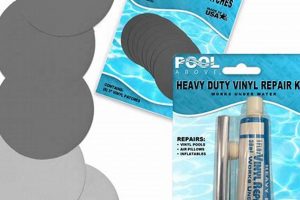
Adhesive or heat-activated materials designed to repair punctures or tears in inflatable mattresses constitute a crucial component for maintaining the functionality and longevity of these sleeping surfaces. These repair materials typically involve a flexible, durable substance combined with an adhesive backing, or a thermoplastic film that bonds to the mattress material upon application of heat. The utilization of such materials allows for the continued use of an otherwise damaged air mattress, preventing air leakage and ensuring a stable sleeping platform.
The significance of readily available and effective repair options lies in their ability to extend the lifespan of inflatable mattresses, offering economic benefits by avoiding premature replacement. Historically, temporary solutions such as duct tape were employed, but dedicated repair options provide a more reliable and lasting fix. The availability of these repair products addresses environmental concerns related to discarding damaged items and promotes responsible consumption practices. Their use minimizes waste and reduces the demand for new manufactured goods.
A comprehensive understanding of the various types of these repair solutions, their application techniques, and factors influencing their effectiveness will be explored in the following sections. This includes consideration of mattress material compatibility, adhesive properties, and proper surface preparation methods for optimal repair outcomes.
Air Mattress Patch Application Tips
Effective application of these repair solutions is crucial for ensuring a lasting and reliable seal. The following guidelines offer proven methods for optimizing the repair process and maximizing the lifespan of the repaired air mattress.
Tip 1: Preparation is Paramount: Thoroughly clean the area surrounding the puncture with isopropyl alcohol to remove dirt, oils, and debris. This ensures optimal adhesion of the repair material.
Tip 2: Precisely Locate the Leak: Inflate the mattress slightly and listen for escaping air. Alternatively, apply a soapy water solution to the surface; bubbles will indicate the precise location of the leak.
Tip 3: Size Appropriately: Cut the repair material larger than the puncture to provide ample surface area for adhesion. A margin of at least one inch beyond the damaged area is recommended.
Tip 4: Round the Corners: Rounding the corners of the repair material helps prevent peeling by distributing stress more evenly across the patch’s surface.
Tip 5: Apply Even Pressure: After applying the repair material, apply firm, even pressure for several minutes to ensure a strong bond. A smooth, hard object, such as a rolling pin, can aid in this process.
Tip 6: Allow Adequate Curing Time: Refer to the manufacturer’s instructions for recommended curing times. Typically, allowing the adhesive to cure for 24 hours before inflating the mattress to full capacity is advised.
Tip 7: Consider Heat Application: For certain types of thermoplastic repair materials, the careful application of heat, using an iron on a low setting with a protective cloth, can enhance the bond strength. Exercise caution to avoid damaging the mattress material.
Consistent adherence to these techniques will significantly improve the effectiveness of the repair, leading to a more durable and reliable solution. This allows users to extend the life of their inflatable mattress investment.
The subsequent sections will delve into specific types of these materials and techniques, providing a comprehensive overview of inflatable mattress repair solutions.
1. Adhesive Strength

Adhesive strength is a fundamental property that dictates the efficacy and longevity of any repair applied to inflatable mattresses. It represents the measure of force required to separate a repair material from the mattress surface, directly impacting the ability of a repair to withstand internal air pressure and external stresses.
- Surface Energy Compatibility
The adhesive’s surface energy must be compatible with the mattress material, typically PVC or a similar polymer. Inadequate surface energy matching results in poor wetting and reduced adhesion. For instance, an adhesive designed for porous materials will perform poorly on the smooth, non-porous surface of a vinyl air mattress. This incompatibility leads to premature patch failure and air leakage.
- Bond Formation Mechanisms
Adhesive strength relies on the formation of intermolecular bonds between the adhesive and the mattress material. These bonds can be mechanical, chemical, or both. Mechanical bonds involve the adhesive interlocking with surface irregularities, while chemical bonds involve the formation of covalent or ionic links. Air mattresses often utilize adhesives that rely primarily on mechanical bonding, necessitating thorough surface preparation to maximize the available surface area for adhesion. Failure to properly prepare the surface compromises the integrity of these bonds.
- Environmental Factors
Environmental factors, such as temperature and humidity, significantly influence adhesive strength. High temperatures can weaken the adhesive bond, while high humidity can interfere with the curing process. Furthermore, exposure to UV radiation can degrade certain adhesives over time. Consequently, repair solutions intended for outdoor use must possess enhanced resistance to these environmental stressors to maintain their adhesive properties.
- Shear and Peel Resistance
Beyond tensile strength, shear and peel resistance are crucial aspects of adhesive performance. Shear resistance refers to the adhesive’s ability to withstand forces applied parallel to the bond surface, while peel resistance refers to its ability to resist forces that tend to peel the adhesive away from the surface. Inflatable mattresses are subject to both shear and peel stresses during use, making high shear and peel resistance essential for a durable repair. This is why simply using household adhesives, which are designed for other purposes, will likely not provide adequate performance for inflatable mattress repairs.
The interplay of these factors demonstrates that selecting an appropriate repair material with sufficient adhesive strength is not merely a matter of choosing a generic adhesive. It requires careful consideration of the mattress material, the environmental conditions, and the types of stress the repair will endure. Proper application techniques, including thorough cleaning and adequate curing time, are equally critical to maximizing the adhesive’s performance and ensuring a reliable, long-lasting repair.
2. Material Compatibility

Material compatibility is a paramount consideration in the selection and application of inf
latable mattress repair solutions. The successful integration of a repair material with the existing mattress fabric is predicated on the chemical and physical properties of both substances, directly influencing the strength and longevity of the resulting bond.
- Polymer Compatibility
The majority of inflatable mattresses are constructed from polyvinyl chloride (PVC) or thermoplastic polyurethane (TPU). Repair options must be formulated to establish a robust bond with these specific polymers. Using repair material incompatible with the mattress polymer will result in poor adhesion, leading to patch failure and air leakage. For instance, an adhesive designed for rubber may not effectively bond to PVC, necessitating the selection of a PVC-specific adhesive.
- Plasticizer Effects
PVC mattresses often contain plasticizers to enhance flexibility and durability. These plasticizers can migrate to the surface over time, potentially interfering with adhesive bonding. Repair materials must be resistant to these plasticizers or include agents that counteract their effects to ensure a lasting seal. Certain adhesives may dissolve or degrade in the presence of specific plasticizers, weakening the bond and reducing the lifespan of the repair.
- Surface Texture and Treatments
Inflatable mattresses may feature various surface textures, such as flocking or embossing, and surface treatments to enhance comfort or durability. Repair materials must be capable of conforming to these textures and adhering to any coatings present on the mattress surface. In cases of flocked surfaces, removal of the flocking in the immediate area of the puncture may be necessary to ensure direct contact between the repair material and the underlying polymer.
- Thermal Expansion Coefficients
Differences in the thermal expansion coefficients of the mattress material and the repair material can induce stress at the bond interface as the temperature fluctuates. Selecting repair materials with thermal expansion coefficients similar to those of the mattress polymer minimizes these stresses, preventing premature failure of the repair. Large discrepancies in thermal expansion can lead to cracking or peeling of the patch over time, particularly in environments with significant temperature variations.
The interaction of these factors underscores the importance of selecting repair materials specifically designed for inflatable mattresses. Consideration of polymer type, plasticizer content, surface texture, and thermal expansion properties ensures a compatible and durable repair, extending the lifespan of the mattress and preventing air leakage.
3. Patch Flexibility

Patch flexibility is a critical attribute directly influencing the performance and longevity of inflatable mattress repairs. Air mattresses, by their nature, undergo considerable deformation during use as weight is applied and redistributed. A repair material lacking sufficient flexibility will be prone to cracking or detachment from the mattress surface due to these constant stresses. This is particularly evident in areas of high stress concentration, such as near seams or edges. For instance, a rigid epoxy patch applied to a vinyl air mattress used for camping would likely fail quickly due to the mattress’s frequent flexing and changes in pressure.
The inherent elasticity of the mattress material, typically PVC or TPU, demands a repair option with comparable flexibility. The repair material must be able to stretch and contract in tandem with the mattress surface, preventing the buildup of stress at the adhesive bond. This flexibility also contributes to the overall comfort of the mattress, as a rigid patch can create an uneven sleeping surface. The application of a flexible, thermoplastic polyurethane (TPU) repair patch to a TPU air mattress will provide good flexibility ensuring that the integrity of the repair is maintained. The result is not only a structural repair but also one that contributes to the continued comfort.
In summary, patch flexibility is not merely a desirable characteristic but an essential requirement for durable air mattress repairs. The ability of the repair material to conform to the dynamic shape of the mattress under load minimizes stress on the adhesive bond, preventing premature failure. Selecting repair options with adequate flexibility, aligned with the material properties of the air mattress, is crucial for ensuring a long-lasting and comfortable repair, effectively extending the usable life of the inflatable mattress.
4. Durability

Durability, in the context of inflatable mattress repair materials, refers to the capacity of a patch to maintain its structural integrity and adhesive bond over an extended period of use and under varying environmental conditions. The durability of a repair solution directly influences the lifespan of the repaired mattress and the reliability of the air seal, impacting both user satisfaction and the overall cost-effectiveness of the repair.
- Material Composition and Resistance to Degradation
The composition of the patch material dictates its resistance to degradation from factors such as ultraviolet (UV) radiation, temperature fluctuations, and chemical exposure. Patches constructed from high-quality polymers, formulated with stabilizers and UV inhibitors, exhibit superior resistance to these degrading influences, maintaining their flexibility and adhesive properties for a longer duration. For example, a patch made from a low-grade PVC may become brittle and crack after prolonged exposure to sunlight, compromising the repair.
- Adhesive Bond Strength Over Time
The initial adhesive bond strength is a primary determinant of patch effectiveness, but its ability to resist degradation over time is equally critical. Factors such as cyclical loading (inflation and deflation), moisture exposure, and plasticizer migration can weaken the adhesive bond, leading to patch peeling or air leakage. Repair solutions employing adhesives formulated to resist these factors, such as those incorporating cross-linking polymers, demonstrate superior long-term bond strength. An example of this would be a patch that initially seals well but detaches after repeated use due to adhesive failure.
- Resistance to Puncture and Abrasion
Patches are often subjected to physical stresses, including abrasion from contact with bedding or flooring and the potential for further punctures. Durable repair solutions exhibit resistance to these stresses, maintaining their integrity even under abrasive conditions. The utilization of reinforced patch materials, such as those incorporating a woven fabric backing, enhances their resistance to puncture and abrasion. A patch applied to the underside of a mattress might experience significant abrasion from contact with the floor, highlighting the need for robust material properties.
- Environmental Factors and Climate Resistance
Environmental conditions, including temperature, humidity, and exposure to chemicals (e.g., cleaning solutions), can significantly impact the durability of repair patches. Patches designed for outdoor use, for instance, must exhibit resistance to extreme temperatures and moisture. Similarly, those intended for use in environments where cleaning solutions are frequently employed must resist chemical degradat
ion. A patch applied to a mattress used in a humid climate might experience accelerated adhesive degradation if it lacks adequate moisture resistance.
In conclusion, the durability of inflatable mattress repair solutions is a multifaceted property influenced by material composition, adhesive bond strength, resistance to physical stresses, and environmental factors. Selecting a repair solution designed to withstand these influences is essential for ensuring a reliable and long-lasting repair, maximizing the lifespan of the mattress and minimizing the need for frequent replacements.
5. Water Resistance

Water resistance is a critical performance parameter for inflatable mattress repair solutions, particularly given the potential exposure to moisture during use, cleaning, or storage. The integrity of the repair is contingent upon its ability to withstand prolonged contact with water without compromising the adhesive bond or structural integrity of the patch material. This factor becomes especially pertinent in outdoor applications or when mattresses are used in humid environments.
- Hydrolytic Stability of Adhesives
The hydrolytic stability of the adhesive component directly influences the long-term performance of a repair. Hydrolysis, the chemical breakdown of a substance due to reaction with water, can weaken or dissolve the adhesive bond between the patch and the mattress material. Adhesives formulated with inherent water resistance or treated with hydrophobic agents exhibit greater resistance to hydrolytic degradation, maintaining a secure seal even when exposed to moisture. The selection of an adhesive with poor hydrolytic stability will result in premature patch failure and air leakage, particularly in damp conditions.
- Water Permeability of Patch Materials
The material from which the repair patch is constructed must exhibit low water permeability to prevent moisture from seeping through the patch and undermining the adhesive bond. Impermeable materials, such as certain grades of vinyl or specialized waterproof fabrics, effectively block the passage of water molecules, maintaining a dry interface between the patch and the mattress surface. A patch material with high water permeability will allow moisture to penetrate, leading to adhesive degradation, mold growth, and eventual bond failure.
- Edge Sealing and Moisture Intrusion
The edges of the repair patch represent potential points of entry for moisture. Proper edge sealing techniques, such as the use of waterproof sealants or the application of heat to fuse the patch edges to the mattress material, minimize the risk of water intrusion. Inadequate edge sealing allows moisture to wick between the patch and the mattress, compromising the adhesive bond and promoting delamination. Effective edge sealing is crucial for preventing moisture-related failures, particularly in applications involving frequent exposure to water.
- Resistance to Mold and Mildew Growth
In humid environments, the proliferation of mold and mildew can degrade repair materials and adhesives, leading to structural damage and bond failure. Repair solutions formulated with antimicrobial agents or constructed from materials resistant to mold and mildew growth exhibit enhanced durability in these conditions. Untreated repair materials can serve as a substrate for microbial growth, accelerating degradation and compromising the integrity of the repair, ultimately reducing the lifespan of the patch and the mattress.
The interconnected nature of these aspects underscores the importance of selecting inflatable mattress repair solutions with robust water resistance properties. Failure to consider hydrolytic stability, material permeability, edge sealing, and resistance to microbial growth can result in premature patch failure, necessitating frequent repairs or mattress replacement. By prioritizing water resistance, users can ensure the longevity and reliability of their air mattress repairs, particularly in environments where moisture exposure is a concern.
6. Application Ease

Application ease represents a critical factor influencing the practical utility and widespread adoption of air mattress repair solutions. The effectiveness of a patching system is directly correlated with its accessibility to the average consumer, who may lack specialized skills or tools. A complex or cumbersome application process can deter users and diminish the perceived value of the repair solution, regardless of its inherent material properties or potential longevity.
- Surface Preparation Requirements
The degree of surface preparation required prior to patch application significantly impacts ease of use. Systems demanding extensive cleaning, sanding, or the use of specialized primers introduce complexity and increase the likelihood of user error. Solutions that necessitate minimal surface preparation, such as a simple wipe-down with an alcohol-based cleaner, offer a more streamlined and user-friendly experience. The need for specialized tools or chemicals can also deter users from attempting the repair.
- Adhesive Activation and Application Methods
The method of adhesive activation and application plays a crucial role in determining the overall ease of use. Systems requiring the mixing of multiple components or the precise application of heat can be challenging for inexperienced users. Self-adhesive patches with pre-applied adhesive layers offer a simpler and more convenient alternative, minimizing the risk of improper mixing or uneven application. The design of the patch, including the presence of a backing layer for easy handling, also contributes to application ease.
- Curing Time and Environmental Sensitivity
The required curing time and the sensitivity of the adhesive to environmental conditions, such as temperature and humidity, can significantly impact the user experience. Systems that necessitate prolonged curing times or specific environmental controls may be impractical for many users. Solutions that cure rapidly under a wide range of conditions offer a more forgiving and convenient repair process. Extended cure times also increase the likelihood of accidental disturbance of the patch before the adhesive has fully set.
- Clarity of Instructions and Included Tools
The clarity and completeness of the instructions provided with the repair kit directly influence the likelihood of a successful application. Well-written, step-by-step instructions, accompanied by clear diagrams or illustrations, guide users through the process and minimize the potential for errors. The inclusion of necessary tools, such as a cleaning pad, an applicator, or a weight to apply pressure, further enhances the user experience. Kits lacking clear instructions or essential tools can lead to frustration and a higher rate of failed repairs.
The collective impact of these factors underscores the importance of prioritizing application ease in the design and marketing of air mattress repair patches. Solutions that minimize preparation, simplify adhesive application, offer rapid curing, and provide clear instructions are more likely to be adopted and successfully utilized by the average consumer, maximizing the potential for extending the lifespan of inflatable mattresses and reducing waste.
7. Size Va
riety
The availability of inflatable mattress repair materials in a range of sizes is a critical aspect of their practicality and effectiveness. Punctures and tears in air mattresses can vary significantly in dimension, necessitating a corresponding diversity in patch sizes to ensure a secure and lasting repair.
- Matching Patch Size to Damage Extent
The primary function of size variety is to allow consumers to select a repair material that adequately covers the damaged area without excessive overlap. A patch that is too small will fail to properly seal the puncture, leading to continued air leakage. Conversely, a patch that is unnecessarily large may be wasteful and potentially more prone to peeling or catching on bedding. An assortment of sizes ensures optimal coverage and efficient material utilization.
- Accommodating Different Types of Damage
Air mattresses can sustain various types of damage, ranging from small pinholes to larger tears or cuts. A comprehensive range of patch sizes provides solutions for addressing these diverse damage types effectively. Small patches are suitable for pinholes, while larger patches are necessary for covering more extensive damage, such as tears caused by sharp objects. A single, uniform patch size would be inadequate for addressing the full spectrum of potential damage scenarios.
- Enabling Layered Repairs for Complex Damage
In some cases, the damage to an air mattress may be complex, involving multiple punctures or tears in close proximity. Size variety allows for the strategic layering of patches to reinforce the damaged area and ensure a complete seal. Smaller patches can be used to address individual punctures, while a larger patch can be applied over the entire area to provide additional support and prevent air leakage. This layered approach is particularly useful for repairing areas that have been previously patched or are subjected to high stress.
- Optimizing Repair Aesthetics and Minimizing Intrusion
While functionality is paramount, the aesthetic appearance of the repair is also a consideration for many consumers. A wide selection of patch sizes allows for choosing the smallest possible patch that effectively covers the damage, minimizing the visual impact of the repair. Smaller patches are less likely to be noticeable or interfere with the comfort of the mattress. Size variety contributes to a more discreet and aesthetically pleasing repair outcome.
In conclusion, the availability of inflatable mattress repair patches in various sizes is essential for effectively addressing the diverse range of damage that can occur. Size variety enables consumers to select the appropriate material for the specific repair task, optimizing functionality, durability, and aesthetic appearance, and ultimately extending the lifespan of their air mattresses.
Frequently Asked Questions
The following section addresses common inquiries regarding the use, application, and effectiveness of repair solutions for inflatable mattresses. These questions aim to provide clear and concise information to ensure proper utilization and maximize repair outcomes.
Question 1: What types of materials are commonly used in inflatable mattress patches?
Typically, repair solutions consist of PVC (polyvinyl chloride) or TPU (thermoplastic polyurethane) films, often coated with a pressure-sensitive adhesive. The specific material is selected to ensure compatibility with the mattress material and to provide adequate flexibility and durability.
Question 2: How should the surface be prepared before applying a repair solution?
The area surrounding the puncture must be thoroughly cleaned with isopropyl alcohol to remove dirt, oils, and any loose particles. A clean, dry surface is essential for optimal adhesive bonding. Some solutions may benefit from light abrasion of the surface to improve adhesion.
Question 3: What is the recommended curing time after applying the repair?
The recommended curing time varies depending on the specific adhesive used in the repair solution. Generally, a minimum of 24 hours is advised to allow the adhesive to fully bond to the mattress material before inflating the mattress to full capacity. Refer to the manufacturer’s instructions for specific curing time guidelines.
Question 4: Can standard household adhesives be used as a substitute for dedicated repair products?
The use of standard household adhesives is generally not recommended. These adhesives may lack the necessary flexibility, water resistance, or material compatibility to provide a lasting repair. Dedicated repair solutions are specifically formulated for inflatable mattress materials and are designed to withstand the stresses associated with air mattress use.
Question 5: How can one ensure proper adhesion when repairing a flocked air mattress?
Flocked surfaces can impede adhesive bonding. It is recommended to carefully remove the flocking material from the immediate area surrounding the puncture using a fine-grit sandpaper or a similar abrasive. This exposes the underlying polymer surface and allows for direct contact with the repair solution adhesive.
Question 6: What factors can contribute to premature patch failure?
Several factors can contribute to premature failure, including inadequate surface preparation, improper adhesive application, insufficient curing time, and the use of incompatible repair materials. Environmental factors, such as exposure to extreme temperatures or humidity, can also weaken the adhesive bond over time.
In summary, successful application and longevity of inflatable mattress repair patches depend on proper material selection, thorough surface preparation, adherence to recommended curing times, and avoidance of incompatible adhesives. By addressing these factors, users can maximize the effectiveness of their repairs and extend the lifespan of their mattresses.
The subsequent section will delve into advanced repair techniques and explore alternative solutions for more complex damage scenarios.
Conclusion
This exploration of air mattress patches has underscored their critical role in maintaining the functionality and extending the lifespan of inflatable mattresses. The analysis has highlighted the significance of material compatibility, adhesive strength, patch flexibility, and water resistance in ensuring effective and durable repairs. Proper application techniques, including thorough surface preparation and adequate curing time, have been emphasized as essential for maximizing the performance of these repair solutions.
Given the economic and environmental benefits associated with extending the lifespan of existing products, continued research and development in the area of air mattress patches is warranted. Focusing on innovative materials, improved adhesive technologies, and simplified application methods will further enhance the effectiveness and accessibility of these repair solutions, promoting responsible consumption and minimizing waste. The future of air mattress maintenance relies on continued advancements in this critical area.