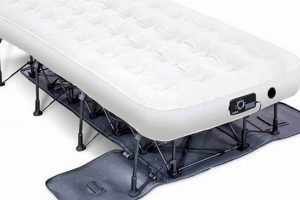
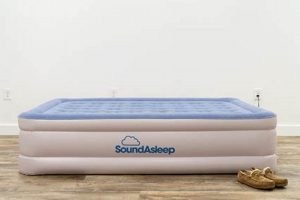
A self-inflating sleeping surface offers convenience and portability for temporary bedding needs. These inflatable beds incorporate a built-in mechanism for automated inflation and deflation. An electrical component within the structure facilitates rapid setup and takedown without requiring external pumps or manual effort.
The utility of such a device lies in its ease of use and space-saving characteristics. It provides a comfortable sleeping solution for guests, camping trips, or temporary living situations. Historically, inflatable mattresses required separate pumping devices, increasing setup time and logistical complexity. The integrated pump represents a significant advancement in user-friendliness and overall efficiency, enabling quick deployment and compact storage.
The following sections will delve into the specific features, advantages, and practical considerations associated with these self-contained inflatable bedding solutions. The focus will be on aspects such as material composition, pump specifications, inflation/deflation times, and user guidelines to ensure optimal utilization and longevity.
Optimizing the Use of Self-Inflating Mattresses
This section provides guidelines for the effective utilization and maintenance of inflatable mattresses with integrated pumping systems, ensuring user satisfaction and extending product lifespan.
Tip 1: Pre-Inflation Inspection: Prior to inflation, inspect the surrounding area for sharp objects or debris that could puncture the mattress. Clear the surface thoroughly to prevent damage during use.
Tip 2: Power Source Verification: Ensure that the power outlet used for inflation is compatible with the mattress’s voltage requirements. Utilize surge protectors to safeguard the integrated pump from electrical fluctuations.
Tip 3: Inflation Monitoring: Observe the mattress during inflation to prevent over-inflation. Excessive pressure can compromise the integrity of the seams and reduce the lifespan of the product. Adhere to the manufacturer’s recommended inflation level.
Tip 4: Temperature Considerations: Avoid using the mattress in extreme temperature conditions. High heat can cause the material to expand excessively, while cold temperatures can reduce its flexibility and increase the risk of cracking.
Tip 5: Proper Deflation Technique: When deflating the mattress, ensure the deflation valve is fully open and unobstructed. This will facilitate rapid and complete deflation, simplifying storage.
Tip 6: Storage Practices: Store the mattress in a cool, dry place, away from direct sunlight and sharp objects. Folding the mattress neatly, following the manufacturer’s guidelines, minimizes stress on the seams.
Tip 7: Regular Cleaning: Periodically clean the mattress surface with a mild soap solution and a damp cloth. Avoid harsh chemicals or abrasive cleaners, which can damage the material.
Adhering to these recommendations will contribute to optimal performance, extended durability, and enhanced user experience when utilizing a self-inflating mattress.
The following sections will discuss further details about the features and materials of this type of mattress.
1. Inflation Time

Inflation time represents a critical performance metric for an air mattress equipped with an integrated pump. It directly influences user convenience and overall satisfaction. A shorter inflation time minimizes setup duration, making the mattress readily available for immediate use.
- Pump Motor Efficiency
The efficiency of the integrated pump’s motor fundamentally dictates the inflation rate. High-efficiency motors deliver greater air volume per unit of energy consumed, leading to faster inflation times. Conversely, less efficient motors require more time to achieve the desired firmness. The motor’s design, materials, and power rating significantly contribute to its overall efficiency and, subsequently, the inflation time.
- Mattress Volume
The internal volume of the air mattress directly correlates with the time required for inflation. Larger mattresses naturally necessitate a greater volume of air to reach optimal inflation levels. This inherent relationship means that, all other factors being equal, a larger mattress will inherently take longer to inflate compared to a smaller one.
- Valve Design and Airflow
The design of the inflation and deflation valves plays a crucial role in controlling airflow. Valve configurations that allow for unrestricted airflow facilitate rapid inflation. Conversely, valves with narrow openings or internal obstructions impede airflow, resulting in extended inflation times. The valve’s seal integrity is also important, as leaks can reduce the efficiency of the inflation process.
- Power Source and Voltage
The available power from the source and the voltage level it provides influence the speed of the inflation. Adequate and stable power input is essential for the pump to operate at its designed capacity. Inadequate power supply leads to decreased pump performance and, ultimately, a longer duration to full inflation. Voltage fluctuations can damage the pump.
These interconnected factors pump motor efficiency, mattress volume, valve design, and power source collectively determine the total inflation time. Optimizing each element is essential for maximizing user convenience and ensuring that the air mattress with integrated pump delivers a swift and efficient inflation experience.
2. Pump Noise

The acoustic output of the integrated pump in a self-inflating mattress directly impacts user experience and overall product satisfaction. Elevated pump noise levels introduce a potential source of disturbance, particularly during nighttime inflation or deflation. This factor holds considerable importance, given that these mattresses are frequently utilized in environments where minimizing noise pollution is paramount, such as shared living spaces, camping sites, or guest rooms. For instance, a pump emitting noise levels exceeding 70 decibels can disrupt sleep and hinder relaxation, negating the convenience afforded by the automated inflation system. The practical significance lies in selecting a model with a pump engineered for quiet operation, ideally producing sound levels below 60 decibels, thus minimizing auditory interference.
Pump noise is influenced by several factors, including motor design, fan blade configuration, and the presence of sound-dampening materials. Certain manufacturers employ brushless motors and optimized fan designs to mitigate noise generation. Furthermore, incorporating sound-absorbing foam or insulation within the pump housing can effectively reduce acoustic emissions. Comparative testing of various models reveals substantial variations in noise levels, unders
coring the importance of considering this parameter during the purchasing process. The application of noise reduction technology in pump design reflects a commitment to enhancing user comfort and accommodating noise-sensitive environments.
In summary, the pump’s noise level is a salient characteristic of self-inflating mattresses, directly affecting user experience. While achieving complete silence is often unfeasible, prioritizing models engineered for low-noise operation presents a tangible benefit, particularly in settings requiring minimal auditory disturbance. This aspect constitutes an essential consideration when evaluating and selecting a self-inflating mattress for optimal performance and user satisfaction.
3. Mattress Material
The material composition of an inflatable mattress with an integrated pump directly influences its durability, comfort, and overall performance. The selection of materials is not arbitrary; it is a crucial design consideration impacting the product’s resistance to punctures, its ability to retain air pressure, and its conformity to the user’s body. For instance, a mattress constructed from thin, low-grade PVC is inherently more susceptible to leaks and deformation than one utilizing reinforced, multi-layer PVC or TPU (Thermoplastic Polyurethane). Material choices directly translate to practical outcomes; a puncture-resistant material allows for use in varied environments, including outdoor settings, while a more pliable material enhances sleeping comfort.
The material’s impact extends beyond physical resilience. The thermal properties of the chosen material influence sleeping temperature. Some materials retain heat, which can be advantageous in colder climates but detrimental in warmer environments. Surface texture also plays a significant role. A flocked surface, for example, provides a non-slip surface and improves the tactile experience, preventing bedding from sliding off the mattress. Material selection also affects the mattress’s weight and pack size, factors critical for portability. High-density materials increase weight but also contribute to durability, presenting a trade-off that manufacturers must carefully consider. Furthermore, the chemical composition of the material influences its environmental impact, with some materials being more readily recyclable or biodegradable than others.
In summary, the choice of material for an inflatable mattress with an integrated pump is a multifaceted decision with far-reaching consequences. It affects not only the product’s longevity and user comfort but also its portability, environmental footprint, and suitability for various applications. Therefore, understanding the properties and trade-offs associated with different materials is essential for both manufacturers and consumers to make informed decisions and ensure optimal product performance and sustainability.
4. Weight Capacity

The weight capacity of a self-inflating mattress is a critical specification directly influencing its suitability and safe operation. This parameter defines the maximum load the mattress can withstand without compromising its structural integrity or performance. Exceeding the stated weight capacity can lead to seam failures, material deformation, or even complete mattress rupture, rendering it unusable and potentially causing discomfort or injury to the user. The weight capacity is therefore a primary consideration for potential buyers, dictating whether the mattress is appropriate for single individuals, couples, or situations involving additional weight, such as children or pets.
Manufacturers establish weight capacity limits based on rigorous testing and material properties. These tests evaluate the mattress’s ability to maintain air pressure and structural stability under sustained loads. The specified weight capacity is often conservative, accounting for variations in user weight distribution and potential dynamic loads (e.g., movement during sleep). Practical examples illustrate the importance of adhering to these limits. A mattress rated for 300 pounds, if subjected to a load of 400 pounds, may exhibit noticeable sagging, reduced support, and increased risk of failure over time. Conversely, selecting a mattress with a higher weight capacity than required provides an added margin of safety and potentially extends the product’s lifespan. For instance, campers who expect to sleep with gear on the mattress should consider a higher weight capacity to avoid overloading it. Furthermore, some inflatable mattresses are designed with internal support structures or reinforced seams to enhance their weight-bearing capabilities.
In conclusion, weight capacity is a fundamental attribute of any self-inflating mattress, acting as a constraint on its safe and effective utilization. Careful consideration of this specification, aligned with the anticipated user weight, is essential for ensuring product longevity, user comfort, and preventing potential hazards. While exceeding the weight limit may not immediately result in catastrophic failure, it invariably accelerates wear and tear, diminishing the mattress’s overall performance and lifespan. Therefore, selecting a model with an appropriate weight capacity constitutes a crucial step in the purchasing process.
5. Portability.

The intrinsic connection between portability and self-inflating mattresses fundamentally alters their utility. The integration of an automated pump directly impacts the ease with which such a mattress can be transported and deployed. The key reason is that the user is freed from carrying a separate, often bulky, inflation device. Without an integrated pump, an external air pump must accompany the mattress, adding weight and volume, effectively negating some of the advantages of an inflatable design. This element of portability transforms a temporary bedding solution from a cumbersome proposition into a convenient option for camping, travel, or accommodating guests.
For example, consider a scenario where a family is camping. A self-inflating mattress simplifies the packing process. The elimination of a separate pump streamlines setup at the campsite. Similarly, in a small apartment, a guest bed needs to be easily stored when not in use. A more portable mattress with integrated pump and smaller deflated volume allows a compact storage.
In summary, portability is not merely a desirable attribute; it’s integral to the value proposition of a self-inflating mattress. The integration of the automated pump directly and positively affects this characteristic, creating a more user-friendly, convenient, and versatile product. Its lightweight, and compact storage capabilities support a range of user requirements and applications.
6. Storage Size

Storage size represents a critical factor in evaluating self-inflating mattresses, impacting their practicality and convenience, particularly in space-constrained environments. The deflated dimensions of these mattresses directly influence their ease of storage and transportation, rendering them suitable or unsuitable for specific a
pplications.
- Material Compressibility
The inherent compressibility of the mattress material dictates its final storage volume. Materials such as thin PVC or TPU allow for tighter folding and compression, resulting in a smaller packed size. Thicker, more rigid materials resist compression, leading to a larger storage footprint. The choice of material thus presents a trade-off between durability and storage efficiency. Examples include comparing a lightweight backpacking mattress (prioritizing compressibility) with a more robust home-use model (emphasizing durability).
- Pump Integration Design
The design of the integrated pump significantly influences the overall storage size. Pumps that are internally recessed or designed to fold flush with the mattress contribute to a more compact storage profile. Bulky, externally mounted pumps increase the packed dimensions, potentially hindering storage in tight spaces. Innovative designs aim to minimize pump protrusion without sacrificing performance.
- Folding and Deflation Mechanisms
The ease and efficiency of the mattress’s folding and deflation mechanisms directly impact the achievable storage size. Mattresses with wide-mouth deflation valves and clear folding instructions allow for rapid and complete air expulsion, minimizing residual volume. Poorly designed valves or complex folding patterns can trap air, resulting in a bulkier, less manageable package.
- Carry Bag Dimensions and Construction
The dimensions and construction of the included carry bag play a crucial role in the overall storage solution. A well-designed bag should be sized appropriately for the fully deflated and folded mattress, providing a snug fit without excessive compression. Durable materials and reinforced seams ensure the bag can withstand repeated packing and unpacking cycles. Features like compression straps can further reduce the packed size.
Ultimately, the storage size of a self-inflating mattress reflects a complex interplay of material properties, pump design, deflation mechanisms, and carry bag specifications. Manufacturers must carefully balance these factors to optimize storage efficiency without compromising durability or ease of use. The resulting storage size directly determines the mattress’s suitability for applications ranging from space-saving home storage to convenient transportation on camping trips.
7. Power Requirements

An air mattress incorporating an automated inflation system fundamentally relies on a consistent and appropriate power supply for effective operation. Power requirements, specified in terms of voltage (V) and wattage (W), dictate the electrical parameters necessary for the integrated pump to function as designed. Inadequate power delivery, stemming from voltage fluctuations or insufficient current, results in compromised pump performance, manifesting as prolonged inflation times, incomplete inflation, or outright pump failure. The integration of an auto pump into such mattresses creates a direct dependency on electrical energy, distinguishing them from manually inflated alternatives. For example, a mattress designed for 120V operation, when connected to a 220V source without appropriate conversion, may experience immediate and irreversible damage to the pump motor.
The practical significance of understanding power requirements extends to ensuring compatibility across various environments. Campers utilizing these mattresses in remote locations often rely on portable power generators or battery-powered inverters. Matching the mattress’s power demands with the generator’s output is crucial for avoiding overloads or under-voltage conditions that impact performance. Similarly, international travelers must consider voltage and plug adapter compatibility to prevent electrical mishaps. Many modern mattresses are equipped with universal voltage compatibility (100-240V), simplifying international use. However, adherence to the specified power parameters remains paramount for safe and effective operation. Protective features such as surge protection are often integrated into the electrical circuitry to mitigate the risk of damage from transient voltage spikes.
In summary, power requirements represent a non-negotiable aspect of self-inflating mattresses. Adhering to the manufacturer’s specified voltage and wattage parameters is essential for ensuring optimal pump performance, preventing equipment damage, and maintaining user safety. The increasing reliance on portable power sources necessitates a thorough understanding of power compatibility, particularly in off-grid or international settings. Attention to these electrical specifications contributes to the reliable and extended operation of these inflatable sleeping solutions.
Frequently Asked Questions
The following addresses common inquiries and concerns regarding self-inflating mattresses, providing factual and unbiased information.
Question 1: How long should inflation take?
Inflation duration varies based on mattress size and pump power. Expect inflation to complete within 3-7 minutes for most standard models. Deviations from this range may indicate pump malfunction or air leakage.
Question 2: Can the pump operate continuously for extended periods?
The integrated pump is designed for intermittent use during inflation and deflation cycles. Continuous operation exceeding manufacturer recommendations may lead to overheating and premature failure.
Question 3: What is the optimal storage method?
Deflate completely, fold neatly, and store in the provided bag in a cool, dry location. Avoid direct sunlight and sharp objects that could damage the material.
Question 4: What maintenance is required for the integrated pump?
Minimal maintenance is generally required. Keep the pump air intake free from dust and debris. Avoid submerging the mattress in water, as this could damage the electrical components.
Question 5: Can the mattress be inflated manually if the pump fails?
Some models include a manual inflation valve as a backup. Consult the product manual to determine if manual inflation is supported. The inflation time will be considerably longer compared to automated inflation.
Question 6: Are replacement pumps available?
Availability of replacement pumps varies by manufacturer and model. Contact the retailer or manufacturer directly to inquire about replacement options. Consider the cost of replacement when assessing overall value.
This information is intended to provide clarity regarding self-inflating mattresses. Proper usage and maintenance contribute to product longevity and user satisfaction.
The subsequent section will detail considerations for selecting an appropriate model based on specific needs and applications.
Concluding Observations on the Self-Inflating Mattress
This exploration has detailed the various facets of the air mattress with auto pump, emphasizing its design features, performance considerations, and practical applications. Aspects such as inflation time, pump noise, material selection, weight capacity, portability, storage implications, and power requirements have been thoroughly examined. These attributes collectively determine the suitability of the product for diverse scenarios, ranging from temporary guest accommodations to outdoor recreational activities.
The integration of automated inflation technolo
gy represents a notable advancement in convenience and user-friendliness. Prudent selection, based on a careful assessment of individual needs and a thorough understanding of the aforementioned parameters, is essential for maximizing satisfaction and ensuring long-term utility. Continued innovation in material science and pump design promises further enhancements in durability, performance, and sustainability.