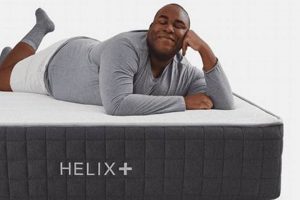
The selection of a suitable sleeping surface significantly impacts the sleep quality and overall well-being of individuals with higher body weights. These individuals require mattresses that offer substantial support, pressure relief, and durability to ensure proper spinal alignment and minimize discomfort during sleep. This is particularly important considering the increased pressure exerted on the mattress and its components.
A well-chosen mattress can promote restful sleep, reduce back pain, and contribute to long-term health. Historically, individuals with higher BMIs faced challenges in finding mattresses that adequately met their needs, often experiencing premature sagging and insufficient support. Modern mattress technology, however, has led to the development of specialized options designed to address these specific concerns, offering enhanced comfort and longevity.
The following sections will delve into the key factors to consider when choosing a mattress appropriate for individuals in this weight range, including construction materials, firmness levels, and specific features that promote optimal sleep quality and mattress lifespan.
Mattress Selection Guidance
Selecting an appropriate mattress is crucial for individuals of significant body weight. This section provides essential tips to ensure optimal support, comfort, and longevity.
Tip 1: Prioritize Innerspring or Hybrid Constructions: Mattresses with innerspring cores, often combined with foam layers in hybrid models, typically provide superior support and durability compared to all-foam options. Look for models with reinforced coil systems.
Tip 2: Consider Higher Coil Counts and Thicker Gauge Coils: Higher coil counts and thicker gauge coils (lower gauge number) indicate greater support and resistance to sagging. These features are particularly beneficial for individuals requiring enhanced structural integrity.
Tip 3: Evaluate Foam Density: When foam is incorporated, prioritize high-density foams (typically 2.5 lbs/cubic foot or higher) in the support layers. Higher density foams resist compression and provide more consistent support over time.
Tip 4: Assess Edge Support: Robust edge support is essential to prevent roll-off and ensure consistent comfort across the entire mattress surface. Reinforced edges enhance stability and expand the usable sleeping area.
Tip 5: Select an Appropriate Firmness Level: While personal preference plays a role, individuals in this weight range often benefit from firmer mattresses (rated 6-8 on a 1-10 firmness scale). Firmer mattresses provide better spinal alignment and prevent excessive sinking.
Tip 6: Examine the Foundation: Ensure the bed frame or foundation is sturdy and designed to support the combined weight of the mattress and occupants. A weak foundation can compromise mattress performance and lifespan.
Tip 7: Research and Read Reviews: Thoroughly research different brands and models, paying close attention to reviews from individuals with similar body types. Real-world experiences can provide valuable insights into mattress performance and durability.
By focusing on these considerations, individuals can significantly improve their sleep quality and overall well-being.
The subsequent section will discuss specific mattress types and materials that are particularly well-suited for this demographic.
1. Reinforced Coil System

A reinforced coil system directly correlates with the suitability of a mattress for individuals weighing approximately 300 pounds. The higher weight exerts significantly more pressure on the mattress core, leading to potential sagging and compromised support if the coil system is inadequate. A reinforced system, typically employing thicker gauge coils and a higher coil count, distributes weight more effectively, preventing localized compression and ensuring proper spinal alignment throughout the night. This is not merely a matter of comfort; it’s a factor affecting long-term spinal health and the prevention of back pain. For instance, a standard innerspring mattress might exhibit noticeable sagging within a year under such weight, whereas a mattress with reinforced coils could maintain its structural integrity for several years. The practical significance lies in extending the mattress’s lifespan and providing consistently optimal support.
The specific reinforcement techniques vary among manufacturers. Some utilize tempered steel coils, which are heat-treated to increase their resilience and resistance to deformation. Others incorporate zoned support systems, where coil density is strategically increased in areas that bear the most weight, such as the lumbar region. Hybrid mattresses often combine reinforced coils with high-density foam layers, further enhancing support and pressure relief. These design choices are critical because they directly influence the mattress’s ability to contour to the body while maintaining proper spinal alignment. Without this reinforcement, heavier individuals may experience discomfort, restless sleep, and even exacerbate pre-existing back issues.
In conclusion, a reinforced coil system is an indispensable component of a mattress designed for individuals around 300 pounds. It directly addresses the increased stress placed on the mattress core, preventing premature sagging, maintaining spinal alignment, and extending the product’s useful life. While other factors, such as foam density and firmness, contribute to overall comfort, the coil system provides the foundational support necessary for long-term sleep quality and musculoskeletal health. The challenges in mattress selection are mitigated by prioritizing models with demonstrably robust coil construction.
2. High-Density Foam Layers

High-density foam layers are a critical determinant in the suitability of a mattress for individuals weighing approximately 300 pounds. The primary cause for this is the substantial pressure exerted on the mattress surface. Lower density foams compress more readily under such weight, leading to diminished support and accelerated degradation. In contrast, high-density foams offer superior resistance to compression, maintaining their structural integrity and providing consistent support over a longer period. The effect is a more stable and comfortable sleep surface, crucial for spinal alignment and pressure relief. Without adequate foam density, individuals may experience premature sagging, uneven weight distribution, and increased risk of discomfort or pain. This is especially evident in edge support, where lower density foams quickly collapse, reducing the usable sleeping area.
The practical significance of high-density foam extends beyond mere comfort. A mattress lacking this feature is prone to developing body impressions, creating uncomfortable sleeping conditions
and potentially exacerbating musculoskeletal issues. For example, consider two mattresses, one with 1.8 lb/cubic foot density foam and another with 2.5 lb/cubic foot density foam. Under the weight of a 300-pound individual, the former may exhibit noticeable sagging within months, while the latter can maintain its form and support for several years. The inclusion of high-density memory foam or polyfoam in the comfort layers contributes to enhanced pressure relief by conforming more effectively to the body’s contours. In support layers, high-density foam provides a stable foundation for the coil system, preventing it from bottoming out and ensuring consistent performance across the mattress surface. In hybrid mattresses, the synergy between reinforced coils and high-density foam amplifies the overall support and durability, making it a particularly well-suited choice.
In conclusion, high-density foam layers are an indispensable element in selecting a mattress appropriate for heavier individuals. They directly address the issues of compression, support, and durability, ultimately impacting sleep quality and long-term musculoskeletal health. The challenge lies in discerning actual foam density, as manufacturers may not always explicitly disclose this information. Thus, thorough research, reading customer reviews, and seeking expert advice are crucial steps in identifying mattresses that genuinely meet the needs of individuals requiring substantial support and lasting performance. A best mattress for 300 pound man requires the features.
3. Robust Edge Support

Robust edge support is a crucial attribute in mattresses designed to accommodate individuals weighing approximately 300 pounds. The connection stems from the increased pressure exerted across the entire mattress surface, including the edges, when a heavier individual sits or sleeps near the periphery. Inadequate edge support can lead to a sensation of rolling off the mattress, reduced usable sleeping area, and accelerated edge degradation. The cause is the insufficient reinforcement along the mattress perimeter, while the effect is compromised comfort and durability. A mattress with robust edge support mitigates these issues, providing a stable and consistent sleeping surface from edge to edge. Without it, individuals may feel less secure and experience discomfort, potentially disrupting sleep quality and compromising overall mattress lifespan. For example, an individual sitting on the edge of a mattress with poor support might experience significant compression and a feeling of instability, whereas a mattress with enhanced edge support would provide a more stable and comfortable seating surface.
The importance of robust edge support extends beyond mere comfort. It directly impacts the mattress’s long-term structural integrity. Over time, repeated compression of the edges, without adequate reinforcement, can lead to sagging and deformation. This is particularly problematic for individuals who frequently sit on the edge of the bed or utilize the full mattress surface while sleeping. Reinforced edge support often involves the use of high-density foam encasements, thicker gauge coils, or specialized edge support systems strategically placed along the mattress perimeter. These features distribute weight more evenly and prevent the edges from collapsing under pressure. Consider a scenario where a couple shares a mattress, and one partner weighs significantly more than the other. Robust edge support ensures that both individuals can comfortably utilize the full sleeping surface without experiencing a noticeable difference in support or feeling as though they are being pushed towards the center.
In summary, robust edge support is an indispensable component of a mattress suitable for individuals around 300 pounds. It addresses the increased pressure placed on the mattress perimeter, preventing sagging, maximizing usable sleeping area, and enhancing overall comfort and stability. The absence of this feature can lead to premature mattress degradation and a compromised sleep experience. Therefore, when selecting a mattress for heavier individuals, prioritizing models with demonstrably robust edge support is crucial for ensuring long-term satisfaction and optimal sleep quality.
4. Appropriate Firmness Level

Selecting the correct firmness level in a mattress is critically important for individuals weighing approximately 300 pounds. The correlation between firmness and support directly influences spinal alignment, pressure relief, and overall sleep quality. An unsuitable firmness level can lead to discomfort, pain, and inadequate sleep.
- Spinal Alignment and Firmness
For individuals in this weight range, a mattress that is too soft will allow the body to sink excessively, disrupting spinal alignment and potentially leading to lower back pain. Conversely, a mattress that is too firm may not provide adequate pressure relief at key points such as the shoulders and hips, resulting in discomfort and restricted circulation. The ideal firmness level strikes a balance, providing sufficient support to maintain the natural curvature of the spine while conforming to the body’s contours.
- Weight Distribution and Support
Firmness directly impacts how weight is distributed across the mattress surface. A firmer mattress generally distributes weight more evenly, preventing localized pressure points and reducing the likelihood of sinking or sagging. This is particularly important for individuals with higher body weights, as localized compression can lead to discomfort and disrupt sleep. A mattress that effectively distributes weight will provide a more stable and comfortable sleeping surface.
- Firmness Preferences and Sleeping Position
While general guidelines suggest that individuals with higher body weights typically benefit from firmer mattresses, personal preference and sleeping position also play a role. Side sleepers may require a slightly softer surface to allow for adequate shoulder and hip compression, while back and stomach sleepers often find firmer mattresses more supportive. It is essential to consider individual sleeping habits and preferences when determining the appropriate firmness level.
- Long-Term Durability and Firmness
The chosen firmness level also has implications for the mattress’s long-term durability. A mattress that is too soft for an individual’s weight is more likely to sag and lose its support over time, leading to premature replacement. Conversely, a mattress that is too firm may retain its shape but provide insufficient comfort. Selecting an appropriate firmness level helps ensure that the mattress maintains its structural integrity and provides consistent support for an extended period.
In summary, the appropriate firmness level is a key consideration when selecting a suitable mattress for individuals weighing around 300 pounds. The optimal choice balances spinal alignment, weight distribution, sleeping position, and long-term durability. A well-chosen mattress firmness promotes restful sleep, reduces pain, and contributes to overall well-being, and is a core component of the best mattress for 300 pound man.
5. Durable Foundation

The selection of a durable foundation is inextricably linked to optimizing the performance and longevity of a mattress designed for individuals weighing approximately 300 pounds. The interaction between the mattress and its foundation directly influences the level of support provided, the distribution of weight, and the overall structural integrity of the sleep system. An inadequate foundation can compromise even the most robust mattress, leading to premature sagging, uneven wear, and diminished comfort. Conversely, a durable and well-constructed foundation enhances the mattress’s ability to provide consistent support, ensuring proper spinal alignment and extending its lifespan. The cause and effect are straightforward: insufficient support from the foundation places undue stress on the mattress, while adequate support optimizes its performance.
Consider the scenario of a high-quality hybrid mattress, engineered with reinforced coils and high-density foam, being placed on a flimsy bed frame with inadequate center support. The mattress, designed to evenly distribute weight, will be forced to compensate for the foundation’s deficiencies. Over time, this can lead to sagging in areas where the foundation lacks support, negating the benefits of the mattress’s construction. Conversely, a solid platform foundation or a bed frame with closely spaced slats and a strong center support beam provides a stable and level surface for the mattress to rest upon. This allows the mattress to perform as intended, distributing weight evenly and minimizing the risk of sagging or deformation. The practical application of this understanding lies in ensuring that the foundation’s weight-bearing capacity meets or exceeds the combined weight of the mattress and its occupants. It’s also important to account for the anticipated static and dynamic loads generated during normal use.
In conclusion, a durable foundation is not merely an accessory but an essential component of a sleep system designed for individuals requiring substantial support. It directly impacts the mattress’s performance, longevity, and ability to provide optimal comfort and spinal alignment. The challenge lies in assessing the foundation’s structural integrity and weight-bearing capacity, as these attributes are not always readily apparent. Therefore, careful consideration should be given to the materials used, the construction methods employed, and the manufacturer’s specifications when selecting a foundation to support a high-quality mattress. For the best mattress for 300 pound man, foundation must have a better quality.
Frequently Asked Questions
The following questions address common concerns and misconceptions related to selecting a mattress that provides adequate support, comfort, and durability for individuals in this weight range.
Question 1: What type of mattress construction is generally recommended?
Innerspring or hybrid constructions, which combine innerspring coils with foam layers, are typically recommended. These constructions offer a balance of support, pressure relief, and durability.
Question 2: What firmness level is most suitable?
While personal preference plays a role, a firmer mattress (rated 6-8 on a 1-10 scale) is often preferred. Firmer mattresses provide better spinal alignment and prevent excessive sinking.
Question 3: Why is high-density foam important?
High-density foam resists compression and provides more consistent support over time. It prevents premature sagging and enhances the mattress’s overall durability. A density of 2.5 lbs/cubic foot or higher is generally recommended.
Question 4: What role does edge support play?
Robust edge support prevents roll-off and ensures consistent comfort across the entire mattress surface. It expands the usable sleeping area and enhances stability.
Question 5: How important is the foundation?
A sturdy foundation is crucial to support the combined weight of the mattress and occupants. A weak foundation can compromise mattress performance and lifespan. Platform foundations or bed frames with closely spaced slats and a center support beam are recommended.
Question 6: How can I assess mattress durability before purchasing?
Research different brands and models, paying close attention to reviews from individuals with similar body types. Look for mattresses with reinforced coil systems, high-density foam layers, and robust edge support. Check warranty information.
These frequently asked questions serve as a starting point for understanding the key considerations when selecting a mattress for individuals weighing approximately 300 pounds. Individual needs and preferences should always be taken into account.
The subsequent section will present concluding remarks, synthesizing the information presented throughout this article.
Conclusion
The selection of a mattress capable of providing adequate support, comfort, and longevity for individuals weighing approximately 300 pounds requires careful consideration of several key factors. These include the mattress construction (innerspring or hybrid), firmness level, foam density, edge support, and foundation. Prioritizing reinforced coil systems, high-density foams, robust edge support, an appropriate firmness level, and a durable foundation will significantly enhance the sleep experience and extend the mattress lifespan. The presence of these features contributes to the characteristics of the best mattress for 300 pound man.
The information presented herein serves as a guide for navigating the complex landscape of mattress selection. Understanding the specific needs and requirements of individuals in this weight range empowers informed decision-making. Further research, including consultation with sleep specialists and careful review of user feedback, is encouraged to ensure optimal selection of a mattress that promotes restful sleep and long-term musculoskeletal health. This process promotes making an informed decision when buying a best mattress for 300 pound man.
![Top Best Affordable Mattress Companies of [Year] Reviewed | Organic & Natural Mattress Buyer’s Guide: Non-Toxic Sleep Solutions](https://mattressworldpa.com/wp-content/uploads/2025/07/th-7840-300x200.jpg "Top Best Affordable Mattress Companies of [Year] Reviewed Organic & Natural Mattress Buyer’s Guide: Non-Toxic Sleep Solutions")

![Top-Rated: Best Firm Innerspring Mattress [Guide & Reviews] | Organic & Natural Mattress Buyer’s Guide: Non-Toxic Sleep Solutions](https://mattressworldpa.com/wp-content/uploads/2025/07/th-7838-300x200.jpg "Top-Rated: Best Firm Innerspring Mattress [Guide & Reviews] Organic & Natural Mattress Buyer’s Guide: Non-Toxic Sleep Solutions")

![Top Spots: Best Place to Buy Twin Mattress [Guide] | Organic & Natural Mattress Buyer’s Guide: Non-Toxic Sleep Solutions](https://mattressworldpa.com/wp-content/uploads/2025/07/th-7836-300x200.jpg "Top Spots: Best Place to Buy Twin Mattress [Guide] Organic & Natural Mattress Buyer’s Guide: Non-Toxic Sleep Solutions")