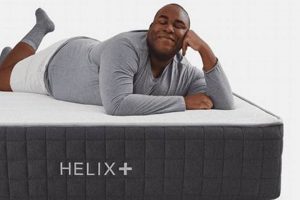
The optimal sleep surface for individuals of larger stature requires specific attributes to ensure adequate support, pressure relief, and longevity. Mattresses designed for this demographic often incorporate robust core construction and higher-density materials, such as reinforced coils or high-density foam, to prevent sagging and maintain proper spinal alignment. A suitable example would be a hybrid mattress featuring individually wrapped coils and multiple layers of high-density memory foam.
Selecting a mattress with these characteristics is crucial for promoting restful sleep and minimizing potential health issues such as back pain, joint stiffness, and poor circulation. Historically, the mattress industry has not always catered specifically to the needs of larger individuals, resulting in premature mattress breakdown and compromised sleep quality. Consequently, specialized designs and materials have emerged to address these shortcomings and provide enhanced comfort and durability.
Understanding the features and benefits of various mattress types and construction methods is essential for making an informed purchasing decision. The following sections will delve into key factors to consider, including material composition, support systems, and long-term performance expectations.
Guidance for Selecting an Appropriate Mattress
Choosing a mattress that adequately accommodates individuals with larger body types requires careful consideration of several key factors to ensure optimal support, comfort, and durability.
Tip 1: Prioritize Innerspring or Hybrid Models: Mattresses incorporating innerspring or hybrid designs, which combine coils with foam layers, typically offer superior support and resilience compared to all-foam constructions. The coil system provides robust support, preventing excessive sinkage and maintaining proper spinal alignment.
Tip 2: Evaluate Coil Gauge and Density: A lower coil gauge indicates thicker coils, which translates to greater support and durability. Additionally, higher coil density, or the number of coils per unit area, enhances weight distribution and reduces motion transfer.
Tip 3: Opt for High-Density Foam: When selecting foam layers, prioritize high-density options. High-density foam provides better support, resists compression over time, and contributes to the mattress’s overall longevity. Avoid low-density foams, which are more prone to sagging and deformation.
Tip 4: Consider Mattress Thickness: A thicker mattress generally offers more support and cushioning. Models ranging from 12 to 14 inches in thickness are often suitable, providing ample room for support layers and comfort layers.
Tip 5: Research Weight Capacity: Check the manufacturer’s specifications for the mattress’s weight capacity. Exceeding the recommended weight limit can compromise the mattress’s structural integrity and void warranties.
Tip 6: Explore Edge Support: Strong edge support prevents roll-off and maximizes the usable sleep surface. Reinforced edges are particularly beneficial for individuals who tend to sleep near the edge of the bed.
Tip 7: Review Warranty and Return Policies: A comprehensive warranty and a generous return policy provide peace of mind and allow ample time to assess the mattress’s suitability.
Adhering to these guidelines will increase the likelihood of selecting a mattress that provides adequate support, comfort, and long-term performance, ultimately promoting improved sleep quality and overall well-being.
The subsequent sections will provide further insight into specific mattress materials and features to consider when making a purchasing decision.
1. Supportive core construction

Supportive core construction is fundamental to the functionality of an appropriate mattress for individuals of larger body size. The mattress core directly impacts its ability to evenly distribute weight, prevent sagging, and maintain proper spinal alignment. Inadequate core support leads to discomfort, increased pressure points, and potential musculoskeletal issues. For example, a mattress with a weak or poorly constructed core will likely exhibit premature sagging, resulting in a hammock-like sleeping surface that fails to adequately support the sleeper’s body.
The selection of materials and construction techniques employed in the core are critical determinants of the mattress’s overall performance. High-density foams, robust coil systems (such as pocketed coils or Bonnell coils with reinforced perimeters), and hybrid designs that combine these elements are commonly used to create a supportive core. These materials provide a stable foundation, resisting compression and ensuring that the mattress maintains its shape and level of support over time. The effectiveness of the core construction is further enhanced by the use of durable, high-quality materials that are resistant to wear and tear. Consider two mattresses: one with a high-density polyfoam core versus one with a low-density polyfoam core. The former will invariably offer superior support and resist compression significantly better, resulting in a longer lifespan and improved sleep quality.
In summary, supportive core construction is an indispensable element of a mattress that adequately meets the needs of larger individuals. The use of appropriate materials and construction techniques is vital for ensuring proper weight distribution, preventing sagging, and promoting healthy spinal alignment. A mattress with a well-designed and robust core not only enhances comfort and sleep quality but also contributes to the long-term durability and overall value of the product.
2. High-density materials

The selection of high-density materials in mattress construction is paramount when catering to the specific needs of larger individuals. These materials contribute significantly to the mattress’s overall durability, support, and longevity, ensuring it can withstand increased weight and pressure over extended periods.
- Enhanced Support and Pressure Distribution
High-density foams and innerspring systems offer superior support by evenly distributing weight across the mattress surface. This prevents concentrated pressure points, reducing the risk of discomfort and promoting proper spinal alignment. For example, a high-density memory foam layer contours to the body’s curves, providing targeted support where needed most, while a high-density innerspring system resists compression and maintains a consistent level of support across the entire mattress surface.
- Increased Durability and Longevity
Mattresses constructed with high-density materials exhibit greater resistance to wear and tear compared to those utilizing lower-density alternatives. High-density foams and robust innersp
ring systems are less prone to sagging, indentation, and deformation over time, ensuring the mattress maintains its shape and support for a longer period. A real-world example would be observing the difference between a mattress with a 2.5 lb/cubic foot density memory foam comfort layer versus one with a 1.5 lb/cubic foot density layer after several years of use. The former will show significantly less degradation. - Improved Motion Isolation
High-density materials, particularly memory foam and latex, excel at isolating motion. This is beneficial for couples, especially when one partner is larger, as it minimizes the disturbance caused by movements during the night. The dense structure of these materials absorbs and dissipates motion, preventing it from transferring across the mattress surface.
- Temperature Regulation Considerations
While high-density materials offer numerous advantages, they can sometimes retain more heat compared to less dense alternatives. To mitigate this issue, manufacturers often incorporate cooling technologies, such as gel infusions or open-cell foam structures, to promote airflow and regulate temperature. A mattress with high-density memory foam infused with cooling gel will provide both the support needed and a mechanism to reduce heat retention.
The deliberate use of high-density materials directly addresses the unique demands placed on a mattress by larger individuals. By enhancing support, durability, motion isolation, and temperature regulation (when paired with appropriate technologies), these materials play a crucial role in ensuring a comfortable and restful sleep experience, and thus in determining the suitability of a mattress.
3. Reinforced edge support

Reinforced edge support is a critical feature in mattresses designed for larger individuals. It addresses specific challenges related to weight distribution, edge stability, and overall durability, thereby contributing significantly to the mattress’s suitability.
- Enhanced Stability and Reduced Sagging
Reinforced edges prevent premature sagging along the perimeter of the mattress. This is particularly important for individuals with higher body weights, as they tend to exert greater pressure on the edges when sitting or sleeping near the sides. Without reinforcement, the edges can compress and deform over time, reducing the usable sleep surface and compromising support. For example, a mattress with reinforced steel coils along the edge will maintain its structural integrity far longer than a mattress without this feature when subjected to consistent edge loading.
- Increased Usable Sleep Surface
By preventing edge collapse, reinforced support maximizes the usable sleep surface of the mattress. This is especially beneficial for individuals who share a bed, as it allows them to comfortably utilize the entire mattress width without feeling as though they are about to roll off. A mattress with robust edge support effectively expands the sleeping area, promoting greater comfort and freedom of movement.
- Improved Ease of Entry and Exit
Strong edge support facilitates easier entry and exit from the bed. Individuals with mobility issues, or those who simply prefer a stable surface for support, will benefit from a mattress with a firm and reliable edge. Reinforced edges provide a secure and stable platform, reducing the risk of falls or instability when getting in or out of bed. For instance, a thicker gauge steel rod encasing the mattress perimeter provides a firm, supportive edge suitable for these purposes.
- Extended Mattress Lifespan
Reinforcing the edges of a mattress contributes to its overall longevity. By preventing premature sagging and deformation, edge support helps to maintain the mattress’s structural integrity over time. This translates to a longer lifespan and a better return on investment. A mattress with reinforced edges is less likely to develop edge-related issues that can compromise its performance and necessitate early replacement.
The incorporation of reinforced edge support directly addresses the unique challenges associated with providing a comfortable and durable sleep surface for larger individuals. By enhancing stability, maximizing usable surface area, improving ease of use, and extending mattress lifespan, this feature plays a crucial role in ensuring the mattress is both supportive and long-lasting.
4. Optimal thickness

The thickness of a mattress is a salient factor in determining its suitability for individuals of larger stature. Adequate mattress thickness provides sufficient space for support and comfort layers, ensuring proper weight distribution and pressure relief. Insufficient thickness can compromise these functions, leading to discomfort and reduced mattress lifespan.
- Enhanced Support and Spinal Alignment
Greater mattress thickness allows for more substantial support cores and comfort layers, which are critical for maintaining proper spinal alignment. A thicker mattress can better accommodate the contours of a larger body, preventing excessive sinkage and promoting a neutral spinal posture during sleep. The implications of inadequate thickness manifest as back pain and discomfort due to uneven weight distribution.
- Improved Pressure Relief
Increased thickness enables the incorporation of multiple layers of pressure-relieving materials, such as memory foam or latex. These materials conform to the body’s shape, reducing pressure points at areas like the shoulders and hips. A thinner mattress may lack sufficient cushioning, resulting in increased pressure and potential discomfort. For example, a mattress with a 14-inch profile could feature a combination of high-density support foam, transitional layers, and a comfort layer, whereas a thinner, 8-inch mattress would likely sacrifice one or more of these components.
- Increased Durability and Longevity
A thicker mattress generally benefits from more robust construction, contributing to increased durability and a longer lifespan. The additional materials provide greater resistance to compression and deformation over time. Thinner mattresses may exhibit premature sagging or indentation, particularly under the increased weight load of a larger individual. This connection to longevity directly affects the long-term value and cost-effectiveness of the mattress.
- Enhanced Edge Support
Thickness can contribute to the effectiveness of edge support systems. A thicker mattress provides more vertical space for incorporating edge reinforcement features, such as high-density foam rails or steel supports. These features prevent edge collapse, maximizing the usable sleep surface and improving ease of entry and exit. A thinner mattress may offer inadequate edge support, leading to a feeling of instability and reduced comfort near the perimeter.
The considerations of optimal thickness are not merely arbitrary; they directly influence the comfort, support, durability, and overall suitability of a mattress for individuals of larger stature. A properly chosen thickness ensures that the mattress can effectively perform its intended function, promoting restful sleep and minimizing the risk of discomfort or premature degradatio
n.
5. Adequate weight capacity

Adequate weight capacity is a fundamental determinant of a mattress’s suitability for larger individuals. It represents the maximum weight a mattress can effectively support without compromising its structural integrity, support characteristics, or long-term performance. Failure to consider this specification can lead to premature sagging, reduced support, and ultimately, a diminished sleep experience. For example, a mattress rated for a maximum weight of 250 pounds will likely exhibit significant deformation and reduced support capabilities when consistently subjected to a load exceeding that limit. Consequently, individuals seeking the best mattress must prioritize models with a weight capacity that accommodates their needs.
The connection between weight capacity and mattress performance is both direct and consequential. Exceeding the specified weight limit compromises the mattress’s internal components, such as coils or foam layers, leading to uneven support and increased pressure points. This can result in discomfort, back pain, and potentially exacerbate existing musculoskeletal issues. Furthermore, exceeding the weight limit often voids the manufacturer’s warranty, leaving the consumer responsible for the cost of replacement. Many mattress manufacturers provide detailed weight capacity specifications for their products, ranging from standard to heavy-duty options. Consulting these specifications prior to purchase is crucial for ensuring long-term satisfaction and preventing premature mattress failure. For example, a couple with a combined weight of 500 pounds should seek a mattress with a stated weight capacity of at least 500 pounds, and preferably higher to account for additional factors such as movement and pressure.
In conclusion, the understanding and consideration of adequate weight capacity is indispensable when selecting the best mattress. Neglecting this factor can lead to a cascade of negative consequences, impacting comfort, support, durability, and warranty coverage. Prioritizing mattresses with appropriate weight ratings ensures a more supportive, durable, and ultimately, a more restful sleep experience. Individuals should diligently review manufacturer specifications and, when in doubt, opt for models with higher weight capacities to safeguard their investment and well-being.
6. Durable coil system
The integrity of the coil system is a crucial determinant of a mattress’s suitability for individuals requiring enhanced support and longevity. A durable coil system provides the essential foundation for weight distribution, spinal alignment, and overall mattress performance, particularly for those with larger body types. Its robustness directly influences the mattress’s ability to withstand consistent pressure and maintain its shape over an extended period.
- Gauge and Material Composition
Coil gauge, measured numerically, indicates the thickness of the steel wire used in the coils. Lower gauge numbers signify thicker, more robust coils, which offer greater resistance to compression and deformation. The material composition, typically tempered steel, influences the coil’s ability to withstand stress and maintain its structural integrity. For example, a mattress utilizing 13-gauge tempered steel coils will provide significantly more support and resilience compared to one with 15-gauge, non-tempered coils, ultimately extending the mattress’s lifespan under heavier loads. This consideration is paramount for individuals needing reliable, long-term support.
- Coil Density and Configuration
Coil density, referring to the number of coils per square foot, directly impacts the mattress’s ability to distribute weight evenly and minimize pressure points. Higher coil densities result in a more uniform support surface, reducing the likelihood of sagging and promoting proper spinal alignment. Coil configuration, such as individually pocketed coils or interconnected coil systems, influences motion isolation and overall support characteristics. Individually pocketed coils, for instance, allow for independent movement and contouring, minimizing motion transfer between sleep partners. The configuration and density need to be carefully chosen to ensure optimized load bearing and balanced support, for larger people.
- Edge Support Reinforcement
Reinforced edge support, often achieved through the use of thicker gauge coils or strategically placed foam encasements along the perimeter of the mattress, is crucial for preventing edge collapse and maximizing the usable sleep surface. This feature is particularly beneficial for individuals who sleep near the edge of the bed or require assistance when getting in and out. Without adequate edge support, the mattress perimeter may sag prematurely, reducing comfort and potentially posing a safety risk. A mattress where an extra row of higher gauge coils are placed around the perimeter would offer the best edge support.
- Coil System Design and Integration
The overall design and integration of the coil system within the mattress’s construction significantly impact its performance. Factors such as the type of coil (e.g., Bonnell, offset, continuous) and its interaction with other mattress components, such as foam layers, influence the mattress’s ability to provide targeted support and pressure relief. Hybrid mattresses, which combine coil systems with layers of memory foam or latex, often offer a balanced approach, providing both support and comfort. The chosen components contribute to the overall weight bearing of the system.
The facets of a durable coil system, from material selection to design integration, are interdependent and collectively contribute to a mattress’s ability to provide adequate support and longevity for individuals requiring specialized accommodations. Prioritizing these elements ensures that the mattress maintains its structural integrity and delivers consistent comfort and support over its lifespan. A compromised coil system translates directly into compromised performance, emphasizing the importance of selecting a mattress with a robust and well-engineered coil system for individuals of larger stature.
7. Temperature regulation

Temperature regulation is a critical factor in selecting an appropriate mattress, especially for individuals of larger stature. Body mass significantly influences heat retention during sleep. Larger individuals tend to generate and retain more body heat, increasing the likelihood of overheating, which can disrupt sleep cycles and reduce sleep quality. Therefore, a mattress’s ability to effectively dissipate heat and maintain a comfortable sleeping temperature becomes paramount.
Mattresses designed with temperature regulation in mind incorporate materials and construction techniques aimed at enhancing airflow and reducing heat retention. Open-cell foam structures, gel-infused memory foam, and breathable fabric covers are commonly employed to facilitate heat dissipation. Innerspring or hybrid mattresses, due to their coil-based construction, generally offer better ventilation compared to all-foam models. The absence of adequate tem
perature regulation can result in increased tossing and turning, night sweats, and a general feeling of discomfort, directly impacting sleep efficiency. For instance, an individual sleeping on a traditional memory foam mattress without cooling technologies may experience significantly higher body temperatures compared to the same individual sleeping on a latex mattress with ventilated channels.
The practical significance of understanding the connection between body size and temperature regulation is evident in the improved sleep quality and overall well-being experienced by individuals who select mattresses tailored to these considerations. By prioritizing mattresses with enhanced breathability and cooling features, larger individuals can mitigate the risk of overheating and enjoy a more restful and restorative sleep experience. Consequently, temperature regulation stands as a vital component of what constitutes an optimal sleep surface for this demographic.
Frequently Asked Questions
This section addresses common inquiries concerning mattress selection for individuals requiring enhanced support and durability. The information presented is intended to provide clarity and guidance.
Question 1: What is the minimum recommended mattress thickness for a larger person?
A mattress with a minimum thickness of 12 inches is generally recommended. This allows for sufficient layering of support and comfort materials to accommodate increased weight and pressure. Thicker mattresses often provide better long-term support and prevent premature sagging.
Question 2: Are innerspring mattresses better than foam mattresses for heavier individuals?
Innerspring or hybrid mattresses, which combine innerspring systems with foam layers, often provide superior support and durability compared to all-foam mattresses. The coil system offers robust support, while foam layers enhance comfort and pressure relief.
Question 3: What is coil gauge, and why is it important?
Coil gauge refers to the thickness of the steel wire used in the coils. A lower gauge number indicates a thicker coil, which provides greater support and resistance to compression. Thicker coils are particularly beneficial for heavier individuals, as they prevent sagging and maintain spinal alignment.
Question 4: What type of foam is best for supporting more weight?
High-density foams, such as high-density memory foam or latex, are generally preferred for supporting more weight. These materials offer better support, resist compression over time, and contribute to the mattress’s overall longevity. Low-density foams are more prone to sagging and deformation.
Question 5: What should be considered in the warranty policy?
A comprehensive warranty should cover sagging beyond a reasonable indentation depth (typically around 1 inch), as well as defects in materials and workmanship. Review the terms and conditions carefully to understand the scope of coverage and any exclusions.
Question 6: Is edge support a crucial feature?
Strong edge support is highly beneficial. It prevents roll-off, maximizes the usable sleep surface, and facilitates easier entry and exit from the bed. Reinforced edges are particularly advantageous for individuals who tend to sleep near the edge or require assistance when getting in or out of bed.
The selection of an appropriate mattress necessitates careful consideration of thickness, construction materials, coil specifications, and warranty terms. Prioritizing these factors ensures optimal support, comfort, and durability.
The subsequent section will provide guidance on evaluating specific mattress brands and models based on the aforementioned criteria.
Conclusion
The preceding analysis underscores the importance of selecting a sleep surface engineered to meet the specific needs of individuals of larger stature. Key factors such as supportive core construction, high-density materials, reinforced edge support, optimal thickness, adequate weight capacity, durable coil systems, and temperature regulation are not merely marketing terms; they are essential components that directly impact comfort, support, and the longevity of the product. Careful consideration of these aspects is paramount in ensuring a sound investment and promoting restful sleep.
The information provided serves as a comprehensive guide for navigating the complexities of the mattress market and making informed purchasing decisions. The selection of a “best mattress for large people” should be driven by a clear understanding of individual requirements and a commitment to prioritizing quality and durability. Continued research and consultation with qualified professionals are encouraged to ensure the chosen mattress provides the support and comfort necessary for optimal sleep health.
![Top Best Affordable Mattress Companies of [Year] Reviewed | Organic & Natural Mattress Buyer’s Guide: Non-Toxic Sleep Solutions](https://mattressworldpa.com/wp-content/uploads/2025/07/th-7840-300x200.jpg "Top Best Affordable Mattress Companies of [Year] Reviewed Organic & Natural Mattress Buyer’s Guide: Non-Toxic Sleep Solutions")

![Top-Rated: Best Firm Innerspring Mattress [Guide & Reviews] | Organic & Natural Mattress Buyer’s Guide: Non-Toxic Sleep Solutions](https://mattressworldpa.com/wp-content/uploads/2025/07/th-7838-300x200.jpg "Top-Rated: Best Firm Innerspring Mattress [Guide & Reviews] Organic & Natural Mattress Buyer’s Guide: Non-Toxic Sleep Solutions")

![Top Spots: Best Place to Buy Twin Mattress [Guide] | Organic & Natural Mattress Buyer’s Guide: Non-Toxic Sleep Solutions](https://mattressworldpa.com/wp-content/uploads/2025/07/th-7836-300x200.jpg "Top Spots: Best Place to Buy Twin Mattress [Guide] Organic & Natural Mattress Buyer’s Guide: Non-Toxic Sleep Solutions")