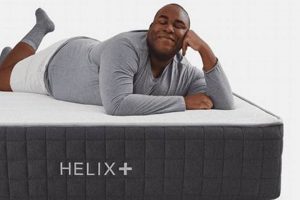
A sleep surface offering a balance between conforming comfort and underlying support is frequently sought. This particular type of mattress is engineered to provide a gentle cradling sensation while maintaining spinal alignment. Its construction typically incorporates materials such as memory foam, latex, or specialized coil systems designed to minimize pressure points and promote restful sleep.
The appeal of such a mattress lies in its ability to accommodate a wide range of sleep preferences and body types. Individuals seeking relief from joint pain or those who prefer a less firm feel often find significant benefit. Historically, advancements in sleep technology have focused on achieving this delicate equilibrium, recognizing that optimal comfort contributes significantly to overall well-being and sleep quality.
The following sections will explore the key factors to consider when selecting a mattress of this type, including material composition, construction techniques, and suitability for various sleep positions. Further discussion will address considerations for individuals with specific physical needs, as well as an overview of available options in the market.
Considerations for Selecting an Ideal Sleep Surface
Selecting a mattress engineered to provide balanced comfort requires careful evaluation. Prioritizing certain features can enhance the likelihood of a satisfying purchase and improve sleep quality.
Tip 1: Assess Material Composition: The materials used in construction significantly impact the overall feel. Memory foam conforms to the body, while latex provides a more responsive surface. Hybrid models combine these materials with coil systems for enhanced support and breathability.
Tip 2: Evaluate Layer Construction: The arrangement of layers within the mattress influences its comfort and support characteristics. Pay attention to the density and thickness of each layer, as these factors determine the mattress’s ability to relieve pressure points and maintain spinal alignment.
Tip 3: Determine Suitable Firmness: “Medium soft” describes a firmness level intended to offer a balance between plushness and support. Individuals should consider their body weight and sleeping position when determining whether this level is appropriate.
Tip 4: Account for Sleeping Position: Side sleepers often benefit from a more conforming surface that cushions the shoulders and hips. Back sleepers may require more support to maintain proper spinal alignment. Stomach sleepers generally need a firmer surface to prevent excessive sinking.
Tip 5: Review Edge Support: Adequate edge support prevents the sensation of rolling off the mattress and maximizes the usable sleep surface. Reinforced edges are particularly important for individuals who share a bed or require assistance getting in and out of bed.
Tip 6: Research Temperature Regulation: Certain materials, such as gel-infused memory foam or breathable latex, can help regulate body temperature and prevent overheating during sleep. Consider these options if you tend to sleep hot.
Tip 7: Consider Motion Isolation: If sharing a bed, motion isolation minimizes the transfer of movement from one side of the mattress to the other. This feature is especially beneficial for light sleepers who are easily disturbed by their partner’s movements.
These considerations provide a framework for informed decision-making. By prioritizing these features, individuals can increase the likelihood of selecting a sleep surface that promotes restorative sleep and overall well-being.
The subsequent section will address specific recommendations and brands known for their commitment to quality and performance in this mattress category.
1. Pressure Point Relief

Pressure point relief is a fundamental characteristic sought in sleep surfaces designed for comfort and support. A mattress’s ability to alleviate pressure concentration at specific areas of the body directly influences sleep quality and overall physical well-being. Mattresses constructed to minimize such pressure are often characterized by conforming materials and strategic layer configurations, effectively redistributing weight and reducing stress on joints and muscles.
The significance of pressure point relief manifests in its impact on various health conditions. Individuals experiencing arthritis, fibromyalgia, or other musculoskeletal disorders often find relief through mattresses that contour to the body’s shape, minimizing localized pressure and promoting better circulation. For example, a mattress incorporating a thick layer of memory foam can conform to the sleeper’s body, reducing pressure on the shoulders and hips for side sleepers, or the lower back for back sleepers. Failure to adequately address pressure points can result in increased discomfort, restless sleep, and potentially exacerbate pre-existing medical conditions.
In summary, the attainment of effective pressure point relief is a core tenet in the design and selection of sleep surfaces intended to provide balanced comfort and support. The ability of a mattress to minimize pressure concentration directly impacts sleep quality and physical well-being. Identifying materials and construction techniques that prioritize pressure relief is essential for individuals seeking a more restful and restorative sleep experience.
2. Spinal Alignment

Spinal alignment is a critical factor in determining the suitability of a sleep surface, particularly when considering a mattress intended to provide balanced comfort. The natural curvature of the spine must be maintained during sleep to minimize stress on vertebral discs, ligaments, and muscles. A mattress that is either too firm or too soft can compromise this alignment, leading to discomfort and potentially chronic pain.
A mattress described as providing “medium soft” support aims to strike a balance, offering sufficient give to contour to the body’s shape while simultaneously preventing excessive sinking, which would disrupt spinal alignment. For instance, a side sleeper requires adequate cushioning for the shoulders and hips to maintain a horizontal spinal position. A back sleeper needs support for the lumbar region to prevent the spine from collapsing inward. Insufficient support results in misalignment and subsequent back pain. Conversely, a mattress that is too firm will not allow the body to sink in enough to maintain natural curves, also leading to discomfort.
In conclusion, the connection between spinal alignment and mattress selection is paramount for achieving restful and restorative sleep. The ideal mattress provides the necessary contouring and support to maintain the spine’s natural curvature, regardless of sleeping position. A “medium soft” mattress, if appropriately designed and constructed, can offer this balance. Individuals must consider their body type and
sleeping preferences to ensure the selected mattress effectively promotes spinal health.
3. Material Durability

Material durability is a critical determinant of long-term value and satisfaction when evaluating sleep surfaces designed for balanced comfort. The inherent qualities of the materials utilized in the construction of a “best medium soft mattress” directly influence its ability to maintain its intended support and comfort characteristics over an extended period. Premature degradation of materials leads to a loss of support, sagging, and ultimately, a diminished sleep experience. For example, low-density foams may initially provide a plush feel but are prone to compression and breakdown, reducing their ability to relieve pressure points effectively over time. This necessitates replacement, undermining the initial investment.
The correlation between material selection and durability extends to various components of the mattress. Higher-quality coil systems, such as individually pocketed coils, exhibit greater resistance to deformation and provide consistent support across the entire sleep surface compared to less robust coil systems. Similarly, natural latex, known for its resilience and longevity, offers superior durability compared to synthetic latex alternatives. Fabric encasements also play a crucial role; a tightly woven, durable fabric can protect the inner components from wear and tear, extending the lifespan of the mattress. Conversely, a flimsy or poorly constructed encasement is susceptible to tearing and accelerated degradation of the underlying materials.
In conclusion, material durability is inextricably linked to the long-term performance and overall value of a mattress designed to provide balanced comfort. The careful selection of resilient materials and robust construction techniques is essential to ensure that the mattress maintains its support, comfort, and structural integrity over time. Consumers prioritizing a “best medium soft mattress” should prioritize materials with proven durability to maximize their investment and enjoy consistently restorative sleep for years to come. The potential for premature degradation due to substandard materials highlights the practical significance of this understanding.
4. Temperature Regulation

Temperature regulation within a sleep environment significantly impacts comfort and restorative sleep quality. The ability of a mattress to dissipate heat and maintain a neutral temperature is a crucial consideration, particularly for those seeking a “best medium soft mattress,” as the conforming nature of softer mattresses can sometimes impede airflow and trap heat.
- Material Breathability
The breathability of mattress materials directly affects heat dissipation. Materials like open-cell memory foam, natural latex, and certain types of plant-derived foams are designed to allow air circulation, preventing heat buildup. Conversely, closed-cell memory foam, while offering excellent pressure relief, tends to retain heat due to its denser structure. The selection of breathable materials is particularly important in a softer mattress where body contact is maximized, potentially leading to increased heat retention.
- Construction and Layering
Mattress construction influences temperature regulation. Hybrid mattresses, combining coils and foam layers, often exhibit better airflow than all-foam models. The presence of coils creates space for air to circulate, dissipating heat away from the body. Layering also plays a role; a top layer of breathable material, such as a phase-change fabric or a layer of wool, can help regulate surface temperature. An all-foam mattress, lacking these features, may require additional design elements to mitigate heat retention.
- Cooling Technologies
Various cooling technologies are incorporated into mattresses to enhance temperature regulation. Gel-infused memory foam, for example, aims to draw heat away from the body. Phase-change materials absorb and release heat to maintain a consistent surface temperature. These technologies are often integrated into the top layers of the mattress, providing immediate cooling relief. The effectiveness of these technologies varies, and their long-term performance depends on the quality and durability of the materials used.
- Environmental Factors
The surrounding environment influences the effectiveness of temperature regulation features in a mattress. Room temperature, bedding materials, and even clothing choices can affect heat retention and dissipation. A cooler room temperature promotes better heat transfer from the body to the mattress and the surrounding environment. Using breathable bedding materials, such as cotton or linen, can also enhance airflow and reduce heat buildup. Therefore, optimizing both the mattress and the sleep environment is essential for achieving optimal temperature regulation.
These factors underscore the importance of carefully evaluating the temperature regulation capabilities of a mattress, particularly when seeking a balanced comfort and support profile. Selecting a “best medium soft mattress” that incorporates breathable materials, strategic construction, and effective cooling technologies can contribute to a more comfortable and restorative sleep experience by minimizing heat retention and promoting a neutral sleep temperature.
5. Motion Isolation

Motion isolation, the ability of a mattress to minimize the transfer of movement across its surface, is a significant factor for individuals sharing a bed. Its relevance is amplified when considering a “best medium soft mattress” due to the inherent properties of softer materials, which can potentially exacerbate motion transfer if not properly addressed in the mattress design.
- Material Composition and Dampening
The specific materials used in a mattress significantly affect its ability to dampen motion. Memory foam and latex, known for their conforming properties, also possess inherent damping characteristics. These materials absorb energy from movement, preventing it from propagating across the mattress surface. For instance, a mattress incorporating a thick layer of high-density memory foam will generally exhibit superior motion isolation compared to one constructed solely from traditional innerspring coils. In the context of a “best medium soft mattress,” selecting materials with strong damping properties is crucial for minimizing partner disturbance.
- Coil System Design
The type of coil system employed plays a vital role in motion isolation. Individually pocketed coils, where each coil is encased in a fabric pocket, allow for independent movement, reducing the transfer of motion. In contrast, interconnected coil systems, where coils are linked together, tend to transmit movement more readily. When seeking a “best medium soft mattress” with optimal motion isolation, prioritizing models with individually pocketed coils is advisable. This design minimizes the impact of one sleeper’s movements on the other, promoting undisturbed rest.
- Layer Construction and Decoupling
The arrangement and density of mattress layers can further enhance motion isolation. Decoupling layers, such as transition foams or specialized fabrics, act as barriers, absorbing and dissipating energy from movement. By strategically placing these decoupling layers within the mattress construction, manufacturers can effectively minimize motion transfer. A “best medium soft mattress” engineered for motion isolation often incorporates multiple layers of varying densities and properties to maximize its damping capabilities. The strategic placement of these layers is crucial in minimizing motion propagation. - Edge Support and Perimeter Reinforcement
While edge support primarily addresses the issue of roll-off prevention, it can also contribute to overall motion isolation. Mattresses with reinforced edges or perimeter support systems often exhibit improved stability and reduced motion transfer near the edges. The enhanced structural integrity of the edge minimizes the propagation of movement along the perimeter of the mattress. Therefore, when evaluating a “best medium soft mattress” for motion isolation, considering models with robust edge support is beneficial. The added stability contributes to a more stable and less disruptive sleep surface.
In summary, achieving effective motion isolation in a “best medium soft mattress” requires a holistic approach that considers material selection, coil system design, layer construction, and edge support. By prioritizing these factors, individuals can minimize partner disturbance and enjoy a more restful and undisturbed sleep experience. Selecting a mattress with these characteristics promotes individual sleep quality within a shared bed.
Frequently Asked Questions
This section addresses common inquiries regarding the selection and suitability of a specific type of mattress. The information presented aims to provide clarity and inform decision-making.
Question 1: What constitutes a “best medium soft mattress?”
This designation refers to a sleep surface designed to offer a balance between conforming comfort and adequate support. It typically incorporates materials such as memory foam or latex in combination with a supportive core, aiming to alleviate pressure points while maintaining spinal alignment.
Question 2: Is a “best medium soft mattress” suitable for all sleep positions?
While adaptable, its suitability varies depending on individual preferences and body weight. Side sleepers generally benefit due to its ability to cushion shoulders and hips. Back sleepers may find adequate support, while stomach sleepers might require a firmer surface to prevent excessive sinking.
Question 3: How does material composition affect the performance of a “best medium soft mattress?”
The type of materials used directly impacts comfort, support, and durability. Memory foam provides contouring, while latex offers responsiveness. Coil systems contribute to support and breathability. Material quality dictates longevity and resistance to sagging.
Question 4: What factors should be considered regarding temperature regulation in a “best medium soft mattress?”
Breathability is crucial. Materials like open-cell foam or gel-infused memory foam can help dissipate heat. Mattress construction, such as hybrid designs with coil systems, also influences airflow and temperature regulation.
Question 5: How important is motion isolation in a “best medium soft mattress?”
Motion isolation minimizes the transfer of movement between sleeping partners. This feature is particularly beneficial for light sleepers or those easily disturbed by movement. Materials like memory foam and individually pocketed coils enhance motion isolation.
Question 6: What is the expected lifespan of a “best medium soft mattress?”
Lifespan is influenced by material quality, construction, and usage. Generally, a well-constructed mattress of this type can last between 7 to 10 years with proper care. Rotation and the use of a mattress protector can extend its lifespan.
These responses provide a foundation for understanding the characteristics and considerations associated with this type of mattress. Careful evaluation of individual needs and preferences is essential for selecting the optimal sleep surface.
The subsequent section will provide guidance on maintaining and caring for a mattress to maximize its longevity.
Conclusion
The preceding analysis has elucidated critical aspects of a mattress categorized as offering a “best medium soft mattress” experience. From the fundamental importance of pressure point relief and spinal alignment to the practical considerations of material durability, temperature regulation, and motion isolation, the selection process demands careful evaluation of individual needs and preferences. The information presented serves as a comprehensive guide, emphasizing the multifaceted nature of optimal sleep surface selection.
The pursuit of a restorative sleep experience hinges on informed decision-making. By understanding the interplay between material properties, construction techniques, and personal requirements, individuals can effectively navigate the available options and secure a sleep surface that promotes long-term comfort and well-being. Continued advancements in sleep technology promise further innovations, reinforcing the significance of staying informed about the evolving landscape of mattress design and functionality.
![Top Best Affordable Mattress Companies of [Year] Reviewed | Organic & Natural Mattress Buyer’s Guide: Non-Toxic Sleep Solutions](https://mattressworldpa.com/wp-content/uploads/2025/07/th-7840-300x200.jpg "Top Best Affordable Mattress Companies of [Year] Reviewed Organic & Natural Mattress Buyer’s Guide: Non-Toxic Sleep Solutions")

![Top-Rated: Best Firm Innerspring Mattress [Guide & Reviews] | Organic & Natural Mattress Buyer’s Guide: Non-Toxic Sleep Solutions](https://mattressworldpa.com/wp-content/uploads/2025/07/th-7838-300x200.jpg "Top-Rated: Best Firm Innerspring Mattress [Guide & Reviews] Organic & Natural Mattress Buyer’s Guide: Non-Toxic Sleep Solutions")

![Top Spots: Best Place to Buy Twin Mattress [Guide] | Organic & Natural Mattress Buyer’s Guide: Non-Toxic Sleep Solutions](https://mattressworldpa.com/wp-content/uploads/2025/07/th-7836-300x200.jpg "Top Spots: Best Place to Buy Twin Mattress [Guide] Organic & Natural Mattress Buyer’s Guide: Non-Toxic Sleep Solutions")