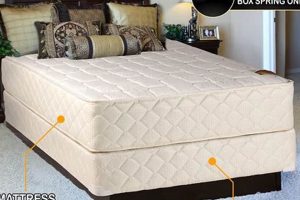
The foundation designed to support a queen-sized bed is typically constructed with a wooden or metal frame, and often contains springs. This component elevates the mattress, providing a level and firm surface upon which to rest. Its dimensions are specifically tailored to accommodate a mattress of corresponding size, ensuring proper weight distribution and preventing premature sagging.
Utilizing this type of foundation offers numerous advantages. It can prolong the lifespan of the overlying mattress by absorbing impact and reducing stress on individual coils or foam layers. Furthermore, it increases the overall height of the bed, which can be particularly beneficial for individuals with mobility issues. Historically, these foundations played a crucial role in bed design, acting as the primary suspension system before advancements in mattress technology.
The following sections will delve into various aspects of selecting, maintaining, and understanding the diverse types of bed foundations available for queen-sized mattresses, addressing factors such as material composition, cost considerations, and impact on sleep quality.
Essential Considerations for Queen Mattress Foundations
Selecting the appropriate foundation for a queen-sized mattress is a critical decision that affects both the longevity of the mattress and the quality of sleep experienced. Adherence to the following guidelines ensures a well-informed purchasing process.
Tip 1: Confirm Compatibility: Prior to purchase, verify that the foundation is specifically designed for use with queen-sized mattresses. Deviations in size can lead to uneven support and accelerated wear.
Tip 2: Assess Mattress Type: The type of mattress being used dictates the most suitable foundation. Innerspring mattresses often benefit from foundations with integrated spring systems, while memory foam mattresses may require a solid platform for optimal support.
Tip 3: Evaluate Frame Integrity: Thoroughly inspect the frame for structural integrity. Welded joints, reinforced corners, and the absence of visible damage are indicators of a durable product.
Tip 4: Consider Height Preferences: The height of the foundation significantly impacts the overall bed height. Individuals with mobility limitations should carefully consider this factor to ensure ease of access.
Tip 5: Investigate Material Composition: Foundations constructed from high-quality materials, such as solid wood or heavy-gauge steel, offer superior durability and resistance to sagging over time.
Tip 6: Research Warranty Provisions: Review the manufacturer’s warranty to ascertain the extent of coverage for potential defects or premature failure. A comprehensive warranty provides valuable protection against unforeseen issues.
Tip 7: Consult Retailer Expertise: Seek guidance from knowledgeable sales personnel who can provide insights into the specific features and benefits of different foundation models.
Adhering to these guidelines ensures the selection of a foundation that provides adequate support, extends the lifespan of the mattress, and contributes to a comfortable and restful sleep environment.
The subsequent section will provide a detailed examination of the different types of queen mattress foundations currently available, highlighting their respective strengths and weaknesses.
1. Support and Stability

Adequate support and stability are fundamental attributes of a bed foundation designed for a queen-sized mattress. A primary function of such a foundation is to provide a level and rigid plane, thereby preventing mattress deformation and ensuring proper weight distribution. Failure to provide sufficient support results in sagging, uneven wear, and a reduced lifespan for the mattress. For instance, a foundation with weakened or broken internal structures will not adequately distribute weight, leading to localized compression of the mattress and potentially causing discomfort or back pain for the user. A stable base also minimizes motion transfer, enhancing sleep quality for individuals sharing the bed.
The construction materials and design of the foundation directly impact its support and stability. Foundations employing solid wood frames, reinforced joints, and closely spaced support slats offer greater resistance to bending and flexing compared to those made with lower-quality materials or sparse support structures. Furthermore, the type of foundation (e.g., traditional spring, platform, or adjustable base) influences its overall stability. Platform foundations, characterized by a solid or closely spaced slatted surface, generally provide superior support for memory foam and latex mattresses, whereas foundations with integrated springs may be more suitable for innerspring mattresses.
In summary, the relationship between support, stability, and the queen mattress foundation is one of direct cause and effect. A well-constructed and appropriately chosen foundation provides the necessary support to maintain the mattress’s integrity, promote proper spinal alignment, and extend its useful life. Conversely, a deficient foundation compromises these benefits, potentially leading to premature mattress failure and diminished sleep quality. Therefore, careful consideration of support and stability is paramount when selecting a foundation for a queen-sized mattress.
2. Proper Airflow

Proper airflow within a sleep system, specifically in relation to a foundation supporting a queen-sized mattress, is critical for maintaining hygiene, comfort, and the longevity of the mattress itself. Adequate ventilation mitigates moisture accumulation, regulates temperature, and inhibits the growth of microorganisms, contributing to a healthier sleep environment.
- Moisture Dissipation
Mattresses, particularly those constructed with memory foam, can retain moisture from perspiration and environmental humidity. A foundation that allows for airflow facilitates the evaporation of this moisture, preventing the formation of mold, mildew, and unpleasant odors. Traditional spring foundations, with their open internal structure, inherently promote greater airflow compared to solid platform foundations. The absence of proper ventilation can lead to a damp mattress interior, fostering an environment conducive to microbial growth.
- Temperature Regulation
Air circulation helps regulate mattress temperature, preventing the buildup of heat during sleep. This is particularly important for individuals who tend to sleep hot or reside in warmer climates. A foundation that allows for airflow dissipates heat, contributing to a more comfortable and restful sleep experience. Conversely, a foundation that restricts airflow can trap heat, leading to discomfort and potential sleep disturbances.
- Prevention of Allergen Accumulation
Adequate ventilation reduces the accumulation of dust mites and other allergens within the mattress. Dust mites thrive in warm, humid environments, and a well-ventilated foundation helps to create a less hospitable environment for these allergens. This is especially relevant for individuals with allergies or asthma, as reducing allergen exposure can significantly improve respiratory health and sleep quality.
- Structural Integrity of the Mattress
Moisture retention, exacerbated by poor airflow, can compromise the structural integrity of the mattress over time. Excessive moisture can break down foam layers and corrode internal spring systems, leading to premature sagging and degradation of support. A foundation that facilitates airflow helps to maintain the mattress in a drier, more stable condition, extending its lifespan and preserving its performance characteristics.
In conclusion, the interaction between mattress, foundation and airflow is crucial for quality sleep. The design of the foundation directly impacts airflow around the mattress. The choice of foundation material and structure is thus critical for managing temperature, moisture, and allergens, all influencing the comfort and hygiene of the sleep environment. A foundation should be selected to work in harmony with the mattress to maximize these benefits.
3. Height Considerations

Height considerations are integral when selecting a foundation designed for a queen-sized mattress. The combined height of the mattress and foundation directly influences ease of access to the bed, impacting individuals with mobility limitations or varying physical stature. A bed that is too low may present challenges for those with joint pain or difficulty rising, while an excessively high bed may require the use of a step stool, posing a safety risk. A queen box spring adds height to the overall bed profile. The choice of foundation height, therefore, should align with the user’s physical needs and capabilities to ensure comfort and safety.
Beyond individual needs, height influences the aesthetic harmony of the bedroom. The scale of the bed in relation to other furniture pieces and the room’s dimensions contributes to visual balance. A low-profile bed might complement a minimalist decor scheme, while a taller bed could serve as a focal point in a larger space. Furthermore, the height impacts the storage capacity beneath the bed. Certain bed frames incorporate drawers or open space, requiring a higher foundation to accommodate storage needs. Conversely, a lower foundation might be preferred if under-bed storage is not a priority. A queen box spring is frequently used to lift the mattress and provide extra storage room underneath.
In summary, height considerations are not merely a matter of preference but a practical aspect influencing accessibility, safety, and aesthetic integration. The appropriate height of a foundation, when combined with a queen-sized mattress, should be carefully assessed based on individual needs, room dimensions, and desired aesthetic. A well-considered choice enhances both the functionality and visual appeal of the sleep environment. Not considering the correct height of a queen box spring can cause a negative impact to your sleep experience.
4. Noise Reduction

Noise reduction is a significant, though often overlooked, attribute of a foundation intended for use with a queen-sized mattress. The interaction between the mattress and foundation, particularly during movement, can generate noise. A poorly constructed foundation amplifies these sounds, disrupting sleep for both the individual and any sleep partners. The materials and design of the foundation directly influence its noise-dampening capabilities. For example, a traditional foundation with loosely connected springs is prone to creaking and squeaking, especially under weight or motion. This noise pollution negatively impacts the restorative benefits of sleep. A higher quality queen box spring will reduce a majority of any sounds your mattress makes when in use.
Foundations employing solid platforms or tightly woven support systems inherently exhibit superior noise reduction properties. These designs minimize friction and movement between components, thereby diminishing the likelihood of generating disruptive sounds. For instance, a platform foundation constructed from solid wood or metal with a fabric-upholstered surface absorbs vibrations and muffles noise. In contrast, a foundation with exposed metal components or loosely fitted slats is more likely to produce creaks and rattles. Furthermore, the presence of padding or cushioning between the mattress and foundation serves as a sound barrier, further mitigating noise transmission. Regular maintenance, such as tightening bolts and lubricating joints, also contributes to noise reduction. The queen box spring design has been adjusted many times to reduce noise, it now has a superior design compared to the older counterparts.
In conclusion, noise reduction is a critical, albeit subtle, component of a queen-sized mattress foundation. The choice of materials, design, and maintenance practices directly impact the foundation’s ability to minimize sleep-disrupting sounds. Selecting a foundation with inherent noise-dampening characteristics and implementing routine upkeep measures contributes to a quieter, more restful sleep environment, thus promoting overall well-being. The queen box spring is a very important component of Noise reduction to your bed and sleep experience.
5. Mattress Compatibility

The concept of mattress compatibility is paramount when selecting a foundation designed to support a queen-sized mattress. The interaction between the mattress and the foundation directly influences the sleep experience, mattress lifespan, and overall structural integrity of the bed. Incompatibility can lead to diminished support, accelerated wear, and even voided mattress warranties. For instance, using a traditional spring foundation with a memory foam mattress can prevent adequate support, causing the foam to sag prematurely. The cause-and-effect relationship underscores the importance of choosing a foundation that complements the specific characteristics of the mattress.
Various mattress types, including innerspring, memory foam, latex, and hybrid models, exhibit distinct support requirements. Innerspring mattresses, characterized by their coil-based construction, often perform well with traditional spring foundations, as the coil systems offer a degree of complementary support. However, memory foam and latex mattresses typically necessitate a solid or closely slatted platform to prevent sagging and ensure proper weight distribution. Hybrid mattresses, which combine elements of both innerspring and foam, require careful consideration to determine the most suitable foundation type. A real-life example involves individuals who experience discomfort or back pain after switching to a memory foam mattress without changing their existing spring foundation. This illustrates the practical significance of understanding mattress compatibility.
In conclusion, mattress compatibility is a critical determinant of sleep quality and mattress longevity. Selecting a queen mattress foundation that aligns with the specific support needs of the mattress is essential for maximizing comfort, preventing premature wear, and ensuring warranty adherence. The practical implications of incompatibility highlight the importance of careful research and informed decision-making during the mattress foundation selection process. Overlooking mattress compatibility jeopardizes investment and sleep quality. Ignoring compatibility with a queen box spring may lead to further health concerns.
6. Durability Assessment
Durability assessment plays a pivotal role in evaluating the long-term value and performance of a foundation designed for a queen-sized mattress. The structural integrity and material composition of such a foundation dictate its ability to withstand consistent use and weight distribution over an extended period. A thorough durability assessment identifies potential weaknesses and ensures that the foundation provides adequate support throughout its intended lifespan.
- Material Composition Analysis
Examining the constituent materials of the foundation is crucial. Solid wood frames, high-gauge steel components, and durable fabric upholstery are indicators of a robust product. Inferior materials, such as low-density particleboard or thin-gauge metal, are prone to warping, cracking, and eventual failure. For example, a foundation constructed with kiln-dried hardwood is more resistant to moisture-induced damage and deformation compared to one made with untreated softwood. Material analysis informs predictions about the foundation’s ability to withstand stress and maintain structural integrity.
- Joint and Fastener Integrity
The method of joining frame components and the quality of fasteners significantly impact the overall durability of the foundation. Welded joints, reinforced corners, and the use of high-strength screws or bolts ensure a secure and stable structure. Weak joints or inadequate fasteners can lead to instability and premature failure, particularly under heavy loads. An example includes a foundation with poorly secured support slats, which may detach over time, compromising the mattress’s support and causing discomfort.
- Load-Bearing Capacity Evaluation
Assessing the foundation’s ability to support the combined weight of the mattress and occupants is essential. Exceeding the recommended weight limit can result in structural damage and a diminished lifespan. A foundation with a higher load-bearing capacity typically indicates a more robust construction and greater resistance to sagging or deformation. In real-world scenarios, a foundation designed for lighter-weight individuals may fail prematurely when used by heavier individuals or couples.
- Resistance to Environmental Factors
The foundation’s ability to withstand environmental factors, such as humidity and temperature fluctuations, influences its long-term durability. Exposure to high humidity can cause wood to warp and metal to corrode, while extreme temperature variations can weaken adhesives and compromise structural integrity. Foundations treated with protective coatings or constructed from moisture-resistant materials offer greater protection against environmental damage. An example would be comparing the lifespan of a foundation in a dry climate versus one in a humid coastal region.
These factors, collectively, determine the durability of the foundation designed for use with a queen-sized mattress. A comprehensive durability assessment, encompassing material analysis, joint integrity evaluation, load-bearing capacity testing, and resistance to environmental factors, provides valuable insights into the foundation’s long-term performance and suitability for its intended purpose. Prioritizing durability ensures a sound investment and contributes to a comfortable and supportive sleep environment.
Frequently Asked Questions About Queen Mattress Foundations
The following section addresses common inquiries regarding queen mattress foundations, providing clarity on their purpose, selection, and maintenance. These answers aim to provide comprehensive information for informed decision-making.
Question 1: What distinguishes a queen mattress foundation from a box spring?
The terms are often used interchangeably; however, subtle distinctions exist. A traditional box spring typically contains metal springs encased within a fabric-covered frame. Modern foundations may utilize wooden slats or a solid platform in lieu of springs, providing varying degrees of support and potentially impacting mattress feel.
Question 2: Is a foundation necessary for all queen mattresses?
While not universally mandatory, a foundation is generally recommended to provide adequate support, prevent sagging, and extend mattress lifespan. Some platform beds incorporate built-in support systems, negating the need for a separate foundation. However, manufacturers often specify foundation requirements to maintain warranty validity.
Question 3: What factors should be considered when selecting a foundation for a queen-sized memory foam mattress?
Memory foam mattresses require a solid, non-yielding surface to prevent indentation and ensure proper weight distribution. A slatted foundation with minimal spacing or a solid platform is preferable to a traditional box spring, which may not provide sufficient support for the foam’s unique properties.
Question 4: How does foundation height affect the overall bed height and user experience?
Foundation height significantly influences the overall bed height, impacting ease of entry and exit. Individuals with mobility concerns may benefit from a higher foundation, while others may prefer a lower profile for aesthetic reasons. Careful consideration of foundation height is essential for comfort and safety.
Question 5: Can an improper foundation void a queen mattress warranty?
Yes, using an incompatible or inadequate foundation can void the mattress warranty. Manufacturers often specify the type of foundation required to maintain warranty coverage. Adherence to these guidelines is crucial to protect the investment.
Question 6: What maintenance practices are recommended to prolong the lifespan of a queen mattress foundation?
Regularly inspect the foundation for signs of damage, such as broken slats or loose joints. Tighten any loose fasteners and address any structural issues promptly. Avoid placing excessive weight or pressure on the foundation, and rotate the mattress periodically to promote even wear.
The information above illuminates key considerations regarding queen mattress foundations, empowering consumers to make informed choices that optimize sleep quality and mattress longevity.
The subsequent section will provide a comparative analysis of different foundation types, further aiding in the selection process.
Box Spring for Queen Mattress
This exposition has provided a detailed analysis of the foundation designed for a queen-sized mattress, encompassing its structural elements, functional benefits, and compatibility considerations. Key facets explored included the significance of support and stability, the role of proper airflow, height implications, noise reduction mechanisms, and the crucial aspect of mattress compatibility. An understanding of these elements empowers informed decision-making.
The selection of a box spring for queen mattress represents a critical investment in both sleep quality and mattress longevity. Neglecting the principles outlined herein may lead to compromised sleep, accelerated mattress wear, and ultimately, a diminished return on investment. Therefore, rigorous evaluation and adherence to established guidelines are essential for optimizing the performance and lifespan of this fundamental component of the sleep environment.
![Best Place: Where Can I Buy a Mattress in a Box? [Deals!] | Organic & Natural Mattress Buyer’s Guide: Non-Toxic Sleep Solutions](https://mattressworldpa.com/wp-content/uploads/2025/07/th-3426-300x200.jpg "Best Place: Where Can I Buy a Mattress in a Box? [Deals!] Organic & Natural Mattress Buyer’s Guide: Non-Toxic Sleep Solutions")