



This specific bedding dimension offers a longer and slightly narrower sleeping surface compared to a standard king. With dimensions typically around 72 inches wide and 84 inches long, it caters to individuals requiring additional legroom or those with narrower bedroom spaces where length is prioritized over width.
The format is particularly well-suited for taller individuals, providing extended support that prevents discomfort from dangling feet. Furthermore, its dimensions can enhance the aesthetic proportions of larger bedrooms. The evolution of bed sizes reflects a growing awareness of individual sleep needs and bedroom design considerations.
Subsequent sections will delve into a comparative analysis of dimensions, material composition, and relevant considerations when selecting this type of bedding, and explore the diverse range of available options.
Essential Considerations for a California King Mattress
Selecting a sleeping surface requires careful consideration of individual needs and preferences. The following provides guidelines to inform the decision-making process when purchasing a longer format sleeping surface.
Tip 1: Measure the Bedroom Space: Before purchasing, accurately measure the intended bedroom. Ensure sufficient space exists for comfortable movement around the bed and other furniture.
Tip 2: Assess Height Requirements: Individuals of greater height benefit significantly. If a standard size leaves insufficient legroom, this longer format is often a more suitable option.
Tip 3: Consider Sleeping Preferences: Different internal components cater to various sleeping styles. Side sleepers might prioritize a plush surface, while back sleepers could benefit from firmer support.
Tip 4: Research Material Composition: Different materials offer varying levels of support, temperature regulation, and durability. Research memory foam, latex, innerspring, and hybrid options to determine the best fit.
Tip 5: Check Warranty and Return Policies: Thoroughly review the manufacturer’s warranty and the retailer’s return policy. This ensures recourse in the event of dissatisfaction or product defects.
Tip 6: Read Customer Reviews: Analyze customer reviews to gain insights into real-world experiences with the product’s comfort, durability, and overall value.
Tip 7: Budget Considerations: Establish a budget prior to shopping. Prices vary widely based on material, brand, and features. Compare options within the established budget to maximize value.
Adhering to these recommendations helps ensure the selection of a sleeping surface that optimally supports individual needs and contributes to improved sleep quality.
The subsequent sections will discuss the maintenance to preserve the life span.
1. Dimensions

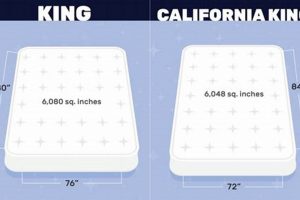
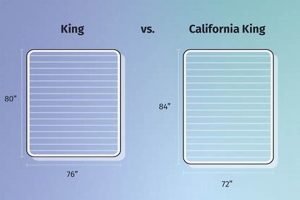
The specific dimensions of 72 inches in width and 84 inches in length are definitive characteristics. The dimensions represent a design choice prioritizing length over width compared to the standard king size, which is wider but shorter. This is a deliberate alteration to accommodate taller individuals who require additional legroom. Without these measurements, a product cannot be accurately identified as that size. The 72″ x 84″ parameter effectively dictates the comfort level for individuals exceeding a certain height, preventing the discomfort of dangling feet during sleep.
Consider a situation where a person who is 6’4″ tall attempts to sleep on a standard queen. They might find their feet extending beyond the mattress edge. The 84-inch length addresses this issue, providing a more comfortable and restorative sleep experience. Moreover, the specified dimensions necessitate the use of appropriately sized bed frames and bedding. Attempting to fit a standard king sheet set, for example, would result in an improper fit and compromised comfort.
In summary, the dimensions are not merely arbitrary measurements, but rather integral components of its definition. They represent a design that caters to specific needs related to height and space. A thorough understanding of these dimensions is crucial for consumers to make informed decisions that align with their physical requirements and bedroom configurations.
2. Taller individual comfort

The enhanced comfort experienced by taller individuals is a primary consideration in its design and market positioning. The longer dimensions directly address the limitations of standard sizes for this demographic, promoting better sleep posture and overall rest quality.
- Extended Legroom and Support
The additional length, typically 84 inches, provides sufficient legroom for taller individuals, preventing discomfort caused by feet hanging off the edge. This support ensures proper spinal alignment throughout the night, reducing the likelihood of back pain and stiffness. Consider a person exceeding six feet in height; a standard queen or king may leave their lower legs unsupported, leading to disrupted sleep.
- Reduced Pressure Points
By accommodating the full length of the body, it minimizes pressure points that can develop when limbs are forced into unnatural positions due to insufficient space. These pressure points can disrupt sleep cycles and contribute to discomfort. A taller person who curls up to fit on a smaller bed will experience increased pressure on their hips and shoulders.
- Improved Sleep Posture
The ability to stretch out fully promotes a more natural and relaxed sleep posture. This is particularly important for individuals with pre-existing back or joint conditions. A strained or cramped posture can exacerbate existing problems and impede recovery during sleep.
- Enhanced Thermal Regulation
Sufficient space allows for better airflow around the body, contributing to improved temperature regulation. A person cramped on a smaller surface may experience increased heat retention and discomfort, particularly in warmer climates. The expanded area reduces this risk by allowing for greater heat dissipation.
The correlation between height and the need for greater surface area is evident. By addressing the specific needs of taller individuals, the California king format delivers a more comfortable and restorative sleep experience. Its dimensions directly contribute to improved spinal alignment, reduced pressure points, enhanced thermal regulation, and overall sleep quality for this demographic.
3. Bedroom space optimization

The decision to incorporate a longer format mattress is intrinsically
linked to bedroom space optimization. Selecting this specific dimension presupposes careful consideration of room proportions, traffic flow, and the overall aesthetic balance within the sleeping area. A failure to adequately assess available space prior to acquiring this larger bedding can result in a cramped, uncomfortable environment, negating the intended benefits. The trade-off between sleeping surface area and usable floor space is a critical element to examine. For instance, in a narrow bedroom, the additional length may impede movement or limit access to other furniture. A wider room might accommodate the bed without such limitations.
Implementing strategic design solutions becomes crucial when integrating this mattress format. Utilizing vertical storage, such as tall bookshelves or wall-mounted cabinets, can compensate for the floor space occupied. Selecting furniture with a smaller footprint, such as nightstands with slender profiles, also contributes to a more spacious feel. Furthermore, optimizing natural light through strategic window placement or the use of mirrors can visually expand the room. A poorly planned room layout featuring a bed that overwhelms the area can lead to a sense of confinement and hinder relaxation, thus counteracting the advantages of the expansive sleep surface.
In summation, bedroom space optimization is an inseparable aspect of selecting this particular bedding size. Thoughtful planning and design are paramount to ensure that the bed enhances, rather than detracts from, the overall functionality and comfort of the room. Careful evaluation of room dimensions, coupled with the implementation of space-saving strategies, enables the user to maximize the benefits of the mattress while maintaining a balanced and aesthetically pleasing environment. The proper integration of this element results in a more comfortable and visually appealing sleep space.
4. Material support variations

The composition of its internal components profoundly influences the support characteristics and overall comfort. Different materials respond uniquely to weight distribution and body contour, thereby impacting spinal alignment and pressure point relief. Understanding these variations is crucial for selecting a mattress that aligns with individual sleeping preferences and physical needs. For instance, individuals with chronic back pain may require the firmer support provided by innerspring or hybrid models, whereas side sleepers might benefit from the conforming properties of memory foam or latex. Therefore, this element is a critical factor in maximizing the therapeutic potential of this size.
Various materials offer distinct advantages and disadvantages. Memory foam excels at conforming to the body’s shape, distributing weight evenly and minimizing pressure points. However, its density can sometimes lead to heat retention, making it less suitable for those who sleep hot. Latex, both natural and synthetic, offers a balance of support and responsiveness, with inherent breathability. Innerspring mattresses provide robust support and airflow but may lack the contouring capabilities of foam. Hybrid models combine elements of multiple materials to achieve a customized balance of comfort and support. The choice of internal composition therefore determines the degree to which the it effectively alleviates pressure and promotes optimal spinal alignment. A real-world example is an individual who finds it difficult to sleep comfortably on a traditional spring mattress that lacks the ability to distribute the weight properly.
In summation, the material composition is not merely a feature but an integral determinant of its functional performance. The selection of appropriate materials directly impacts its ability to provide adequate support, pressure relief, and thermal regulation. By carefully considering individual sleeping preferences and physical needs in relation to available material options, consumers can optimize their investment and ensure a more restorative sleep experience. Failing to do so can lead to discomfort, disrupted sleep, and potentially exacerbate pre-existing physical conditions.
5. Frame compatibility required
The specific dimensions necessitate the utilization of a compatible frame to ensure adequate support and prevent structural damage. The substantial length, coupled with potentially significant weight, requires a frame designed to accommodate these parameters. Employing a frame intended for a smaller size, such as a standard king or queen, can result in inadequate support, leading to bowing, sagging, and premature wear. The frame serves as the foundation upon which the entire system rests; therefore, its structural integrity is paramount to the longevity and performance. For instance, placing it on an unsupported frame, or even directly on the floor, negates any potential benefits and compromises both the product and sleep quality.
A properly matched frame ensures even weight distribution across the entire sleeping surface. This evenness is essential for maintaining the structural integrity of the mattress and preventing localized stress points. The frame’s construction, including the number and placement of support slats or crossbeams, directly affects the level of support provided. A frame with insufficient support will lead to uneven settling, potentially voiding the warranty and compromising the user’s comfort. For example, an individual who invests in a high-quality mattress may find their investment undermined by a weak frame that sags in the middle, causing discomfort and disrupting sleep.
Frame compatibility represents a fundamental aspect of the entire sleep system. Failure to address this element can lead to premature degradation, compromised comfort, and potential safety hazards. Selecting a frame that is specifically engineered for its dimensions is therefore a crucial step in ensuring optimal performance, longevity, and overall value. Understanding the interplay between the support structure and the intended bedding is essential for making informed purchasing decisions and maximizing the benefits of this oversized format. This element is often a crucial yet easily overlooked consideration in purchasing.
Frequently Asked Questions
The subsequent section addresses common inquiries and misconceptions surrounding extended-length bedding. It provides clarity and evidence-based information to inform purchase decisions.
Question 1: What distinguishes it from a standard king?
It is longer and narrower than a standard king. Specifically, it measures 72 inches wide and 84 inches long, while a standard king measures 76 inches wide and 80 inches long. The former prioritizes length for taller individuals, whereas the latter offers greater width.
Question 2: Are specialized bed frames required?
Yes, specifically sized bed frames are required. A standard king or queen frame will not provide adequate support, potentially leading to damage and compromising comfort. Ensure the frame is explicitly labeled for use with its dimensions.
Question 3: Does it accommodate all heights?
While it caters to taller individuals, it may not suit all heights. Persons exceeding 6’6″ may still find the 84-inch length insufficient. It is imperative to measure individual height and sleeping preferences prior to purchase.
Question 4: Are the
re specific sheet sizes associated?
Yes, appropriately sized sheets are required. Standard king sheets will not fit properly, resulting in a loose and uncomfortable sleeping surface. Seek sheet sets specifically labeled.
Question 5: Do they require additional floor space?
Due to the extended length, it necessitates more floor space compared to standard sizes. Prior to purchasing, accurately measure the bedroom dimensions to ensure adequate space for comfortable movement around the bed.
Question 6: Does material composition affect the durability?
Material composition significantly impacts durability. Higher-quality materials, such as high-density memory foam or natural latex, tend to exhibit greater resistance to wear and tear, contributing to a longer lifespan. Lower-quality materials may degrade more rapidly, necessitating replacement sooner.
Understanding the nuances of dimension, support requirements, and material properties facilitates informed decision-making. By addressing these common inquiries, consumers can better assess the suitability of an extended-length mattress for their specific needs.
The following section presents a comparative analysis versus other mattress types.
Concluding Remarks
This exposition has detailed the salient features, benefits, and considerations associated with the format. It has elucidated the importance of dimensional compatibility, material composition, and the specific advantages it offers, particularly for taller individuals and those seeking optimized bedroom space utilization. The comparative analysis against standard sizes has clarified the distinct advantages and limitations inherent in its design.
Ultimately, the selection of bedding represents a significant investment in personal well-being. Prudent evaluation of individual needs, coupled with a thorough understanding of the attributes discussed herein, is paramount. Consumers are advised to carefully weigh these factors to ensure that the chosen provides optimal support, comfort, and long-term value, leading to improved sleep and enhanced quality of life.

![The Best: Top Rated Split King Adjustable Mattress [Guide] | Organic & Natural Mattress Buyer’s Guide: Non-Toxic Sleep Solutions](https://mattressworldpa.com/wp-content/uploads/2025/07/th-8347-300x200.jpg "The Best: Top Rated Split King Adjustable Mattress [Guide] Organic & Natural Mattress Buyer’s Guide: Non-Toxic Sleep Solutions")