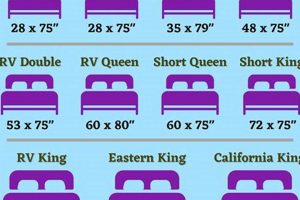
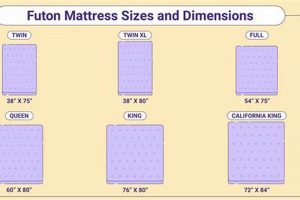
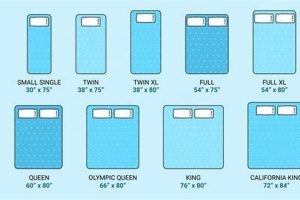
The measurements of a California king mattress define a specific rectangular sleeping surface, typically longer but narrower than a standard king. These measurements are generally 72 inches in width and 84 inches in length. As an example, a bedroom must accommodate these dimensions, plus the bed frame, to comfortably house such a mattress.
This size is particularly well-suited for individuals of greater height, providing extended legroom and preventing discomfort. Historically, the development of this less common mattress size catered to those who found standard king mattresses insufficient in length. The elongated design allows for a more restful sleep experience for taller individuals, contributing to improved sleep quality and overall well-being.
The subsequent sections will delve further into aspects such as comparing these measurements to other mattress sizes, discussing appropriate bedroom size considerations, and exploring the availability of bedding options tailored for this specific mattress type.
Guidance on Utilizing a California King Mattress
The following points offer practical advice regarding the implementation and upkeep of sleeping surfaces of this scale.
Tip 1: Bedroom Space Assessment: Prior to acquisition, thoroughly measure the intended bedroom. A room with minimum dimensions of 12 feet by 14 feet is generally recommended to comfortably accommodate the mattress and allow for adequate movement.
Tip 2: Bed Frame Selection: Choose a bed frame specifically designed for this mattress size. Standard king frames are not interchangeable. Ensure the frame provides sufficient support to prevent sagging and premature wear.
Tip 3: Bedding Procurement: Source sheets, comforters, and other bedding items specifically labeled as “California King.” Standard king-size bedding will not fit properly, leading to discomfort and a less aesthetically pleasing presentation.
Tip 4: Mattress Rotation and Flipping: Rotate the mattress every six months to promote even wear. If the mattress is flippable, alternate between sides. This practice can extend the lifespan of the sleeping surface.
Tip 5: Weight Distribution Considerations: Be mindful of weight distribution. Excessive concentration of weight in one area can lead to localized sagging. Encourage even weight distribution across the mattress surface.
Tip 6: Transportation Planning: The elongated format presents unique transportation challenges. Ensure the vehicle used for transport is adequately sized. Professional moving services may be necessary in certain situations.
Tip 7: Storage Considerations: When storing this mattress, it is critical to keep it flat to prevent long-term deformation. Avoid storing it on its side for an extended period.
Adhering to these guidelines will contribute to the longevity, comfort, and overall satisfaction derived from the mattress.
The next section will discuss the long-term ownership costs associated with mattresses of this specific dimensional category.
1. Overall Length

The overall length is a critical dimension defining a California king mattress. This dimension, typically 84 inches, dictates the space occupied lengthwise by the mattress. Its significance stems from its direct impact on the comfort and suitability of the mattress for individuals of above-average height. A deficiency in this dimension could result in discomfort, disrupted sleep, and potential health implications due to inadequate support for the legs and feet. For instance, an individual measuring 6’4″ would likely find a standard king mattress (80 inches in length) insufficient, whereas the California king’s increased length offers a more accommodating sleeping surface.
The practical application of understanding the overall length extends to bedroom design and furniture selection. Prior to purchasing a California king mattress, accurate measurement of the bedroom space is imperative. Failure to account for the mattress’s length can result in an overcrowded room, impeding movement and diminishing the overall usability of the space. Bed frames designed for this specific mattress size are readily available and must be selected to ensure proper support along the entire 84-inch length, thereby preventing sagging and premature wear. This knowledge allows for optimal spatial planning and product selection when building or redesigning a bedroom.
In summary, the overall length, specifically 84 inches, is a defining feature of the California king mattress, directly influencing user comfort, spatial planning, and furniture compatibility. Overlooking this measurement can lead to discomfort, spatial inefficiencies, and premature degradation of the mattress. The ability to correlate height with mattress length is crucial for ensuring an optimal sleep experience. Challenges in understanding the practical implications of the overall length can be mitigated through careful measurement and consideration of individual height requirements. The overall length ties directly to the user experience and lifespan of the product, making it critical to the overall conversation.
2. Overall Width
The overall width constitutes a fundamental aspect of mattress dimensions, directly influencing the sleeping area available and the suitability for single or dual occupancy. In the context of a California king mattress, the width determines the lateral space afforded to each sleeper, impacting comfort and freedom of movement.
- Individual Sleeper Space
The specified width, typically 72 inches, translates to 36 inches of personal sleeping space per individual when occupied by two people. This dimension provides ample room for most adults to shift and turn without disturbing their partner. Insufficient width would lead to restricted movement, potentially causing discomfort and sleep disruption.
- Bedroom Layout Constraints
The overall width necessitates careful consideration during bedroom layout planning. A bedroom must possess adequate dimensions to accommodate the mattress, bed frame, and associated furniture without impeding traffic flow. Overlooking the width can result in a cramped and functionally compromised living space.
- Bedding Compatibility
The 72-inch width mandates the use of appropriately sized bedding, specifically sheets and comforters labeled as “California King.” Standard king-size bedding will prove inadequate, resulting in poor fit and diminished aesthetic appeal. Accurate width measurements are essential for procuring suitable bedding accessories.
- Weight Distribution
While length is often emphasized for taller individuals, width plays a critical role in distributing weight across the mattress surface. A greater width can offer improved support and reduce pressure points, especially when two individuals are sharing the bed. This aspect contributes to overall sleep quality and mattress longevity.
In summary, the overall width of a California king mattress is a significant parameter that dictates individual sleeper space, impacts bedroom layout, influences bedding compatibility, and contributes to weight distribution. Understanding this dimensional aspect is crucial for making informed purchasing decisions and optimizing the sleep environment.
3. Surface Area

The surface area of a California king mattress is a direct consequence of its specific length and width measurements. This attribute, quantified in square inches or square feet, represents the total available sleeping space. The dimensional specifications, typically 72 inches wide and 84 inches long, yield a specific surface area value. An understanding of this value is important because it dictates the degree of movement freedom and comfort experienced by sleepers, particularly in dual-occupancy scenarios. For instance, a larger surface area allows for greater separation between sleepers, minimizing disturbances caused by movement during the night. This is a practical consideration for individuals sensitive to motion or those with varying sleep schedules.
Moreover, surface area considerations extend beyond mere comfort. The mattress’s ability to accommodate weight distribution is directly related to the available area. A larger surface area can potentially distribute weight more effectively, reducing pressure points and contributing to a more restful sleep experience. This is particularly relevant for individuals with specific musculoskeletal conditions or those requiring specialized support. The selection of appropriate bedding, such as sheets and mattress protectors, is also contingent upon accurate surface area knowledge. Bedding designed for smaller mattress sizes will not adequately cover a California king mattress, leading to discomfort and diminished aesthetic appeal. In the hospitality industry, furnishing suites with California king mattresses requires a precise understanding of the surface area to ensure appropriate linen procurement and room layout design.
In conclusion, the surface area, derived directly from California king mattress dimensions, is a critical parameter influencing comfort, weight distribution, and bedding selection. Its practical significance lies in facilitating informed decisions regarding mattress suitability for individual needs and bedroom space constraints. Failure to account for surface area can result in compromised sleep quality and spatial inefficiencies. A clear understanding of this attribute is therefore essential for maximizing the benefits of a California king mattress.
4. Frame Compatibility

Frame compatibility is intrinsically linked to California king mattress dimensions; the latter dictates the necessary specifications for the former. A bed frame designed for a queen-size mattress, for example, is fundamentally incompatible with the elongated shape of a California king, resulting in inadequate support and potential damage to the mattress. The dimensions of the mattress, typically 72 inches by 84 inches, necessitate a bed frame specifically engineered to accommodate these measurements. Attempting to use an undersized frame will leave portions of the mattress unsupported, leading to sagging, uneven weight distribution, and ultimately, a reduced lifespan for the sleeping surface.
The practical consequences of neglecting frame compatibility are numerous. Beyond the structural integrity of the mattress, an improperly sized frame can pose safety risks. A mattress protruding beyond the frame’s support can create a tripping hazard or lead to instability. Furthermore, incompatible frames often lack the necessary support structures to evenly distribute weight, resulting in localized pressure points and discomfort for the sleeper. Purchasing a bed frame labeled as “California King” is the only way to ensure dimensional precision. Real-world examples include scenarios where individuals, unaware of the specific dimensional requirements, attempt to use existing king-size frames, only to find that the mattress overhangs significantly, creating both aesthetic and functional problems.
In conclusion, frame compatibility is not merely a matter of convenience but a crucial component in maintaining the structural integrity, safety, and longevity of a California king mattress. Precise adherence to dimensional specifications is essential for selecting the appropriate bed frame. The economic and physical repercussions of neglecting this relationship underscore the importance of informed decision-making when acquiring a California king mattress and its corresponding support structure.
5. Sheet Size

The selection of appropriately sized sheets is inextricably linked to the dimensions of a California king mattress. A mismatch between the dimensions of the mattress and the sheets results in functional and aesthetic deficiencies, undermining the comfort and usability of the bedding ensemble.
- Fitted Sheet Depth
Fitted sheet depth is a critical consideration when dealing with a California king mattress. Standard sheet sets may not accommodate mattresses with significant depth, leading to the fitted sheet slipping off the corners. Measurements of mattress depth must be accurately assessed prior to purchasing fitted sheets to ensure a secure and proper fit. For example, a mattress with a 16-inch depth necessitates fitted sheets with a corresponding pocket depth to prevent detachment during sleep.
- Flat Sheet Dimensions
The dimensions of the flat sheet must adequately cover the surface of a California king mattress with sufficient overhang for tucking. Undersized flat sheets will fail to provide adequate coverage, resulting in discomfort and a compromised aesthetic. Manufacturers typically designate flat sheets for California king mattresses with dimensions exceeding those of standard king sheets to accommodate the greater length and width.
- Pillowcase Proportions
While not directly related to the mattress dimensions, pillowcase proportions within a sheet set should complement the overall scale of a California king bed. Standard pillowcases may appear disproportionately small when paired with a larger bed. King-size pillowcases are typically included in California king sheet sets to maintain visual harmony and provide adequate space for larger pillows.
- Material Considerations
Material properties, such as shrinkage after washing, must be considered when selecting sheets for a California king mattress. Natural fibers like cotton may experience shrinkage, potentially rendering sheets too small after laundering. Manufacturers often account for this shrinkage by producing sheets with slightly larger initial dimensions. Synthetic or blended materials may exhibit less shrinkage but possess different textural characteristics. This facet relates to sheet size due to ensuring a proper fit even after care.
The inherent relationship between sheet size and mattress dimensions is a fundamental aspect of bedding selection. Accurate measurements and a thorough understanding of material properties are essential for ensuring a functional and aesthetically pleasing bedding ensemble for a California king mattress.
6. Room Footprint

Room footprint, representing the overall area occupied by furniture within a given space, is inextricably linked to the specific measurements of a California king mattress. These dimensions, nominally 72 inches in width and 84 inches in length, establish the minimum area required to accommodate the mattress and its associated bed frame. A bedroom lacking sufficient room footprint will experience restricted maneuverability, hindering functionality and compromising the aesthetic appeal. The introduction of a California king mattress into an undersized room can create a sense of overcrowding, negatively impacting the overall ambiance and usability of the space.
Real-world examples illustrate this connection. A bedroom measuring 10 feet by 12 feet, totaling 120 square feet, may prove inadequate for a California king bed, frame included, alongside other essential furnishings such as dressers and nightstands. In such scenarios, prioritizing room footprint becomes paramount. Trade-offs may involve selecting smaller ancillary furniture or opting for alternative bed sizes. The practical significance of understanding this relationship lies in preventing costly mistakes and ensuring a harmonious balance between furniture and available space. Accurate measurement and spatial planning are therefore indispensable when considering the acquisition of a California king mattress. Utilizing online room planning tools or consulting with interior design professionals can aid in visualizing the impact of the mattress dimensions on the overall room footprint.
In conclusion, the dimensions of a California king mattress are a primary determinant of the required room footprint. Disregarding this relationship can lead to spatial constraints and a compromised living environment. Understanding and carefully considering the impact of these dimensions on the overall room footprint is essential for ensuring a functional, comfortable, and aesthetically pleasing bedroom design. Overcoming the challenge of accurately assessing room size and furniture placement is crucial for reaping the benefits of a California king mattress without sacrificing spatial efficiency.
Frequently Asked Questions Regarding California King Mattress Dimensions
The following questions and answers address common inquiries and misconceptions pertaining to the precise measurements and related aspects of California king mattresses. This information aims to provide clarity and facilitate informed decision-making.
Question 1: What are the standard dimensions of a California king mattress?
The recognized dimensions are typically 72 inches in width and 84 inches in length. Deviations from these measurements are uncommon but can occur based on manufacturer specifications. Consultation of product documentation is advisable for confirmation.
Question 2: How do California king mattress dimensions compare to those of a standard king mattress?
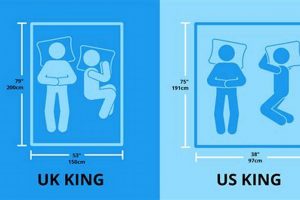
A California king mattress is typically narrower but longer than a standard king mattress. While a standard king measures approximately 76 inches wide and 80 inches long, the California king measures roughly 72 inches wide and 84 inches long.
Question 3: What minimum bedroom size is recommended for a California king mattress?
While personal preferences vary, a bedroom measuring at least 12 feet by 14 feet is generally recommended to comfortably accommodate a California king mattress, bed frame, and additional furniture. Smaller rooms may experience spatial constraints.
Question 4: Will standard king-size sheets fit a California king mattress?
No. Standard king-size sheets are generally not compatible with a California king mattress due to the dimensional differences. Sheets specifically labeled as “California King” are required to ensure proper fit and coverage.
Question 5: What should be considered when transporting a California king mattress due to its size?
The elongated dimensions pose transportation challenges. A vehicle with sufficient cargo space is required. Professional moving services may be necessary in certain instances. Protecting the mattress during transport is also crucial.
Question 6: Do California king mattress dimensions impact the price compared to other mattress sizes?
Generally, mattresses of this size tend to have higher prices owing to the materials used and less demand. Price differences vary considerably across brands and materials. Prices reflect the increase in size.
In summary, the dimensions of a California king mattress necessitate careful consideration of bedroom size, bedding selection, and transportation logistics. A thorough understanding of these aspects is essential for optimizing the ownership experience.
The following section will further examine the long-term ownership costs of California king mattresses.
Conclusion
The preceding exploration of california king mattress dimensions has underscored the importance of understanding these measurements for optimizing sleep quality, bedroom space utilization, and overall comfort. The dimensional specifications, primarily 72 inches by 84 inches, directly influence frame compatibility, bedding selection, and transportation logistics. Neglecting these dimensions can lead to compromised sleep experiences and spatial inefficiencies.
Consequently, informed decision-making regarding mattress purchase and room planning requires a thorough comprehension of california king mattress dimensions. Future developments in sleep technology and mattress design will likely continue to emphasize the significance of tailored dimensions for individual needs, thereby reinforcing the enduring relevance of this fundamental aspect of sleep science. Careful consideration of these specific measurements is essential for maximizing the benefits and mitigating potential drawbacks associated with this mattress size.