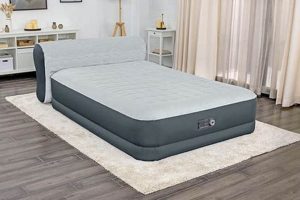
A listing of dimensions for sleeping platforms commonly found within recreational vehicles, or suitable for use in them. This information is essential when replacing existing bedding or planning a custom build within a camper, ensuring the correct fit and comfort.
Accurate dimensional data for recreational vehicle mattresses prevents ill-fitting replacements, maximizing space utilization and sleep quality. This knowledge simplifies the selection process, ensuring compatibility with existing RV layouts and facilitating a more comfortable and efficient camping experience. Historically, standardized sizes have been less prevalent in the RV industry, making precise measurements and dimension guides particularly valuable.
The following sections will detail common recreational vehicle mattress dimensions, explore variations in size based on RV type, and offer guidance on selecting the appropriate mattress for individual needs and camper specifications.
Optimizing Recreational Vehicle Bedding Selection
The subsequent guidance is designed to aid in the selection and procurement of appropriate mattresses for recreational vehicles. Precise measurements and careful consideration of available space are paramount.
Tip 1: Measure Existing Space Accurately: Prior to purchasing any mattress, meticulous measurement of the available sleeping area is essential. Consider any existing contours or obstructions within the space.
Tip 2: Consult Dimensional Guides: Refer to recognized dimensional guides to ascertain standard recreational vehicle mattress dimensions. These guides provide a baseline for comparison and selection.
Tip 3: Consider Mattress Thickness: Account for mattress thickness when assessing overall space constraints. Excessive thickness may impede movement within the recreational vehicle.
Tip 4: Evaluate Weight Considerations: The weight of the mattress should be a factor, particularly in smaller recreational vehicles. Lighter mattresses can improve fuel efficiency and reduce overall vehicle weight.
Tip 5: Prioritize Compatibility: Ensure the selected mattress is compatible with existing bed frames or support structures within the recreational vehicle.
Tip 6: Account for Bedding: When assessing the proper size, account for space that will be taken by bedding. Sheets, blankets, and mattress toppers can all affect the overall fit within the sleeping area.
Tip 7: Document Measurements and Specifications: Maintain a record of all measurements and mattress specifications to facilitate future replacements or upgrades.
Adhering to these recommendations facilitates a more informed purchasing decision, optimizing comfort and space utilization within the recreational vehicle.
The following section will provide a summary of key considerations and offer concluding remarks regarding optimal recreational vehicle bedding selection.
1. Standard Dimensions

Standard dimensions within the context of a recreational vehicle bedding dimensions guide serve as foundational reference points. These pre-defined measurements offer a baseline for manufacturers, consumers, and custom builders, enabling efficient selection and installation of mattresses. The existence of recognized standard dimensions streamlines the replacement process and facilitates compatibility with pre-existing recreational vehicle layouts.
- Queen Short (60″ x 75″)
This size is a common adaptation of the standard queen, shortened to accommodate space limitations in many recreational vehicles. Its prevalence stems from its balance between sleeping area and floor plan efficiency. Selecting a mattress outside of this dimension may require extensive modifications to the existing bed frame or sleeping platform.
- Full (54″ x 75″)
A more compact option, the full-size mattress provides sleeping space for one or two individuals while minimizing its footprint within the camper. This size is frequently utilized in smaller RV models or those with convertible sleeping arrangements. Deviation from these dimensions necessitates custom bedding or alterations to the bed structure.
- Twin (38″ x 75″)
The twin mattress is the narrowest standard option, typically implemented in bunk bed configurations or for single-occupancy sleeping areas. The dimensional constraints of the twin size prioritize efficient space utilization. Attempting to integrate a larger mattress size would almost certainly require structural modifications.
- RV King (72″ x 80″)
This size is wider than a regular king mattress, it provide more space, more comfortable for user to sleep.
These standard dimensions provide a critical framework within the overall recreational vehicle dimensional guide. While custom sizes are prevalent due to the variability in camper layouts, understanding these established measurements allows for more efficient selection and customization, ensuring compatibility and maximizing space utilization within the vehicle.
2. Custom Sizes

The prevalence of individualized layouts in recreational vehicles necessitates the frequent specification of non-standard mattress dimensions. While a dimensional guide provides a framework, a significant proportion of recreational vehicle owners require custom solutions to accommodate unique spatial constraints.
- Irregular Compartment Geometry
Many recreational vehicles feature sleeping areas with non-rectangular shapes, such as tapered corners or wheel well intrusions. Standard-sized mattresses are incompatible with these irregular geometries, necessitating custom fabrication to maximize usable space and ensure a snug fit. For instance, a camper van conversion might incorporate a curved sleeping platform to follow the vehicle’s body lines, requiring a uniquely shaped mattress.
- Optimizing Limited Space
Recreational vehicles often prioritize multi-functional design, resulting in convertible sleeping areas. Custom-sized mattresses allow for efficient utilization of available space, accommodating both sleeping and living configurations. An example of this is a dinette that converts into a bed, requiring a custom mattress to perfectly fit the transformed space, avoiding gaps or overlaps that would compromise comfort.
- Accounting for Built-In Features
Existing cabinetry, appliances, and structural elements within a recreational vehicle can dictate unconventional mattress dimensions. Custom sizing allows the mattress to integrate seamlessly with these fixed features, preserving accessibility and functionality. A common scenario involves a mattress designed to fit around a pre-existing wheel well or storage compartment, maximizing storage capacity while ensuring a comfortable sleeping surface.
- Accommodating Personal Preferences
Beyond spatial constraints, individual comfort preferences may necessitate custom mattress dimensions. Some users may prefer a narrower or shorter mattress to facilitate easier movement within the recreational vehicle or to reduce overall weight. This customization allows individuals to prioritize specific needs, such as ease of access to storage or reduced fuel consumption, while maintaining a comfortable sleeping arrangement.
The ability to specify custom mattress dimensions is, therefore, an integral aspect of recreational vehicle bedding selection. This flexibility allows owners to overcome spatial limitations, integrate with existing features, and personalize their sleeping arrangements to achieve optimal comfort and functionality within their unique recreational vehicle environment.
3. Thickness Variations

Mattress thickness significantly impacts overall comfort and space utilization within a recreational vehicle. Considering thickness in conjunction with dimensional guides is crucial for proper fit and functionality. Selection without regard for thickness may result in restricted movement, compromised storage, or inadequate support.
- Headroom Limitations
Recreational vehicles often have limited vertical space. Excessive mattress thickness can reduce headroom, leading to discomfort and restricted movement within the sleeping area. In pop-up campers or converted vans, every inch of vertical space is valuable. A thicker mattress may necessitate crouching or impede access to overhead storage. For example, a 12-inch mattress in a camper van with a low roof might create an uncomfortably confined space.
- Storage Access
Many recreational vehicle beds are designed with integrated storage underneath. Mattress thickness directly affects the accessibility of this storage. A thicker mattress reduces the vertical clearance, making it difficult to reach items stored below. For instance, a platform bed with drawers might become functionally unusable if the mattress is too thick, preventing the drawers from opening fully.
- Weight Considerations
While dimensions are primary, mattress thickness also correlates with overall weight. Thicker mattresses generally contain more material, increasing the total weight. This is relevant as excessive weight impacts fuel efficiency and can strain the vehicle’s suspension. For smaller recreational vehicles, prioritizing thinner, lighter mattresses is advisable to minimize the impact on vehicle performance. A thick memory foam mattress, while comfortable, may add significant weight compared to a thinner, lighter alternative made of latex or polyfoam.
- Support and Comfort Trade-offs
Thickness is often associated with the level of support and comfort a mattress provides. Thicker mattresses can accommodate multiple layers of different materials, allowing for customized support and pressure relief. However, this does not always guarantee superior comfort, as the quality and density of the materials also play a crucial role. A thinner, high-density foam mattress can sometimes provide better support and comfort than a thicker, lower-density option. Therefore, evaluating the composition and construction, alongside thickness, is essential.
The interplay between mattress dimensions and thickness is a critical consideration. A comprehensive dimensional guide should include recommendations for optimal thickness ranges, based on specific recreational vehicle types and individual needs. Failure to account for thickness variations can negate the benefits of accurate dimensional measurements, resulting in a poorly fitting and uncomfortable sleeping arrangement.
4. Bed Frame Compatibility

Bed frame compatibility is intrinsically linked to recreational vehicle bedding dimensions. The dimensions provided in a bed chart are only useful if the selected mattress can properly interface with the existing or planned bed frame structure. Incompatibility can lead to inadequate support, premature mattress wear, and potential safety hazards. The framework, whether a simple platform, a complex adjustable system, or part of a convertible dinette, must be precisely matched to the mattress for optimal function.
Consider a scenario where a recreational vehicle owner attempts to install a mattress designed for a standard residential queen-sized bed (60″ x 80″) onto a frame intended for a short queen (60″ x 75″). The excess length of the mattress would create an overhang, compromising support and potentially interfering with surrounding fixtures or walkways. Conversely, installing a short queen mattress on a standard queen frame would result in a gap, leading to uneven support and a potential tripping hazard. These examples highlight the need for precise adherence to a dimension guide to guarantee proper integration of the mattress with the frame.
Accurate assessment of existing frame dimensions, or careful planning of frame construction based on intended mattress size, is, therefore, paramount. While custom mattress dimensions can address unique layout challenges, the frame must be constructed or adapted to accommodate those specific measurements. Ultimately, bed frame compatibility is not merely a secondary consideration but a fundamental component of a successful recreational vehicle bedding solution, impacting comfort, safety, and the overall functionality of the living space. The information provided in a dimensional guide becomes actionable only when applied in conjunction with careful consideration of bed frame dimensions and construction.
5. Weight Restrictions

Adherence to prescribed weight restrictions constitutes an essential, though often overlooked, component of any recreational vehicle dimensional data set. Exceeding a recreational vehicle’s designated weight capacity can precipitate mechanical failures, compromise handling characteristics, and increase the risk of accidents. The selection of bedding directly influences overall vehicle weight; therefore, dimensional guides must incorporate considerations pertaining to material density and total mattress mass. Failure to account for this factor can negate the benefits of precise dimensional measurements, substituting a properly sized but excessively heavy mattress that undermines vehicle performance.
For example, a recreational vehicle dimensional guide might specify a short queen mattress size of 60″ x 75″ for a particular model. However, this specification is incomplete without acknowledging the associated weight limitations. A memory foam mattress of this size may significantly exceed the permissible weight compared to a lighter latex or innerspring alternative. The dimensional guide, therefore, necessitates the inclusion of weight ranges or specific material recommendations to ensure compliance with vehicle load capacities. In practical terms, disregarding these weight limitations could lead to overloaded axles, compromised braking performance, and increased fuel consumption. A smaller camper van conversion, in particular, is highly sensitive to weight increases, making careful mattress selection, guided by a comprehensive dimensional data, especially important.
In summary, weight restrictions are not merely an ancillary consideration but an integral aspect of any reliable recreational vehicle bedding dimensional guide. A comprehensive guide must provide dimensional specifications alongside appropriate weight ranges and material recommendations to facilitate informed decision-making and prevent overloading, thereby ensuring safe and efficient vehicle operation. Ignoring this crucial interconnection can compromise vehicle performance and safety, underscoring the importance of considering weight alongside size when selecting recreational vehicle bedding.
Frequently Asked Questions
The following questions address common inquiries regarding the application and interpretation of recreational vehicle bedding dimensions.
Question 1: What is the purpose of a camper mattress size chart?
The primary purpose is to provide standardized dimensional information for mattresses used in recreational vehicles. This information facilitates the selection of appropriately sized mattresses for replacement or custom builds, ensuring a proper fit within the designated sleeping area.
Question 2: Are camper mattress sizes standardized?
While some dimensions are considered standard (e.g., short queen), significant variation exists due to the diverse layouts of recreational vehicles. Custom sizes are frequently required to accommodate unique spatial constraints.
Question 3: How does mattress thickness affect the suitability of a mattress for a camper?
Mattress thickness impacts headroom, storage access, and overall weight. Excessive thickness can restrict movement, impede storage utilization, and contribute to exceeding vehicle weight limits.
Question 4: What factors should be considered when selecting a custom-sized camper mattress?
Consider the irregular shape of the sleeping area, the need to optimize limited space, the presence of built-in features, and individual comfort preferences. Accurate measurements are paramount when ordering a custom mattress.
Question 5: Why is bed frame compatibility important when choosing a camper mattress?
A compatible bed frame ensures proper support for the mattress, preventing premature wear and potential safety hazards. The dimensions of the mattress must align with the dimensions of the frame.
Question 6: How do weight restrictions relate to camper mattress selection?
Mattress weight contributes to the overall vehicle weight. Exceeding weight limits can compromise vehicle handling and fuel efficiency. Consider the material composition and density of the mattress to minimize weight.
In summary, the “camper mattress size chart” provides essential information, but careful consideration of thickness, frame compatibility, custom needs, and weight restrictions is crucial for optimal selection.
The next section will address resources for finding specific mattress dimensions and manufacturers specializing in recreational vehicle bedding.
Concluding Remarks
The preceding discussion has elucidated the complexities associated with recreational vehicle bedding dimensions. A thorough understanding of a “camper mattress size chart,” along with its inherent limitations, is crucial for optimizing comfort, functionality, and safety within the confined spaces of recreational vehicles. Consideration of standard sizes, custom requirements, thickness variations, bed frame compatibility, and weight restrictions is essential for informed decision-making.
Accurate dimensional data, coupled with careful planning, facilitates the selection of bedding that maximizes space utilization, promotes restful sleep, and minimizes the risk of mechanical or structural compromise. Future advancements in recreational vehicle design may necessitate further refinements to dimensional standards and necessitate ongoing vigilance in adhering to specified weight limitations. Therefore, continuous reference to and proper application of “camper mattress size chart” data remains paramount for all stakeholders within the recreational vehicle industry and community.

![Futon Mattress Size: Find Your Perfect Fit [Guide] | Organic & Natural Mattress Buyer’s Guide: Non-Toxic Sleep Solutions](https://mattressworldpa.com/wp-content/uploads/2025/07/th-2346-300x200.jpg "Futon Mattress Size: Find Your Perfect Fit [Guide] Organic & Natural Mattress Buyer’s Guide: Non-Toxic Sleep Solutions")