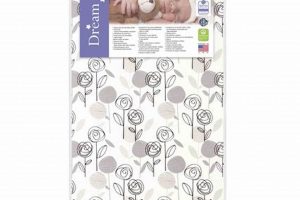
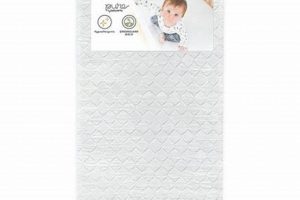
A table detailing dimensions for infant bedding platforms is a crucial resource for caregivers. These guides specify the length, width, and sometimes thickness requirements for mattresses intended to fit securely within standardized baby beds, preventing gaps that could pose safety hazards. For instance, a standard-size option is required to measure 28 inches wide and 52 inches long.
Adherence to these dimensional guidelines is paramount for infant safety, ensuring a snug fit that minimizes the risk of entrapment. These standardized measurements emerged from concerns regarding infant safety and have become integral to the manufacturing and retail of infant bedding. Utilizing available resources ensures compliance with safety standards and best practices.
The subsequent sections will delve into specific standardized dimensions, the various mattress types available, and critical considerations when selecting the appropriate option for an infant’s sleeping environment.
Considerations for Optimal Crib Mattress Selection
Selecting an appropriate infant sleeping surface necessitates careful attention to detail. The following points underscore critical factors for informed decision-making, ensuring safety and comfort.
Tip 1: Verify Dimensional Accuracy: Prior to purchase, meticulously confirm that the intended mattress conforms precisely to the specific baby beds interior dimensions. Discrepancies can lead to hazardous gaps.
Tip 2: Prioritize Firmness: A firm sleeping surface is medically recommended to mitigate the risk of sudden infant death syndrome (SIDS). Avoid overly soft materials that conform excessively to the infant’s face.
Tip 3: Scrutinize Material Composition: Evaluate the mattress core and cover materials for potential allergens, toxins, and volatile organic compounds (VOCs). Opt for certified organic or hypoallergenic options when possible.
Tip 4: Evaluate Edge Support: Robust perimeter support is crucial, particularly as infants begin to stand. Weak edges may compress, creating potential entrapment points.
Tip 5: Assess Cover Waterproofing: A waterproof or water-resistant cover is essential for hygiene and facilitates easy cleaning. Look for durable, non-toxic waterproofing materials.
Tip 6: Review Safety Certifications: Ensure the mattress meets or exceeds established safety standards, such as those set by the Consumer Product Safety Commission (CPSC). Verification of certifications provides assurance of product safety.
Tip 7: Inspect Seam Integrity: Assess the quality of the mattress seams. Weak or poorly constructed seams may unravel over time, creating a potential hazard.
Adhering to these considerations fosters a safer and more comfortable sleep environment for infants, minimizing potential risks associated with inadequate bedding choices.
The subsequent conclusion will consolidate key information and reiterate the importance of informed decision-making in infant bedding selection.
1. Standard dimensions

The concept of standardized measurements forms the bedrock upon which tables specifying measurements for infant beds are constructed. These guides are predicated on the requirement for a universally recognized set of dimensions. Without such standardization, these reference guides would be rendered meaningless, as bedding platforms would vary arbitrarily, preventing the creation of any consistent correlation between mattress and bed frame sizes. A real-world example underscores this: a manufacturer producing mattresses to non-standard dimensions would render the available reference tables ineffective for consumers attempting to find a correctly sized sleeping surface for their infant beds. Standard dimensions are thus a foundational component.
The practical application of these guides hinges on the adherence of mattress manufacturers to the established standards. If manufacturers deviate from the specified length and width, the information contained within the reference charts loses its utility. Retailers rely on the assumption that items listed as ‘standard’ are in fact compliant, while parents are assured the product fits their bed, allowing for safe use.
In summary, standardized sizes are not merely a feature of reference material; they are a prerequisite for its existence and utility. The challenges surrounding non-compliant items highlight the importance of rigorous quality control and consumer awareness. The efficacy of such tables is directly proportional to the industry’s commitment to adhering to established standardized sizes.
2. Thickness requirements
Thickness requirements, as delineated within guides for infant bedding platforms, are integral, though sometimes overlooked, elements. While length and width ensure proper fit within the frame, thickness contributes directly to infant safety and support. Insufficient thickness may compromise spinal alignment, potentially leading to discomfort or developmental issues. Conversely, excessive thickness could elevate the sleeping surface, increasing the risk of a child climbing out, or impeding visibility.
These specifications are not arbitrary; they are often determined through rigorous testing and evaluation by regulatory bodies and industry experts. A real-world example involves the revision of thickness guidelines based on emerging data regarding SIDS and infant suffocation. As research evolves, these parameters may be adjusted to reflect current best practices. Understanding these requirements is crucial, because a mattress deemed dimensionally compliant but failing to meet thickness requirements may still pose a potential safety hazard.
In conclusion, the consideration of depth is equally as important as length and width. Strict adherence to these guidelines is paramount for optimal safety. Reference charts listing compliant mattresses serve as valuable resources for navigating this complexity, ensuring a secure sleep environment for infants while mitigating associated risks.
3. Safety guidelines

Established “Safety guidelines” are fundamentally intertwined with the specifications detailed in bedding platform guides. These guidelines serve as the regulatory framework that dictates acceptable parameters, ensuring infant safety. The dimensional aspects outlined in size guides are directly informed by these safety mandates.
- Dimensional Compliance and Entrapment Prevention
Safety regulations stipulate precise dimensional standards to minimize the risk of infant entrapment between the mattress and the bed frame. For instance, guidelines may mandate a maximum gap allowance to prevent infants from becoming wedged, leading to potential suffocation hazards. Failure to adhere to these dimensions, as outlined in the applicable size guide, constitutes a safety violation with potentially severe consequences.
- Material Composition and Toxicity
Safety directives often impose stringent requirements on the materials used in infant bedding construction. These mandates aim to eliminate or minimize exposure to toxic substances, such as phthalates and flame retardants. The size guide may reference compliance with these material safety standards, ensuring consumers are aware of the compositional safety of the selected item. An example is certifications like Greenguard Gold, which indicate low chemical emissions.
- Firmness Standards and SIDS Reduction
Research has established a correlation between mattress firmness and a reduced risk of Sudden Infant Death Syndrome (SIDS). Safety protocols therefore mandate specific firmness levels for mattresses. The size guide may include information related to firmness testing and compliance with relevant safety regulations. A mattress that is too soft may create an unsafe sleep surface.
- Durability and Structural Integrity
Safety guidelines require that these mattresses maintain their structural integrity over time. The size guides provide information that ensures that the mattress is durable and reliable over time. It maintains its shape, firmness and its non-toxic build quality.
In conclusion, “Safety guidelines” are not merely ancillary recommendations; they are the foundational principles that inform the creation and utilization of infant bedding guides. Adherence to these guidelines, as verified through dimensional specifications and material compliance information, is paramount for ensuring a secure and healthy sleep environment for infants.
4. Material compliance

Material compliance, in the context of the infant bedding platforms and related guides, denotes adherence to established regulations and standards governing the composition of mattress components. This is not merely an ancillary consideration but a fundamental aspect of safety, directly impacting infant health and well-being. It ensures that materials used do not pose undue risks of toxicity or allergen exposure.
- Adherence to Chemical Emission Standards
Mattress composition frequently involves synthetic materials that can emit volatile organic compounds (VOCs). Material compliance mandates adherence to stringent emission standards, such as those established by Greenguard Gold certification, to minimize infant exposure to potentially harmful airborne chemicals. This ensures that mattresses, while meeting dimensional specifications outlined in the reference guides, also maintain acceptable indoor air quality.
- Restriction of Phthalates and Heavy Metals
Regulations restrict the use of phthalates and heavy metals in infant products due to their potential endocrine-disrupting and neurotoxic effects. Material compliance necessitates rigorous testing and certification to confirm the absence or minimal presence of these substances. Ensuring that a mattress, selected using available charts, meets these criteria safeguards the infant from harmful chemical exposure.
- Flame Retardant Compliance
While flame retardants are often incorporated to meet flammability standards, certain chemicals used for this purpose have been linked to adverse health effects. Material compliance dictates the use of flame retardant alternatives that are considered safer for infants. Reference charts listing compliant mattresses typically indicate adherence to these revised safety protocols, guiding consumers toward safer options.
- Allergen Mitigation
Certain mattress materials, such as latex or certain synthetic fibers, may trigger allergic reactions in susceptible infants. Material compliance may involve the use of hypoallergenic materials and manufacturing processes to minimize allergen exposure. Specifying hypoallergenic properties ensures consumers can confidently select mattresses from reference guides that mitigate the risk of allergic reactions.
The above facets underscore the critical connection between material composition and infant health. Material compliance is a foundational element for safety. Mattress reference charts must indicate adherence to stringent material regulations and certifications, empowering consumers to make informed choices that prioritize infant well-being. The interplay of size and composition ensures a comprehensive approach to safety in infant bedding.
5. Weight considerations

Weight considerations, while not explicitly dimensional, are inherently linked to specifications delineated in guides to infant bedding platforms. These guides, primarily focused on length, width, and thickness, indirectly address weight through material selection and construction techniques. The underlying principle is that the mattress must adequately support the infant’s weight without sagging or compromising the sleeping surface, which could lead to unsafe sleeping conditions. For instance, a mattress constructed with low-density foam may meet dimensional standards but fail to provide adequate support for a heavier infant, increasing the risk of suffocation or positional asphyxia. These guides implicitly direct manufacturers to select materials and construction methods appropriate for the intended weight range of infants using standard-size cribs.
The practical application of weight considerations manifests in the choice of materials. Manufacturers often specify weight limits for products, advising caregivers when to transition to alternative bedding solutions. For example, a guide may indicate a specific type of innerspring mattress suitable for infants up to 30 pounds. Exceeding this weight limit could void warranties, but more critically, it could compromise the structural integrity of the mattress, rendering it less effective at maintaining a firm, flat sleep surface. Therefore, while a chart primarily illustrates dimensional compatibility, it also subtly informs on weight-related performance characteristics and safety implications.
In summary, although weight is not a directly measured dimension in crib guides, it is intrinsically related to the materials and construction methods used to achieve those dimensions safely. Overlooking weight recommendations jeopardizes the safety and effectiveness of the selected sleeping surface. Understanding the implied weight considerations of reference guides empowers caregivers to make informed decisions and ensures the infant sleeps safely and comfortably within specified weight parameters, which contributes to a better safety level.
6. Crib compatibility

The concept of crib compatibility is intrinsically linked to standard guides for infant bedding platforms. Adherence to dimensional specifications ensures that mattresses fit safely and securely within prescribed crib frames. Deviations from these standards can lead to hazardous gaps or improperly supported sleeping surfaces.
- Standard Dimensions and Fit
Crib compatibility begins with adherence to standard crib dimensions, typically 28 inches by 52 inches for full-size beds. Mattresses conforming to these dimensions, as specified in size charts, are designed to fit snugly within compatible crib frames. A real-world example includes a mattress that is too small, leading to gaps between the mattress edge and the crib side, increasing the risk of infant entrapment.
- Crib Type Variations
While standard dimensions are common, variations exist among different crib types, such as mini-cribs or convertible options. Reference charts often delineate dimensions specific to these variations. For instance, a mini-crib mattress must adhere to smaller dimensional requirements than a standard-size one. Ignoring these variations compromises compatibility and safety.
- Mattress Thickness Considerations
Crib compatibility extends to thickness, as excessively thick mattresses can reduce the height of the crib side rail, increasing the risk of a child climbing out. Size charts may provide guidance on maximum permissible mattress thickness for particular models, often related to safety guidelines that must be met.
- Secure Fit and Safety Standards
The ultimate goal of crib compatibility is to ensure a secure fit that meets or exceeds safety standards. A snug fit minimizes the risk of entrapment, suffocation, and falls. Compliance with size charts is not merely about physical fit; it is about ensuring a safe and regulated sleep environment. Independent testing labs evaluate product dimensions and their compliance to federal safety standards.
In conclusion, crib compatibility, guided by reference tables and manufacturer specifications, serves as a cornerstone of infant safety. Attention to dimensional details, understanding crib type variations, adherence to thickness limitations, and a commitment to a secure fit are essential for ensuring a safe sleep environment. These elements, when properly understood and implemented, contribute to a compliant and secure infant bedding setup.
7. Gaps minimization
Gaps minimization is a fundamental principle directly influencing the design and utilization of infant bedding specifications. The specifications detailed within the chart are, in essence, a means to achieve the end goal of negligible space between the mattress and bed frame. These charts offer dimensional information, allowing caregivers to select a mattress that corresponds precisely to the interior dimensions of the crib, thereby precluding the existence of potentially hazardous spaces. The consequences of ignoring the specifications can be severe, creating openings where an infant may become entrapped, leading to injury or, in extreme instances, suffocation. Therefore, adherence to recommendations, as illustrated in the guide, is not merely a matter of preference but a critical safety consideration.
The practical significance of minimizing gaps becomes evident when considering the potential movement of an infant within the crib environment. Even slight positional shifts during sleep can place a child at risk if a sufficient void exists. For instance, if an infant rolls towards the perimeter of the crib and a gap is present, the infant’s limb could become lodged, restricting movement or causing distress. Similarly, larger openings present an even greater danger, permitting the entire body to slip into the space. Mattress manufacturing focuses on dimension to fill the crib and minimize the gaps.
In conclusion, gaps minimization is an integral aspect of the size guides. These charts provide caregivers with the information necessary to select bedding that mitigates safety concerns. The effectiveness of this resource is directly proportional to adherence to dimensional specifications, underscoring the importance of meticulous measurement and informed selection when choosing an infant bedding platform. Failure to observe these guidelines introduces unnecessary risk, jeopardizing the infant’s well-being within a seemingly secure environment.
Frequently Asked Questions
The following addresses prevalent inquiries regarding dimensional guides for infant beds, offering clarification on crucial aspects related to infant safety and bedding selection.
Question 1: What constitutes a “standard-size” specification for crib mattresses?
The designation “standard-size” typically refers to mattresses measuring approximately 28 inches in width and 52 inches in length. These dimensions are designed to fit within full-size infant beds manufactured to meet established safety regulations.
Question 2: Why is adherence to dimensional standards critical when selecting an infant bedding surface?
Compliance with specified dimensions is paramount to prevent hazardous gaps between the mattress and the bed frame. These gaps pose a risk of infant entrapment, potentially leading to suffocation or injury.
Question 3: Are there different size specifications for mini-cribs versus standard-size options?
Yes, mini-cribs typically require smaller mattresses than standard-size beds. Specifications for mini-crib options vary but generally measure around 24 inches in width and 38 inches in length. Always consult manufacturer specifications.
Question 4: What is the recommended thickness for a safe infant sleeping surface?
The recommended depth typically ranges from 4 to 6 inches, but verifying the bed manufacturer’s guidance is essential. Overly thick mattresses can reduce the height of the bed’s side rail, increasing the risk of a child climbing out.
Question 5: Do all mattresses adhere to established safety standards?
No, not all mattresses meet established safety standards. Verifying that the selected option meets or exceeds guidelines set forth by organizations such as the Consumer Product Safety Commission (CPSC) is crucial.
Question 6: Where can reliable specifications be found for infant bedding dimensions?
Reliable sources include manufacturer specifications, product labeling, and certification bodies such as the Juvenile Products Manufacturers Association (JPMA). Consulting multiple sources is advisable to ensure accuracy.
Key takeaways emphasize strict adherence to size guidelines for infant safety. Disregarding these standards elevates the risk of potential harm to the infant.
The following section provides a conclusion summarizing key aspects and reiterating the importance of informed decision-making.
Crib Mattress Size Chart
This exploration of the crib mattress size chart has illuminated its critical role in infant safety. The dimensions detailed within these guides, including length, width, and thickness, are not arbitrary measurements but rather safeguards against potential hazards. Adherence to these specifications minimizes gaps that could lead to entrapment or suffocation. Furthermore, weight considerations and material compliance contribute to a secure and healthy sleeping environment.
The availability of crib mattress size chart underscores a collective responsibility to prioritize infant well-being. The implications of neglecting these resources can be profound. Continued vigilance and adherence to established standards are paramount in creating a safe sleep environment for infants. The future of infant safety relies on the informed choices of caregivers and the continued commitment of manufacturers to uphold dimensional and material compliance.


![Best Organic Crib Mattress Protector [Safe Sleep] | Organic & Natural Mattress Buyer’s Guide: Non-Toxic Sleep Solutions](https://mattressworldpa.com/wp-content/uploads/2025/07/th-1363-300x200.jpg "Best Organic Crib Mattress Protector [Safe Sleep] Organic & Natural Mattress Buyer’s Guide: Non-Toxic Sleep Solutions")