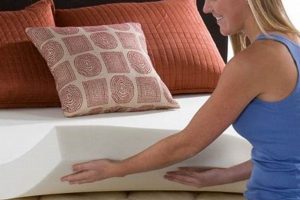
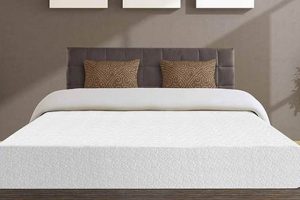
The alteration of a viscoelastic polyurethane foam sleeping surface through slicing or sectioning is a process undertaken for various reasons. This modification typically involves using a sharp instrument to resize or reshape the mattress. Examples include reducing a larger mattress to fit a smaller bed frame, creating custom shapes for specific needs, or removing damaged sections.
Modifying a foam mattress can offer significant advantages, such as cost savings by avoiding the purchase of a new mattress, adapting the mattress to unique bed dimensions, or salvaging a partially damaged product. Historically, this practice has allowed individuals to tailor comfort and functionality to their specific requirements, extending the lifespan and utility of the original item.
The following sections will detail the tools and techniques involved, safety considerations during the process, and tips for achieving a professional finish when resizing or repairing viscoelastic polyurethane foam bedding.
Tips for Modifying Viscoelastic Polyurethane Foam Mattresses
Achieving a satisfactory outcome when altering a viscoelastic polyurethane foam mattress necessitates careful planning and execution. The following tips provide guidance for a successful modification.
Tip 1: Secure Accurate Measurements: Prior to any physical alteration, precise measurements of the target dimensions are crucial. Double-check all figures to minimize errors and waste.
Tip 2: Employ Appropriate Tools: A long, sharp knife, preferably an electric carving knife or a specialized foam cutter, yields the cleanest results. Dull blades will tear the foam, creating an uneven edge.
Tip 3: Ensure Adequate Support: Place the mattress on a flat, stable surface during the modification process. This ensures consistent pressure and prevents warping during the sectioning.
Tip 4: Utilize a Cutting Guide: A straight edge, such as a metal ruler or a wooden board, serves as a valuable guide for maintaining a consistent line. Secure the guide firmly to prevent slippage.
Tip 5: Apply Controlled Pressure: Avoid forcing the cutting tool. Instead, use a steady, sawing motion with light pressure to gradually section the foam. This reduces the risk of tearing and ensures a cleaner cut.
Tip 6: Address Imperfections: Minor irregularities can be corrected with a sharp pair of scissors or a rotary cutter. Focus on achieving a smooth, even surface along the newly sectioned edge.
Tip 7: Consider Protective Measures: When modifying a foam mattress, loose particles may be generated. Wearing a dust mask and eye protection is recommended to minimize irritation and potential health hazards.
Successful mattress modification depends on meticulous attention to detail and the application of proper techniques. Adhering to these tips will contribute to a more professional and satisfactory result.
The following sections will address safety considerations and advanced techniques to further refine the process of altering viscoelastic polyurethane foam mattresses.
1. Sharpness of Cutting Tool

The efficacy of modifying a viscoelastic polyurethane foam mattress is inextricably linked to the sharpness of the employed cutting instrument. A honed edge on the tool serves as the primary determinant of a clean, precise section, directly influencing the final quality of the altered product. Conversely, a dull blade increases the force required to penetrate the foam, resulting in tearing, compression, and an irregular surface. This irregular surface compromises the mattress’s structural integrity and aesthetic appeal.
Examples abound in demonstrating the importance of a sharp cutting tool. Consider a scenario where a homeowner attempts to resize a foam mattress using a standard kitchen knife lacking adequate sharpness. The resulting cut is likely to be jagged, uneven, and may even damage the surrounding foam structure. In contrast, a professional upholstery shop employing an electric carving knife with a razor-sharp blade can achieve a smooth, consistent section, minimizing material waste and preserving the mattress’s overall integrity. This difference underscores the practical significance of proper tool selection.
In conclusion, the sharpness of the cutting tool is not merely a peripheral consideration but a core requirement for effectively altering viscoelastic polyurethane foam mattresses. Employing a sharp implement mitigates the risk of damage, promotes accuracy, and ultimately contributes to a superior finished product. The inherent challenge lies in maintaining the tool’s sharpness throughout the modification process, potentially necessitating frequent honing or blade replacement. This understanding is vital for anyone undertaking such a project, linking directly to the broader theme of precision and quality in mattress modification.
2. Measurement Accuracy

Measurement accuracy is a non-negotiable prerequisite for successful alteration of viscoelastic polyurethane foam mattresses. It establishes the foundation for all subsequent actions in the modification process, directly impacting the final dimensions, shape, and usability of the mattress. Errors introduced during measurement propagate through the sectioning phase, leading to irreversible discrepancies and potential material waste. A direct cause-and-effect relationship exists: imprecise measurements yield an inaccurately modified mattress, which may be unusable for its intended purpose.
Consider, for instance, an individual attempting to resize a mattress to fit a non-standard bed frame. If the initial measurements are inaccurate by even a small margin, the resulting mattress may be either too large, requiring further modification and potential compromise of its structure, or too small, rendering it unsuitable for the frame. The practical significance of this extends beyond mere inconvenience; inaccuracies can lead to discomfort, reduced sleep quality, and ultimately, the need for a replacement mattress. Professional mattress modification services prioritize precision measurement using calibrated tools to mitigate these risks and ensure a tailored fit.
In summary, measurement accuracy serves as the cornerstone of any mattress modification endeavor. Challenges associated with imprecise measurements include material wastage, structural compromise, and a reduction in the overall functionality of the modified mattress. Recognizing the centrality of accurate measurement is essential for achieving a desirable outcome and aligning with the broader theme of precision and quality in mattress alterations.
3. Edge Finishing
Edge finishing, in the context of altering viscoelastic polyurethane foam mattresses, represents the terminal stage of the modification process. It directly follows the physical sectioning of the foam and encompasses the techniques employed to refine and smooth the newly created edge. The quality of edge finishing is a critical determinant of the mattress’s overall aesthetic appeal, durability, and user comfort. A poorly finished edge can exhibit roughness, unevenness, or jaggedness, which detracts from the product’s appearance, compromises structural integrity over time, and may even cause discomfort or irritation upon contact. The correlation between meticulous sectioning and careful edge treatment is that the section provides the raw material and shape, while the edging is refining and ensuring the shape is usable and safe.
For example, consider two scenarios: In the first, a viscoelastic polyurethane foam mattress is cut to fit a custom-built bed frame, but the resulting edges are left unfinished. Over time, these edges may begin to crumble, releasing foam particles and compromising the mattress’s structural integrity. Furthermore, the rough edges may irritate the skin. In contrast, a mattress that has undergone meticulous sectioning followed by professional edge finishing, involving techniques such as shaving, sanding, or the application of edge banding, presents a clean, uniform appearance, exhibits enhanced durability, and offers a more comfortable sleeping surface. The practical application of this understanding extends to both DIY mattress modification and professional upholstery services. Edge finishing will influence the customer’s satisfaction when DIY or with a professional upholstery.
In summary, edge finishing is an indispensable component of viscoelastic polyurethane foam mattress modification. Its execution directly impacts the product’s aesthetic appeal, structural integrity, and usability. Overlooking this final stage can negate the benefits of precise sectioning and result in a substandard outcome. Addressing challenges in achieving a superior edge finish, such as uneven foam density or complex mattress shapes, often requires specialized tools and techniques. Understanding its significance is essential for achieving a desirable and long-lasting result.
4. Foam Density

Foam density is a critical parameter influencing the behavior and outcome of altering viscoelastic polyurethane foam mattresses. It directly affects the resistance encountered during sectioning, the cleanliness of the resulting edges, and the overall structural integrity of the modified piece. A nuanced understanding of foam density is, therefore, essential for successful mattress modification.
- Cutting Resistance
Higher density foams present greater resistance to cutting tools. More force is required to achieve penetration, increasing the likelihood of tearing or uneven sectioning if the appropriate cutting tool is not selected or if insufficient sharpness is present. Lower density foams, conversely, offer less resistance but may be more prone to compression or distortion during the sectioning process. An example of high resistance may be a section of high-density viscoelastic foam mattress.
- Edge Finish Quality
Foam density also influences the quality of the finished edge. High-density foams, when properly cut, tend to exhibit cleaner, more defined edges. Lower density foams may be more prone to crumbling or leaving behind loose particles, necessitating additional finishing work to achieve a smooth and uniform surface. For example, an uneven cut could cause loose particles and compromise the integrity of the edge finish.
- Structural Integrity
The density of the foam impacts the modified mattress’s overall structural integrity. Removing a substantial section from a low-density mattress can significantly reduce its support and durability. Conversely, a high-density mattress, while offering greater inherent support, may require more careful consideration of weight distribution after sectioning to maintain balanced performance. If weight is poorly distributed, that can affect structure.
- Tool Selection
The choice of cutting tool is directly affected by foam density. High-density foams may necessitate the use of specialized tools, such as electric carving knives or rotary cutters, to achieve a clean and efficient section. Lower density foams may be adequately sectioned with simpler tools, but care must be taken to avoid compression or distortion. The density of the foam will influence what tool will work.
In summary, foam density exerts a significant influence on multiple facets of modifying viscoelastic polyurethane foam mattresses, from the ease of sectioning to the quality of the finished product and the maintenance of structural integrity. An awareness of these interdependencies is crucial for achieving a satisfactory and durable result when undertaking such alterations.
5. Support Structure

The support structure directly impacts the process of modifying viscoelastic polyurethane foam mattresses. Its influence is twofold: first, in providing a stable base during sectioning, and second, in affecting the mattress’s overall performance post-modification. A lack of adequate support during sectioning can lead to uneven cuts and structural compromise. Furthermore, alterations can disrupt the original support system, requiring careful consideration to maintain the mattress’s intended comfort and ergonomic properties. An example includes attempting to section a memory foam mattress while it rests on an uneven surface; the resulting cuts are likely to be angled or distorted, affecting its usability and feel. The support structure can also mean the presence of springs or other components in the mattress.
The practical significance of understanding this connection lies in mitigating potential negative consequences of mattress modification. For instance, when resizing a memory foam mattress, reinforcing the edges with additional foam or a specialized border can help to compensate for any loss of structural integrity caused by the sectioning. Similarly, utilizing a firm, flat surface as a cutting platform ensures greater accuracy and control during the modification process, minimizing the risk of uneven or angled cuts. Failure to account for these considerations can result in a mattress that is either uncomfortable or prone to premature wear.
In summary, the support structure is an integral component of the mattress modification process. Addressing its role both during and after sectioning is crucial for achieving a satisfactory outcome. Challenges may arise in accurately assessing the impact of modifications on the support structure and implementing appropriate compensatory measures. Recognizing this relationship is fundamental to maintaining the desired comfort and durability characteristics of a viscoelastic polyurethane foam mattress following alteration.
Frequently Asked Questions About Modifying Viscoelastic Polyurethane Foam Mattresses
The following addresses common inquiries related to the process of altering viscoelastic polyurethane foam mattresses. These questions are designed to provide clarity and guidance for individuals considering such modifications.
Question 1: What is the primary purpose for modifying a viscoelastic polyurethane foam mattress?
The modification of a viscoelastic polyurethane foam mattress is typically undertaken to resize the mattress to fit a specific bed frame, to customize its shape for unique needs, or to remove damaged sections.
Question 2: What tools are essential for achieving a clean and precise section when modifying a foam mattress?
Essential tools include a long, sharp knifepreferably an electric carving knife or a specialized foam cutterand a straight edge guide for maintaining a consistent line. A stable, flat work surface is also necessary.
Question 3: What safety precautions should be observed when modifying a viscoelastic polyurethane foam mattress?
Safety precautions include wearing a dust mask and eye protection to minimize irritation from airborne particles. Adequate ventilation is also recommended.
Question 4: How does foam density influence the modification process?
Foam density affects the resistance encountered during sectioning and the quality of the resulting edge. Higher density foams require sharper tools and more controlled pressure.
Question 5: What measures can be taken to ensure the structural integrity of the mattress post-modification?
Reinforcing the edges with additional foam or a specialized border can help compensate for any loss of structural integrity caused by sectioning. Maintaining a balanced weight distribution is also important.
Question 6: How does measurement accuracy impact the outcome of a mattress modification project?
Measurement accuracy is crucial. Imprecise measurements can lead to an inaccurately modified mattress, which may be unusable or require further alteration, compromising its structure and comfort.
These frequently asked questions highlight the key considerations involved in modifying viscoelastic polyurethane foam mattresses. Careful planning, appropriate tool selection, and adherence to safety guidelines are paramount for a successful outcome.
The subsequent section will explore advanced techniques and specialized tools used in professional mattress modification services.
Concluding Remarks on Altering Viscoelastic Polyurethane Foam Mattresses
This exposition has detailed the complexities associated with cutting memory foam mattress material, examining the influence of tool sharpness, measurement accuracy, edge finishing techniques, foam density variations, and the importance of a stable support structure. The preceding discussion underscored the critical interdependencies between these factors and their combined impact on the quality and durability of the modified end product.
The information presented herein serves to equip individuals and professionals with a foundational understanding of the key considerations involved in viscoelastic polyurethane foam mattress modification. Prudent application of these principles is essential for achieving a satisfactory and long-lasting result, and for minimizing potential risks to both the mattress’s integrity and the user’s comfort. The successful implementation of these guidelines ensures proper sleep and proper usage of viscoelastic polyurethane foam mattresses.