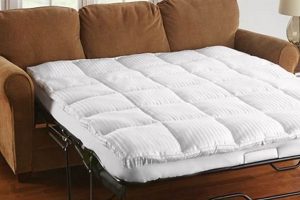
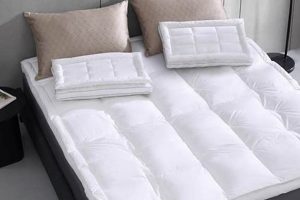
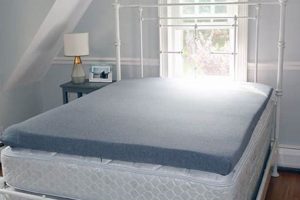
A bedding accessory designed to add a layer of comfort and support to a mattress, a specialized version accommodates thicker mattresses. Standard mattress toppers may not adequately fit mattresses with greater depth; therefore, toppers with deeper pockets are engineered with elasticized sides to ensure a secure and snug fit, preventing slippage and maintaining a smooth sleeping surface. For example, a mattress measuring 14 inches or more in height typically requires this type of topper.
The significance of using a correctly sized topper lies in its ability to enhance sleep quality and prolong the lifespan of the underlying mattress. Ill-fitting toppers can bunch up, creating uneven pressure points and disrupting sleep. Moreover, a secure fit prevents the topper from shifting, reducing wear and tear on both the topper and the mattress. Historically, as mattress thicknesses have increased to accommodate advanced coil systems and comfort layers, the need for specialized bedding accessories like these has grown.
The subsequent sections will delve into various aspects of this bedding solution, including the materials used in their construction, the different types available, and factors to consider when selecting one. Furthermore, the article will address the maintenance and care required to maximize its lifespan and performance.
Guidance on Selecting a Deep Pocket Mattress Topper
Optimal utilization of a mattress enhancement necessitates careful consideration of various factors. The following guidelines aid in selecting a topper designed for thicker mattresses, ensuring both comfort and longevity.
Tip 1: Measure Mattress Depth Accurately: Prior to purchase, precisely measure the height of the mattress. This measurement dictates the required pocket depth of the topper. A measurement error can result in improper fit and diminished performance.
Tip 2: Prioritize Material Quality: Toppers are available in diverse materials, including memory foam, latex, and down alternatives. Assess the properties of each material in relation to individual sleep preferences and sensitivities. Consider density, support, and breathability.
Tip 3: Evaluate Edge Support: For mattresses with reinforced edges, ensure the toppers construction complements this feature. Inadequate edge support in the topper can negate the benefits of the mattress’s edge reinforcement.
Tip 4: Consider Topper Thickness: Thickness influences the degree of added comfort and support. Evaluate the existing mattress firmness and select a topper thickness that achieves the desired balance. Thicker is not always better; compatibility with the mattress is paramount.
Tip 5: Review Washing/Care Instructions: Examine the manufacturer’s care instructions. Some toppers are machine washable, while others require professional cleaning. Selecting a topper with manageable care requirements ensures ease of maintenance.
Tip 6: Read Customer Reviews: Consult customer reviews for real-world insights into topper performance, durability, and fit. Focus on reviews that specifically address the topper’s suitability for thicker mattresses.
Tip 7: Verify Return Policy: Confirm the retailer’s return policy. A trial period allows for assessment of the topper’s comfort and fit within the user’s sleeping environment. A favorable return policy mitigates the risk of dissatisfaction.
Adhering to these guidelines facilitates the selection of a topper that enhances sleep quality and extends the lifespan of deeper mattresses. Precise measurements and careful consideration of material properties are crucial for achieving optimal results.
The subsequent section will address the correct methods for installing and maintaining the selected product, ensuring its long-term effectiveness.
1. Secure Fit
A secure fit constitutes a foundational characteristic of a correctly implemented deep pocket mattress topper. The causal relationship is direct: the depth of the mattress dictates the necessity for a topper designed with correspondingly deep pockets. If the topper lacks adequate pocket depth to securely encase the mattress, slippage and movement are inevitable. For instance, a 16-inch mattress paired with a standard pocket topper will exhibit inadequate adherence, resulting in discomfort and compromised support. The importance of a secure fit resides in its capacity to maintain consistent weight distribution and prevent the formation of pressure points. This is further crucial for individuals with back pain or other musculoskeletal sensitivities, where a stable sleeping surface is paramount.
Beyond comfort considerations, a secure fit also impacts the longevity and efficacy of the topper itself. A topper that is constantly shifting and bunching is subject to accelerated wear and tear. The elasticized edges, designed to grip the mattress, are placed under undue stress, leading to premature degradation. Furthermore, the effectiveness of the topper’s intended purpose, be it providing additional cushioning or temperature regulation, is diminished when its placement is inconsistent. For example, a memory foam topper, renowned for its conforming properties, requires consistent contact with the body to effectively distribute weight and alleviate pressure.
In summary, a secure fit is not merely a desirable attribute but an integral component of a functioning deep pocket mattress topper. Its absence undermines both comfort and durability. Understanding the practical implications of this relationship, from weight distribution to material longevity, is essential for informed purchasing decisions and optimal sleep quality. Challenges in achieving a secure fit often stem from inaccurate mattress depth measurements; therefore, precise measurement prior to purchase is crucial. The emphasis on secure fit reinforces the broader theme of ensuring bedding accessories are correctly sized and compatible with the specific dimensions of the mattress.
2. Material Density
Material density, a quantifiable measure of mass per unit volume, directly influences the performance characteristics of a deep pocket mattress topper. The cause-and-effect relationship is evident: higher density materials generally provide greater support and durability. For instance, a memory foam topper with a density of 5 pounds per cubic foot will offer more substantial support and resist compression over time compared to a topper with a density of 3 pounds per cubic foot. The importance of material density as a component of the product lies in its capacity to affect pressure distribution, spinal alignment, and overall sleep quality. A topper lacking sufficient density may bottom out under pressure, negating its intended benefits and potentially exacerbating discomfort.
Practical significance manifests in the longevity of the topper and its ability to maintain consistent performance over extended per
iods. A high-density topper resists deformation and retains its shape, ensuring consistent support and cushioning. Conversely, a low-density topper is prone to sagging and compression, requiring more frequent replacement. For example, individuals seeking pressure relief for chronic pain conditions often benefit from high-density memory foam or latex toppers, as these materials conform closely to the body and distribute weight evenly. Moreover, the density of the topper impacts its temperature regulation capabilities. Denser materials may retain more heat, while open-cell structures within certain materials can promote airflow and dissipate heat, catering to different thermal preferences.
Understanding the relationship between material density and performance characteristics is essential for informed purchasing decisions. Challenges arise in accurately assessing density without standardized labeling practices across manufacturers. Consumers should seek detailed product specifications and consider independent reviews to ascertain the actual density and performance of different topper options. In conclusion, material density is a critical determinant of a deep pocket mattress topper’s effectiveness, influencing support, durability, and temperature regulation. Its proper consideration is paramount for achieving optimal sleep quality and long-term satisfaction. The selection process should reflect the individual’s needs, considering factors such as weight, sleep position, and thermal preferences, to ensure that the chosen density provides the desired balance of comfort and support.
3. Edge Support
Edge support within a deep pocket mattress topper influences its overall functionality and the stability it provides to the sleeper. The integration of reinforced edges into the topper design can mitigate the common issue of edge collapse, a phenomenon where the perimeter of the topper compresses significantly under weight. This is causally linked to the topper’s structural integrity and its ability to maintain a level sleeping surface across its entire area. The importance of robust edge support lies in its contribution to a consistent sleep experience, preventing the sensation of rolling off the bed and maximizing the usable sleeping surface. For instance, individuals who sleep near the edge of the bed or rely on the edge for support when getting in and out will find substantial benefit in a topper with enhanced edge reinforcement. This reinforces the structural integrity and minimizes uneven compression.
The practical significance of edge support extends beyond mere comfort; it also affects the longevity of both the topper and the underlying mattress. By preventing excessive compression along the edges, the topper maintains its shape and provides uniform support, reducing strain on the mattress’s perimeter. This is especially relevant for thicker mattresses, where edge support can be compromised due to the increased weight and complexity of the internal components. Real-world applications illustrate this point: a deep pocket mattress topper with weak edge support will exhibit noticeable sagging over time, leading to discomfort and potentially shortening the lifespan of both the topper and mattress. The selection of appropriate edge support becomes critical when addressing weight distribution challenges, ensuring sustained support throughout the product’s lifespan.
In summary, edge support is an essential attribute of a high-quality deep pocket mattress topper, contributing to sleep stability, comfort, and the longevity of both the topper and the mattress. A lack of adequate edge reinforcement can compromise the entire sleeping surface and lead to premature wear. Recognizing this critical feature allows consumers to make informed purchasing decisions, ensuring that their investment provides sustained support and comfort. Challenges in assessing edge support often involve subjective evaluation, but focusing on the firmness and construction of the topper’s edges can provide a valuable indication of its overall quality and durability. Prioritizing this aspect within the selection process aligns with the broader goal of optimizing sleep quality and maximizing the lifespan of bedding investments.
4. Comfort Level

Comfort level, a subjective but critical determinant, significantly impacts the perceived value of a deep pocket mattress topper. The correlation between the two is demonstrable: a topper, regardless of its deep pocket design intended for thicker mattresses, will fail to satisfy if it does not enhance the sleeper’s comfort. The cause-and-effect relationship manifests as follows: inadequate comfort negates the benefits of proper fit and support. The importance of comfort level as an integral aspect of this product resides in its direct influence on sleep quality and overall well-being. For example, an individual experiencing back pain requires a topper that provides adequate cushioning and pressure relief, whereas a person who sleeps hot needs a topper with cooling properties, irrespective of mattress thickness. The satisfaction of the individual is based on this comfort, not only by its size.
The practical significance of understanding the comfort level stems from the wide array of materials and constructions available. Memory foam toppers, for example, are known for their conforming properties and pressure relief, appealing to those seeking a cradling sensation. Latex toppers, conversely, offer a firmer, more responsive feel and are often preferred by those who require more support. Down alternative toppers provide a plush, cloud-like comfort, while wool toppers regulate temperature and wick away moisture. Individuals should assess personal sleep preferences, including sleeping position, body weight, and thermal sensitivities, to determine the appropriate comfort level. This also includes assessing the physical characteristics of the mattress, with its thickness being one. A mattress that is thicker has a comfort level that will be different than others. Real-world examples include individuals with sensitive pressure points, often choosing gel-infused memory foam toppers to mitigate discomfort, or side sleepers selecting thicker, plusher toppers to alleviate pressure on their shoulders and hips.
In summary, comfort level is not merely a supplementary attribute but a foundational element of a successful deep pocket mattress topper selection. Achieving an optimal balance between support, pressure relief, and temperature regulation is crucial for maximizing sleep quality. Challenges in determining the ideal comfort level often arise from subjective preferences and the lack of standardized comfort ratings. Therefore, test periods, comprehensive product descriptions, and informed customer reviews are valuable tools for navigating this complex landscape. This consideration aligns with the broader theme of tailoring bedding choices to individual needs, ensuring that the investment enhances both sleep and overall health.
5. Mattress Protection
A deep pocket mattress topper inherently contributes to mattress protection, albeit indirectly. The topper acts as a barrier, shielding the mattress from spills, stains, and everyday wear and tear. The cause-and-effect relationship is evident: placing a protective layer atop the mattress reduces t
he likelihood of direct contact with contaminants. The importance of mattress protection, even when provided secondarily, lies in its capacity to prolong the lifespan and maintain the hygiene of the underlying mattress. For instance, a spilled liquid is more likely to be absorbed by the topper, rather than penetrating the mattress layers, thus preventing potential mold growth and lasting odors. The inclusion of the word protection helps ensure that these two topics are connected. Real-life examples highlight the practical benefits: families with young children or individuals who consume beverages in bed often appreciate the added layer of defense against accidents, which are more easily rectified through cleaning or replacing the topper, as opposed to the entire mattress.
The practical significance of this protective aspect extends to the mattress warranty. Many mattress warranties are voided by stains or unsanitary conditions. A deep pocket mattress topper, even one not specifically marketed as a protector, can serve as a deterrent to such warranty violations. Certain toppers are engineered with additional protective features, such as waterproof or stain-resistant coatings, further enhancing their ability to safeguard the mattress. For example, a deep pocket mattress topper incorporating a waterproof membrane provides a more robust barrier against liquid penetration than a standard topper lacking this feature, thus offering a higher degree of assurance against spills and accidents. Additionally, the topper may also assist in reducing wear from friction with bed sheets.
In summary, the deep pocket mattress topper provides an element of mattress protection as a consequence of its placement and function. Though not always its primary purpose, this protective role contributes to the overall value proposition of the topper. Challenges in relying solely on the topper for protection include the potential for spills to seep through the sides or the need for additional specialized protectors for complete coverage. This connection underscores the broader theme of proactive mattress care, emphasizing the importance of employing various strategies to maintain mattress hygiene and longevity. By using a thick cover, and ensuring it fits snuggly, the mattress will benefit by having added protection from fluids, dirt, and wear and tear.
Frequently Asked Questions
The following addresses common inquiries regarding the selection, application, and maintenance of mattress toppers designed for deeper mattresses.
Question 1: What constitutes a “deep pocket” in relation to mattress toppers?
A “deep pocket” indicates that the topper is engineered to accommodate mattresses exceeding standard thicknesses, typically 14 inches or more. This dimension refers to the depth of the topper’s fitted sheet-like construction, ensuring a secure and snug fit.
Question 2: How does the thickness of the mattress influence the choice of a deep pocket mattress topper?
The mattress thickness dictates the necessary pocket depth of the topper. Accurate measurement of the mattress height is paramount to ensure a proper fit. Failure to account for mattress depth can result in slippage and compromised support.
Question 3: What materials are commonly used in deep pocket mattress toppers, and what are their respective benefits?
Common materials include memory foam, latex, down alternatives, and wool. Memory foam offers pressure relief and contouring; latex provides support and resilience; down alternatives offer a plush feel; and wool regulates temperature and wicks away moisture. Material selection depends on individual sleep preferences.
Question 4: How does material density affect the performance of a deep pocket mattress topper?
Higher density materials generally offer greater support and durability. A denser topper resists compression and maintains its shape over time, ensuring consistent support. Lower density toppers may compress and sag, requiring more frequent replacement.
Question 5: Is edge support a significant factor when selecting a deep pocket mattress topper?
Yes, edge support is crucial, particularly for those who sleep near the edge of the bed. Reinforced edges prevent sagging and maximize the usable sleeping surface. Adequate edge support contributes to overall stability and comfort.
Question 6: How should a deep pocket mattress topper be cleaned and maintained?
Cleaning and maintenance instructions vary depending on the material. Some toppers are machine washable, while others require spot cleaning or professional cleaning. Adhering to the manufacturer’s guidelines is essential to preserve the topper’s integrity and lifespan.
In summary, selecting the appropriate deep pocket mattress topper requires careful consideration of mattress depth, material properties, density, edge support, and cleaning requirements. An informed purchasing decision ensures optimal comfort and extended mattress lifespan.
The subsequent section will address potential issues and troubleshooting tips associated with using a deep pocket mattress topper.
Deep Pocket Mattress Topper
This examination of the deep pocket mattress topper has illuminated critical facets of its design, selection, and utilization. The analysis encompassed the significance of a secure fit, the impact of material density, the role of edge support, the influence of comfort level, and the supplementary benefit of mattress protection. Furthermore, the frequently asked questions section provided clarity on common concerns and considerations. The objective has been to provide a comprehensive understanding of this specialized bedding accessory, moving beyond superficial descriptions to explore its functional attributes and practical implications.
The informed application of this knowledge equips consumers with the tools necessary to make judicious purchasing decisions, maximizing the potential for enhanced sleep quality and extended mattress longevity. The selection of a deep pocket mattress topper represents a deliberate investment in both comfort and mattress preservation. Continued advancements in materials and design are anticipated, further optimizing the performance and durability of these essential bedding components. Prioritize informed choices to achieve the intended benefits.
![Top Topper Tips: How to Keep Mattress Topper From Sliding [Guide] | Organic & Natural Mattress Buyer’s Guide: Non-Toxic Sleep Solutions](https://mattressworldpa.com/wp-content/uploads/2025/07/th-6038-300x200.jpg "Top Topper Tips: How to Keep Mattress Topper From Sliding [Guide] Organic & Natural Mattress Buyer’s Guide: Non-Toxic Sleep Solutions")