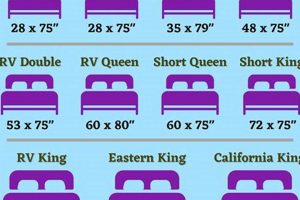
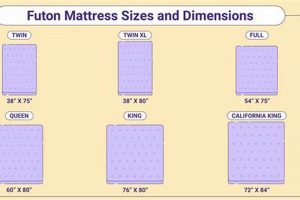
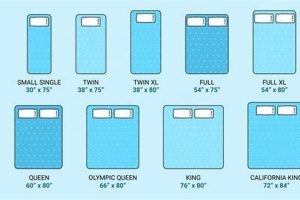
A sleeping surface categorized as “full” typically measures approximately 54 inches in width and 75 inches in length. These measurements define a specific mattress size commonly chosen for accommodating single sleepers who desire more space than a twin provides, or for couples in smaller living environments. This size offers a balance between spaciousness and practicality.
The popularity of this particular bed size stems from its versatility. It provides sufficient room for comfortable individual sleep while remaining compact enough for smaller bedrooms. Historically, it served as a transitional size, offering an upgrade from the space constraints of a twin bed, particularly as individuals matured and sought more personal space during sleep. Its enduring appeal lies in its adaptability to various needs and spatial limitations.
Understanding the spatial footprint allows for informed decisions regarding bedroom layout, furniture selection, and overall comfort. Consequently, subsequent sections will delve into considerations for room size, suitable sleeping arrangements, and the selection of appropriate bedding and accessories, all optimized for this widely utilized sleeping platform.
Optimizing Space with a Full Size Mattress
The subsequent guidelines aim to maximize the utility and comfort associated with a mattress of the specified size. Careful consideration of these points will ensure an optimal sleeping environment.
Tip 1: Assess Room Dimensions: Prior to purchase, meticulously measure the intended room. A minimum room dimension of 10 feet by 10 feet is recommended to accommodate the bed and allow for adequate movement. Subtract the mattress’s spatial footprint from the total room area to determine remaining usable space.
Tip 2: Consider Occupancy: While suitable for single sleepers, a full size mattress can accommodate two individuals in a pinch. If regular co-sleeping is anticipated, consider a larger option, such as a queen, to prevent sleep disturbances and ensure individual comfort.
Tip 3: Optimize Bed Placement: Position the bed strategically to maximize available space. Avoid obstructing doorways or walkways. Consider placing the headboard against a wall to provide stability and create a focal point in the room.
Tip 4: Select Appropriate Bedding: Choose bedding designed specifically for this mattress. Oversized bedding can appear bulky and detract from the overall aesthetic, while undersized bedding may not provide adequate coverage and comfort.
Tip 5: Utilize Under-Bed Storage: Maximize vertical space by utilizing under-bed storage containers. These can effectively store seasonal clothing, extra linens, or other items, thereby minimizing clutter and optimizing the available space within the room.
Tip 6: Invest in a Supportive Frame: A sturdy bed frame is essential for providing adequate support and preventing premature wear and tear. Ensure the frame is appropriately sized and constructed from durable materials to withstand the weight of the mattress and occupants.
Tip 7: Evaluate Mattress Thickness: Different mattress types have varying thicknesses. A thicker mattress will raise the sleeping surface, potentially impacting the overall proportion of the room. Choose a thickness that complements the bed frame and the overall aesthetic of the space.
Adherence to these recommendations ensures an efficient and comfortable utilization of the chosen mattress size, optimizing both sleep quality and spatial efficiency.
These guidelines offer a foundation for creating a functional and aesthetically pleasing bedroom environment centered around the practical advantages of a mattress of this specified dimension.
1. Width

The measurement of fifty-four inches in width is a defining characteristic and non-negotiable component when specifying the dimensions of a standard full-size mattress. This width directly influences the sleeping capacity and overall comfort level the mattress provides. A narrower width would classify the mattress as a twin or twin XL, while a greater width would categorize it as a queen or larger. This fixed dimension establishes the full-size mattress as a specific category within the mattress size classification system. For example, individuals transitioning from a twin bed often choose a full-size mattress precisely because of the increased width, allowing for greater freedom of movement during sleep.
The practical significance of understanding the fifty-four-inch width extends to considerations of bedroom space planning. Interior designers and homeowners alike must factor in this dimension when arranging furniture and determining the optimal placement of the bed. A room that is too small will feel cramped with a full-size mattress, negating any potential comfort benefits. Moreover, bedding manufacturers tailor their products to specific mattress dimensions, meaning that sheets, blankets, and comforters designed for a full-size mattress will fit properly only if the mattress adheres to this established width. The availability of appropriately sized bedding is contingent upon maintaining the standard width.
In summary, the fifty-four-inch width is not merely an arbitrary number; it is a fundamental parameter that defines the characteristics, suitability, and applications of the full-size mattress. Deviations from this dimension alter the category of the mattress entirely. Challenges arise when manufacturers deviate from standard sizes; therefore, consumers must verify dimensions prior to purchase to ensure compatibility with existing bedding and to confirm suitability for the intended sleeping space. This understanding is essential for informed decision-making and effective space utilization.
2. Length

The seventy-five-inch length constitutes a critical dimension defining a standard full-size mattress. This measurement significantly influences suitability for different individuals and impacts bedroom spatial planning. It’s not simply an arbitrary measurement but a defining characteristic. The length must be precisely considered within the context of overall size.
- Adult Accommodation
Seventy-five inches dictates whether a fully grown adult can comfortably sleep without limb overhang. This is particularly crucial for individuals between 5’10” and 6’2″. Failure to account for this length may result in compromised sleep quality and discomfort. For taller individuals, alternative mattress sizes like a Queen or King are advisable to provide adequate support and prevent restricted movement during sleep.
- Bedroom Layout Considerations
The seventy-five-inch length must be factored into bedroom layout planning. Adequate space surrounding the mattress is necessary for comfortable movement and accessibility. Ignoring this dimension can lead to a cramped and dysfunctional space. Minimalist room design hinges on space efficiency, highlighting the necessity of precise length measurement for optimized functionality. The goal is to balance size of furniture and use area of a room with full size mattress.
- Bed Frame Compatibility
Bed frame selection is directly tied to the seventy-five-inch length. An incompatible frame can compromise structural integrity and lead to mattress damage or instability. Standardized sizing ensures seamless integration; however, variations exist and require verification prior to purchase. Deviation from this length, even slight, can manifest into improper mattress seating, potential noise and reduce the life of components. A proper measurement helps prevent this situation.
- Sleeping Position Implications
The seventy-five-inch length accommodates the average sleeping position. Individuals who frequently stretch or extend their limbs during sleep must assess the suitability of this length. Side sleepers may find it adequate, whereas those favoring back or stomach positions may require additional space to accommodate extended reach. Awareness of habitual sleeping positions allows for informed selection and maximizes sleep comfort. Sleeping position impacts space needs of a bed.
Collectively, the implications of the seventy-five-inch length extend beyond a simple measurement; this number helps evaluate the compatibility of using dimensions full size mattress. It dictates user comfort, room layout practicality, frame compatibility, and suitability for specific sleeping positions. Neglecting this parameter can result in discomfort, spatial inefficiencies, and compromised sleep quality. Careful assessment guarantees a harmonious blend of utility and comfort within the sleeping environment.
3. Area

The designation “Area: 4050 Square Inches” explicitly quantifies the two-dimensional space offered by a standard full-size mattress. This figure is derived from multiplying the width (54 inches) by the length (75 inches) and serves as a concrete metric for evaluating its spatial accommodation relative to individual needs and room constraints.
- Single Sleeper Comfort
The area of 4050 square inches provides substantial space for a single sleeper, allowing for unrestricted movement and minimizing the sensation of confinement. This contrasts with a smaller twin bed, which may feel restrictive for some adults. A greater surface allows for adopting diverse sleeping positions without encroaching on edge boundaries, thus improving sleep quality.
- Co-Sleeping Limitations
While suitable for single occupancy, this area presents limitations for comfortable co-sleeping. Dividing 4050 square inches between two individuals results in significantly reduced personal space, potentially leading to disrupted sleep patterns and physical discomfort. Couples considering shared sleeping arrangements might find a queen or king-sized mattress more conducive to undisturbed rest.
- Room Size Considerations
The total area of a room must exceed 4050 square inches to reasonably accommodate the mattress without compromising maneuverability. Additional space is required for complementary furniture, such as dressers and nightstands, and for pedestrian traffic flow. Constricting the environment can create a sense of overcrowding, negatively impacting psychological well-being.
- Pet Accommodation
For individuals cohabitating with pets, the available area becomes a factor in shared comfort. Small pets may comfortably share a full-size mattress with their owner; however, larger animals can significantly reduce the usable space for the human occupant. Planning for pet accommodation involves considering individual animal size and sleeping habits relative to the mattress dimensions.
In conclusion, the metric of 4050 square inches serves as a tangible representation of the spatial capacity offered by a full-size mattress. Its significance extends from dictating individual sleeping comfort and co-sleeping viability to impacting room layout and pet accommodation. This figure provides a foundational element for informed decision-making regarding mattress selection, effectively balancing practical needs with available resources, to maximize dimensions full size mattress benefits.
4. Occupancy

The designation “Occupancy: Single/Two Sleepers” directly relates to the available surface area of a full-size mattress and dictates its suitability for various sleeping arrangements. The dimensions of the mattress, roughly 54 inches in width and 75 inches in length, provide approximately 4050 square inches of sleeping space. This surface area, in turn, governs the level of comfort and freedom of movement experienced by the occupant(s). In the case of a single sleeper, this offers ample space to stretch, change positions, and experience undisturbed rest. Conversely, when accommodating two sleepers, this space is effectively halved, leading to potential limitations in individual space and increased likelihood of sleep disruption. A practical example is a guest room designed to accommodate either a single visitor requiring ample space or a couple for a shorter stay. The occupancy informs purchase decisions.
Considering the occupancy is crucial in determining the appropriate mattress size. If consistent co-sleeping is anticipated, the full-size mattress presents challenges. Two adults sharing approximately 27 inches each often experience restricted movement and increased disturbance from a partner’s movements. This can lead to compromised sleep quality and necessitate exploration of larger mattress options, such as a queen or king. The choice of occupancy is therefore inextricably linked to sleep hygiene and overall well-being. This can be found in smaller apartments or dorm rooms. The importance of the choice is high and the impact of the choice should be high.
In summary, the occupancy potential of a full-size mattress directly correlates to its utility and suitability for different sleeping arrangements. The limitations imposed by its dimensions necessitate careful consideration of individual needs and sleeping habits. While offering sufficient space for a single sleeper, its capacity for accommodating two individuals comfortably is constrained. Ultimately, informed decision-making requires balancing spatial limitations with occupancy requirements to optimize sleep quality and maximize satisfaction with the chosen mattress size. Its practical significance cannot be understated in achieving a restful and undisturbed night’s sleep, impacting daily life in a meaningful way.
5. Room Size

The specification of “Room Size: Minimum Ten Feet” directly correlates with the practical implementation of “dimensions full size mattress” within a residential space. A full-size mattress, with its approximate 54-inch width and 75-inch length, demands a compatible environment to ensure functionality and comfort. The ten-foot minimum, therefore, is not arbitrary, but a consequence of accommodating the bed’s footprint and facilitating ease of movement.
The ten-foot minimum dimension serves as a threshold for preventing spatial constriction. Placing a full-size mattress in a room smaller than this prescribed size often results in obstructed pathways, limited access to furniture, and an overall sense of confinement. For example, a room measuring eight feet by eight feet would leave inadequate space for even basic movement after the mattress is positioned. Conversely, a room exceeding this minimum allows for inclusion of nightstands, dressers, or a small desk without sacrificing usability. Furthermore, adherence to this minimum promotes psychological comfort by preventing the feeling of being overwhelmed by the furniture. Real estate listings frequently emphasize bedroom dimensions to highlight their suitability for various bed sizes, a direct reflection of this spatial relationship.
In conclusion, the “Room Size: Minimum Ten Feet” guideline is an essential prerequisite for effective use of “dimensions full size mattress”. It ensures sufficient clearance for movement, allows for the incorporation of essential furniture, and contributes to a sense of spatial well-being. Ignoring this spatial requirement leads to a compromised living environment, underscoring the critical link between mattress dimensions and appropriate room sizing. Failure to account for this can cause reduced room efficiency.
6. Bedding
The phrase “Bedding: Full Size Specific” indicates the direct relationship between textile products designed for sleep and the precise measurements of a particular mattress category. A standard full-size mattress, characterized by its 54-inch width and 75-inch length, necessitates bedding configured to these dimensional parameters. This is not a matter of preference, but rather a functional requirement to ensure proper fit and optimal comfort. Mismatched bedding, either too large or too small, compromises both the aesthetic appeal and the practical utility of the sleep environment. For example, fitted sheets intended for a queen-size mattress will inevitably bunch and wrinkle on a full-size bed, leading to discomfort and premature wear. This demonstrates a cause-and-effect scenario where inappropriate bedding undermines the benefits associated with correctly sized sleep surfaces. The dimensions full size mattress’ benefits become clear.
The specificity extends beyond fitted sheets to encompass flat sheets, comforters, duvet covers, and mattress protectors. Each of these items is manufactured with precise measurements to correspond to the full-size mattress. Inconsistent sizing across bedding components can lead to functional problems, such as inadequate coverage or excessive fabric overhang. Furthermore, the availability of bedding specifically designed for a given mattress size directly influences consumer purchasing decisions. Retailers categorize bedding by size designation to facilitate ease of selection and ensure compatibility. Online product listings and brick-and-mortar store displays reinforce this categorical distinction, allowing shoppers to readily identify items suited to their particular mattress dimensions. This systematic categorization is essential for streamlining the consumer experience and minimizing purchase errors. The need for proper measurements is highlighted.
In conclusion, “Bedding: Full Size Specific” underscores the vital connection between textile products and the accurate dimensions of a full-size mattress. The correct fit maximizes comfort, extends the lifespan of both the bedding and the mattress, and contributes to an aesthetically pleasing sleep environment. Challenges arise when manufacturers deviate from standardized sizing, necessitating careful measurement and verification prior to purchase. This understanding aligns with the broader theme of spatial awareness and informed consumerism, emphasizing the significance of detail in optimizing everyday living spaces. The purchase consideration must be in line with the correct dimensions.
Frequently Asked Questions
The subsequent questions address common inquiries regarding the dimensions, suitability, and practical considerations associated with a full-size mattress.
Question 1: What are the precise measurements defining a standard full-size mattress?
A standard full-size mattress measures approximately 54 inches in width and 75 inches in length. Minor variations may exist between manufacturers, but these dimensions represent the industry norm.
Question 2: Is a full-size mattress suitable for accommodating two adults?
While a full-size mattress can physically accommodate two adults, it is generally considered more appropriate for single sleepers due to its limited width. Co-sleeping may result in restricted movement and compromised sleep quality.
Question 3: What is the recommended minimum room size for a full-size mattress?
A room measuring at least 10 feet by 10 feet is recommended to comfortably accommodate a full-size mattress and allow for sufficient movement and placement of additional furniture.
Question 4: Can bedding designed for a queen-size mattress be used on a full-size mattress?
Bedding designed for a queen-size mattress is generally too large for a full-size mattress, leading to a poor fit and potential discomfort. Using bedding specifically designed for full-size dimensions is recommended.
Question 5: What factors should be considered when selecting a bed frame for a full-size mattress?
The bed frame must be sized appropriately to support the dimensions and weight of the full-size mattress. Constructing this support from durable materials is crucial to prevent premature wear and maintain structural integrity.
Question 6: Are there alternative mattress sizes that offer greater sleeping space than a full-size?
Yes. Queen, king, and California king-size mattresses offer larger sleeping surfaces, providing greater space for single sleepers or couples who prioritize freedom of movement during sleep.
In summation, these questions provide a comprehensive overview of key considerations related to the specifications, application, and practical aspects of a full-size mattress.
The following section will address potential variations in mattress dimensions and their impact on overall sleeping comfort.
Dimensions Full Size Mattress
The preceding discourse meticulously explored the characteristics, limitations, and practical applications of “dimensions full size mattress.” Considerations ranging from spatial constraints and intended occupancy to the nuanced selection of appropriately sized bedding underscore the multifaceted nature of this decision. A thorough understanding of these factors is paramount to optimizing sleep quality and maximizing the utility of available living space.
Selecting a sleeping platform is not merely a matter of preference, but a deliberate assessment of individual needs and environmental realities. The informed consumer, equipped with the knowledge presented herein, is empowered to make a judicious choice, thereby ensuring a functional and comfortable sleeping environment. The investment in careful consideration will yield dividends in the form of improved rest and enhanced quality of life.