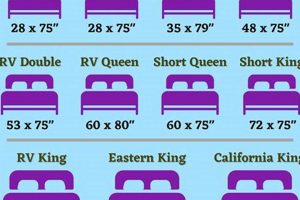
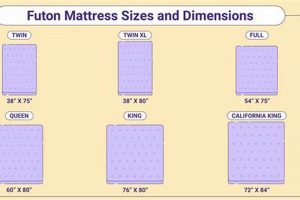
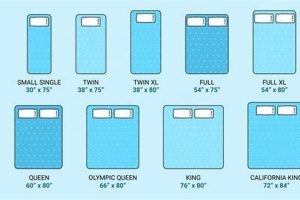
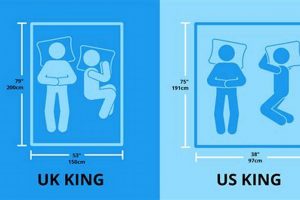
The standard measurements for a full size mattress, often referred to as a double mattress, are approximately 54 inches in width and 75 inches in length. These figures represent the typical surface area available for sleeping on a mattress of this designation. For example, a bed frame intended for a full size mattress should accommodate these specific spatial requirements.
Understanding the surface area is important for space planning, particularly in smaller bedrooms or guest rooms. These measurements allow consumers to accurately assess whether the bed will fit comfortably within the designated area, leaving adequate space for movement and other furniture. Historically, this size offered a step up in space from a twin bed, accommodating single adults or couples seeking a more compact sleeping solution.
The subsequent sections will delve into a detailed discussion of factors to consider when choosing a mattress, including aspects of comfort, support, material composition, and considerations for different sleep styles. This information will allow readers to make informed decisions based on their individual needs and preferences, beyond simply the overall size of the mattress itself.
Tips Regarding Mattress Size
Selecting the correct mattress size is crucial for optimizing sleep quality and bedroom space utilization. Consider the following tips to ensure informed decision-making.
Tip 1: Assess Room Dimensions. Prior to purchase, measure the available space within the bedroom. Account for other furniture and walkways to prevent overcrowding. A mattress that is too large can impede movement and make the room feel cramped.
Tip 2: Consider Occupancy. A full size mattress may be suitable for a single adult or a couple who prefer a smaller sleeping surface. However, couples who value personal space during sleep may benefit from a larger size, such as a queen or king.
Tip 3: Evaluate Sleep Style. Individuals who tend to move frequently during sleep require ample space to avoid disturbing their sleep partner or falling off the bed. Assess personal sleep habits and consider a larger mattress accordingly.
Tip 4: Research Frame Compatibility. Ensure that the chosen bed frame is specifically designed to accommodate the measurements of a full size mattress. Using an incompatible frame can compromise support and potentially damage the mattress.
Tip 5: Account for Bedding. When selecting bedding, verify that the dimensions of sheets, comforters, and other accessories are appropriate for a full size mattress. Ill-fitting bedding can detract from the overall aesthetic and comfort.
Tip 6: Consider Future Needs. Evaluate potential future changes in living arrangements or sleeping partners. Choosing a slightly larger mattress can provide flexibility for future needs and prevent the necessity of replacement.
By carefully considering these factors, individuals can select a mattress that provides optimal comfort, support, and space utilization. Taking the time to properly assess needs and measure the available space will result in a more satisfactory and restful sleep experience.
In the subsequent sections, we will explore specific mattress types and materials to further refine the selection process and ensure a purchase that meets individual requirements for sleep health and well-being.
1. Width

The assertion “Width: Fifty-four inches” directly addresses a fundamental component of the overall spatial attributes associated with the term “dimensions of a full size mattress in inches.” This specific measurement constitutes one of the two primary linear parameters defining the sleeping surface’s area. Consequently, any deviation from this standard width significantly alters the mattress’s intended functionality and compatibility with designated bed frames and bedding accessories. For instance, a width less than fifty-four inches would render the mattress functionally smaller, potentially impacting sleep comfort for an individual or the ability to accommodate two sleepers comfortably. Conversely, a width exceeding this specification could present fitting issues with standard full-size bed frames, thereby requiring custom solutions and negating the cost benefits of adhering to standard sizing. The width, therefore, is a critical determinant of the mattress’s usability within the established product category.
The implications extend beyond simple spatial fit. The fifty-four-inch width influences the distribution of weight across the mattress surface, affecting support and potentially longevity. For example, mattresses intended for heavier individuals often incorporate reinforced internal structures to counteract potential sagging or compression, particularly in the center. Altering the width would necessitate a recalculation of these structural requirements to maintain intended performance. Furthermore, the width directly impacts manufacturing processes and supply chain management. Standardization of width dimensions allows for efficient production of bed frames, bedding, and related accessories, minimizing waste and reducing manufacturing costs. Deviation from this standard necessitates customized production processes, potentially increasing the overall cost to the consumer.
In summary, the “Width: Fifty-four inches” specification is not merely an arbitrary measurement but a critical element defining the usability, compatibility, and manufacturing efficiency associated with a full size mattress. Its practical significance extends from bedroom space planning and bedding selection to the structural integrity and cost-effectiveness of the overall sleeping system. The established dimension reflects a balance between accommodating individual or dual occupancy and optimizing production and resource utilization.
2. Length

The specification of “Length: Seventy-five inches” is a crucial dimension within the overall characterization of a full size mattress. It directly dictates the suitability of the mattress for accommodating individuals of varying heights and influences the overall comfort level experienced during sleep. The following points detail the significance of this measurement.
- Accommodation of Height
The 75-inch length directly correlates with the maximum height of an individual who can comfortably utilize the mattress. Subtracting a reasonable allowance for pillow space, this length typically accommodates individuals up to approximately 6 feet tall. Exceeding this height may result in discomfort due to insufficient legroom, potentially disrupting sleep patterns.
- Impact on Sleep Posture
Adequate length is necessary for maintaining proper spinal alignment during sleep. If the mattress is too short, individuals may unconsciously contort their bodies to fit, potentially leading to back pain and discomfort. The 75-inch dimension aims to provide sufficient space for most adults to stretch out comfortably, supporting a healthy sleep posture.
- Room Placement Considerations
The length of the mattress, combined with its width, dictates the minimum room dimensions required for comfortable placement. In smaller bedrooms, the 75-inch length must be factored into the overall layout to ensure adequate space for movement and other furniture. Careful measurement is essential to prevent overcrowding and maintain functionality within the room.
- Bedding Compatibility
Standard bedding sizes are designed to correspond with common mattress dimensions. Sheets, comforters, and other accessories labeled “full size” are manufactured with the 75-inch length in mind. Using bedding designed for a shorter mattress may result in an inadequate fit, while excessively long bedding can appear untidy and create tripping hazards.
In conclusion, the “Length: Seventy-five inches” parameter is not merely a superficial measurement but a critical factor influencing the comfort, health, and practicality of a full size mattress. Understanding its implications regarding height accommodation, sleep posture, room placement, and bedding compatibility is essential for making an informed purchasing decision.
3. Area

The calculated area of 4050 square inches derived from the dimensions of a full size mattress (54 inches in width and 75 inches in length) provides a quantifiable measure of the available sleeping surface. This figure has direct implications for comfort, space utilization, and suitability for different users.
- Surface Area and Sleep Comfort
The total surface area directly influences the amount of personal space available to an individual or individuals using the mattress. A larger area typically allows for greater freedom of movement during sleep, potentially reducing discomfort and promoting better sleep quality. In contrast, a smaller area may lead to restricted movement and a feeling of confinement, especially for restless sleepers.
- Occupancy and Space Allocation
The 4050 square inches of a full size mattress dictate its suitability for different occupancy scenarios. While this area may adequately accommodate a single adult, it may prove insufficient for couples who prefer a greater degree of personal space. The available surface area per person decreases significantly when shared, potentially affecting sleep quality and comfort levels.
- Room Size Considerations
The overall dimensions, including the area, must be considered in relation to the available room space. A full size mattress, occupying 4050 square inches of horizontal space, requires adequate room dimensions to allow for comfortable movement around the bed and placement of other furniture. Overcrowding can result in a cramped and uncomfortable environment.
- Material Distribution and Support
Manufacturers utilize the area measurement when designing the internal support structure and material distribution within the mattress. The 4050 square inches must be uniformly supported to prevent sagging and ensure proper spinal alignment. The type and quantity of materials used are directly related to the need to provide adequate support across the entire surface area.
In summary, the area of 4050 square inches is not merely a calculated figure but a critical parameter that directly impacts the practical functionality of a full size mattress. It influences the level of comfort, suitability for occupancy, room placement considerations, and material distribution, all of which contribute to the overall user experience and value proposition. Understanding this relationship is essential for making informed purchasing decisions and optimizing sleep environments.
4. Frame Compatibility

The concept of frame compatibility is inextricably linked to the standard measurements of a full size mattress. A mismatch between the mattress dimensions and the bed frame can lead to compromised support, reduced comfort, and accelerated wear and tear on both components. Adherence to standardized measurements is paramount for ensuring proper fit and function.
- Structural Support and Longevity
A correctly sized frame provides essential structural support across the entire surface of the mattress. If the frame is too small, the mattress may overhang, leading to sagging and uneven weight distribution. Conversely, a frame that is too large may allow the mattress to shift and slide, reducing stability and increasing the risk of damage. This misalignment directly impacts the lifespan of the mattress and the overall comfort experienced by the user. For example, a full size mattress placed on a queen-size frame would lack proper edge support, significantly reducing its longevity and potentially voiding manufacturer warranties.
- Safety and Stability
Frame compatibility directly affects the safety and stability of the bed. An ill-fitting frame can create instability, increasing the risk of the bed collapsing or tipping over. This poses a significant safety hazard, particularly for children or individuals with mobility limitations. Secure and proper support is essential for preventing accidents and ensuring a safe sleep environment. A frame designed for a twin mattress should never be used for a full size mattress due to these critical safety considerations.
- Bedding Fit and Aesthetics
While not directly related to structural integrity, frame compatibility influences the fit and appearance of bedding. A properly sized frame will ensure that sheets and comforters drape appropriately, maintaining a neat and aesthetically pleasing appearance. An ill-fitting frame can lead to bedding that is too short or too long, detracting from the overall look of the bedroom. The selected frame dictates the size and proportion of all bedding accessories needed for a cohesive design.
- Manufacturer Specifications and Warranties
Mattress manufacturers often stipulate specific frame requirements as a condition of their warranties. Using an incompatible frame can void the warranty, leaving the consumer responsible for any damages or defects that may arise. Adhering to the manufacturer’s specifications regarding frame type and dimensions is crucial for protecting the investment in the mattress. Failure to use the correct type of support will have negative consequences.
In conclusion, the relationship between frame compatibility and the established dimensions of a full size mattress is a critical factor in ensuring optimal support, safety, longevity, and overall user satisfaction. Proper alignment between the two components is essential for maximizing the benefits of the mattress and maintaining a safe and comfortable sleep environment.
5. Room Space

The available area within a bedroom is a primary determinant in selecting an appropriate mattress size. The dimensions of a full size mattress, being a fixed spatial requirement, must be carefully considered in relation to the overall room dimensions to ensure functionality and comfort.
- Minimum Room Dimensions
The length and width of the mattress dictate the minimum room dimensions necessary for comfortable placement and movement. A room that is too small will result in overcrowding, impeding functionality and creating an uncomfortable environment. For a full size mattress, allowing at least two feet of space around the bed is generally recommended. This consideration includes the allowance of furniture to be placed, thus creating an accessible movement within the available room space. Failure to account for these minimums results in an unusable space.
- Furniture Placement and Accessibility
The dimensions of the mattress influence the placement of other furniture within the room. Nightstands, dressers, and other storage units must be positioned to avoid obstructing walkways or creating a cramped feeling. The size of the mattress dictates the remaining usable space for these essential furnishings. For a room to function, movement paths and accessibility have to be accommodated, thus needing a careful approach toward space arrangements.
- Visual Balance and Aesthetics
The size of the mattress relative to the room’s dimensions can impact the overall visual balance and aesthetics. A mattress that is too large for the room can appear overwhelming, making the space feel smaller and less inviting. Conversely, a mattress that is too small may appear insignificant, diminishing the overall impact of the room’s design. Therefore, the dimensions of the item and available space need to be considered in tangent.
- Impact on Functionality and Use
The dimensions of a full size mattress directly affect the functionality of the room. A larger mattress will require more space, potentially limiting the activities that can be comfortably performed within the room. Smaller bedrooms may be better suited for twin-size mattresses to maximize usable space and functionality. Consideration should be given not only to sleep, but functionality for daily life as well.
Therefore, the successful integration of a full size mattress into a bedroom hinges on careful consideration of the available space and its implications for furniture placement, accessibility, and overall room functionality. The fixed dimensions of the mattress serve as a primary constraint in determining the optimal room layout and ensuring a comfortable and functional living environment.
6. Occupancy (single/double)

The designated usage of a full size mattress, whether for single or double occupancy, fundamentally influences the suitability of its fixed dimensions. The surface area afforded by the mattress becomes a critical factor in determining comfort levels and sleep quality for the intended occupant or occupants. For single occupancy, the dimensions may provide ample space for movement and varied sleep positions. Conversely, for double occupancy, the same dimensions may present a compromised sleeping environment, potentially restricting movement and disrupting sleep patterns due to proximity and shared space constraints. A practical example is a single adult who values sprawling during sleep finding the full size mattress adequate, while a couple might experience restricted movement and disrupted sleep due to limited personal space.
The impact of occupancy on the suitability of the surface area extends to considerations of weight distribution and support. While a full size mattress may adequately support the weight of a single individual, the combined weight of two individuals may necessitate enhanced support structures to prevent sagging or uneven compression. Moreover, the degree of movement exhibited by each occupant further exacerbates the challenge of providing a consistent and comfortable sleeping surface. For instance, couples where one partner is a restless sleeper might find the dimensions inadequate, leading to frequent awakenings and compromised sleep quality for both individuals. Selecting a mattress material with motion isolation properties can alleviate these limitations to some extent.
In conclusion, the intended occupancy of a full size mattress directly interacts with the practical implications of its fixed dimensions. While offering a compact and potentially cost-effective solution, its suitability for double occupancy is contingent upon factors such as individual sleep habits, weight distribution, and the degree of acceptable shared space. Challenges arise when the dimensions are insufficient to accommodate the comfort and sleep quality requirements of two individuals, necessitating consideration of larger mattress sizes. A thorough assessment of intended occupancy is thus a crucial step in the mattress selection process, ensuring a comfortable and restful sleep experience for all occupants.
7. Sheet Size
The selection of appropriately sized sheets is inextricably linked to the standardized dimensions of a full size mattress. Deviations from the correct sheet size can compromise comfort, aesthetics, and even the longevity of both the bedding and the mattress itself.
- Fitted Sheet Dimensions and Corner Depth
Fitted sheets are specifically designed to conform to the dimensions of the mattress, including its width, length, and thickness (corner depth). An undersized fitted sheet will not adequately cover the mattress, resulting in slippage and potential damage to the fabric. Conversely, an oversized sheet will bunch and wrinkle, creating discomfort and an unkempt appearance. The corner depth is particularly critical; if too shallow, the sheet will continuously slip off the corners of the mattress, rendering it practically unusable. A standard full size mattress sheet should, therefore, match 54 inches in width and 75 inches in length, while the corner depth must accommodate the mattress thickness, typically ranging from 9 to 15 inches.
- Flat Sheet Dimensions and Overhang
Flat sheets are intended to provide a layer of separation between the sleeper and the comforter or blanket. They should be sufficiently large to allow for adequate overhang on all sides of the mattress, ensuring complete coverage and preventing exposure to the underlying bedding. Insufficient overhang can lead to discomfort and a feeling of constraint, while excessive overhang can appear untidy and become a nuisance. A full size flat sheet typically measures approximately 81 inches in width and 96 inches in length to provide adequate coverage and overhang for a standard full size mattress.
- Pillowcase Dimensions and Pillow Size
While not directly related to the mattress dimensions, pillowcase sizes are an important consideration when selecting bedding for a full size bed. Standard pillowcases typically measure 20 inches by 30 inches and are designed to fit standard-size pillows. Queen-size pillowcases, measuring 20 inches by 30 inches, are also sometimes used to achieve a fuller look. Ensuring that the pillowcases are appropriately sized for the pillows used on the bed contributes to the overall comfort and aesthetic appeal of the bedding ensemble.
In conclusion, the successful integration of bedding with a full size mattress relies on precise adherence to standardized sheet dimensions. Selecting appropriately sized fitted sheets, flat sheets, and pillowcases is essential for ensuring comfort, aesthetics, and longevity. Failure to account for these relationships can lead to a compromised sleep experience and diminished value from both the bedding and the mattress itself.
Frequently Asked Questions Regarding Full Size Mattress Dimensions
This section addresses common inquiries concerning the dimensions of a full size mattress, providing definitive answers to ensure clarity and inform decision-making.
Question 1: What are the precise width and length measurements of a standard full size mattress?
A standard full size mattress measures approximately 54 inches in width and 75 inches in length. These figures represent the industry-accepted dimensions for this mattress category.
Question 2: Does mattress thickness influence the required dimensions of a bed frame?
While mattress thickness does not alter the required width and length of the bed frame, it is important to consider the frame’s overall height to ensure comfortable access to the bed.
Question 3: Are there variations in the dimensions of full size mattresses produced by different manufacturers?
Minor variations may exist; however, reputable manufacturers generally adhere to the standard measurements of 54 inches by 75 inches. Significant deviations should be viewed with caution.
Question 4: Can a full size mattress comfortably accommodate two adults?
A full size mattress may accommodate two adults; however, the limited width may result in a restricted sleeping space, potentially impacting comfort and sleep quality.
Question 5: What are the implications of using bedding designed for a different size mattress?
Using bedding designed for a different size mattress can lead to an improper fit, compromising comfort and aesthetics. Specifically, fitted sheets may be too loose or too tight, while flat sheets may lack sufficient overhang.
Question 6: How do the dimensions of a full size mattress compare to those of a queen size mattress?
A queen size mattress is larger than a full size mattress, measuring approximately 60 inches in width and 80 inches in length. The added width and length provide a more spacious sleeping surface, particularly for couples.
In summary, understanding the precise measurements of a full size mattress and their implications for bed frame selection, bedding compatibility, and occupancy is crucial for making an informed purchase. Adherence to standardized dimensions ensures optimal comfort and functionality.
The subsequent section will explore alternative mattress sizes and their respective suitability for different sleeping arrangements and room dimensions.
Dimensions of a Full Size Mattress in Inches
The preceding exploration has delineated the critical importance of understanding the “dimensions of a full size mattress in inches.” The measurements, 54 inches in width and 75 inches in length, are not arbitrary figures but rather define the parameters within which compatibility with bed frames, bedding selection, room space utilization, and occupancy suitability must be assessed. These dimensions dictate the available sleeping surface, influencing comfort, spinal support, and the overall quality of rest. Deviations from these measurements introduce potential compromises in structural integrity, aesthetic appeal, and user satisfaction.
Therefore, careful consideration of these specifications is paramount when choosing a mattress to ensure alignment with individual needs and spatial constraints. A thorough assessment, coupled with an understanding of the implications associated with these fixed dimensions, will facilitate a more informed decision, ultimately leading to a more restful and satisfying sleep experience. Continued awareness of these factors will remain pertinent as material science and sleep technology evolve, ensuring that the established dimensions continue to serve as a foundational reference point in the pursuit of optimal sleep solutions.