



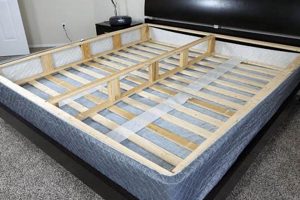
A box spring is a support system typically composed of a wooden or metal frame containing springs. Its traditional purpose is to elevate a mattress, absorb shock, and provide a stable, flat surface. Historically, most innerspring mattresses were designed to be used with this type of foundation for optimal support and longevity. The construction was intended to work in tandem for comfort and durability.
Employing a compatible foundation can significantly extend the lifespan of a mattress by evenly distributing weight and preventing sagging. Furthermore, elevation can enhance comfort and accessibility, making it easier to get in and out of bed. In the past, the lack of alternative support options meant the use of this system was largely considered essential for innerspring models.
However, advancements in mattress technology have introduced various alternatives that offer suitable support. Platform beds, adjustable bases, and even the floor can function as viable options depending on the mattress type and manufacturer recommendations. Evaluating these different support structures is crucial in determining the optimal setup for a specific mattress.
Guidance on Mattress Support Systems
Selecting an appropriate foundation is vital for mattress performance and longevity. Consider these guidelines to ensure optimal support and comfort.
Tip 1: Consult Manufacturer Guidelines: Always refer to the mattress manufacturer’s recommendations regarding foundation type. Deviating from these guidelines may void the warranty or compromise support.
Tip 2: Evaluate Mattress Type: Innerspring mattresses generally benefit from a supportive foundation, while memory foam or latex mattresses can often function effectively on platform beds or adjustable bases.
Tip 3: Assess Weight Distribution: Ensure the chosen foundation provides even weight distribution. Uneven support can lead to sagging and discomfort over time.
Tip 4: Consider Bed Frame Compatibility: Verify the foundation is compatible with the existing bed frame. Some frames require specific types of support systems.
Tip 5: Examine Foundation Height: Foundation height influences the overall bed height. Choose a height that promotes comfortable access and aligns with personal preferences.
Tip 6: Inspect Foundation Quality: Prioritize durable construction materials and robust support structures to ensure long-term stability.
Tip 7: Factor in Budget: Foundation costs can vary significantly. Explore available options and weigh features against budgetary constraints.
Adhering to these guidelines will help ensure the selection of a foundation that complements the mattress, promotes proper support, and enhances overall sleep quality.
By carefully assessing mattress requirements and available support systems, an informed decision can be made that avoids unnecessary expense or compromised comfort.
1. Support Requirements

The correlation between structural needs and necessity is direct. A mattress lacking proper support will exhibit reduced lifespan and diminished comfort. A traditional innerspring mattress, characterized by coils, inherently requires a stable, flat surface to maintain its structural integrity. Without adequate support, the coils compress unevenly, leading to sagging and compromised spinal alignment. For example, placing an innerspring mattress directly on a slatted bed frame with wide gaps can cause the coils to push through, accelerating wear and tear. Proper support effectively distributes weight, preventing premature failure and preserving the intended comfort level. This understanding forms a cornerstone for determining if a supplementary support system is necessary.
Conversely, some modern mattresses are engineered to function optimally without a conventional spring foundation. Memory foam and latex mattresses, for instance, often perform well on platform beds or adjustable bases. These designs typically offer inherent support due to their dense composition. A solid platform provides a uniform surface, eliminating the need for spring-based shock absorption. An adjustable base offers customized support and positioning. These examples illustrate that the support requirement is intrinsic to mattress construction and dictates foundation necessity. Manufacturer specifications typically outline acceptable support structures.
In conclusion, support requirements dictate the utility of supplemental systems. The construction of the mattress establishes support thresholds. Understanding these thresholds through manufacturer information and structural consideration enables suitable foundation selection. Deviating from recommended support structures compromises the integrity of the mattress, leading to potential warranty invalidation and decreased product longevity. Proper support ensures proper body alignment for better sleep quality. This interrelation defines whether a supplemental understructure proves critical or if it remains superfluous.
2. Warranty Implications

The use of an inappropriate foundation can have significant ramifications for mattress warranties. Manufacturers establish specific requirements regarding support structures, and deviations from these requirements may render the warranty null and void. This aspect necessitates careful consideration during mattress setup.
- Foundation Compatibility
Many mattress warranties stipulate the use of a compatible foundation. A box spring, platform bed, or adjustable base may be deemed acceptable, depending on the mattress type and manufacturer specifications. Using an unapproved foundation can lead to warranty denial if the mattress develops issues related to inadequate support. For example, using a standard box spring with a mattress specifically designed for a platform bed may invalidate the warranty if sagging occurs.
- Support Requirements
Warranties often specify minimum support requirements, such as the number and spacing of slats in a bed frame or the load-bearing capacity of a foundation. Insufficient support can cause premature wear and tear, which may not be covered under the warranty. Consider a memory foam mattress placed on a bed frame with widely spaced slats; the mattress may deform between the slats, leading to uneven support and potential warranty issues.
- Evidence of Misuse
Manufacturers may deny warranty claims if there is evidence of misuse or improper care, including the use of an unsuitable foundation. For instance, if a mattress is found to have been used directly on the floor, resulting in moisture damage or inadequate ventilation, the warranty may be voided. Documentation, such as photographs of the setup, may be required during the warranty claim process.
- Proper Bed Frame
A warranty may require that the mattress be used with a stable bed frame. Any damage caused by the poor build of a bed frame may not be covered if you make a claim. Ensure that the bed frame is the correct size for the mattress to prevent any damage, like slippage, from occurring.
In summary, adherence to manufacturer guidelines regarding foundation type is crucial for maintaining warranty coverage. Understanding the specific requirements outlined in the warranty documentation and selecting a compatible and supportive foundation can protect against potential claim denials and ensure the long-term value of the mattress investment. This link highlights the connection to the question of whether a particular support is required, where following the support recommendations within warranty documents can make or break a coverage claim.
3. Mattress Type

The composition of a mattress directly dictates its support requirements, thus influencing the necessity of a box spring. Innerspring mattresses, characterized by interconnected coils, typically benefit significantly from a supportive foundation. These foundations, whether traditional box springs or modern alternatives, provide a stable, even surface that prevents coil deformation and uneven wear. Without adequate support, the coils can sag, leading to discomfort and reduced mattress lifespan. This contrasts with other mattress types, such as memory foam, where a solid platform bed might suffice, negating the need for a spring-based foundation. The inherent structure of innerspring models necessitates specific support to maintain their integrity.
Memory foam and latex mattresses, constructed from dense, conforming materials, often require less rigid support than innerspring counterparts. These mattresses can function effectively on platform beds, adjustable bases, or even directly on the floor (provided ventilation is adequate), as their inherent density distributes weight evenly. However, manufacturer guidelines should always be consulted, as some memory foam or latex mattresses may still benefit from a foundation that promotes airflow and prevents moisture buildup. Hybrid mattresses, combining elements of innerspring and foam construction, present a middle ground, often requiring a foundation that offers both support and flexibility. For example, a hybrid mattress with a pocketed coil system and a thick memory foam layer might perform optimally on a platform bed with slats spaced closely together, providing a balance of support and ventilation.
In conclusion, the internal architecture of a mattress acts as a primary determinant in deciding whether a box spring or alternative foundation is necessary. A thorough evaluation of the mattress type, coupled with careful consideration of manufacturer recommendations, ensures the selection of an appropriate support system that maximizes comfort, prolongs mattress lifespan, and preserves warranty coverage. Recognizing this relationship proves essential in making an informed decision and achieving optimal sleep quality.
4. Alternative Foundations
The emergence of alternative foundations presents a shift in the traditional understanding of mattress support, directly impacting the perception of whether a box spring is essential. These alternatives, including platform beds, adjustable bases, and slatted frames, offer varied support mechanisms that can, in certain cases, negate the necessity of a traditional box spring. For instance, a solid platform bed provides a firm, uniform surface, offering adequate support for many memory foam or latex mattresses. This contrasts with the traditional box spring, designed primarily to support innerspring mattresses by absorbing shock and distributing weight.
The suitability of an alternative foundation hinges on mattress type and manufacturer specifications. Platform beds, with their solid or closely slatted surfaces, offer a stable base for mattresses that require firm support but not the springiness of a box spring. Adjustable bases, on the other hand, allow for customized positioning, catering to individual comfort preferences and potentially alleviating certain health conditions. However, using an incompatible foundation can compromise mattress integrity and void warranties. A lightweight, widely-spaced slatted frame, for example, may not provide sufficient support for a heavy hybrid mattress, leading to sagging and premature wear. Therefore, the viability of these options must be assessed in relation to the mattress’s specific requirements.
In summary, alternative foundations offer practical substitutes for box springs, contingent upon mattress compatibility and adherence to manufacturer guidelines. The choice between a traditional box spring and an alternative should be guided by the mattress type, support needs, and warranty considerations. While these options provide flexibility and potentially enhanced comfort, their effectiveness relies on a thorough understanding of the mattress’s structural requirements. Selecting the appropriate foundation ensures optimal support, prolongs mattress lifespan, and preserves warranty coverage.
5. Budget Considerations
Financial constraints significantly influence decisions regarding mattress support systems. The choice between using a box spring and exploring alternatives often hinges on budgetary limitations and a cost-benefit analysis.
- Initial Purchase Price
A complete bed setup, including both a mattress and a box spring, typically incurs a higher initial purchase price compared to simply buying a mattress. Box springs themselves can range in cost, with more elaborate models featuring enhanced support or premium materials commanding a higher price. Budget-conscious consumers may explore alternatives like platform beds, which eliminate the need for a separate support structure, reducing upfront expenses. The long-term impact on the mattress is a key consideration.
- Longevity and Replacement Costs
While a box spring may represent an added expense, it can potentially extend the lifespan of certain mattress types, particularly innerspring models. Proper support reduces wear and tear, delaying the need for mattress replacement. Conversely, using an unsuitable or inadequate foundation can accelerate mattress degradation, leading to premature replacement and increased long-term costs. Evaluating the potential lifespan extension against the initial cost is crucial.
- Alternative Foundation Options
Platform beds and adjustable bases offer alternatives to traditional box springs, each with varying price points. Platform beds can range from inexpensive DIY options to high-end designer models. Adjustable bases typically represent a more significant investment but offer added functionality and potential health benefits. Exploring these alternatives requires balancing budgetary limitations with desired features and long-term value. It’s important to choose a good bed frame that offers the support for the mattress.
- Warranty Requirements
Budget-conscious choices should not compromise warranty compliance. Failing to meet the manufacturer’s recommended support system requirements can void the warranty, leaving the consumer responsible for repair or replacement costs. Considering the potential financial implications of warranty voidance is paramount when making budget-driven decisions. Research thoroughly what types of bed frames are warranty-friendly.
Therefore, integrating budget considerations into the decision-making process necessitates a holistic assessment encompassing initial purchase price, potential lifespan extension, alternative foundation options, and warranty compliance. Balancing these factors allows for a financially prudent choice that aligns with both budgetary constraints and long-term mattress performance.
6. Comfort Preferences

Individual sleeping preferences significantly influence the choice of mattress support system. The decision to utilize a box spring, or an alternative, often hinges on subjective factors related to desired bed height, firmness, and overall sleep experience.
- Bed Height and Accessibility
A traditional box spring adds considerable height to the mattress, which may be preferred by individuals who find it easier to get in and out of a higher bed. Conversely, some individuals, particularly those with mobility issues or a preference for a lower profile bed, may opt for a platform bed or low-profile foundation, negating the necessity of additional height. The impact of bed height on ease of access is a primary consideration.
- Firmness and Support Feel
The foundation type affects the overall firmness and support feel of the mattress. A box spring, particularly one with springs, can add a degree of “give” or responsiveness to the sleep surface. This may be desirable for individuals who prefer a softer feel. In contrast, a solid platform bed provides a firmer, more unyielding surface, which may be preferred by those seeking enhanced support and spinal alignment. This highlights the subjective relationship with mattress comfort.
- Motion Isolation
The ability to isolate motion is another factor influenced by the choice of support system. Box springs, especially older models, may transfer motion more readily than solid platform beds or adjustable bases. Individuals who share a bed with a partner may prioritize motion isolation to minimize sleep disturbances. Therefore, the selection of the foundation should align with the desired level of motion isolation. The construction of the foundation materials play a key role.
- Aesthetic Preferences
The visual appeal of the bed setup also contributes to comfort preferences. Some individuals prefer the classic look of a traditional bed frame with a box spring, while others favor the clean lines of a platform bed or the modern functionality of an adjustable base. This illustrates the connection between subjective comfort and aesthetic appreciation. It is important to align any choice of support with the room that it is to go in.
In summary, comfort preferences are a critical determinant in the choice of mattress support system. Evaluating these subjective factors, including bed height, firmness, motion isolation, and aesthetic considerations, ensures a personalized sleep experience that aligns with individual needs and preferences. These preferences help shape whether a box spring proves essential or if a different structure is preferable.
Frequently Asked Questions
This section addresses common inquiries regarding the necessity of employing a specific foundation. Clarification of common support questions enables informed choices.
Question 1: Must all innerspring mattresses be used with a box spring?
Not necessarily. While traditional innerspring mattresses were designed to function optimally with a box spring, alternative foundations like platform beds or adjustable bases can provide adequate support if they meet the manufacturer’s specifications regarding slat spacing and weight capacity.
Question 2: What happens if a mattress is used without any foundation?
Using a mattress directly on the floor or on an unsupportive surface can lead to premature wear and tear, sagging, and potential voidance of the warranty. It may also impede airflow, contributing to moisture buildup and potential mold growth.
Question 3: Will using the wrong type of foundation void the mattress warranty?
Yes, using an incompatible foundation can void the mattress warranty. Manufacturers often specify the types of foundations that are approved for use with their mattresses. Deviating from these recommendations can lead to warranty denial if issues arise due to inadequate support.
Question 4: Are platform beds a suitable replacement for box springs?
Platform beds can serve as a suitable replacement for box springs, provided they offer a solid or closely slatted surface that provides adequate support and prevents sagging. The suitability of a platform bed depends on the specific mattress type and manufacturer recommendations.
Question 5: How does the foundation affect the comfort of a mattress?
The foundation influences the overall firmness and support feel of the mattress. A box spring can add a degree of responsiveness, while a solid platform bed provides a firmer surface. Choosing a foundation that complements individual comfort preferences is crucial.
Question 6: Can an adjustable base be used with any type of mattress?
While many mattresses are compatible with adjustable bases, certain models, particularly those with stiff or inflexible constructions, may not be suitable. Always consult the mattress manufacturer’s guidelines to ensure compatibility and prevent damage.
The selection of an appropriate foundation, therefore, requires careful consideration of mattress type, manufacturer guidelines, warranty requirements, budget constraints, and individual comfort preferences. Understanding these factors empowers informed decision-making.
The next section details the types of foundations available for mattresses.
Determining Foundation Requirements
This exploration of whether a mattress has to have a box spring highlights the multifaceted nature of mattress support. Key considerations include mattress type, manufacturer guidelines, warranty implications, budget constraints, and comfort preferences. Understanding these elements is crucial for selecting an appropriate foundation that maximizes mattress longevity, maintains warranty coverage, and ensures optimal sleep quality. Alternative foundation options, such as platform beds and adjustable bases, offer viable substitutes for box springs, provided they meet specific mattress support needs.
Ultimately, the necessity of a particular support system hinges on the interplay of these factors. Careful assessment and informed decision-making are paramount. Consultation with mattress manufacturers and retailers can provide valuable insights. Prioritizing proper support is essential for achieving restful sleep and preserving the investment in a quality mattress.
![Best Twin Bed Mattress & Box Springs [Deals] | Organic & Natural Mattress Buyer’s Guide: Non-Toxic Sleep Solutions](https://mattressworldpa.com/wp-content/uploads/2025/07/th-3472-300x200.jpg "Best Twin Bed Mattress & Box Springs [Deals] Organic & Natural Mattress Buyer’s Guide: Non-Toxic Sleep Solutions")
![Find Your Best Boxed Mattress: [Brand] & Beyond | Organic & Natural Mattress Buyer’s Guide: Non-Toxic Sleep Solutions](https://mattressworldpa.com/wp-content/uploads/2025/07/th-3469-300x200.jpg "Find Your Best Boxed Mattress: [Brand] & Beyond Organic & Natural Mattress Buyer’s Guide: Non-Toxic Sleep Solutions")