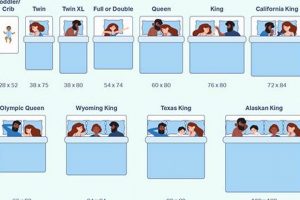
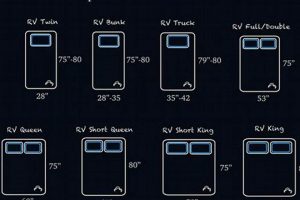
A resource displaying the dimensions of mattresses commonly categorized as ‘double’ or ‘full’ is crucial for consumers and retailers. This visual aid, often presented in a tabular format, specifies the length and width measurements, typically in inches or centimeters, of these mattresses. For example, a standard chart may indicate that a double mattress measures 54 inches wide by 75 inches long.
Such a guide offers several benefits. It provides clarity when selecting a mattress, ensuring compatibility with bed frames and available bedroom space. Furthermore, it aids in purchasing correctly sized bedding, thereby minimizing the inconvenience of returns or exchanges. Historically, these charts have evolved alongside standard mattress dimensions, reflecting the increasing need for standardized sizes in the bedding industry.
The following sections will delve into specific aspects of mattress dimensions, including variations in size, the impact of mattress type on perceived space, and considerations for choosing the right mattress based on individual needs and circumstances.
Essential Information for Selecting a Properly Sized Mattress
The following guidelines serve to provide critical insights when evaluating mattress dimensions, ensuring an informed decision and optimal sleep experience.
Tip 1: Confirm Room Dimensions. Prior to examining any size specifications, accurately measure the intended bedroom space. This step is paramount to guaranteeing the mattress will fit comfortably, leaving adequate room for movement and other furniture.
Tip 2: Scrutinize Bed Frame Compatibility. Match mattress dimensions to the interior measurements of the bed frame. Discrepancies can lead to instability, reduced mattress lifespan, and potential safety hazards.
Tip 3: Consider Sleeper Occupancy. For single sleepers, a double may offer ample space, while for couples, it may prove insufficient. A larger mattress, such as a queen or king, may be more suitable to minimize sleep disturbance and maximize individual comfort.
Tip 4: Evaluate Body Size and Sleeping Style. Taller individuals or those who prefer to stretch out require a mattress with adequate length and width. Side sleepers may benefit from a mattress with greater surface area to accommodate their preferred position.
Tip 5: Compare Mattress Thickness. Thickness can influence overall bed height and ease of getting in and out of bed. Factor in the thickness of the mattress alongside the bed frame height to determine the optimal bed height for individual needs.
Tip 6: Understand Dimensional Variations. Minor differences in mattress dimensions may exist between manufacturers. Always consult the specific dimensions provided by the seller to ensure accurate comparisons.
Tip 7: Prioritize Long-Term Comfort. Selecting the right mattress size is an investment in sleep quality and overall well-being. Consider the long-term implications of the decision, weighing factors such as space constraints and future lifestyle changes.
Adhering to these guidelines ensures a well-informed mattress selection process, promoting restful sleep and maximizing the utilization of bedroom space.
The subsequent section will outline key considerations in choosing a mattress based on factors beyond just dimensions.
1. Standard dimensions

The standard dimensions of a double mattress constitute a fundamental element of any size chart pertaining to this specific mattress type. The chart’s primary purpose is to communicate these precise measurements, typically 54 inches in width and 75 inches in length, to consumers and retailers. The accuracy and clarity of this information are critical, as deviations can lead to incompatibility with bed frames and bedding, causing practical difficulties for the end user. For instance, a chart displaying incorrect dimensions could result in a consumer purchasing a mattress that does not properly fit their existing bed frame, necessitating a return or exchange.
The importance of standardized dimensions becomes particularly evident in mass-produced bedding. Manufacturers rely on consistent mattress sizes to ensure that sheets, comforters, and other accessories are uniformly compatible. Without adherence to standard dimensions, consumers would face significant challenges in finding appropriately sized bedding, hindering the functionality and convenience associated with mattress ownership. The presence of a reliable size chart serves as a crucial reference point, facilitating seamless integration of the mattress into a cohesive bedding system.
In conclusion, the reliance on standard dimensions is inextricably linked to the utility and relevance of a double mattress size chart. The chart’s informational value stems directly from its ability to accurately and consistently convey the established measurements of the double mattress. Challenges arise when variations exist or when misleading information is presented, underscoring the need for rigorous quality control in the creation and dissemination of these informational resources. The understanding of this connection is essential for both consumers and businesses operating within the bedding industry.
2. Bed frame compatibility

Bed frame compatibility represents a critical consideration directly linked to the function and application of a double mattress size chart. The chart’s primary utility lies in facilitating informed purchasing decisions, and ensuring bed frame compatibility is a central component of this process. Failure to consider the dimensional specifications outlined within the chart can result in significant practical problems, such as the inability to securely and properly support the mattress.
The consequences of mismatched dimensions are varied. A mattress that is too large for a frame may overhang, creating instability and potential for damage. Conversely, a mattress that is too small can shift within the frame, leading to uneven weight distribution and discomfort. The “double mattress size chart” is thus not merely a collection of numbers but a tool to prevent these scenarios. For example, purchasing a bed frame designed for a full mattress without consulting the size chart to verify internal dimensions could lead to a structurally unsound and uncomfortable sleeping arrangement.
Ultimately, the link between bed frame compatibility and the function of a “double mattress size chart” hinges on the practicality of matching physical dimensions. Consulting and accurately interpreting the chart before purchasing either a mattress or a bed frame represents a preventative measure against incompatibility. Such informed actions are integral to maximizing the lifespan and comfort of both the mattress and the bed frame, ensuring a stable and functional sleeping environment.
3. Sleeping space needed

The determination of adequate sleeping space is a crucial preliminary step directly influencing the effective utilization of a double mattress size chart. The dimensions indicated on the chart must correlate with the actual space requirements of the individual or individuals intended to use the mattress. Failure to adequately assess these spatial needs renders the information provided by the chart practically irrelevant.
- Individual Occupancy vs. Shared Occupancy
For a single occupant, a double mattress may offer ample space for unrestricted movement during sleep. However, when shared by two individuals, the same mattress may prove constricting, leading to discomfort and disturbed sleep patterns. The chart must therefore be considered in light of the anticipated occupancy, with attention paid to individual preferences for personal space.
- Body Size and Sleeping Position
Individuals with larger body frames or those who tend to spread out significantly during sleep necessitate a greater surface area than may be provided by a standard double mattress. The size chart must be evaluated in conjunction with the sleeper’s physical dimensions and preferred sleeping positions. For example, a tall individual may find the length of a double mattress insufficient, requiring a larger alternative despite the chart indicating adequate width.
- Co-Sleeping and Pet Considerations
The presence of children or pets co-sleeping on the mattress further reduces available sleeping space, requiring adjustments to the size assessment. The chart’s dimensions must be interpreted in light of this additional occupancy. A double mattress, adequate for two adults, may become overcrowded and uncomfortable with the addition of a child or pet, necessitating a larger mattress size not initially considered based on the chart alone.
- Movement and Restless Sleep
Individuals who are prone to significant movement or restless sleep require additional space to prevent disturbing their sleep partner or falling off the mattress. A double mattress, while potentially sufficient in overall size according to the chart, may prove inadequate in practice due to the dynamic nature of sleep. This factor requires a more subjective assessment beyond the strictly dimensional data provided by the chart.
In conclusion, the information conveyed by a double mattress size chart must be contextualized by a thorough assessment of the sleeping space required by its intended occupants. Factors such as occupancy, body size, sleeping position, and movement during sleep all contribute to the determination of the appropriateness of a double mattress, making the size chart a tool that must be wielded with careful consideration of individual needs and circumstances.
4. Room size limitations
The constraints imposed by room dimensions significantly influence the practical application of a double mattress size chart. While the chart provides precise measurements of a mattress, its utility is contingent upon the compatibility of those dimensions with the physical limitations of the intended space. Overlooking this crucial relationship can lead to logistical challenges and dissatisfaction with the final arrangement.
- Minimum Clearance Requirements
Effective utilization of the bedroom necessitates sufficient clearance around the mattress for movement and access. A double mattress, while seemingly compact, may impede navigation within a small room if insufficient space is left for walking, opening doors, or accessing closets. The size chart data must be considered in conjunction with the room’s layout to ensure adequate free space remains post-installation.
- Furniture Placement Considerations
Bedroom furniture, such as dressers, nightstands, and desks, occupies valuable floor space that must be accounted for when evaluating mattress size. A double mattress, when combined with existing or planned furniture, may create a cramped or cluttered environment, diminishing the room’s functionality and aesthetic appeal. The charts dimensions must inform a holistic space planning strategy that integrates all elements present within the room.
- Doorway and Stairwell Accessibility
The practicality of installing a double mattress is contingent upon its ability to physically fit through doorways, stairwells, and hallways. A large or unusually shaped mattress may encounter difficulties during transport and setup, potentially necessitating alternative delivery methods or rendering it entirely unsuitable for the space. This logistical constraint must be assessed prior to purchase, factoring in the accessibility of the room itself.
- Window and Radiator Obstructions
The placement of windows and radiators can impose further limitations on mattress size and placement. A double mattress positioned in front of a window may obstruct natural light or hinder ventilation, while placement against a radiator can pose safety hazards or compromise heating efficiency. The size charts data must be analyzed in light of these architectural features to ensure optimal placement and functionality.
The interplay between room size restrictions and the data presented in a double mattress size chart underscores the importance of a comprehensive spatial assessment prior to any purchase. Ignoring these constraints can lead to impractical and unsatisfactory outcomes, highlighting the need for meticulous planning and informed decision-making within the context of bedroom furnishings.
5. Bedding fit assurance

Bedding fit assurance is directly contingent upon accurate dimensional knowledge of the mattress, rendering the double mattress size chart a crucial tool. Discrepancies between stated mattress dimensions and actual bedding measurements result in compromised comfort and functionality.
- Sheet Size Alignment
Fitted sheets require precise correspondence with mattress dimensions to ensure secure placement and prevent slippage. A double mattress size chart provides the necessary information to select sheets with appropriate pocket depths and overall dimensions. Insufficient depth leads to detachment, while oversized sheets bunch and wrinkle, reducing sleep quality.
- Comforter and Duvet Cover Proportions
Comforters and duvet covers must adequately cover the mattress surface to provide warmth and aesthetic appeal. The size chart enables consumers to choose covers with sufficient width and length to avoid exposing the sides or foot of the bed. Under-sized coverings compromise thermal insulation and detract from visual uniformity.
- Bedspread and Quilt Overhang
Bedspreads and quilts are selected based on desired overhang beyond the mattress edges. The size chart informs the calculation of appropriate bedspread dimensions to achieve the intended aesthetic. Insufficient overhang appears visually unbalanced, while excessive overhang may interfere with floor access.
- Mattress Protector and Topper Compatibility
Mattress protectors and toppers are designed to conform closely to the mattress surface, preserving its integrity and enhancing comfort. Accurate dimensional data from the size chart allows consumers to select protectors and toppers that fit snugly, preventing shifting and maintaining optimal performance. Ill-fitting protectors or toppers can compromise their intended benefits and reduce mattress lifespan.
In essence, the double mattress size chart serves as a critical reference point for ensuring compatibility between the mattress and its associated bedding components. Accurate utilization of this information leads to enhanced comfort, improved functionality, and optimized aesthetic outcomes within the bedroom environment.
6. International variations
Variations in mattress dimensions across international markets introduce complexity into the utilization of a double mattress size chart. Standardization efforts are primarily regional, resulting in inconsistencies that necessitate careful consideration during cross-border transactions and bedding purchases.
- Nomenclature Divergence
The term “double” or “full” mattress can denote differing dimensions depending on the geographical location. A mattress marketed as “double” in North America may not correspond to the dimensions of a mattress similarly labeled in Europe or Asia. This semantic variation necessitates a thorough dimensional comparison before any purchase is made.
- Metric vs. Imperial Measurement Systems
The use of metric versus imperial measurement systems contributes to dimensional discrepancies. Size charts employing inches and feet are not directly transferable to markets where centimeters and meters are standard. Conversion errors can lead to mismatched bed frames and bedding, causing practical difficulties for consumers.
- Regional Dimensional Standards
Distinct regional standards dictate the precise dimensions of mattresses categorized as “double” or “full”. For example, the European “double” typically differs in both width and length compared to its North American counterpart. Ignoring these regional variations can lead to purchasing incompatible mattresses or bedding.
- Customary Bedding Availability
Bedding, such as sheets and comforters, is manufactured to align with regional mattress dimensions. Purchasing a mattress from one country and attempting to use bedding from another may result in ill-fitting accessories. This consideration is crucial for consumers who import mattresses or bedding from international sources.
The confluence of these international variations underscores the importance of rigorously verifying dimensions against established standards within the intended region of use. Reliance solely on categorical labels like “double” or “full” is insufficient; instead, precise measurements should guide purchasing decisions to ensure compatibility and avoid practical complications.
Frequently Asked Questions Regarding Double Mattress Dimensions
The following questions address common points of confusion and provide clarity on aspects of mattress dimensions.
Question 1: What are the standard dimensions of a double mattress, and are these dimensions consistent across all manufacturers?
A double mattress typically measures 54 inches in width and 75 inches in length. While these dimensions represent an industry standard, slight variations may occur between manufacturers. Consumers should consult the specifications provided by the specific manufacturer to ensure accurate measurements.
Question 2: How does mattress thickness affect the overall bed height, and what considerations should be made regarding this dimension?
Mattress thickness contributes directly to the overall height of the bed. Considerations should include the bed frame height and the ease of getting in and out of bed. A mattress that is too thick or thin can create discomfort or pose challenges for individuals with mobility limitations.
Question 3: Is a double mattress suitable for two adults, and what alternative sizes should be considered for couples?
A double mattress may be inadequate for two adults, especially those who prefer ample personal space or tend to move significantly during sleep. Queen or king-size mattresses offer greater surface area and are generally recommended for couples.
Question 4: How do international mattress dimensions differ from those in North America, and what precautions should be taken when purchasing mattresses or bedding from abroad?
International mattress dimensions can vary significantly from North American standards. Consumers should verify the dimensions in inches or centimeters and compare them to North American sizes to ensure compatibility with bed frames and bedding. Conversion tools and size charts are readily available online for this purpose.
Question 5: What factors should be considered when choosing a mattress size for a guest room, and how does this differ from choosing a mattress for a primary bedroom?
Guest room mattress size should balance comfort and space efficiency. While a king or queen mattress may be desirable for a primary bedroom, a double or twin mattress may be more practical for a guest room with limited space. Consider the typical occupant and available room dimensions when making this decision.
Question 6: How can discrepancies in mattress dimensions be resolved, and what recourse is available if a mattress does not meet the advertised specifications?
Discrepancies in mattress dimensions should be addressed with the retailer or manufacturer. Most reputable companies offer return or exchange policies for mattresses that do not meet advertised specifications. Retaining proof of purchase and documenting the dimensional discrepancy are essential for resolving such issues.
Understanding these frequently asked questions provides consumers with a foundation for making informed decisions regarding mattress dimensions.
The subsequent section will address potential challenges encountered when selecting a mattress and offer troubleshooting strategies.
Essential Information for Selecting a Properly Sized Mattress
This exploration has elucidated the critical role of the “double mattress size chart” in facilitating informed decisions. The accuracy of dimensions, compatibility with bed frames, assessment of sleeping space, accounting for room limitations, ensuring bedding fit, and understanding international variations have all been identified as essential factors. The ramifications of neglecting any of these elements can range from discomfort to practical incompatibility.
Therefore, a comprehensive understanding of mattress dimensions, as conveyed by the size chart, represents a fundamental prerequisite for a successful purchase. Vigilance in verifying measurements and considering individual needs remains paramount to optimizing sleep quality and maximizing the utility of bedroom space. This knowledge empowers consumers to navigate the market with greater confidence and to avoid potential pitfalls associated with dimensional discrepancies.
![Best Queen Size Adjustable Mattress [Deals] | Organic & Natural Mattress Buyer’s Guide: Non-Toxic Sleep Solutions](https://mattressworldpa.com/wp-content/uploads/2025/07/th-2362-300x200.jpg "Best Queen Size Adjustable Mattress [Deals] Organic & Natural Mattress Buyer’s Guide: Non-Toxic Sleep Solutions")

![RV Comfort: Custom Size Mattress for RVs [Guide] | Organic & Natural Mattress Buyer’s Guide: Non-Toxic Sleep Solutions](https://mattressworldpa.com/wp-content/uploads/2025/07/th-2359-300x200.jpg "RV Comfort: Custom Size Mattress for RVs [Guide] Organic & Natural Mattress Buyer’s Guide: Non-Toxic Sleep Solutions")