



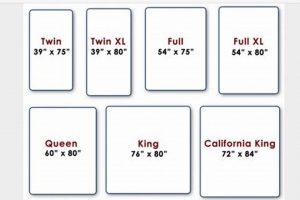
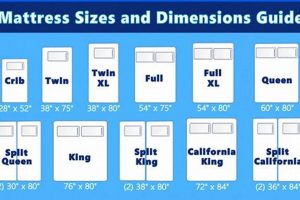
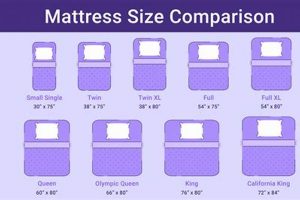
A bed size slightly longer than a standard twin, this configuration offers increased length for taller individuals who find a regular twin insufficient. This extended sleeping surface is commonly found in dorm rooms or smaller spaces where maximizing length is prioritized over width. These mattresses typically maintain the same width as a standard twin, approximately 38 inches, but feature an extended length, usually around 80 inches.
The extended length provides enhanced comfort and support for growing children, teenagers, and adults who require additional legroom. This can contribute to improved sleep quality by allowing for full extension without feet hanging off the edge. Historically, this particular size has become increasingly popular as average heights have increased, and smaller living spaces necessitate efficient use of available square footage.
The subsequent sections will delve into the specific dimensions, common uses, available accessories, and factors to consider when selecting this specialized sleeping solution. Considerations regarding bed frames, bedding options, and appropriate demographics will also be addressed.
Tips for Selecting an Extra Large Twin Mattress
This section provides guidance on selecting a sleeping surface that prioritizes individual needs and spatial considerations.
Tip 1: Measure Available Space: Prior to purchase, accurately measure the dimensions of the room where the extended twin will be placed. Ensure sufficient clearance for movement and other furniture.
Tip 2: Consider Sleeper Height: Evaluate the height of the intended user. Individuals exceeding six feet in height will benefit most significantly from the added length.
Tip 3: Evaluate Support Requirements: Assess the individual’s preferred sleeping position and weight. Select a mattress with appropriate firmness and support to maintain spinal alignment.
Tip 4: Investigate Mattress Materials: Research different mattress materials, such as memory foam, innerspring, or latex. Each material offers unique comfort and durability characteristics.
Tip 5: Review Warranty and Return Policies: Understand the manufacturer’s warranty and return policies before making a purchase. This protects against potential defects or dissatisfaction.
Tip 6: Inspect Bed Frame Compatibility: Confirm that the existing or intended bed frame is specifically designed to accommodate the dimensions of an extra long twin mattress. A standard twin frame will not be suitable.
Tip 7: Account for Bedding Needs: Recognize that specialized bedding, such as sheets and comforters, is often required for this specific mattress size. Factor this additional expense into the overall budget.
By carefully considering these tips, individuals can make informed decisions when acquiring this particular sleeping surface. The implementation of these tips will provide for informed decisions, leading to optimal sleep and proper posture.
The following sections will explore accessories and specific considerations when purchasing a bed frame for this extended twin mattress.
1. Dimensions

Dimensions are foundational when considering an extended twin mattress. The precise measurements dictate compatibility with bed frames, available bedroom space, and the comfort level experienced by the user. Understanding these dimensions is crucial for making an informed purchase decision.
- Length
The defining characteristic of an extra large twin is its extended length, typically measuring around 80 inches. This additional length caters to taller individuals, preventing discomfort caused by feet hanging off the edge of the bed. Failure to account for this length may result in an unsuitable fit within smaller rooms or incompatibility with standard twin bed frames.
- Width
The width of the mattress remains consistent with a standard twin, generally measuring about 38 inches. This narrower profile allows for placement in smaller spaces, such as dorm rooms or compact bedrooms. While the length is augmented, the unchanged width ensures it remains a space-saving option.
- Thickness/Height
Thickness, or height, can vary significantly based on the mattress construction and materials. Thicker mattresses may provide enhanced comfort and support but could also impact the overall bed height, influencing the ease of getting in and out. Selecting an appropriate thickness is vital for optimizing comfort and accommodating potential mobility limitations.
- Weight
Weight is a dimensional factor that impacts maneuverability and bed frame selection. These mattresses tend to be heavier than standard twins due to their increased size and material volume. Consideration of weight is essential, especially if frequent movement or relocation is anticipated.
In conclusion, a thorough evaluation of dimensions, encompassing length, width, thickness, and weight, is indispensable for selecting the correct size. Each dimension plays a critical role in ensuring a proper fit within the intended space, compatibility with bed frames, and overall user comfort. Neglecting these dimensional aspects can result in an ill-suited mattress, compromising sleep quality and potentially leading to discomfort.
2. Firmness

Firmness, in the context of an extra large twin mattress, is a crucial factor determining sleep quality and comfort. It directly influences spinal alignment, pressure point relief, and overall support. The optimal firmness level is subjective and depends on individual preferences, sleeping positions, and body weight.
- Spinal Alignment
Mattress firmness plays a vital role in maintaining proper spinal alignment during sleep. A mattress that is too soft may cause the spine to sag, while one that is too firm may create pressure points. The ideal firmness level supports the natural curvature of the spine, minimizing discomfort and preventing potential back pain. For an extra large twin, ensuring proper alignment is particularly important for taller individuals, as improper support can exacerbate spinal issues.
- Pressure Point Relief
Firmness directly impacts pressure point relief, particularly at the shoulders, hips, and knees. A mattress with inadequate firmness may not distribute weight evenly, leading to localized pressure and discomfort. Conversely, a mattress that is too firm may not conform to the body’s contours, resulting in similar pressure points. Proper pressure point relief is essential for promoting circulation and preventing tossing and turning during sleep. On an extended twin, this becomes even more critical as the sleeper has more room to shift and potentially exert pressure on different areas.
- Sleeping Position
Preferred sleeping position significantly influences the optimal firmness level. Side sleepers generally benefit from a softer mattress that allows the shoulder and hip to sink in, maintaining spinal alignment. Back sleepers often prefer a medium-firm mattress that provides support while conforming to the body’s shape. Stomach sleepers typically require a firmer mattress to prevent the abdomen from sinking too far, which can strain the lower back. This variability must be considered when selecting firmness levels for an extended-length twin, especially if the user alternates between sleeping positions.
- Body Weight
Body weight is a key determinant of appropriate mattress firmness. Individuals with higher body weights generally require a firmer mattress to provide adequate support and prevent excessive sinking. Conversely, individuals with lower body weights may find a softer mattress more comfortable, as it allows for greater contouring and pressure relief. Selecting the appropriate firmness based on body weight is critical for maximizing comfort and preventing long-term discomfort, particularly when a taller person uses an extra long twin.
Therefore, selecting the appropriate firmness level for an extra large twin requires a careful consideration of individual factors such as spinal alignment needs, pressure point sensitivities, preferred sleeping position, and body weight. The interplay of these elements will ultimately determine the optimal sleeping experience and contribute to long-term comfort and health. Failure to address these variables results in dissatisfaction and potential health implications.
3. Support
In the context of an extra large twin mattress, “support” refers to the mattress’s ability to maintain proper spinal alignment and distribute weight evenly across its surface. This is especially critical given the mattress’s extended length, which is designed to accommodate taller individuals. Inadequate support can lead to discomfort, back pain, and disrupted sleep, negating the benefits of the increased length. For example, a mattress with insufficient support may cause the spine to sag, leading to lower back strain and discomfort, particularly for heavier individuals. Conversely, a mattress with appropriate support will maintain the natural curvature of the spine, reducing pressure points and promoting a more restful sleep.
The importance of support can be demonstrated through real-life scenarios. Consider a college student using an extended twin in a dorm room. If the mattress lacks adequate support, the student may experience chronic back pain, which can affect their academic performance and overall well-being. Conversely, a mattress offering proper support can improve sleep quality, leading to increased focus and productivity. In practical terms, understanding the support characteristics of the mattress, such as the type of coil system or foam density, allows consumers to make informed decisions. For instance, a pocketed coil system can provide targeted support, reducing motion transfer and conforming to the body’s shape, while high-density foam offers consistent support across the entire surface.
In summary, the “support” component of an extra large twin mattress is not merely a comfort feature but a fundamental aspect of its functionality. It directly impacts spinal health, sleep quality, and overall well-being. Understanding the different types of support available and how they cater to individual needs is crucial for selecting a mattress that meets specific requirements. Challenges remain in accurately assessing support levels without physically testing the mattress; however, relying on manufacturer specifications and independent reviews can provide valuable insights. The connection between support and mattress quality highlights the importance of investing in a product that prioritizes both comfort and proper spinal alignment.
4. Material

The selection of materials for an extra large twin mattress directly impacts its durability, comfort, and overall performance. The larger surface area, relative to a standard twin, means material properties become even more critical. For instance, a low-density foam core will compress and degrade more rapidly in an extra long twin, particularly under the weight of a taller individual, leading to sagging and reduced support. Conversely, using higher-density foams or incorporating innerspring systems can mitigate this issue, extending the lifespan and maintaining consistent support. Consider a dormitory setting, where these mattresses often see heavy use; a mattress with robust, high-quality materials withstands wear and tear more effectively, providing long-term value and minimizing the need for frequent replacements.
Different materials offer varying degrees of thermal regulation, which is another significant consideration. Memory foam, known for its conforming properties, can retain heat, potentially causing discomfort for some sleepers. Open-cell foams or incorporating breathable materials like latex or natural fibers can improve airflow and reduce heat retention. Furthermore, the cover material plays a role in moisture management and hygiene. Fabrics with moisture-wicking properties can help keep the sleeping surface dry, preventing the growth of mold and bacteria. The choice of materials also influences the mattress’s weight, affecting ease of handling and transport. For example, a hybrid mattress combining innersprings with multiple foam layers will likely be heavier than a purely foam mattress of similar dimensions.
In summary, the materials used in an extra large twin mattress are integral to its functionality and longevity. The selection process should prioritize durability, comfort, and thermal regulation to ensure a high-quality sleeping experience. The challenges related to material selection include balancing cost with performance and navigating the complex array of options available. Understanding the properties of different materials and their implications for mattress performance enables informed purchasing decisions, ultimately leading to greater satisfaction and a longer-lasting product.
5. Durability
Durability, with respect to the extra large twin mattress, refers to its capacity to withstand prolonged use and maintain its original structural integrity and performance characteristics over an extended period. A mattress’s durability directly impacts its long-term value and cost-effectiveness. A less durable mattress will require more frequent replacement, resulting in higher overall expenses and increased environmental impact. This is particularly significant in settings where such mattresses are commonly used, such as college dormitories, summer camps, and guest rooms, where they may experience consistent and varied usage patterns. The construction materials, manufacturing processes, and overall design contribute significantly to a mattresss durability.
The consequences of inadequate durability manifest in several ways. Sagging, indentations, and loss of support can compromise sleep quality, potentially leading to discomfort and health issues. Edge support degradation can reduce the usable sleeping surface and increase the risk of rolling off the mattress. Fabric tears and seam failures can compromise hygiene and aesthetics. In practical
terms, a durable extra large twin mattress should resist these issues, maintaining its shape, support, and comfort levels for several years. Regular rotation and proper support from a compatible bed frame can extend the lifespan of a durable mattress. Evaluating warranty terms and reviewing independent product tests provide insights into a mattress’s expected lifespan and durability.
Ultimately, the durability of an extra large twin mattress is a critical factor in determining its long-term suitability. By understanding the factors that contribute to or detract from durability, and by carefully evaluating product specifications and user reviews, purchasers can make informed decisions that optimize value and minimize the environmental impact of mattress replacements. The ability to withstand consistent usage patterns without significant degradation is paramount, directly influencing user satisfaction and the overall cost of ownership.
6. Bed Frames
The relationship between bed frames and extra large twin mattresses is one of necessary compatibility. An extra large twin mattress, with its specific dimensions, requires a bed frame designed to accommodate its length. A standard twin bed frame will not suffice, as it lacks the necessary length, leading to inadequate support and potential damage to the mattress. This underscores the importance of selecting a bed frame specifically manufactured for extra large twin mattresses. The effect of using an incompatible bed frame can range from reduced mattress lifespan to compromised sleep quality due to uneven support. For instance, placing an extra large twin mattress on a standard twin frame leaves a portion of the mattress unsupported, causing it to sag prematurely in that area.
Bed frames serve as the structural foundation for the mattress, influencing its comfort and longevity. Beyond simple support, bed frames impact aesthetics, storage options, and even the ease of getting in and out of bed. An appropriate bed frame provides uniform support, preventing deformation and maximizing the mattress’s intended lifespan. Bed frames with integrated slats, for example, offer enhanced support and ventilation compared to those with a solid foundation. This is particularly relevant in dormitories or smaller living spaces, where optimized use of space and durability are paramount. Examples of suitable bed frames include platform beds, adjustable beds designed for extra long twin mattresses, and those with headboards and footboards that provide additional stability.
In summary, the correct bed frame is an essential component for the effective use and maintenance of an extra large twin mattress. Neglecting this aspect can lead to reduced comfort, compromised mattress lifespan, and potential structural damage. Ensuring compatibility between the mattress and the bed frame is crucial for achieving optimal sleep quality and maximizing the investment in a high-quality sleeping surface. The challenge lies in verifying dimensions and construction quality prior to purchase, making informed research and careful measurement indispensable steps in the selection process.
7. Intended Use

The selection of an extra large twin mattress is inextricably linked to its intended use. The specific purpose dictates the necessary features, impacting factors such as material selection, support level, and durability requirements. For instance, a mattress intended for a college dorm has vastly different needs compared to one designed for occasional use in a guest room. The former demands higher durability to withstand daily use and potential misuse, while the latter may prioritize comfort and aesthetic appeal over sheer longevity. Ignoring the intended use leads to suboptimal performance and premature degradation of the mattress.
Consider the example of a summer camp. Mattresses in this environment are subjected to rigorous conditions: frequent changes in occupants, potential exposure to moisture, and often, less-than-gentle handling. In this scenario, a mattress with a waterproof cover, reinforced seams, and a robust innerspring system becomes essential. Conversely, in a spare bedroom designed for occasional guests, a memory foam mattress with moderate support might suffice, prioritizing guest comfort over rugged durability. Understanding the intended use informs the purchasing decision, ensuring alignment with performance expectations and budgetary constraints. Failure to consider intended use results in dissatisfaction and increased replacement costs.
In conclusion, the concept of intended use is paramount when selecting an extra large twin mattress. The application determines the required features, impacting mattress longevity, comfort, and overall value. Understanding the specific needs of the user and the environment in which the mattress will be placed is crucial for making informed decisions. The challenge lies in accurately forecasting usage patterns; however, a thorough assessment of anticipated conditions leads to greater satisfaction and optimized performance. Therefore, intended use serves as a foundational principle, guiding the selection process and ensuring that the mattress fulfills its designed purpose effectively.
Frequently Asked Questions
This section addresses common inquiries regarding extended twin mattresses, providing clarity on key features, applications, and considerations.
Question 1: What distinguishes an extra large twin mattress from a standard twin mattress?
The primary difference lies in length. An extra large twin mattress offers approximately five additional inches, typically measuring 80 inches in length compared to the standard twin’s 75 inches. The width remains consistent at approximately 38 inches.
Question 2: Are standard twin sheets compatible with an extra large twin mattress?
No. Standard twin sheets are generally too short to properly fit this configuration. Extra long twin sheets are required to accommodate the additional length.
Question 3: What are the primary benefits of selecting this particular mattress size?
The primary benefit is enhanced comfort for taller individuals who find a standard twin too short. This provides adequate legroom, preventing discomfort and promoting better sleep quality.
Question 4: In what settings are these mattresses typically used?
These mattresses are frequently found in college dormitories, summer camps, and guest rooms where space is limited but accommodating taller individuals is necessary.
Question 5: Does this size mattress require a specialized bed frame?
Yes. A standard twin bed frame is not sufficient. A bed frame specifically designed for an extra large twin mattress is required to provide adequate support.
Question 6: What factors should be considered when selecting this type of mattress?
Factors to consider include the sleeper’s height, weight, preferred sleeping position, and the intended use of the mattress. Additionally, budget, material preferences, and warranty terms should be evaluated.
Understanding the specific dimensions and requirements of this mattress variant is crucial for making informed purchasing decisions. Proper bed frame selection and appropriate bedding are essential for maximizing comfort and longevity.
The following section will delve into a comparison of these ma
ttresses with other common mattress sizes, highlighting the trade-offs and suitability for various situations.
Conclusion
The preceding analysis has explored various facets of the extra large twin mattress, encompassing its dimensions, firmness, support, material composition, durability, compatibility with bed frames, and appropriate usage scenarios. This comprehensive examination underscores the importance of considering individual needs and specific applications when selecting such a sleeping surface.
The optimal selection hinges on a precise alignment between user requirements, environmental factors, and mattress characteristics. A judicious evaluation of these parameters ensures a durable, comfortable, and supportive sleep experience. Further research and critical assessment remain paramount in navigating the diverse range of options available in the market, fostering informed decision-making and maximizing long-term value.
![Best Twin Mattress at Sam's Club: [Year] Guide | Organic & Natural Mattress Buyer’s Guide: Non-Toxic Sleep Solutions](https://mattressworldpa.com/wp-content/uploads/2025/07/th-5187-300x200.jpg "Best Twin Mattress at Sam's Club: [Year] Guide Organic & Natural Mattress Buyer’s Guide: Non-Toxic Sleep Solutions")
![Best Twin Size Beds with Mattress [Deals] | Organic & Natural Mattress Buyer’s Guide: Non-Toxic Sleep Solutions](https://mattressworldpa.com/wp-content/uploads/2025/07/th-5186-300x200.jpg "Best Twin Size Beds with Mattress [Deals] Organic & Natural Mattress Buyer’s Guide: Non-Toxic Sleep Solutions")
![Best Twin Folding Mattress [Deals] Compact Sleep! | Organic & Natural Mattress Buyer’s Guide: Non-Toxic Sleep Solutions](https://mattressworldpa.com/wp-content/uploads/2025/07/th-5185-300x200.jpg "Best Twin Folding Mattress [Deals] Compact Sleep! Organic & Natural Mattress Buyer’s Guide: Non-Toxic Sleep Solutions")