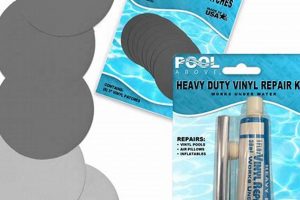
Addressing punctures in inflatable sleeping pads involves identifying the location of the leak and applying a durable sealant to restore airtight integrity. The process generally includes cleaning the affected area, applying adhesive, and allowing sufficient time for the bond to cure. A common example involves using a vinyl repair kit to mend a small puncture on the surface of the device.
Maintaining the integrity of these pads is essential for preserving their utility and lifespan, preventing air leakage that compromises support and comfort. Historically, temporary solutions like duct tape were employed, but modern adhesives offer more permanent and effective solutions. This contributes to both economic savings, by extending product life, and reduces environmental impact by minimizing the need for replacement.
The subsequent sections will detail various methods for leak detection, explore suitable repair materials, and provide step-by-step instructions for implementing effective strategies.
Guidance on Repairing Air Mattress Leaks
The following constitutes practical advice for addressing breaches in the airtight seal of inflatable sleeping surfaces.
Tip 1: Employ Soapy Water for Leak Detection: A solution of mild soap and water, applied to the inflated mattress, will generate bubbles at the site of the perforation. This visual aid precisely pinpoints the area requiring attention.
Tip 2: Thoroughly Clean the Affected Area: Prior to applying any adhesive, the area surrounding the breach must be meticulously cleaned and dried. Isopropyl alcohol is suitable for removing residue and ensuring optimal adhesion.
Tip 3: Utilize Appropriate Patch Materials: Vinyl repair kits, specifically designed for inflatable products, are recommended. Avoid using generic adhesives that may not bond effectively or may degrade over time.
Tip 4: Apply Even Pressure During Adhesive Curing: After applying the patch, consistent pressure should be maintained for the duration specified by the adhesive manufacturer. This ensures a strong and lasting bond.
Tip 5: Allow Adequate Curing Time: Premature inflation can compromise the bond. Adhering strictly to the manufacturers recommended curing time is crucial for achieving a robust repair.
Tip 6: Reinforce Large Tears with Fabric Backing: For substantial breaches, consider incorporating a fabric patch on the underside of the mattress for added support and durability.
Tip 7: Consider a Liquid Vinyl Repair Solution: For pinhole leaks or difficult-to-patch areas, liquid vinyl repair solutions can provide a flexible and airtight seal. Apply in thin layers, allowing each layer to dry completely before applying the next.
By adhering to these guidelines, the lifespan and functionality of inflatable sleeping surfaces can be significantly extended, mitigating the need for costly replacements.
The subsequent discussion will cover alternative repair techniques and preventive measures to minimize the occurrence of future perforations.
1. Leak Location

The efficacy of any attempt to restore the airtight integrity of an inflatable sleeping surface is directly contingent upon accurate leak location. Undetected or misidentified punctures render repair efforts futile, leading to continued air loss and compromised functionality. Cause-and-effect is demonstrably clear: inaccurate leak identification invariably results in unsuccessful remediation.
Consider the scenario where a small puncture exists on the underside of the mattress. If the repair focuses solely on a suspected leak on the top surface, the true source of the problem remains unaddressed, resulting in persistent deflation. The precision with which a leak is located dictates the specificity and effectiveness of the subsequent repair procedure. Various techniques, from soapy water application to submersion methods, are employed to pinpoint these perforations. The investment of time and effort in precise leak identification is directly proportional to the success of the repair.
In summary, accurate leak location is a non-negotiable prerequisite for a successful repair of an inflatable sleeping pad. Overlooking or misdiagnosing the source of the leak will inevitably lead to continued performance issues. The thoroughness and precision applied to this initial step directly influence the outcome of the entire restoration process, impacting the longevity and usability of the product.
2. Surface Preparation
Effective adhesion, a critical component of mending breaches in inflatable sleeping pads, hinges directly on meticulous surface preparation. Contaminants such as dirt, oils, and residual cleaning agents inhibit the formation of a robust bond between the patching material and the mattress surface. Inadequate preparation invariably leads to premature patch failure and continued air leakage, negating the intended repair. A real-world example involves attempting to patch a mattress after outdoor use without first removing embedded sand and grime; the adhesive will bond to the debris rather than the mattress material, resulting in a weak seal. The practical significance of understanding this relationship lies in maximizing the longevity and effectiveness of repairs, thus extending the usable lifespan of the inflatable product.
The ideal surface preparation process involves several key steps. First, the area surrounding the puncture must be thoroughly cleaned with a suitable solvent, such as isopropyl alcohol, to remove any surface contaminants. Abrading the surface lightly with fine-grit sandpaper can further enhance adhesion by creating microscopic irregularities that increase the surface area available for bonding. This is particularly important for mattresses with a smooth or glossy finish. Following abrasion, a second cleaning with isopropyl alcohol is recommended to remove any sanding residue. The cleaned surface must then be allowed to dry completely before the adhesive is applied. Failure to adhere to these steps significantly increases the risk of repair failure, necessitating repeated attempts and ultimately reducing the lifespan of the mattress.
In conclusion, surface preparation is not merely a preliminary step but an integral determinant of the success of patching air mattress leaks. Diligent attention to cleaning and preparing the surface ensures optimal adhesion, resulting in a durable and long-lasting repair. Neglecting this crucial stage undermines the entire repair process, leading to continued air loss and the eventual need for replacement. The understanding and implementation of proper surface preparation techniques directly correlate with the effective restoration and prolonged usability of inflatable sleeping surfaces.
3. Adhesive Type

The selection of adhesive is a critical determinant in the successful repair of punctures in inflatable sleeping pads. Adhesive composition directly influences the strength and longevity of the bond formed between the mattress material and the patching material. Incompatible adhesives can result in weak or non-existent adhesion, leading to patch detachment and continued air leakage. For example, using a cyanoacrylate-based adhesive (super glue) on a vinyl air mattress may result in a brittle bond that cracks and fails upon inflation, due to the differing flexibilities of the adhesive and the mattress material. The type of adhesive must therefore be carefully matched to the substrate material of the air mattress to ensure a durable and airtight seal.
Specific adhesive formulations are designed for bonding to vinyl, the most common material in air mattress construction. Vinyl repair kits typically include adhesives with plasticizers that allow the bond to flex and stretch with the mattress, preventing cracking or separation under stress. These adhesives are also formulated to resist degradation from exposure to air and moisture, ensuring long-term performance. Alternatives, such as specialized polyurethane adhesives, may be suitable for mattresses constructed from different materials, such as flocked nylon. The choice depends on understanding the chemical properties of both the mattress and patching materials. Consideration must also be given to the application method. Some adhesives require heat activation, while others are designed for ambient temperature curing. Improper application can compromise the bond, regardless of the adhesive’s inherent strength.
In conclusion, the appropriate selection and application of adhesive is paramount to achieving a lasting and effective repair of air mattress leaks. Compatibility with the mattress material, resistance to environmental factors, and proper application technique all contribute to the overall success of the repair. Employing an unsuitable adhesive undermines the entire repair process, potentially necessitating costly replacements. Therefore, careful consideration of adhesive type is essential for maximizing the lifespan and functionality of inflatable sleeping surfaces.
4. Patch Application
Effective patch application is a cornerstone of successful air mattress repair. The procedure directly influences the integrity and longevity of the mend, determining whether the inflatable structure regains its airtight seal. Proper execution mitigates further air loss and extends the usable lifespan of the mattress.
- Surface Contact Optimization
Ensuring complete and uniform contact between the patch and the mattress surface is paramount. Air pockets or incomplete adhesion points create weak spots susceptible to failure under pressure. The implications are clear: compromised contact directly results in compromised repair integrity, rendering the effort ineffective. For example, rolling a hard object, such as a seam roller, over the applied patch can help to ensure uniform contact and eliminate air pockets, greatly improving bond strength.
- Overlap Margin Adequacy
The extent to which the patch overlaps the perimeter of the puncture is a critical design parameter. An insufficient overlap provides inadequate surface area for adhesive bonding, increasing the likelihood of patch detachment. Conversely, an excessively large overlap may create stress concentrations at the patch edges. Industry best practices dictate a minimum overlap of one inch beyond the puncture boundary. Failure to adhere to this guideline compromises the seal’s ability to withstand internal pressure and dynamic stresses.
- Pressure Distribution Uniformity
The manner in which pressure is applied during the curing process directly impacts the strength and uniformity of the adhesive bond. Uneven pressure can result in variations in adhesive thickness and localized stress concentrations, leading to premature failure. Clamping or weighting the patched area during curing promotes uniform pressure distribution, enhancing bond strength and durability. An example would be placing a flat weight on top of the patch after application, helping to create an even distribution of pressure during the curing process.
- Alignment Precision
Accurate alignment of the patch over the puncture is essential for preventing stress concentrations and ensuring uniform distribution of forces. Misalignment can result in localized stress points, particularly at the edges of the patch, increasing the risk of bond failure. Precise alignment ensures that the patch effectively reinforces the compromised area, distributing the load evenly across the repair. This is especially important for larger punctures, where misalignment can significantly compromise the integrity of the repair.
Collectively, these facets of patch application underscore its pivotal role in achieving a successful repair. Neglecting any of these considerations compromises the structural integrity of the mend, ultimately defeating the purpose of fixing the air mattress. The effectiveness of patch application directly correlates with the overall lifespan and performance of the repaired inflatable structure.
5. Curing Time

The duration allocated for adhesive curing directly influences the structural integrity of repairs on inflatable sleeping surfaces. Insufficient curing time prevents the adhesive from achieving its full bonding strength, resulting in a weak and unreliable seal. The cause-and-effect relationship is readily apparent: inadequate curing invariably leads to premature patch detachment and subsequent air leakage, nullifying the repair effort. A practical example includes inflating an air mattress too soon after applying a patch; the pressure exerted by the expanding air mass disrupts the adhesive bond before it has fully formed, causing the patch to peel away from the surface. Curing time, therefore, is not merely a procedural detail, but a critical component of a successful remediation.
Manufacturers’ instructions specify curing times based on adhesive formulation, ambient temperature, and humidity. These parameters dictate the rate at which the adhesive polymers cross-link to form a cohesive and durable bond. Deviations from these guidelines compromise the mechanical properties of the adhesive layer, diminishing its ability to withstand stress and maintain an airtight seal. Proper curing often requires a stable environment free from excessive temperature fluctuations or direct sunlight, which can unevenly cure the adhesive and introduce stress. Furthermore, any mechanical stress on the patched area during the curing period can disrupt the bonding process, leading to structural weaknesses within the adhesive matrix. Therefore, adherence to recommended curing times and environmental conditions is crucial for maximizing repair effectiveness.
In summary, the curing time is an indispensable element in the successful repair of inflatable sleeping pads. Neglecting this phase compromises the structural integrity of the repair, resulting in potential air leaks and the need for repeated remediation. Understanding and implementing proper curing procedures, as specified by adhesive manufacturers, is essential for ensuring a durable and long-lasting repair. The challenge lies in
resisting the urge to expedite the process, recognizing that patience during curing is paramount to achieving a robust and reliable seal.
Frequently Asked Questions
The following addresses common inquiries concerning the diagnosis and repair of punctures in inflatable sleeping surfaces.
Question 1: Is it possible to effectively mend a large tear in an air mattress?
While minor punctures are readily addressed, substantial tears present a greater challenge. The success of repairing large tears hinges on the availability of suitable patching material and the application of specialized adhesives designed for high-stress environments. Reinforcement techniques, such as incorporating fabric backing, may be necessary to ensure a durable and airtight seal.
Question 2: Can any type of adhesive be used to patch an air mattress?
The utilization of generic adhesives is generally discouraged. Optimal results are achieved by employing vinyl repair kits specifically formulated for inflatable products. These kits contain adhesives with plasticizers that accommodate the flexibility of the mattress material, preventing cracking or separation under stress.
Question 3: What is the recommended procedure for locating a small leak in an air mattress?
A solution of mild soap and water, applied to the inflated mattress, serves as an effective leak detection method. The presence of bubbles at the site of the perforation indicates the precise location requiring attention.
Question 4: How long should the adhesive be allowed to cure after applying a patch?
Adhering strictly to the manufacturer’s recommended curing time is crucial for achieving a robust and lasting bond. Premature inflation can compromise the adhesive, resulting in patch detachment and subsequent air leakage.
Question 5: Is it necessary to clean the surface of the air mattress before applying a patch?
Thorough surface preparation is paramount for optimal adhesion. The area surrounding the breach must be meticulously cleaned with a solvent, such as isopropyl alcohol, to remove any contaminants that may inhibit bonding.
Question 6: Are there any preventative measures that can be taken to minimize the risk of punctures in air mattresses?
Preventive measures include utilizing a protective barrier, such as a fitted sheet or mattress topper, to shield the surface from abrasion and sharp objects. Avoiding placement on rough or uneven surfaces can also reduce the likelihood of punctures.
In summary, addressing breaches in inflatable sleeping surfaces requires a systematic approach, encompassing accurate leak detection, appropriate material selection, and adherence to recommended repair procedures.
The subsequent section will explore alternative repair techniques and preventative measures in greater detail.
Conclusion
The comprehensive exploration of methods to fix hole in air mattress has underscored the importance of meticulous technique, appropriate materials, and adherence to manufacturers’ guidelines. From precise leak detection to the selection of compatible adhesives and adequate curing times, each stage demands diligent attention to detail. Neglecting any facet of the repair process compromises the integrity of the final result, potentially leading to recurring deflation and premature product failure.
Therefore, the application of informed strategies, as detailed herein, remains paramount for maximizing the lifespan and utility of inflatable sleeping surfaces. By embracing these best practices, consumers can mitigate waste, conserve resources, and ensure continued comfort and functionality from their air mattresses. The long-term benefits of effective repair extend beyond immediate convenience, contributing to sustainable consumption patterns and reduced environmental impact.