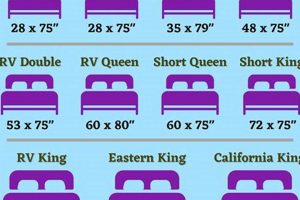
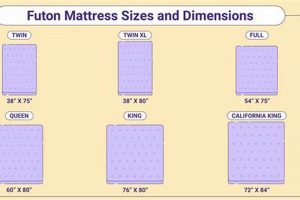
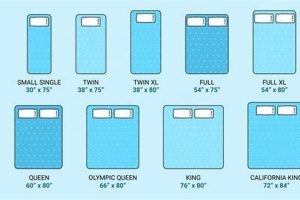
The measurements of sleeping surfaces categorized as “full” and “twin” represent distinct spatial solutions for accommodating sleepers. A “full,” also known as a double, bed offers more width than a “twin,” providing extra room for an individual or, in some cases, comfortably fitting two smaller individuals. Conversely, a “twin” bed, the smallest standard size, is designed primarily for single occupancy, optimizing space in smaller rooms. As an example, a full bed typically measures 54 inches wide and 75 inches long, while a twin bed usually spans 38 inches in width and 75 inches in length.
Understanding these size differentiations is crucial for effective space planning and optimizing sleep comfort. Selecting the appropriate size can enhance room functionality and ensure a restful night’s sleep. Historically, these size designations evolved to cater to varying needs, from maximizing space efficiency in smaller dwellings to providing greater individual sleeping area.
The following sections will delve into detailed comparisons, target user profiles, and considerations for selecting the optimal bed size for various needs and circumstances.
Key Considerations for Choosing Between Sizes
Selecting the appropriate sleeping surface size is paramount for maximizing comfort and optimizing space utilization. Careful consideration of individual needs and spatial constraints is essential.
Tip 1: Assess Room Size. Before making a purchase, accurately measure the intended room. Allow sufficient space for movement around the bed and placement of other furniture. A too-large bed can overwhelm a small room, hindering functionality.
Tip 2: Consider Occupancy. Determine the number of occupants who will regularly use the bed. A larger sleeping surface is generally advisable for couples or individuals who prefer ample personal space. A smaller surface is sufficient for single occupants with limited space.
Tip 3: Evaluate Individual Needs. Account for sleeping habits and physical size. Taller individuals may require extended-length options, while restless sleepers may benefit from a larger surface to avoid feeling confined. Orthopedic conditions may also influence the size and type of support needed.
Tip 4: Budgetary Constraints. Recognize that a larger option often entails a higher cost, not only for the mattress itself but also for associated bedding and frames. Establish a realistic budget and prioritize features that are most important.
Tip 5: Future Needs. Anticipate potential changes in living arrangements or lifestyle. A size that suits current circumstances may not be adequate in the long term. Consider the possibility of needing to accommodate additional sleepers in the future.
Tip 6: Frame Compatibility. Ensure that any existing bed frame is compatible with the chosen mattress size. Mismatched frames can lead to instability and damage to the mattress. Verify dimensions and support structures before purchasing.
Tip 7: Assess Transportation. Consider the ease of transporting the mattress to the intended location. A larger mattress can be challenging to maneuver through narrow hallways or stairwells. Professional delivery services may be necessary in some cases.
Selecting the correct sleeping surface involves a thoughtful evaluation of numerous factors. Prioritizing individual requirements and spatial limitations ensures both comfort and practical functionality.
The following section will explore specific scenarios and provide recommendations based on common user profiles.
1. Width differences

The disparity in width constitutes a primary differentiating factor between full and twin mattress dimensions, fundamentally influencing their respective suitability for various applications. The dimensional variance directly impacts a sleeper’s available space, particularly affecting freedom of movement and overall comfort. A full, or double, mattress typically measures 54 inches in width, while a twin mattress is standardized at approximately 38 inches. This 16-inch difference has considerable implications. The increased width of a full-size sleeping surface can accommodate a single sleeper with greater ease or, in some scenarios, two smaller individuals. In contrast, a twin is designed primarily for single occupancy. Selecting the appropriate width is therefore a critical step when fitting the mattress to both the sleeper’s physical needs and the room’s spatial constraints. For example, in a child’s bedroom, a twin might suffice until adolescence, at which point a full might offer more comfortable space.
The width differential also influences the perceived spaciousness of a bedroom. A larger sleeping surface can visually dominate a small room, potentially making it feel cramped. Conversely, in a larger room, a twin bed might appear disproportionately small. Furthermore, different widths necessitate different bedding sizes, influencing overall expense and availability of options. Retailers acknowledge and cater to these width differences by stocking separate bedding collections for each standard size. Width differences are, therefore, not simply a matter of inches; they are the basis of choosing between models according to their dimensional needs.
In summary, the width differences between full and twin mattresses are a key determinant of their utility, directly affecting comfort, spatial harmony, and cost considerations. Accurate assessment of individual needs and room dimensions is vital in leveraging these dimensional variations effectively.
2. Length commonality

A significant aspect of both full and twin mattress dimensions is their shared length, typically around 75 inches. This length commonality simplifies certain aspects of manufacturing and retail while influencing consumer decisions regarding bedding and frame compatibility. The standardized length addresses a common need: accommodating the average adult height, thus providing adequate legroom and support regardless of the bed’s width. Failure to adhere to this standardized length would render either mattress size impractical for a significant portion of the adult population. For instance, someone purchasing a full bed for its extra width can still expect the same leg support as a twin, meaning they don’t need to adjust their sleeping posture based on length.
This dimensional similarity impacts product availability and cost-effectiveness. Manufacturers can streamline production by using the same cutting patterns and machinery for the length of both mattress types, reducing waste and complexity. Retailers benefit from simplified inventory management, as certain accessories, such as mattress protectors, may fit both sizes, depending on their elasticity and design. This common dimension also offers consumers flexibility in repurposing bedding. While fitted sheets will differ due to the width discrepancy, flat sheets and some blankets may be interchangeable, reducing the need for entirely new bedding sets when transitioning between these two mattress sizes.
In summary, the length commonality between full and twin mattresses represents a practical consideration driven by manufacturing efficiencies and consumer needs. While the width distinguishes these sizes, the shared length ensures that both provide adequate support for the average adult, simplifying bedding choices and frame selection. This standardization underscores the importance of understanding all dimensional aspects when selecting a mattress that aligns with both individual comfort requirements and spatial constraints.
3. Area variance
Area variance, directly resulting from differing mattress dimensions, is a key factor distinguishing full and twin sleeping surfaces. The total area, calculated by multiplying width and length, quantifies the space available to the sleeper. A full mattress, with dimensions of approximately 54 inches by 75 inches, yields an area of 4,050 square inches. In contrast, a twin mattress, measuring around 38 inches by 75 inches, provides an area of 2,850 square inches. This disparity of 1,200 square inches constitutes a significant difference in usable space. This impacts the comfort level for single sleepers who prefer more room to move and also the possibility, though often less comfortable, of accommodating two sleepers.
The effects of area variance extend beyond mere comfort. In confined spaces, such as small apartments or shared bedrooms, choosing between a full and a twin becomes a pragmatic decision. A twin bed maximizes floor space, allowing for additional furniture or greater freedom of movement within the room. Conversely, the larger area of a full bed is beneficial for individuals who are restless sleepers, requiring more space to shift positions without disrupting sleep quality. Moreover, area variance directly influences the thermal properties of the sleeping surface; a larger area may result in greater heat dissipation, impacting sleep comfort for individuals sensitive to temperature fluctuations. Hospital rooms, for instance, frequently employ twin mattresses to optimize space and facilitate patient care, while master bedrooms often accommodate full-size surfaces for enhanced sleeping comfort.
In summary, the area variance between full and twin sleeping surfaces is a critical consideration that impacts comfort, space utilization, and overall sleep quality. The choice between these sizes necessitates a thorough evaluation of individual needs and spatial limitations, ensuring that the selected mattress provides an optimal balance of comfort and practicality. Understanding area variance allows for informed decision-making, promoting effective space management and improved sleep hygiene.
4. Room compatibility

Room compatibility, when considering full and twin mattress dimensions, represents a critical aspect of interior space planning and functional design. The appropriateness of a given mattress size is inextricably linked to the available space and the intended use of the room.
- Spatial Footprint Optimization
The spatial footprint of a mattress directly impacts the usable area within a room. A full mattress, wider than a twin, consumes more floor space, potentially limiting movement and the placement of other furniture. Conversely, a twin mattress optimizes space utilization, making it suitable for smaller rooms or situations where maximizing open floor area is paramount. For example, in a studio apartment, a twin might be preferred to allow for a functional living area during the day.
- Proportional Aesthetics
The visual harmony between a mattress and the room’s dimensions contributes significantly to the overall aesthetic appeal. A full mattress in a small room can create a sense of overcrowding, while a twin in a large room might appear disproportionately small. Achieving proportional aesthetics requires careful consideration of the room’s size, shape, and existing decor. A well-proportioned room enhances the sense of comfort and relaxation.
- Functional Accessibility
Room compatibility extends to the ease of navigating and utilizing the space surrounding the mattress. Adequate space should be available on either side of the bed to allow for comfortable movement, bed-making, and access to bedside tables or other furniture. The choice between a full and a twin impacts this functional accessibility. A twin mattress generally allows for greater ease of movement and access in confined spaces, whereas a full might restrict accessibility in smaller rooms.
- Storage Considerations
The size of the mattress influences the availability of under-bed storage space. A taller bed frame, often paired with a twin mattress, provides greater vertical clearance for storing items beneath the bed. Conversely, a lower-profile frame, frequently used with a full mattress, might limit or eliminate under-bed storage options. This consideration is particularly relevant in smaller living spaces where maximizing storage is crucial.
The effective integration of a full or twin mattress hinges on a holistic assessment of room dimensions, intended functionality, and aesthetic considerations. Selecting the appropriate mattress size optimizes space utilization, enhances visual harmony, and promotes functional accessibility, ultimately contributing to a more comfortable and well-designed living environment.
5. Sleeping capacity

The correlation between sleeping capacity and mattress dimensions is a foundational element in furnishing decisions, particularly when differentiating between full and twin sizes. Sleeping capacity, defined as the number of individuals who can comfortably occupy a sleeping surface, is directly constrained by the dimensions of that surface. A twin mattress, typically measuring 38 inches in width, is inherently designed for single occupancy. The limited width restricts comfortable accommodation to one individual, aligning with its primary purpose in settings such as children’s rooms, dormitories, and smaller guest spaces. Conversely, a full mattress, with a width of 54 inches, presents a more ambiguous scenario. While also often used for single sleepers seeking additional space, its dimensions technically permit two smaller individuals to occupy it. However, the resulting sleeping arrangement is frequently less comfortable than when two individuals share a queen- or king-sized mattress. For instance, a college student in a cramped dorm room may opt for a twin to maximize floor space, implicitly accepting the limitation of single occupancy. Families hosting guests, however, might choose a full in a spare room, knowing it offers the option, albeit a potentially cramped one, of accommodating two visitors.
The practical significance of understanding this relationship extends to various planning scenarios. In hospitality settings, awareness of sleeping capacity assists in room allocation and inventory management. Hotels strategically balance room types based on anticipated occupancy trends, ensuring an adequate number of rooms with greater sleeping capacity (e.g., rooms with two full beds or rooms with king beds and pull-out sofas) to meet diverse customer needs. In residential settings, the decision between a full and a twin must consider both current and potential future requirements. A growing child may initially use a twin, but as they mature, a full mattress may become more appropriate to provide adequate space and prevent sleep disturbances. Furthermore, in smaller living spaces, maximizing sleeping capacity while minimizing the spatial footprint often necessitates creative solutions, such as bunk beds or trundle beds, which utilize vertical space to accommodate multiple occupants without compromising floor area.
In summary, the connection between sleeping capacity and mattress dimensions is a vital consideration in diverse contexts, ranging from individual comfort to large-scale planning. While a twin mattress inherently restricts occupancy to a single individual, a full mattress presents a more flexible, albeit sometimes compromised, option. The ultimate selection hinges on a careful evaluation of spatial constraints, occupancy needs, and desired comfort levels, highlighting the importance of aligning mattress dimensions with the intended sleeping capacity to ensure optimal functionality and user satisfaction.
6. Frame selection

Frame selection, when considered in relation to full and twin mattress dimensions, is a critical determinant of mattress support, longevity, and overall bed stability. The mattress frame serves as the foundational structure, providing necessary support to prevent sagging, maintain proper spinal alignment, and ensure even weight distribution across the sleeping surface. A mismatched frame, either too large or too small, can compromise these functions, leading to premature mattress wear, discomfort for the sleeper, and potential structural damage to both the mattress and the frame itself. For instance, placing a full-size mattress on a frame designed for a queen mattress will result in inadequate support and potential shifting of the mattress, while attempting to fit a full mattress onto a twin-sized frame is physically impossible and would render the assembly unstable. The correct dimensions of the frame are, therefore, not merely a cosmetic consideration but a functional imperative, impacting the mattress’s performance and lifespan.
The implications of improper frame selection extend beyond the immediate comfort and support of the mattress. An inadequately supported mattress is more susceptible to developing indentations, sagging, and uneven wear patterns, effectively shortening its usable lifespan and potentially voiding manufacturer warranties. Furthermore, a poorly fitted frame can create safety hazards, such as the mattress sliding off the frame during use, posing a risk of injury. Consider the scenario of a child’s room where a twin mattress is placed on an ill-fitting frame; the instability could lead to the mattress collapsing during sleep or play, resulting in potential harm. Frame selection, therefore, demands meticulous attention to dimensional accuracy, ensuring that the frame’s interior dimensions precisely match the corresponding dimensions of the full or twin mattress. Additionally, the type of frame, whether it be a platform bed, a slatted frame, or a box spring foundation, should be compatible with the mattress type to optimize support and airflow.
In summary, the relationship between frame selection and full and twin mattress dimensions is one of critical interdependence, influencing not only the immediate comfort and support of the sleeping surface but also its long-term performance and safety. Precise dimensional matching between the mattress and the frame is paramount to prevent premature wear, maintain proper spinal alignment, and mitigate potential safety hazards. Understanding this connection underscores the importance of careful consideration and accurate measurements when selecting both a mattress and its corresponding frame, ensuring a stable, supportive, and safe sleeping environment.
Frequently Asked Questions
This section addresses common inquiries concerning the specific dimensions of full and twin mattresses, offering clarity and guidance for informed purchasing decisions.
Question 1: What are the precise measurements that define a “full” size mattress?
A “full” or “double” size mattress typically measures 54 inches in width and 75 inches in length. Minor variations may occur between manufacturers, but these dimensions represent the industry standard.
Question 2: What are the standardized dimensions of a “twin” size mattress?
A “twin” size mattress is generally standardized at 38 inches in width and 75 inches in length. Similar to full mattresses, slight dimensional variations may exist depending on the manufacturer.
Question 3: Are full and twin mattresses interchangeable on the same bed frame?
No, full and twin mattresses are not interchangeable due to their differing widths. A full-size mattress requires a frame specifically designed to accommodate its 54-inch width, while a twin-size mattress requires a 38-inch wide frame.
Question 4: What are the recommended room sizes for comfortably accommodating a full versus a twin mattress?
For a full mattress, a room size of at least 10 feet by 10 feet is generally recommended to allow for adequate space around the bed. A twin mattress can comfortably fit in a smaller room, typically at least 7 feet by 10 feet.
Question 5: How do the dimensions of a full mattress compare to those of a twin XL mattress?
While a full mattress is 54 inches wide and 75 inches long, a twin XL mattress maintains the 38-inch width of a standard twin but extends its length to 80 inches. The twin XL is designed to accommodate taller individuals.
Question 6: Do bedding sizes for full and twin mattresses differ significantly?
Yes, bedding sizes differ significantly. Fitted sheets, flat sheets, and comforters designed for full mattresses are not compatible with twin mattresses due to the substantial width difference. Separate bedding sets are required for each size.
Accurate understanding of these dimensional specifications enables informed decisions aligning individual needs with available space and intended use.
The subsequent section will delve into considerations for selecting accessories, such as bed frames and bedding, based on full and twin mattress dimensions.
Concluding Remarks on Full and Twin Mattress Dimensions
The preceding analysis clarifies the distinct characteristics of “full and twin mattress dimensions,” underscoring their respective suitability for varying spatial and individual needs. Key considerations, including room size, occupancy requirements, and budgetary constraints, significantly influence the optimal selection between these standard sizes. The length commonality, width differences, and resultant area variance critically impact comfort and functionality.
Informed decision-making regarding sleeping surface selection necessitates a comprehensive evaluation of these dimensional factors. A judicious approach ensures both enhanced sleep quality and efficient space utilization. Continued awareness of evolving mattress technologies and dimensional standards remains essential for future purchasing considerations, optimizing long-term comfort and value.