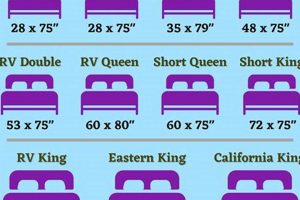
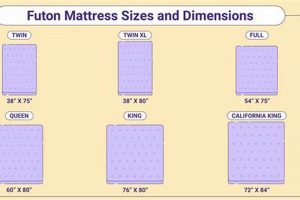
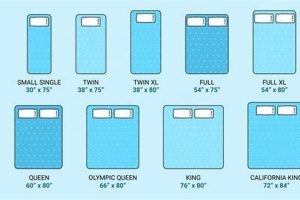
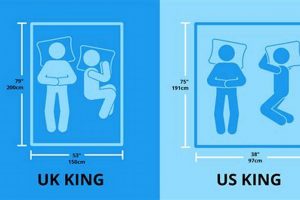
A standard bed size commonly used by adults and growing children measures approximately 137 centimeters in width and 190 centimeters in length. These measurements are crucial when selecting appropriate bedding, such as sheets, comforters, and bed frames, to ensure a proper fit and optimal comfort. These dimensions allow for comfortable sleeping arrangements for one or two individuals, depending on individual size and preference.
Understanding the specific measurements is important for space planning within a bedroom, facilitating informed purchasing decisions and optimizing room layout. This allows consumers to select furniture and other bedroom accessories that complement the bed’s dimensions. Historically, this particular bed size has served as a versatile option, offering more space than a twin bed but remaining smaller and more affordable than larger alternatives.
The following sections will delve into a more detailed examination of factors influencing bed size selection, provide guidance on measuring bedroom space, and explore alternative bed sizes for comparison.
Guidance on Bed Selection
The following guidelines facilitate optimal bed selection considering spatial and individual needs, prioritizing informed purchasing and maximizing bedroom functionality.
Tip 1: Measure Available Space: Accurately assess the bedroom dimensions. Ensure adequate clearance around the bed for movement and furniture placement. Consider door swing and closet access when determining optimal bed placement.
Tip 2: Determine Occupancy Requirements: Evaluate whether the bed will accommodate one or two individuals. Consider body size and preferred sleeping positions to ensure adequate sleeping space for all occupants. This factor influences the suitability of the specified mattress size.
Tip 3: Evaluate Budget Constraints: Bed and mattress pricing vary significantly. Establish a budget prior to shopping, accounting for the bed frame, mattress, and associated bedding costs. A larger bed invariably entails higher costs.
Tip 4: Prioritize Comfort and Support: Select a mattress with appropriate firmness and support levels. Consider individual preferences for sleeping position (side, back, stomach) and any existing physical conditions that require specialized mattress features.
Tip 5: Research Mattress Materials: Investigate different mattress materials, such as memory foam, innerspring, and latex. Each material offers distinct advantages in terms of comfort, support, and durability. Evaluate material properties based on individual needs and preferences.
Tip 6: Consider Future Needs: Anticipate future changes in sleeping arrangements or physical needs. A bed purchased for a child may be inadequate as they grow. Choose a size that accommodates potential future requirements.
Tip 7: Check Bed Frame Compatibility: Ensure the selected bed frame is compatible with the mattress dimensions. Incompatible bed frames can compromise mattress support and potentially void warranties. Confirm all dimensions are accurately aligned prior to purchase.
Adhering to these guidelines ensures a well-informed decision, leading to a bed selection that optimizes comfort, spatial efficiency, and long-term satisfaction.
The subsequent sections will address frequently asked questions and offer comparative analysis of alternative mattress dimensions.
1. Width

The measurement of 137 centimeters defines the lateral extent of a standard mattress. As a component of the overall dimensional specifications, it dictates the available space for sleeping, influencing occupancy and comfort. For example, a solo sleeper may find this width adequate, while two adults may experience restricted space. Deviation from this standard width directly impacts the mattress classification. A width exceeding or falling short of 137 cm would disqualify the mattress from being considered a “full size” or “double” mattress, thereby affecting compatibility with associated bed frames and bedding.
The practical significance of understanding this specific width extends to space planning within a bedroom. This dimension is critical for determining optimal bed placement, ensuring sufficient clearance for movement, and preventing overcrowding. In smaller bedrooms, an inaccurate understanding of the width could lead to poor furniture arrangement and compromised room functionality. Furthermore, furniture manufacturers rely on this standard width when designing complementary bedroom sets. Therefore, consumers should verify the width matches their requirements before purchasing to ensure proper integration with existing or planned furnishings.
In summary, the 137-centimeter width is a defining characteristic of a standard mattress. Its importance lies in its direct impact on comfort, room layout, and compatibility with supporting structures and accessories. Challenges arise when manufacturers deviate from the standard, necessitating careful verification by consumers. Accurate understanding of this measurement is crucial for informed purchasing decisions and optimizing bedroom functionality.
2. Length

The 190-centimeter length is an indispensable component of the dimensional standard. It dictates the longitudinal extent of the sleeping surface. This measurement significantly affects the degree of comfort and physical accommodation for individuals utilizing this mattress type. A standard mattress is specifically engineered to be 190 cm long. Failure to adhere to this measurement would disqualify a mattress from being categorized as “full size.” The length is crucial for accommodating the average height of adults, preventing discomfort resulting from inadequate space for limbs and body alignment.
Consider a scenario where a taller individual, approximately 185 cm in height, attempts to utilize a mattress deviating from the specified 190 cm length. The individual’s feet or head would likely extend beyond the mattress edge, resulting in disrupted sleep patterns and potential physical strain. Furthermore, bedding manufacturers design sheets and blankets to correspond with these precise dimensions. Therefore, a non-standard length would render conventional bedding ill-fitting and aesthetically unappealing. The connection is clear: “Length: 190 cm” is not an arbitrary figure, but a critical determinant of usability and comfort. A bed frame engineered for “full size mattress dimensions cm” assumes and requires this length for structural integrity and support.
In summary, the 190 cm length is inseparable from the concept of a “full size mattress.” It dictates comfort, influences bed frame and bedding compatibility, and ultimately impacts the overall sleeping experience. Deviations from this standard measurement undermine the mattress’s intended purpose. Accurate knowledge of this dimension is therefore vital for informed consumer choices.
3. Surface Area

The surface area of a standard mattress, derived directly from its width and length, defines the total available sleeping space. This measurement is critical for determining its suitability for individual or dual occupancy and influences the overall comfort level.
- Calculation and Significance
The surface area is calculated by multiplying the width (137 cm) by the length (190 cm), yielding approximately 2.6 square meters. This figure provides a quantitative measure of the available sleeping space. Larger surface areas generally accommodate multiple occupants or provide more room for a single sleeper to move freely. This also has significance, when comparing alternative size mattress options.
- Occupancy and Comfort
The calculated surface area impacts the perceived comfort level for occupants. While a standard mattress may adequately accommodate a single adult, it may prove restrictive for two adults, particularly if they prefer ample personal space or are of larger stature. Limited surface area can lead to disrupted sleep and discomfort due to restricted movement.
- Bedding Selection Implications
Bedding, such as sheets and blankets, must be appropriately sized to cover the entire mattress surface area. Under-sized bedding will fail to adequately protect the mattress and provide sufficient coverage for occupants. Over-sized bedding can create excess material that becomes entangled or uncomfortable. The total surface area affects the decision-making for bedding purchase.
- Room Size Considerations
The surface area occupied dictates placement and integration within a given bedroom space. The area of the mattress, combined with any additional furnishings, needs to fit adequately into the room. Understanding the dimensional constraints enables appropriate planning of the room layout. It provides guidance on selecting furniture that maintains accessibility to closets and doors.
The surface area, directly derived from the width and length parameters, is integral to understanding its practical implications. It informs decisions relating to occupancy, bedding, and room layout. Accurate calculation and consideration of this measurement are important for optimizing comfort and space utilization.
4. Frame Compatibility

The dimensional specifications are intrinsically linked to appropriate frame selection. A bed frame designed for a standard mattress is engineered to precisely accommodate the 137 cm width and 190 cm length. Deviations from these dimensions on either the mattress or the frame side compromise structural integrity and mattress support. For example, a mattress exceeding the frame’s dimensions will overhang, lacking adequate support and increasing the risk of sagging. Conversely, a mattress smaller than the frame may shift and slide, creating instability and discomfort. The practical significance of adhering to standard dimensions becomes evident when considering the potential for premature mattress wear and tear caused by an incompatible frame.
Manufacturers of both mattresses and bed frames adhere to these standardized measurements to ensure product interoperability. However, slight variations can occur due to manufacturing tolerances. It is therefore important for consumers to verify the dimensions of both the mattress and the bed frame before purchase, using a measuring tape to confirm accurate alignment. Further considerations include the bed frame’s slat spacing and center support, which directly affect weight distribution and prevent mattress deformation. A solid platform bed eliminates the need for slat spacing considerations, but still requires accurate dimensional alignment. The lack of a compatible and well-built bed frame will impact the support that is provided and lead to premature wear and tear.
In conclusion, frame compatibility is not merely a superficial consideration but a critical component of maintaining mattress longevity and ensuring optimal sleep quality. The consequences of dimensional mismatch extend beyond aesthetic concerns, impacting mattress support, structural integrity, and ultimately, consumer satisfaction. Precise adherence to standard dimensions and careful verification of product specifications are therefore essential. These measures help maintain the function of mattresses and minimize potential investment losses.
5. Height Variation

Height variation in standard mattresses, while not directly defining what qualifies as “full size mattress dimensions cm”, influences several practical considerations related to aesthetics, accessibility, and bedding fit. This factor introduces nuanced choices beyond the standard width and length parameters.
- Aesthetic Integration
The vertical dimension impacts how the bed integrates with the overall bedroom design. A taller mattress may elevate the sleeping surface, creating a more prominent focal point, while a lower-profile mattress can contribute to a minimalist aesthetic. The chosen height must harmonize with existing furniture, headboards, and the room’s scale to achieve visual coherence.
- Accessibility Considerations
Mattress height affects ease of access, particularly for individuals with mobility limitations or those recovering from injuries. An excessively tall mattress may present challenges when getting in and out of bed, while a very low mattress can strain joints. Optimal height facilitates comfortable transfers and reduces the risk of falls.
- Bedding Fit and Coverage
The height dictates the appropriate size of sheets, blankets, and bed skirts. A thicker mattress necessitates deeper-pocketed sheets to ensure a secure fit without slippage. Bed skirts need to be of adequate length to conceal the bed frame without dragging on the floor. Incorrect bedding selection due to mismatched height can compromise both aesthetics and functionality.
- Foundation and Support Implications
The chosen foundation or bed frame interacts with the mattress height to determine the overall bed height. A low-profile frame combined with a thick mattress can result in a significantly higher sleeping surface than anticipated. Conversely, a tall foundation and a thin mattress may create an uncomfortably low bed. Careful consideration of both components ensures an ergonomically sound and aesthetically pleasing final product.
In summary, while the height dimension is not intrinsically part of defining “full size mattress dimensions cm,” it significantly influences the practical implications of selecting and using a standard mattress. Considerations relating to aesthetics, accessibility, bedding fit, and foundation compatibility must be addressed to optimize the sleeping experience and ensure harmonious integration within the bedroom environment.
Frequently Asked Questions
The following questions address common inquiries regarding the dimensions of standard mattresses, providing clarity on key aspects of this widely used size.
Question 1: What are the exact dimensions of a standard mattress?
A standard mattress measures approximately 137 centimeters in width and 190 centimeters in length. These dimensions are foundational for determining frame compatibility and selecting appropriate bedding.
Question 2: Is there any tolerance for deviation from these standard dimensions?
While manufacturers strive to adhere to these dimensions, slight variations may occur due to production tolerances. A variance of more than a few centimeters can impact frame fit and bedding compatibility, necessitating careful measurement before purchase.
Question 3: Are standard mattresses suitable for two adults?
A standard mattress may accommodate two adults. Comfort levels vary significantly depending on individual size and sleeping preferences. Some couples may find this size restrictive, opting for larger alternatives for increased personal space.
Question 4: How does the mattress height affect the overall sleeping experience?
Mattress height impacts bed accessibility, aesthetic integration with bedroom furniture, and bedding selection. Taller mattresses may present challenges for individuals with mobility issues, while bedding must be appropriately sized to accommodate the height.
Question 5: What type of bed frame is best suited for a standard mattress?
A bed frame specifically designed for standard mattresses is essential to ensure proper support and prevent premature wear. The frame’s dimensions must precisely match those of the mattress. Slat spacing and center support also influence weight distribution and mattress longevity.
Question 6: Where can accurate dimensional specifications for standard mattresses be found?
Accurate specifications can be found on manufacturer websites, product labels, and retail listings. Verifying dimensions using a measuring tape before purchase is advised to mitigate potential discrepancies.
Accurate understanding of standard mattress dimensions is crucial for informed decision-making, ensuring both comfort and compatibility within the bedroom environment.
The next section will address standard mattress alternatives, providing detailed comparative analyses.
Conclusion
The preceding exploration of “full size mattress dimensions cm” has illuminated its definitive measurements (137 cm x 190 cm) and the multifaceted implications for bedroom planning, furniture compatibility, and individual comfort. Frame compatibility, surface area, and height variations are all integral considerations for the optimal use of this mattress type.
Adherence to these dimensional standards fosters informed consumer choices. Continued awareness of the significance of “full size mattress dimensions cm” will ensure proper investment in associated bedding and frames and improved user satisfaction. It’s important for consumers to always check dimensions to ensure best compatibility.