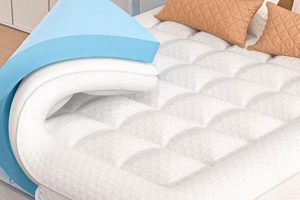
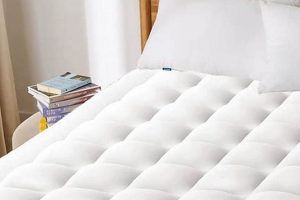
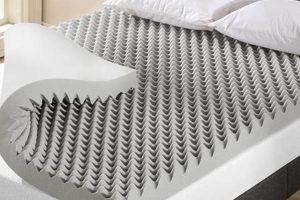
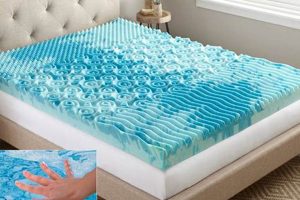
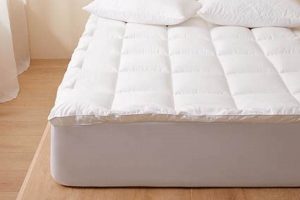
This bedding accessory, sized for a standard queen bed, features a filling derived from the soft plumage of geese. This type of product is designed to enhance the comfort of a mattress by adding a layer of plushness and insulation. For example, individuals seeking a softer sleeping surface might select this item to improve their sleep quality.
The significance of this bed enhancement lies in its ability to augment pressure relief and regulate temperature. Its natural loft provides cushioning, potentially alleviating discomfort at pressure points. Furthermore, the inherent breathability of the filling material can contribute to a more consistent sleep temperature throughout the night. Historically, similar fillings have been prized for their thermal properties and luxurious feel.
This article will further elaborate on the construction variations, quality determinants, care requirements, and potential advantages of choosing such a mattress enhancement. Subsequent sections will also address considerations for individuals with allergies and provide guidance on selecting an appropriate product based on individual needs and preferences.
Selecting a Goose Down Mattress Topper (Queen Size)
The selection of a queen-size bedding enhancement filled with goose plumage requires careful consideration. Optimal performance and longevity depend on informed decision-making. The following tips offer guidance in this process.
Tip 1: Assess Down Fill Power: Examine the fill power specification. A higher fill power indicates greater loft and insulation for the same weight of down. This correlates to enhanced comfort and durability.
Tip 2: Consider the Shell Fabric: The outer fabric, typically cotton, should be tightly woven to prevent down leakage. A thread count of 300 or higher is generally recommended for enhanced down-proofness.
Tip 3: Evaluate Baffle Box Construction: Baffle box construction, which creates individual compartments, prevents down from shifting and clumping. This ensures even distribution and consistent comfort across the surface.
Tip 4: Inquire About Down Source and Processing: Seek information about the origin and treatment of the down. Responsible sourcing practices, such as adherence to the Responsible Down Standard (RDS), ensure ethical treatment of animals. Also, ascertain if the down has been thoroughly cleaned and sanitized.
Tip 5: Check for Hypoallergenic Properties: Individuals with allergies should look for products that have undergone hypoallergenic processing. This involves removing dust and allergens from the down, reducing the risk of allergic reactions.
Tip 6: Review Warranty and Return Policies: Prior to purchase, carefully review the manufacturer’s warranty and return policies. This provides recourse in the event of manufacturing defects or dissatisfaction with the product.
Tip 7: Compare Prices and Read Reviews: Conduct comparative shopping to identify products that offer the best value for the price. Consult customer reviews to gain insights into the real-world performance and durability of different options.
These tips emphasize the importance of evaluating fill power, fabric quality, construction, ethical sourcing, hypoallergenic properties, warranty, and consumer feedback. Adherence to these guidelines can significantly improve the likelihood of selecting a high-quality product that meets individual needs and expectations.
The subsequent sections will delve into the maintenance and care of this bedding type, ensuring long-term satisfaction with the chosen product.
1. Fill Power Rating

Fill power rating serves as a critical indicator of the quality and performance characteristics of the down used within a goose down mattress topper, queen size. This metric directly impacts the topper’s loft, insulation, and overall comfort level.
- Loft and Compression Recovery
Fill power measures the volume, in cubic inches, occupied by one ounce of down. A higher fill power signifies that the down has greater loft and the ability to trap more air, resulting in superior insulation. Furthermore, it indicates better compression recovery, meaning the down will return to its original shape more readily after being compressed under body weight. For a queen mattress topper, this translates to consistent support and cushioning across the entire sleeping surface.
- Insulation Efficiency
Higher fill power corresponds to enhanced thermal efficiency. The trapped air within the down clusters acts as an insulator, minimizing heat transfer. A goose down mattress topper, queen size, with a high fill power will therefore provide superior warmth in colder climates and better temperature regulation throughout the night, preventing overheating.
- Weight-to-Warmth Ratio
Fill power directly influences the weight-to-warmth ratio of the down. A higher fill power allows for a lighter mattress topper that provides the same level of warmth as a heavier topper with a lower fill power. This is particularly advantageous for individuals who prefer a lightweight sleeping surface but still desire adequate insulation. In the context of a queen-sized topper, this can contribute to ease of handling and reduced strain on the mattress.
- Durability and Longevity
Down with a higher fill power generally exhibits greater durability and a longer lifespan. Its superior resilience to compression and repeated use means it will maintain its loft and insulating properties for a more extended period. Consequently, a goose down mattress topper, queen size, with a higher fill power represents a more significant investment in long-term comfort and performance.
In summary, the fill power rating is a primary factor to consider when evaluating a queen mattress topper featuring goose down. Higher fill power translates directly into enhanced loft, insulation, a favorable weight-to-warmth ratio, and improved durability, ultimately contributing to a more comfortable and restorative sleep experience. The investment in a higher fill power represents a long-term benefit in terms of performance and longevity.
2. Shell Fabric Quality
The quality of the shell fabric in a goose down mattress topper (queen size) is paramount in determining its longevity, comfort, and overall performance. The fabric serves as the primary barrier containing the down fill, and its integrity directly impacts the user’s experience.
- Down-Proofness and Leakage Prevention
The weave density of the shell fabric is critical for preventing down leakage. A tightly woven fabric, often indicated by a high thread count (300 or higher), minimizes the spaces between threads, thereby preventing the fine down fe
athers from escaping. Down leakage not only diminishes the topper’s fill and insulation over time but can also create discomfort and allergen exposure. Real-world examples include percale or tightly woven cotton, chosen for their ability to contain the down effectively. The implications are significant; a poorly woven shell will lead to a rapid decline in the topper’s quality and lifespan. - Breathability and Moisture Management
While preventing down leakage is essential, the shell fabric must also allow for adequate breathability. This permits air circulation, facilitating the dissipation of moisture generated during sleep. Fabrics such as cotton or linen are often favored for their natural breathability, helping to regulate temperature and prevent the buildup of humidity within the topper. An example is a cotton shell with a sateen weave, providing a smooth surface while maintaining breathability. Inadequate breathability can lead to a less comfortable sleeping experience and potentially contribute to the growth of mold or mildew within the down fill.
- Durability and Resistance to Wear
The shell fabric must withstand the rigors of regular use, including friction from bedding and body weight. Durable fabrics, such as those with reinforced weaves or higher thread counts, are less prone to tearing or abrasion. An example includes a cotton blend with polyester, which increases the fabric’s strength and resistance to wear. The consequences of a fragile shell include premature failure of the topper and the need for frequent replacement.
- Tactile Properties and Comfort
The shell fabric’s texture directly affects the sleeper’s comfort. Soft and smooth fabrics enhance the overall sleeping experience, while rough or scratchy fabrics can detract from it. Fabrics like Egyptian cotton or silk are often chosen for their luxurious feel and ability to create a comfortable sleeping surface. For instance, a brushed cotton shell offers a soft, inviting feel. The tactile properties of the shell fabric contribute significantly to the perceived quality of the goose down mattress topper, queen size.
In essence, the shell fabric is not merely a casing for the down fill; it is an integral component that determines the effectiveness and longevity of the goose down mattress topper (queen size). The interplay between down-proofness, breathability, durability, and tactile properties contributes significantly to the overall user experience and should be a primary consideration during the selection process.
3. Baffle Box Design

Baffle box design is a construction method employed in goose down mattress toppers (queen size) to maintain consistent fill distribution and prevent shifting of the down. The design involves sewing fabric walls, or baffles, between the top and bottom layers of the topper, creating individual compartments. This compartmentalization directly affects the topper’s performance, comfort, and longevity. Without baffle box construction, the down fill would tend to migrate towards the edges of the topper, resulting in uneven support and cold spots. A real-life example illustrates this: a topper without baffles, after a few weeks of use, exhibits a flattened center with bunched-up down around the perimeter, thereby reducing comfort and negating the purpose of the topper. The practical significance of understanding this design lies in recognizing its role in preserving the topper’s structural integrity and ensuring uniform support throughout its lifespan.
The dimensions and configuration of the baffle boxes influence the loft and feel of the topper. Smaller boxes tend to restrict the down’s ability to fully loft, resulting in a firmer feel, while larger boxes allow for greater loft and a plusher feel. The height of the baffles also plays a role; taller baffles permit more down to be contained within each compartment, potentially increasing the overall thickness and cushioning. Manufacturers often experiment with different baffle box configurations to achieve specific comfort levels. For instance, a topper designed for orthopedic support might incorporate smaller, strategically placed baffle boxes to provide targeted pressure relief. Conversely, a topper intended for general comfort might utilize larger baffle boxes for a softer, more enveloping feel.
In summary, baffle box design is an integral element of a goose down mattress topper (queen size). It serves to maintain even down distribution, prevent shifting, and contribute to the topper’s overall comfort and longevity. While specific configurations may vary depending on the desired level of support and plushness, the underlying principle of compartmentalization remains consistent. The challenge lies in selecting a topper with a baffle box design that aligns with individual comfort preferences and sleep needs. A well-designed baffle box construction is a key indicator of quality and a significant factor in ensuring a restful and supportive sleep experience.
4. Down Source Ethics
The ethical sourcing of down for a queen-sized mattress topper is a critical consideration that directly impacts the well-being of waterfowl. Unethical practices, such as live plucking and force-feeding, inflict significant suffering on geese and ducks. These practices, though sometimes less expensive, are unacceptable from a humane perspective. The connection between ethical down sourcing and a mattress topper lies in the fundamental responsibility of manufacturers and consumers to promote humane treatment of animals. A real-life example illustrates the impact of unethical sourcing: Investigations have revealed farms where geese are subjected to painful plucking of their feathers while still alive, causing distress and injury. Therefore, the understanding of down source ethics becomes practically significant, pushing for humane treatment.
Certifications such as the Responsible Down Standard (RDS) provide a framework for ensuring that down is sourced from farms that adhere to strict animal welfare guidelines. These guidelines prohibit live plucking and force-feeding and require humane handling practices throughout the birds’ lives. Consumers seeking a queen mattress topper filled with goose plumage can look for RDS certification as an assurance that the down has been sourced ethically. Alternative materials, such as recycled down or synthetic down alternatives, offer choices to consumers who are particularly concerned about animal welfare. By supporting ethical sourcing practices, consumers contribute to improved animal welfare standards and send a message to manufacturers that humane treatment is a priority.
In summary, the ethical sourcing of down is an indispensable aspect of producing and purchasing a queen mattress topper filled with goose plumage. Challenges exist in ensuring full transparency and traceability throughout the down supply chain. However, certifications like RDS and informed consumer choices play a vital role in promoting ethical practices. Ultimately, the choice to prioritize ethical down sourcing reflects a commitment to animal welfare and sustainable production practices within the bedding industry.
5. Hypoallergenic Processing
H
ypoallergenic processing, as applied to queen-sized mattress toppers filled with goose down, represents a critical step in mitigating allergen exposure. The goose down, while prized for its loft and insulation, can harbor dust mites, feathers, and other potential allergens that trigger sensitivities in susceptible individuals. Hypoallergenic processing aims to remove these irritants, rendering the topper suitable for individuals with allergies or asthma. The absence of such processing transforms a potentially beneficial bedding item into a source of discomfort. A real-world example: A person with a dust mite allergy purchases a goose down mattress topper without hypoallergenic treatment and subsequently experiences increased allergy symptoms, such as sneezing, congestion, and skin irritation. The practical significance of this understanding lies in preventing adverse health reactions and ensuring a comfortable and restful sleep environment.
The specific methods employed in hypoallergenic processing vary, but generally involve thorough cleaning and sanitization of the down. Washing with specialized detergents and high-temperature drying are common techniques to eliminate dust mites and other allergens. Some manufacturers may also utilize ozone treatment or other chemical processes to further reduce allergen levels. The effectiveness of these treatments can be verified through testing and certification by independent organizations. For instance, a mattress topper that has been certified asthma- and allergy-friendly by a reputable third-party testing laboratory provides a reasonable assurance that it has undergone rigorous hypoallergenic processing and meets specific allergen reduction standards. This process extends the product’s use to sensitive populations, enabling a wider range of consumers to enjoy the benefits of goose down without compromising their health.
In summary, hypoallergenic processing is an essential element in the production of goose down mattress toppers, especially those sized for queen beds. It directly addresses the potential for allergic reactions and makes the topper accessible to a broader range of users. While complete elimination of all allergens may be impossible, effective hypoallergenic processing significantly reduces the risk of adverse reactions, promoting a healthier and more comfortable sleep experience. A key challenge lies in transparently communicating the specific methods and effectiveness of hypoallergenic treatments to consumers, empowering them to make informed purchasing decisions. The benefits of down without the allergens is a key factor.
Frequently Asked Questions
This section addresses common inquiries and misconceptions concerning queen-sized mattress enhancements filled with goose plumage. The information aims to provide clarity and assist in making informed purchasing decisions.
Question 1: What is the typical lifespan of a goose down mattress topper (queen)?
The expected lifespan varies based on usage frequency, maintenance practices, and down quality. Generally, a well-maintained topper can last between three to five years. Proper cleaning, protection with a mattress pad, and periodic fluffing can extend its longevity. Deterioration of loft and fill clumping are indicators of impending replacement.
Question 2: How does fill power affect the performance of a queen goose down mattress topper?
Fill power quantifies the loft and insulating capacity of the down. A higher fill power (e.g., 700+) indicates superior loft, better insulation, and enhanced durability. This translates to increased comfort and a more consistent sleep temperature. Lower fill powers may result in diminished loft and reduced thermal regulation.
Question 3: What are the recommended cleaning procedures for a goose down mattress topper (queen)?
Professional cleaning is generally recommended to avoid damaging the down. Spot cleaning with a mild detergent is permissible for minor stains. If machine washing is attempted, use a front-loading machine on a delicate cycle with cold water and a down-specific detergent. Tumble dry on low heat with dryer balls to prevent clumping. Ensure the topper is thoroughly dry before use.
Question 4: How can down leakage be prevented in a goose down mattress topper (queen)?
The quality of the shell fabric is paramount. A tightly woven fabric with a high thread count (300 or higher) minimizes down leakage. Avoid stretching or stressing the fabric. Regularly inspect the topper for any signs of tears or seam separation. Using a mattress pad can provide an additional layer of protection.
Question 5: Are queen goose down mattress toppers suitable for individuals with allergies?
Toppers that have undergone hypoallergenic processing can reduce the risk of allergic reactions. Look for certifications from reputable organizations indicating allergen removal. However, individuals with severe allergies may still experience sensitivities. Consider alternative fill materials if concerns persist.
Question 6: What is the ideal thickness for a goose down mattress topper (queen)?
Thickness preferences are subjective. Thicker toppers generally provide more cushioning and pressure relief. However, excessive thickness may alter mattress support. A thickness of two to four inches is generally considered optimal for most users, balancing comfort and support.
These FAQs address key considerations regarding queen mattress toppers filled with goose plumage. Proper maintenance, understanding fill power, and addressing potential allergen concerns are crucial for maximizing satisfaction with this bedding accessory.
The subsequent section will delve into cost-benefit analyses of various goose down mattress topper options, guiding consumers toward value-driven purchasing decisions.
Conclusion
The preceding analysis of the goose down mattress topper, queen size, has addressed various facets of its construction, performance, ethical considerations, and maintenance. Critical aspects, including fill power, shell fabric quality, baffle box design, down source ethics, and hypoallergenic processing, significantly influence the overall value and suitability of this bedding accessory. Understanding these factors enables consumers to make informed decisions aligned with their individual needs and priorities.
The selection of a goose down mattress topper, queen size, represents a balance between comfort, performance, and ethical responsibility. Consumers are encouraged to critically evaluate product specifications, seek certifications validating ethical sourcing and hypoallergenic properties, and consider long-term maintenance requirements. The ultimate goal is to procure a high-quality product that provides enhanced sleep comfort while adhering to ethical and sustainable practices.