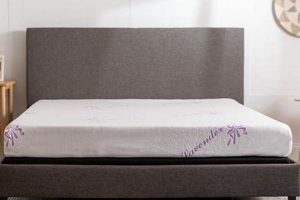
The duration required for a memory foam mattress to reach its full size after unboxing is a crucial consideration for consumers. This expansion period allows the compressed foam to regain its intended shape and density, ensuring optimal comfort and support. Factors influencing this timeframe include the mattress’s density, the ambient temperature, and the length of time it remained compressed during shipping and storage.
Understanding the expansion process is important because it directly affects the initial sleep experience. A mattress that has not fully expanded may not provide the intended level of support, potentially leading to discomfort. Historically, mattresses were not compressed for shipping, making this expansion period a relatively new consideration driven by advancements in manufacturing and delivery logistics. The benefits of compressed mattresses include reduced shipping costs and easier handling, but these advantages require an understanding of the expansion process to ensure customer satisfaction.
The subsequent sections will delve into the specific timelines associated with expansion, the various factors impacting the process, and practical steps consumers can take to facilitate complete and timely decompression. Furthermore, common issues that may arise during expansion and troubleshooting tips to address them will be discussed.
Facilitating Mattress Expansion
The following guidelines are designed to optimize the expansion process of a memory foam mattress, ensuring it achieves its intended comfort and support level within a reasonable timeframe.
Tip 1: Unpack Promptly. After delivery, remove the mattress from its packaging as soon as feasible. Prolonged compression can hinder the foam’s ability to fully recover.
Tip 2: Provide Adequate Ventilation. Open windows and doors to allow fresh air to circulate around the mattress. This aids in off-gassing and accelerates the expansion process.
Tip 3: Maintain Optimal Room Temperature. A warmer environment (ideally between 70-75F or 21-24C) promotes faster expansion. Cold temperatures can slow down the process considerably.
Tip 4: Ensure a Flat Surface. Place the mattress on a solid, level foundation or bed frame. Uneven surfaces can impede proper expansion and potentially damage the foam.
Tip 5: Allow Sufficient Time. Most memory foam mattresses require between 24 and 72 hours to fully expand. Avoid using the mattress until it has reached its intended size and firmness.
Tip 6: Rotate and Flip (If Applicable). Some mattresses benefit from occasional rotation or flipping (if the design allows). This can help distribute weight evenly and promote uniform expansion.
Tip 7: Monitor for Uniformity. Observe the mattress closely during the expansion period. If any areas appear uneven or underdeveloped, gently massage or apply light pressure to encourage full inflation.
By adhering to these recommendations, individuals can effectively manage the decompression phase and ensure the memory foam mattress provides the intended level of comfort and support. Patience and careful attention to environmental factors are key to a successful outcome.
The concluding section will address potential issues that may arise during expansion and outline troubleshooting steps to resolve them effectively.
1. Density of Foam

The density of the memory foam core is a primary determinant in the expansion rate of a compressed mattress. Higher density foam generally requires a longer period to fully decompress and achieve its intended dimensions and firmness.
- Cellular Structure and Airflow
Denser foam possesses a tighter cellular structure, reducing the rate at which air can permeate the material. This restricted airflow slows the expansion process as the foam struggles to draw in sufficient air to regain its original volume. Lower density foams, with more open cellular structures, expand more quickly due to the ease of airflow. This characteristic can be observed in side-by-side comparisons of mattresses with varying density ratings.
- Material Viscosity and Elasticity
Density is directly related to the viscosity and elasticity of the memory foam. Higher density foams exhibit greater viscosity, meaning they resist deformation and recover more slowly. The higher material content and tighter cell configuration provide increased resistance to change, thus prolonging the expansion timeframe. Conversely, lower density foams are less viscous and more elastic, allowing for a more rapid return to their original shape.
- Temperature Sensitivity
The impact of temperature on the expansion rate is more pronounced in higher density foams. Cooler temperatures further reduce the elasticity of dense foam, significantly slowing the expansion process. Warmer temperatures can help mitigate this effect by increasing the foam’s flexibility and facilitating faster recovery. This sensitivity necessitates maintaining a controlled ambient temperature during the expansion period to achieve optimal results.
- Compression Set Resistance
Higher density memory foam typically exhibits greater resistance to compression set, which is the permanent deformation of the foam after prolonged compression. While this is a desirable attribute for long-term durability, it also means that the foam requires more time to overcome the initial compression and regain its intended shape. The inherent resilience of the material necessitates a longer expansion period to fully recover from shipping and storage conditions.
In summary, the interplay between cellular structure, material properties, temperature sensitivity, and compression set resistance directly links foam density to the total time required for a memory foam mattress to fully expand. A thorough understanding of these factors enables manufacturers and consumers to manage expectations and optimize the expansion process.
2. Ambient Temperature

Ambient temperature exerts a considerable influence on the expansion rate of memory foam mattresses. A direct correlation exists between the surrounding temperature and the speed at which compressed foam regains its original dimensions and firmness. Understanding this relationship is crucial for managing consumer expectations and optimizing the mattress unboxing experience.
- Molecular Mobility and Elasticity
At higher temperatures, polymer chains within the memory foam exhibit increased molecular mobility. This enhanced mobility allows the foam to more readily deform and recover its shape. Conversely, lower temperatures restrict molecular movement, resulting in reduced elasticity and a slower expansion rate. T
he foam becomes more rigid and less responsive, hindering its ability to regain its original volume. - Air Pressure Dynamics
Temperature influences the air pressure within the foam cells. Warmer air expands, increasing the internal pressure within the mattress and accelerating the expansion process. Conversely, cooler air contracts, reducing internal pressure and slowing expansion. This pressure differential affects the rate at which the foam draws in ambient air to fill the voids created by compression.
- Viscoelastic Properties and Recovery Time
The viscoelastic properties of memory foam are temperature-dependent. Viscosity, a measure of a fluid’s resistance to flow, decreases with increasing temperature, allowing the foam to deform more easily. Elasticity, the ability to return to its original shape after deformation, also improves with higher temperatures. This combination of reduced viscosity and increased elasticity contributes to a faster recovery time and a more complete expansion.
- Compression Set Mitigation
Prolonged compression during shipping and storage can induce a compression set, where the foam retains a deformed shape. Elevated ambient temperatures can help mitigate this effect by increasing the foam’s ability to overcome the compression set and return to its intended dimensions. Warmer conditions provide the necessary energy for the foam to break free from the compressed state and fully expand.
In conclusion, ambient temperature is a critical factor governing the expansion timeline of memory foam mattresses. Maintaining an appropriate temperature range during the unboxing and expansion phase can significantly reduce the waiting period and ensure optimal mattress performance. Failure to account for temperature can result in incomplete expansion and diminished sleep quality.
3. Compression Duration
The period for which a memory foam mattress remains compressed prior to unboxing directly affects the time it requires to fully expand. Extended compression leads to increased deformation of the foam’s cellular structure, necessitating a longer recovery period for the material to regain its intended form.
- Cellular Deformation and Recovery
Prolonged compression causes the cell walls within the memory foam to deform and collapse. The longer the foam remains in this state, the more structural damage occurs, hindering its ability to spring back to its original shape. A mattress compressed for a few weeks will typically expand faster than one compressed for several months, as the cell walls of the latter have undergone more significant and potentially semi-permanent changes. This effect is analogous to bending a metal rod; the longer it remains bent, the more difficult it is to straighten.
- Gas Exchange Impedance
Compression restricts the flow of gas within the memory foam. The foam relies on air exchange to regain its volume after being released. Extended compression impedes this process, as the collapsed cell structure limits the entry of air. Mattresses that have been compressed for shorter durations have more open cell structures, allowing for quicker gas exchange and faster expansion. For example, vacuum-sealed mattresses stored in warehouses for extended periods will exhibit significantly slower expansion rates compared to those shipped shortly after compression.
- Material Fatigue and Elasticity Reduction
Memory foam, like any material, is subject to fatigue. Prolonged compression can lead to a reduction in its elasticity. The foam’s ability to rebound diminishes with extended periods of stress, thereby increasing the amount of time needed to achieve full expansion. This effect is more pronounced in lower-density foams, which are generally more susceptible to fatigue. The longer the compression duration, the greater the potential for irreversible changes in the foam’s material properties.
- Temperature Sensitivity Amplification
The effect of temperature on expansion is amplified by the compression duration. A mattress that has been compressed for an extended period will be even more sensitive to temperature fluctuations during expansion. Lower temperatures will further slow the recovery process, while higher temperatures may expedite it. Therefore, managing the ambient temperature becomes increasingly important for mattresses with longer compression histories to ensure optimal expansion.
The interplay of cellular deformation, gas exchange impedance, material fatigue, and temperature sensitivity underscores the significant influence of compression duration on the expansion time of memory foam mattresses. Mattresses compressed for shorter periods, when properly unpacked and ventilated, will generally reach their intended size and firmness within a shorter timeframe, providing consumers with a more predictable and satisfactory experience.
4. Layer Composition

The arrangement and types of layers within a memory foam mattress significantly impact its expansion duration. Mattresses consisting of multiple layers, each with distinct properties, exhibit expansion behaviors that differ from single-layer designs. The interaction between these layers, their individual densities, and their respective responses to decompression collectively determine the overall expansion timeframe.
A multi-layered mattress might incorporate a high-density base layer for support, a medium-density transition layer for pressure distribution, and a low-density top layer for comfort. Each layer expands at its own rate, influenced by its specific density and composition. For instance, a high-density base layer will generally expand more slowly than a low-density comfort layer. Consequently, the complete expansion of the mattress depends on the slowest-expanding layer achieving its intended form. Furthermore, the sequence in which the layers expand can also create tension within the mattress, potentially hindering the full expansion of individual layers. Practical application involves understanding that mattresses with complex layer arrangements may require a longer period for full expansion compared to simpler, single-layer models. A consumer should wait the full recommended time, even if some layers appear fully expanded, to ensure the entire mattress achieves its intended support characteristics.
In summary, the composition and configuration of layers within a memory foam mattress contribute substantially to its expansion timeframe. Variations in density, material properties, and layer arrangement affect the rate at which each layer decompresses, influencing the mattress’s overall expansion duration. A comprehensive understanding of layer composition allows for realistic expectations and optimized handling during the initial unboxing and setup phase, ultimately ensuring the mattress delivers its intended performance and comfort.
5. Ventilation Levels

The level of ventilation during the unboxing and expansion phase of a memory foam mattress significantly influences the duration required for it to reach its intended dimensions and firmness. Adeq
uate airflow facilitates the escape of volatile organic compounds (VOCs) and promotes a more rapid and uniform expansion process.
- Gas Exchange and Foam Expansion
Memory foam relies on gas exchange with the surrounding environment to regain its volume after compression. Ventilation promotes this exchange by facilitating the influx of air into the foam’s cellular structure. Restricted airflow hinders this process, prolonging the expansion time. For example, a mattress unboxed in a small, enclosed room will expand more slowly than one unboxed in a well-ventilated space.
- Heat Dissipation and Material Properties
Ventilation aids in dissipating heat generated during the expansion process. As the foam decompresses, it can generate heat due to friction and the release of energy. Elevated temperatures can slow down the expansion process and even affect the foam’s material properties. Proper airflow helps regulate the temperature, allowing the foam to expand more efficiently. A mattress placed near a heat source without adequate ventilation may experience uneven expansion or damage.
- VOC Off-Gassing and Air Quality
Ventilation accelerates the off-gassing of VOCs, which are chemicals released from the foam during the initial expansion phase. Poor ventilation traps these gases, leading to unpleasant odors and potential health concerns. Increased airflow allows these compounds to dissipate more quickly, improving air quality and minimizing any potential adverse effects. A consumer sensitive to chemical odors should prioritize well-ventilated conditions during the mattress expansion period.
- Humidity Control and Mold Prevention
Ventilation helps regulate humidity levels around the mattress. Excessive humidity can slow down the expansion process and create a breeding ground for mold and mildew. Adequate airflow prevents moisture buildup, ensuring a more hygienic and efficient expansion. A mattress unboxed in a damp basement with limited ventilation is at greater risk of mold growth and prolonged expansion time.
The relationship between ventilation levels and the expansion rate of memory foam mattresses is multifaceted, encompassing gas exchange, heat dissipation, VOC off-gassing, and humidity control. Optimizing ventilation during the initial expansion phase is crucial for ensuring the mattress achieves its intended size, firmness, and overall quality, providing consumers with a healthier and more comfortable sleep experience.
6. Mattress Thickness
Mattress thickness plays a significant role in determining the duration required for a memory foam mattress to fully expand. A direct correlation exists between the vertical dimension of the mattress and the timeframe needed for complete decompression. Thicker mattresses, containing a greater volume of compressed foam, naturally necessitate a longer expansion period.
- Volume of Compressed Material
A thicker mattress contains a proportionally larger volume of compressed memory foam compared to a thinner model. This increased volume translates to a greater degree of compression throughout the mattress’s structure. Consequently, the cellular matrix of the foam experiences more significant deformation, requiring more time and air to return to its original state. A 12-inch mattress, for example, will generally require a longer expansion time than an 8-inch mattress of similar composition due to the increased amount of compressed material.
- Internal Pressure Gradients
Thicker mattresses often exhibit more pronounced internal pressure gradients during the expansion process. The outer layers may decompress relatively quickly, while the inner layers, further removed from the external environment, experience slower decompression rates. These pressure differentials can hinder uniform expansion and prolong the overall timeframe. Measuring the height at various points can reveal the difference.
- Heat Retention and Dissipation
Mattress thickness influences heat retention and dissipation during expansion. Thicker mattresses tend to retain more heat generated by the decompression process, which can potentially slow down expansion due to the effect on the viscoelastic properties of the foam. Proper ventilation becomes even more crucial for thicker mattresses to facilitate heat dissipation and promote efficient expansion.
- Layer Interaction and Uniformity
In multi-layered mattresses, increased thickness can exacerbate the challenges associated with layer interaction. Disparate expansion rates between layers of varying densities and compositions can create internal stress and impede uniform decompression. A thicker mattress with multiple layers may require strategic flipping or rotation to ensure each layer expands evenly and contributes to the overall mattress performance.
In summation, mattress thickness is a critical factor influencing the expansion duration of memory foam mattresses. The increased volume of compressed material, internal pressure gradients, heat retention characteristics, and layer interaction dynamics all contribute to the extended timeframe required for thicker mattresses to fully decompress and achieve their intended comfort and support characteristics. Consumers and retailers should factor in thickness when managing expectations regarding the expansion timeline.
7. Manufacturing Process

The manufacturing process employed in the production of memory foam mattresses exerts a significant influence on the time required for the mattress to fully expand post-compression. Variations in techniques, materials, and quality control measures can all impact the foam’s cellular structure and its ability to recover its original shape.
- Foaming Techniques and Cell Structure
The method used to create the memory foam directly impacts its cell structure, which in turn influences expansion. Open-cell foams, created using specific blowing agents and processing parameters, tend to expand more quickly due to easier airflow. Closed-cell foams, resulting from different manufacturing techniques, may expand more slowly as air permeability is reduced. For example, a mattress produced using a variable pressure foaming (VPF) process, designed to create a more consistent and open-cell structure, will likely expand faster than one produced with a traditional, less controlled foaming process. The consistency and uniformity of the cell structure are crucial for predictable expansion.
- Compression and Packaging Methods
The method of compression and packaging used during shipping also contributes. Mattresses that are compressed using high-pressure rollers and tightly sealed in plastic may experience more cell deformation, requiring a longer expansion period. Conversely, mattresses compressed using gentler methods and packaged with breathable materials may expand more quickly. A roll-packed mattress, tightly compressed and wrapped, will generally take longer to expand fully compared to one that is flat-packed with less aggressive compression. The packaging material also matters; breathable fabrics allow for better airflow during expansion, while impermeable plastics hinder the process.
- Curing and Off-Gassing Processes
The curing process, w
hich stabilizes the foam and removes residual chemicals, significantly affects expansion time. Inadequate curing can result in continued off-gassing after unboxing, which can both slow expansion and create unpleasant odors. Proper curing, often involving extended periods in temperature-controlled environments, allows the foam to stabilize and reduces the need for extensive off-gassing post-compression. A mattress that has undergone a thorough curing process will likely expand more consistently and with less odor compared to one that has been rushed through production. - Quality Control and Material Consistency
Stringent quality control measures throughout the manufacturing process are essential for ensuring consistent material properties, which in turn affect expansion. Variations in foam density, composition, or cell structure within the same mattress can lead to uneven expansion. Manufacturers with robust quality control protocols, including regular testing and inspection, produce mattresses that expand more predictably. A mattress made with consistently high-quality materials and precise manufacturing techniques will exhibit a more uniform and predictable expansion rate compared to one made with inconsistent materials and lax quality control.
In conclusion, the foaming technique, compression method, curing process, and quality control measures employed during mattress manufacturing collectively determine the foam’s cellular structure, stability, and overall ability to expand fully after compression. Understanding these factors allows manufacturers to optimize their processes for faster and more predictable expansion times, ultimately improving consumer satisfaction.
Frequently Asked Questions
The following addresses common inquiries regarding the expansion process of memory foam mattresses after unboxing. This information is intended to provide clarity and guidance to ensure optimal mattress performance.
Question 1: What is the average timeframe for a memory foam mattress to fully expand?
The typical expansion period for a memory foam mattress ranges from 24 to 72 hours. Certain models, particularly those with higher densities or complex layer compositions, may require up to a week to achieve their intended dimensions.
Question 2: Does temperature affect the expansion rate of a memory foam mattress?
Yes, ambient temperature significantly influences expansion. Warmer environments (ideally between 70-75F or 21-24C) promote faster expansion, while colder temperatures can substantially slow down the process.
Question 3: What factors contribute to a prolonged expansion period?
Several factors can extend the expansion timeframe, including high foam density, prolonged compression during shipping, low ambient temperature, inadequate ventilation, and complex mattress construction.
Question 4: Is it safe to sleep on a memory foam mattress before it has fully expanded?
While it is generally safe to sleep on a mattress that has not fully expanded, doing so may compromise its intended support and comfort characteristics. It is recommended to allow the mattress to fully decompress before regular use.
Question 5: What steps can be taken to expedite the mattress expansion process?
To accelerate expansion, promptly unpack the mattress after delivery, ensure adequate ventilation, maintain a warm room temperature, and place the mattress on a flat, stable surface. Gentle massage of any uneven areas may also be beneficial.
Question 6: What should be done if the mattress does not fully expand after the recommended time?
If the mattress fails to fully expand within the specified timeframe, verify that all recommended steps have been followed. Contact the manufacturer or retailer for assistance. The issue could stem from a manufacturing defect or an environmental factor hindering proper decompression.
The expansion duration of a memory foam mattress is influenced by a combination of factors. Understanding these elements facilitates informed decision-making and appropriate handling to optimize mattress performance and satisfaction.
Conclusion
The inquiry of how long does memory foam mattress take to expand has been thoroughly examined. Factors such as foam density, ambient temperature, compression duration, layer composition, ventilation levels, mattress thickness, and manufacturing process collectively dictate the necessary timeframe. Understanding these variables empowers consumers and retailers to manage expectations and optimize the expansion process for optimal comfort and support.
The informed management of these influencing factors remains paramount in achieving the intended performance characteristics of memory foam mattresses. As manufacturing techniques continue to evolve, the ongoing study of foam expansion dynamics will further refine the processes involved, leading to reduced expansion times and enhanced customer satisfaction. Further research into optimizing foam formulations and compression methods may yield significant advancements in streamlining the unboxing experience for consumers.