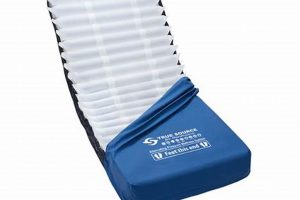
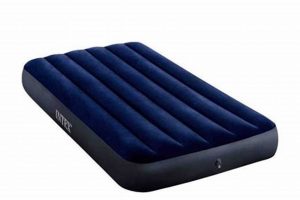
The process of repairing a puncture or tear in an inflatable sleeping surface constitutes a crucial maintenance task. This involves identifying the breach, preparing the surrounding area, and applying a patching material to restore airtight integrity. A common example involves locating a small leak in an air mattress and using a vinyl repair kit to seal it effectively.
Effective repair extends the lifespan of valuable equipment, preventing premature disposal and minimizing waste. Historically, techniques have evolved from simple adhesives to sophisticated bonding agents, improving durability and reliability of repairs. A properly executed repair prevents further deflation, ensuring a comfortable and supportive sleeping surface and avoiding the cost of replacement.
The subsequent sections will provide detailed instructions on identifying the location of damage, preparing the surface for repair, selecting appropriate patching materials, and applying those materials to achieve a lasting seal. Furthermore, preventative measures to minimize the risk of future damage will be discussed.
Practical Suggestions for Repairing Inflatable Mattress Damage
This section presents actionable advice to facilitate effective repairs of punctures or tears in inflatable mattresses, maximizing the likelihood of a successful, long-lasting solution.
Tip 1: Thoroughly Clean the Repair Area: Prior to any patching, the area surrounding the damage must be free of dirt, oils, and debris. Isopropyl alcohol is recommended as a cleaning agent to ensure proper adhesion.
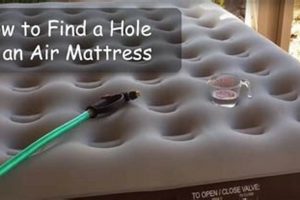
Tip 2: Accurately Locate the Source of the Leak: Submerge the inflated mattress in water, or apply soapy water to the surface, to observe bubble formation indicating the leak’s precise location. Marking the perimeter of the damage with a pen can aid in accurate patch placement.
Tip 3: Select an Appropriately Sized Patch: The patch should extend at least one inch beyond the edges of the damage to distribute stress and prevent future failures. Larger damages require larger patches.
Tip 4: Roughen the Mattress Surface: Lightly abrading the surface of the mattress around the hole, using fine-grit sandpaper, creates a better bonding surface for the adhesive.
Tip 5: Apply Adhesive Sparingly and Evenly: Excessive adhesive can weaken the bond. Apply a thin, even layer of specialized vinyl adhesive to both the patch and the prepared mattress surface.
Tip 6: Allow Sufficient Curing Time: Follow the adhesive manufacturer’s instructions for recommended curing time. Premature inflation may compromise the bond’s integrity.
Tip 7: Reinforce High-Stress Areas: For leaks near seams or edges, consider applying a second patch over the first, increasing overall strength and preventing future failures due to stress concentration.
Adhering to these suggestions enhances the effectiveness of repairs, extending the operational life of the inflatable mattress and preventing recurring issues.
The concluding section will summarize the key aspects of successful inflatable mattress repairs and provide guidance on preventative maintenance.
1. Locate the breach.

The initial step in addressing an inflatable mattress leak involves precisely locating the puncture or tear. This action is intrinsically linked to the overall process because an unidentified leak cannot be effectively repaired. The inability to pinpoint the exact location of the damage renders any subsequent patching attempts futile, potentially leading to wasted resources and continued deflation. An analogy is finding a single hole in a tire tube.
Failure to meticulously search the whole surface necessitates a search over a broad area, wasting time and resources. In contrast, finding the specific location enables targeted preparation and application of patching material, maximizing the chance of a durable seal. This systematic approach minimizes guesswork and prevents the need for multiple attempts, ensuring efficiency. Imagine a scenario where a user indiscriminately applies patches over a large area, while the actual leak remains unaddressed, which is a case study for bad process.
Accurate leak identification reduces waste by targeting the repair effort. Effective search strategies, such as submerging the inflated mattress in water or applying a soapy solution to observe bubble formation, contribute directly to the success of the entire repair undertaking. These methods save time and prevent unnecessary material consumption, aligning with resource conservation principles.
2. Surface preparation essential.

Proper surface preparation represents a critical prerequisite for a successful inflatable mattress repair. The integrity and longevity of any patch are fundamentally contingent upon the condition of the surrounding material to which it is bonded. Without adequate preparation, adhesive bonds are compromised, significantly increasing the likelihood of future leakage and premature failure.
- Removal of Contaminants
The presence of dirt, oils, and moisture on the mattress surface interferes with adhesive bonding. These contaminants act as a barrier, preventing the adhesive from establishing a strong molecular connection with the vinyl material. Using isopropyl alcohol to thoroughly clean the area ensures that the adhesive directly contacts the mattress surface, maximizing bond strength. Imagine applying tape to a dusty table: it will not stick well until the dust is removed.
- Abrasive Roughening
In many instances, the smooth surface of the inflatable mattress provides insufficient texture for the adhesive to properly grip. Lightly abrading the surface with fine-grit sandpaper creates microscopic irregularities that increase the surface area available for bonding. This roughening process mechanically interlocks the adhesive with the mattress material, resulting in a stronger and more durable repair. This concept is similar to the increased grip achieved by sanding wood before applying paint.
- Complete Drying
Moisture present during adhesive application significantly reduces its effectiveness. Water molecules compete with adhesive molecules for bonding sites on the mattress surface, weakening the bond. Ensuring complete dryness after cleaning or roughening the surface is crucial to achieving optimal adhesion. Allowing sufficient air drying time or gently applying heat from a low-setting hairdryer facilitates complete moisture removal. The same way moisture affect glue bond in building.
- Appropriate Area Definition
Clearly defining the area requiring patching ensures that the prepared surface adequately encompasses the damage. Marking the perimeter of the puncture or tear with a pen allows for precise application of the patch
and adhesive, preventing any untreated areas that could contribute to future leaks. Visual delimitation ensures proper procedure execution.
Ignoring surface preparation compromises the repair process, irrespective of the quality of the patching materials employed. Prioritizing thorough cleaning, roughening, and drying enhances the bond between the patch and the mattress material, guaranteeing the successful repair to air mattress hole.
3. Appropriate patching materials.
The selection of appropriate patching materials constitutes a critical determinant in the successful repair of inflatable mattress damage. The materials employed must be compatible with the mattress construction and possess the requisite adhesive properties to establish a durable and airtight seal. Suboptimal material choices inevitably lead to repair failures and compromised mattress functionality.
- Vinyl-Specific Patches
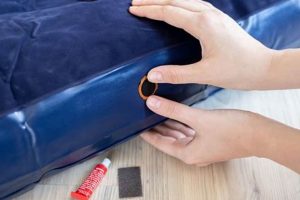
Inflatable mattresses are commonly constructed from polyvinyl chloride (PVC), commonly known as vinyl. Consequently, vinyl repair patches, specifically designed for compatibility with PVC materials, are the most suitable option. These patches exhibit similar flexibility and expansion characteristics as the mattress material, minimizing stress concentration at the repair site. Using patches designed for other materials, such as rubber or fabric, may result in poor adhesion and premature failure due to differing material properties. Many inflatable mattress repair kits are equipped with the correct vinyl patches.
- Specialized Vinyl Adhesives
Corresponding to the use of vinyl patches, a specialized vinyl adhesive is equally essential. These adhesives are formulated to chemically bond with PVC, creating a robust and enduring connection. General-purpose adhesives, while potentially providing an initial bond, typically lack the necessary long-term durability and resistance to flex and stress required for inflatable mattress repairs. Vinyl adhesives often contain solvents that partially dissolve the PVC, facilitating a stronger and more permanent weld. Consider the use of super glue, which is brittle in flexibility against the vinyl and the tear that expands.
- Patch Size and Thickness
The dimensions and thickness of the patch must be appropriate for the size and nature of the damage. Patches should extend at least one inch beyond the perimeter of the damage to distribute stress effectively. Thicker patches may provide greater durability for larger tears or punctures, but should not be so rigid as to impede the mattress’s flexibility. Balancing patch thickness with flexibility is important for a durable and comfortable repair. Consider a larger patch size when near a corner or curvature as it is a stress area.
- Pre-Cut vs. Cut-to-Size Patches
Both pre-cut and cut-to-size patch options are available. Pre-cut patches offer convenience and consistent sizing, while cut-to-size patches allow for customization to accommodate irregularly shaped damage. Cut-to-size patches provide greater flexibility in repair, ensuring optimal coverage and stress distribution. Pre-cut patches are convenient but not necessarily optimal for all situations. Round patches might be better for puncture, while square for tear.
The selection of appropriate patching materials, encompassing vinyl-specific patches and adhesives, along with considerations for patch size and flexibility, directly influences the success of inflatable mattress repair. Employing materials incompatible with the mattress construction invariably results in compromised repairs and reduced mattress lifespan. The selection of the correct materials can increase time value due to the lack of resources spent again.
4. Secure adhesive application.
Secure adhesive application constitutes a crucial phase in the successful rectification of inflatable mattress breaches. The method by which adhesive is applied directly influences the strength and longevity of the resulting bond, thereby determining the effectiveness of the repair.
- Uniform Adhesive Distribution
Consistent adhesive coverage across both the patch and the prepared mattress surface is paramount. Uneven application leads to localized areas of weakness, increasing the risk of air leakage. This can be achieved using a small brush or applicator to spread a thin, even layer of adhesive, ensuring full contact between the surfaces. Absence of uniform coverage provides multiple potential pathways for air to escape.
- Air Bubble Elimination
Trapped air bubbles between the patch and the mattress material compromise the integrity of the adhesive bond. These bubbles create voids that weaken the connection and can eventually lead to delamination. Careful application, pressing the patch firmly onto the prepared surface while working from the center outwards, helps displace trapped air and promotes uniform adhesion. A roller device enhances removal.
- Adequate Contact Pressure
Sufficient pressure during the curing process ensures optimal contact between the adhesive and the mattress material. Applying firm, consistent pressure to the patched area, often through the use of a weight or clamp, facilitates the formation of a strong, durable bond. Without adequate pressure, the adhesive may not properly adhere, resulting in a weak and unreliable repair. Weight should be added for more secure bond.
- Proper Edge Sealing
The edges of the patch are particularly vulnerable to peeling and separation. Ensuring that the adhesive adequately seals the edges of the patch is essential for preventing moisture ingress and delamination. Applying a small amount of additional adhesive to the patch edges and carefully smoothing them down can significantly enhance the durability of the repair, particularly under stress from movement and inflation.
The facets of secure adhesive application are inextricably linked to the overall success of how to fix air mattress hole. Inadequate application techniques, characterized by uneven distribution, trapped air bubbles, insufficient pressure, or compromised edge sealing, inevitably lead to diminished repair effectiveness and a shorter lifespan for the inflatable mattress.
5. Curing time crucial.

The duration dedicated to adhesive curing is a critical parameter in the overall process of repairing inflatable mattress breaches. Insufficient curing time compromises the formation of a robust molecular bond between the patch and the mattress material, undermining the integrity and longevity of the repair.
- Molecular Bond Formation
Adhesive curing involves a chemical process whereby adhesive molecules cross-link and solidify, forming a strong, durable bond. This process requires a specific duration, dictated by the adhesive’s composition and environmental conditions. Premature use of the repaired mattress interrupts this chemical reaction, resulting in an incomplete and weakened bond, susceptible to failure under pressure. The chemical reaction i
sn’t complete, comparable to unfinished glue on wood leading to separation with pressure. - Solvent Evaporation
Many vinyl adhesives contain solvents that facilitate the initial adhesion to the mattress material. These solvents must fully evaporate during the curing process to allow the adhesive to achieve its maximum strength. Premature inflation traps solvents within the adhesive layer, weakening the bond and potentially causing the patch to delaminate over time. The trapping process degrades the vinyl integrity.
- Stress Distribution
Adequate curing time allows the adhesive to uniformly distribute stresses across the patched area. Inflating the mattress before the adhesive is fully cured concentrates stress on the bond line, potentially causing it to weaken or fail. A fully cured adhesive provides a more robust and resilient connection, capable of withstanding the pressures associated with inflation and use. With premature use, this means the patch can detach.
- Environmental Factors
Temperature and humidity influence adhesive curing time. Lower temperatures and higher humidity levels generally extend the curing period, while higher temperatures and lower humidity levels accelerate it. Adhering to the adhesive manufacturer’s recommended curing time, adjusted for environmental conditions, is crucial for achieving optimal bond strength. This ensures the surrounding and process time doesn’t degrade the vinyl integrity.
Neglecting the recommended curing time significantly reduces the effectiveness of air mattress hole repair efforts. Prioritizing adequate curing time, accounting for both the adhesive’s specifications and environmental conditions, guarantees a durable, airtight repair that extends the lifespan of the inflatable mattress.
Frequently Asked Questions
The following questions address common inquiries regarding puncture and tear repair in inflatable mattresses. Clarification of these points aims to improve success rates and prolong the useful life of this equipment.
Question 1: What is the most effective method for locating small leaks in an air mattress?
Submerging the inflated mattress in water and observing for bubble formation is a reliable method. Alternatively, applying a solution of soapy water to the surface can reveal leaks through bubble formation.
Question 2: Can standard household glue be used to patch an air mattress?
Standard household glues are generally unsuitable due to their lack of flexibility and poor adhesion to vinyl. Specialized vinyl adhesives provide a superior and more durable bond.
Question 3: How long should the adhesive cure before the air mattress is re-inflated?
The curing time varies depending on the specific adhesive used. Adherence to the manufacturer’s instructions is critical. Typically, a minimum of 24 hours is required for complete curing.
Question 4: Is it necessary to deflate the air mattress completely before attempting a repair?
While not always strictly necessary, deflating the air mattress to a degree that relieves pressure around the damaged area facilitates easier patch application and improves adhesive bonding.
Question 5: How can the risk of future air mattress punctures be minimized?
Maintaining a clean and debris-free sleeping surface, avoiding sharp objects, and storing the air mattress properly when not in use reduces the likelihood of punctures.
Question 6: What is the best way to store an air mattress to prevent damage?
The air mattress should be fully deflated, cleaned, and folded or rolled loosely before storing it in a cool, dry place away from direct sunlight and sharp objects. Using the original storage bag, if available, offers added protection.
Proper understanding and application of these guidelines will significantly enhance the effectiveness and longevity of inflatable mattress repairs.
The subsequent section will discuss preventative measures to minimize the occurrence of punctures and tears.
Concluding Remarks on Inflatable Mattress Repair
This exploration of how to fix air mattress hole has detailed the systematic approach necessary for effective puncture and tear remediation. Key aspects include accurate leak identification, meticulous surface preparation, selection of appropriate patching materials, secure adhesive application, and adherence to recommended curing times. These elements, when properly executed, collectively contribute to a durable and reliable repair.
The knowledge presented serves to extend the lifespan of valuable equipment and minimize unnecessary waste. Implementing the outlined procedures represents a proactive investment in resource conservation and promotes responsible consumption. Continued diligence in maintenance practices ensures both the longevity and sustained usability of inflatable mattresses.