



The dimensions of a king-size bed frame and mattress, expressed using the imperial unit of feet, provide a standard for fitting bedding, calculating room space, and ensuring comfortable sleeping arrangements. The standard size typically measures approximately 6.33 feet wide by 6.67 feet long. This spatial characteristic is a primary factor when selecting a bed appropriate for the user and the bedrooms available area.
Understanding these spatial dimensions is crucial for several reasons. It allows consumers to accurately assess if the bed will fit comfortably within the room, considering space for movement and other furniture. It also ensures correct sizing for sheets, blankets, and other bedding accessories, preventing ill-fitting or inadequate coverage. Historically, standardization of mattress sizes has facilitated ease of manufacturing, sales, and consumer convenience in purchasing associated products.
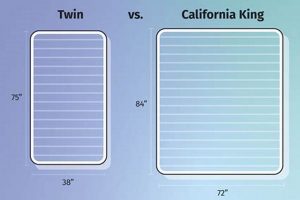
The ensuing discussion will delve further into the specifics of these dimensions, exploring variations like California King, and offering guidance on how to use this information effectively when making purchasing decisions and planning bedroom layouts.
Guidance on King Mattress Dimensions
The following recommendations are intended to assist in making informed decisions regarding the utilization of king mattress dimensional data.
Tip 1: Verify Room Size: Prior to purchase, accurately measure the intended bedroom space. Account for other furniture and walkways to ensure the bed does not impede movement within the room.
Tip 2: Consider Bed Frame Dimensions: Remember that the bed frame will add to the overall footprint beyond the bare dimensions of the mattress. Factor in the frame’s width and length when calculating space requirements.
Tip 3: Account for Bedding: Sheet sizes and comforter draping will influence the final aesthetic and space utilization. Opt for bedding designed specifically for king-size mattresses to ensure proper fit and coverage.
Tip 4: Explore Alternative Sizes: If space is limited, consider alternative sizes, such as a queen or California king, and their respective dimensions to determine the most suitable option.
Tip 5: Compare Online and In-Store Measurements: While standard dimensions exist, slight variations may occur between manufacturers. Always confirm the dimensions provided by the retailer, whether purchasing online or in a brick-and-mortar store.
Tip 6: Plan for Accessibility: Ensure sufficient clearance around the bed for ease of making it, cleaning, and accessing bedside tables and other furniture.
Accurate comprehension and application of the spatial characteristics are essential for a harmonious and functional bedroom design. These insights will help to facilitate the selection of correctly-sized bedding accessories and to inform interior design plans.
The subsequent section will provide a summary of the advantages realized through careful consideration of measurements and will outline a clear conclusion to these recommendations.
1. Width

The designation “Width: 6.33 feet” constitutes a fundamental component of spatial specification for a standard king-size mattress. This dimension directly influences room layout, bed placement, and the selection of appropriate bedding accessories, making it a critical consideration within the broader context of king mattress measurements in feet.
- Spatial Occupancy
The 6.33-foot width dictates the horizontal space the mattress occupies within a room. A room with a width of only 10 feet would leave less than 4 feet of walking space on each side of the bed. This metric is paramount for determining if a king-size bed is suitable for a given bedroom size, influencing the user’s comfort and mobility.
- Sleeping Capacity
The expansive width directly correlates to increased sleeping space. This dimension allows two adults to sleep comfortably without significant physical restriction or encroachment, thereby promoting better sleep quality. For example, couples who experience sleep disturbances due to proximity may benefit from the added width afforded by a king-size mattress.
- Bedding Compatibility
Bed sheets, comforters, and bedspreads marketed as “king-size” are designed specifically to fit a mattress width of approximately 6.33 feet. Purchasing bedding that deviates significantly from this dimension will result in either insufficient coverage or excessive draping, impacting both functionality and aesthetics. A fitted sheet for a queen-size bed, for instance, is physically incapable of properly fitting a king-size mattress.
- Frame Compatibility
Bed frames intended for king-size mattresses are constructed to accommodate a width of 6.33 feet. Choosing a frame designed for a smaller size can lead to inadequate support and potential damage to the mattress. Conversely, a frame designed for a larger size may result in instability and an aesthetically unappealing gap between the mattress and the frame.
These facets collectively underscore the significance of the 6.33-foot width as an integral parameter within the overall spatial context of king mattress measurements. Its accurate understanding and application are crucial for informed purchasing decisions, ensuring a functional and comfortable bedroom environment.
2. Length

The dimension “Length: 6.67 feet” constitutes the second essential component defining a standard king-size mattress, influencing both user comfort and room layout. This dimension, as part of the overall spatial considerations, requires careful assessment for compatibility and optimal utilization within a given bedroom environment.
- Body Support
The 6.67-foot length is designed to accommodate individuals of average height, providing ample support from head to toe. A shorter mattress length would result in discomfort for taller individuals, leading to potential sleep disturbances and reduced overall rest quality. This dimension is crucial for ensuring adequate spinal alignment and minimizing pressure points.
- Room Orientation
The length dictates how the bed can be oriented within a room. A room with a shorter wall may restrict the bed’s placement, potentially impacting the overall flow and functionality of the space. For instance, placing a bed perpendicular to a narrow room might impede movement and accessibility to other furniture.
- Bedding Requirements
Similar to width, bedding marketed as “king-size” is designed to accommodate a mattress length of approximately 6.67 feet. Using shorter sheets can result in them pulling loose during sleep, while excessively long sheets may create tripping hazards or an unkempt appearance.
- Compatibility with Fram
esFrames intended for king mattresses adhere to this length specification. Employing a frame designed for a shorter mattress can leave the user with an unsupportive and visually unappealing setup. The frame’s design and materials should complement the mattress dimensions to provide consistent support and maintain aesthetic harmony.
These considerations underscore the importance of accurately understanding and applying the 6.67-foot length measurement. It contributes significantly to the overall user experience and the proper integration of the bed within the bedroom environment, highlighting its role in the comprehensive evaluation of king mattress specifications.
3. Area

The designated “Area: 42.22 square feet” directly results from multiplying the width (6.33 feet) and length (6.67 feet) dimensions of a standard king-size mattress. As such, this area represents the total surface occupied by the mattress. Its importance stems from its direct influence on bedroom space planning and suitability assessment. For instance, a bedroom measuring 10 feet by 12 feet provides a total floor area of 120 square feet. Subtracting the 42.22 square feet occupied by the mattress leaves approximately 77.78 square feet of usable space, which must accommodate other furniture items and walkways.
Consider a smaller bedroom measuring 9 feet by 10 feet, yielding 90 square feet. Placing a king-size mattress within this room leaves only 47.78 square feet of remaining space. This reduced area can create a cramped and less functional environment, potentially obstructing movement and limiting furniture options. Furthermore, the understanding of this area is crucial when selecting bedding accessories such as area rugs. A rug too small in relation to the bed’s area may appear disproportionate, while a rug too large may overwhelm the remaining space.
In conclusion, the 42.22 square feet area serves as a critical metric for evaluating the compatibility of a king-size mattress with a given bedroom. Its proper assessment, in conjunction with other room dimensions and furniture considerations, is essential for achieving a balanced and functional living space. Failure to account for this area can result in suboptimal room layouts and compromised comfort.
4. Frame Overhang

The term “frame overhang” refers to the extent to which a bed frame’s dimensions exceed the corresponding dimensions of a mattress. In the context of “king mattress measurements in feet,” frame overhang represents a critical consideration, directly impacting overall space requirements and aesthetic integration within a bedroom. A bed frame designed for a king mattress typically extends beyond the specified 6.33 feet width and 6.67 feet length to accommodate the mattress securely and to provide structural support. This overhang varies depending on the frame’s design and material, ranging from minimal extensions to substantial protrusions, influencing the final footprint of the bed within the room.
The significance of frame overhang lies in its effect on room planning. While the mattress’s dimensions establish the primary sleeping surface area, the frame’s dimensions determine the actual space consumed by the bed. For example, a king mattress within a room measuring 12 feet by 14 feet may appear well-proportioned if only the mattress dimensions are considered. However, a frame with a significant overhang of 6 inches on each side and end would increase the bed’s overall dimensions by one foot in both width and length. This addition reduces the available space for other furniture and walkways, potentially creating a cramped environment. Understanding and accounting for frame overhang are essential for ensuring a harmonious balance between the bed and the surrounding space.
In conclusion, frame overhang is a critical parameter inseparable from the comprehension of “king mattress measurements in feet.” It dictates the actual spatial impact of the bed within a room, influencing layout decisions and overall functionality. Accurate measurement and consideration of frame overhang are paramount for informed purchasing and optimal bedroom design.
5. Bedroom Suitability
Bedroom suitability, in the context of king mattress measurements in feet, represents the comprehensive evaluation of whether a king-size mattress is appropriately sized for a particular bedroom. This assessment transcends simply determining if the mattress fits within the room. It incorporates a range of factors, including remaining floor space, furniture placement, traffic flow, and overall aesthetic balance. The measurements of a king-size mattressapproximately 6.33 feet wide by 6.67 feet longestablish a significant spatial footprint. A mismatch between these dimensions and the bedroom’s size can lead to a cramped, dysfunctional, and visually unappealing environment. For example, placing a king-size mattress in a small bedroom, such as one measuring 10 feet by 10 feet, leaves limited space for other essential furniture and reduces ease of movement, thereby compromising the room’s functionality.
The importance of bedroom suitability stems from its direct impact on user comfort and lifestyle. A bedroom that feels crowded and restrictive can negatively affect sleep quality, relaxation, and overall well-being. Furthermore, inadequate space can hinder daily routines, making it difficult to access closets, dress comfortably, or move freely within the room. Conversely, a well-proportioned bedroom allows for a seamless integration of the bed with other furnishings, promoting a sense of spaciousness, comfort, and visual harmony. From a practical standpoint, understanding the connection between king mattress dimensions and bedroom suitability enables informed purchasing decisions. It encourages consumers to accurately measure their rooms, consider their lifestyle needs, and choose a mattress size that complements the available space. Ignoring this connection often leads to dissatisfaction, necessitating costly returns or compromises in furniture arrangement.
In summary, bedroom suitability serves as a crucial component of the broader considerations surrounding king mattress measurements in feet. It highlights the necessity of evaluating not only the physical dimensions of the mattress but also its spatial relationship with the intended bedroom. Challenges arise when consumers prioritize mattress size over room size, resulting in compromised functionality and aesthetic imbalance. Therefore, emphasizing the importance of this relationship is essential for promoting informed consumer choices and fostering comfortable, functional, and aesthetically pleasing bedroom environments.
Frequently Asked Questions Regarding King Mattress Dimensions
The following section addresses common inquiries and misconceptions surrounding the measurements of king-size mattresses. The intent is to provide clarity and ensure accurate comprehension of these critical dimensions.
Question 1: Are there standard dimensions for a king-size mattress?
Yes, the standard dimensions are approximately 6.33 feet in width and 6.67 feet in length. However, slight variations may occur between manufacturers.
Question 2: How do these measurements translate into square footage?
The standard king mattress occupies approximately 42.22 square feet of floor space, calculated by multiplying the width and length dimensions.
Question 3: Do the stated measurements include the bed frame?
No, the specified dimensions refer solely to the mattress itself. The bed frame will add to the overall footprint of the bed.
Question 4: Should one always trust the advertised dimensions?
While standard sizes exist, it is advisable to verify the dimensions provided by the retailer or manufacturer, as minor discrepancies may occur.
Question 5: What is the impact of bedding on perceived measurements?
Bedding can slightly alter the perceived size. Proper fitting bedding, designed for king-size mattresses, will maintain accurate proportions, while ill-fitting sheets may distort the appearance.
Question 6: How are these measurements relevant for room planning?
These dimensions are critical for assessing the suitability of a king-size mattress within a particular bedroom, ensuring adequate space for movement and other furniture.
In conclusion, precise comprehension and accurate application of king mattress dimensions are crucial for informed decision-making. These specifications directly influence both the comfort and functionality of the sleeping environment.
The subsequent section will provide a summary and concluding remarks.
Conclusion
The preceding examination of king mattress measurements in feet underscores their significance in spatial planning and purchasing decisions. The dimensions, approximately 6.33 feet wide by 6.67 feet long, and the resulting area of 42.22 square feet, are not merely numerical specifications but determinants of bedroom functionality, aesthetic harmony, and overall user comfort. The evaluation of frame overhang and bedroom suitability are inseparable considerations when assessing the viability of incorporating this particular bed size into a given living space.
Therefore, it is incumbent upon consumers to recognize the implications of these dimensional specifications. A thorough understanding and meticulous application of these measurements will ensure informed choices, promoting both spatial efficiency and a well-proportioned bedroom environment, conducive to rest and relaxation. The careful assessment of king mattress measurements is not merely a matter of convenience, but an essential element in creating a comfortable and functional living space.
![Ultimate Tempur-Pedic King Size Mattress [Guide & Review] | Organic & Natural Mattress Buyer’s Guide: Non-Toxic Sleep Solutions](https://mattressworldpa.com/wp-content/uploads/2025/07/th-8395-300x200.jpg "Ultimate Tempur-Pedic King Size Mattress [Guide & Review] Organic & Natural Mattress Buyer’s Guide: Non-Toxic Sleep Solutions")
![Best King Size Mattress Platform [Guide] | Organic & Natural Mattress Buyer’s Guide: Non-Toxic Sleep Solutions](https://mattressworldpa.com/wp-content/uploads/2025/07/th-8392-300x200.jpg "Best King Size Mattress Platform [Guide] Organic & Natural Mattress Buyer’s Guide: Non-Toxic Sleep Solutions")