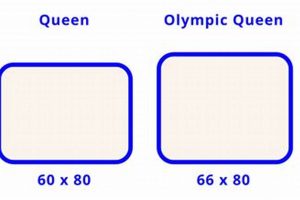
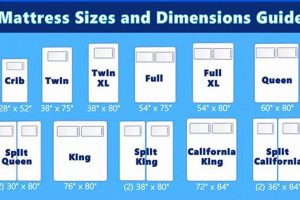
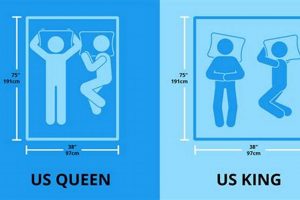
Dimensions of sleep surfaces vary, and standardized guides present these measurements. These guides offer a visual representation, often in table format, outlining length and width specifications for different categories. For instance, a queen typically measures 60 inches wide and 80 inches long. Understanding these dimensional specifics is essential for selecting appropriate bedding and bedroom furniture.
Precise knowledge of sleep surface dimensions facilitates informed consumer decisions. It aids in selecting correctly sized sheets, blankets, and bed frames, optimizing comfort and aesthetics. Historically, such dimensional guides were less accessible, leading to compatibility challenges. The advent of standardized guides streamlines the selection process, minimizing errors and maximizing value.
The following sections will delve into specific categories, explore factors influencing measurements, and discuss the implications of dimensional variances on sleep quality and overall well-being. This includes detailed examination of common categories and less common variations.
Guidance on Dimensional Specifications for Sleep Surfaces
Utilizing dimensional specifications ensures compatibility and maximizes comfort when selecting sleep-related products.
Tip 1: Verify Dimensional Accuracy. Consult multiple resources. Manufacturer specifications should be cross-referenced with established dimensional guides to confirm accuracy. Minor discrepancies can lead to fit issues with bedding and frames.
Tip 2: Account for Mattress Depth. Consider the depth dimension in addition to length and width. Deeper models may require specialized sheets with deeper pockets to ensure a secure fit. Neglecting this factor can result in sheets that constantly slip off.
Tip 3: Measure Bedroom Space Precisely. Accurately assess available space prior to selecting a sleep surface. Consider existing furniture and planned walkways. Underestimating dimensions can result in a cramped and uncomfortable bedroom layout.
Tip 4: Understand International Size Variations. Dimensions vary between countries. When purchasing internationally sourced products, convert measurements to ensure compatibility with domestically produced items. Failing to do so can lead to significant fitment problems.
Tip 5: Consider Shared Sleep Surface Needs. Couples should consider a larger surface dimension to accommodate individual movement patterns. Insufficient space can disrupt sleep quality for both individuals.
Tip 6: Prioritize Frame Compatibility. Ensure that the frame dimensions precisely match the sleep surface specifications. An ill-fitting frame can compromise support and reduce the lifespan of the core material.
Adherence to these guidelines will ensure proper fitment, maximize comfort, and prevent costly errors.
The subsequent section provides a conclusion summarizing the benefits of dimensional accuracy in selecting sleep products and creating optimal sleep environments.
1. Standard Dimensions

Standard dimensions are fundamental elements within a comprehensive guide. These fixed measurements, such as the 39×75 inches of a twin, or the 76×80 inches of a king, provide the foundational data points upon which comparisons, selections, and purchasing decisions are based. Without these consistent benchmarks, assessments would lack a common reference, leading to compatibility issues and inaccurate spatial planning. For example, a customer relying on a guide to determine whether a king-sized bed will fit in their 12×12 foot bedroom depends entirely on the accuracy and reliability of the stated dimensions for that bed size.
The establishment of standard dimensions allows for efficient manufacturing and distribution of associated products like sheets, frames, and mattress protectors. A uniform size means that bedding manufacturers can produce at scale, knowing their products will fit a wide range of cores. Similarly, bed frame manufacturers can design universal platforms that accommodate all variations within that standard. This standardization, facilitated by the guide, reduces costs, increases availability, and simplifies the consumer experience.
In summary, standard dimensions are not merely numbers on a page; they are the bedrock of an industry. Their presence in a chart provides a framework for informed consumer choice, efficient manufacturing processes, and the overall stability of the bedding market. Lack of adherence to or misinterpretation of these standards leads to problems ranging from mismatched bedding to compromised sleep quality.
2. Depth Variations

Depth variations, often unrepresented in simplified dimensional guides, significantly impact bedding fit and overall comfort. While the core dimension charts typically focus on length and width, the depth, or thickness, of the core material influences sheet selection and the suitability of certain bed frames. Neglecting this aspect can result in sheets that either fail to cover the core entirely or exert excessive pressure, compressing the sleeping surface and diminishing its intended support characteristics. For example, a pillow-top model with a depth of 14 inches necessitates deep-pocket sheets, unlike a standard 8-inch model.
The inclusion of depth within the dimensional specifications assists consumers in accurately assessing the compatibility of various sleep accessories. Bed frame designs, particularly those with recessed platforms or headboards, require consideration of depth to ensure proper alignment and aesthetic integration. Furthermore, the increasing prevalence of specialty cores, such as those incorporating layers of memory foam or latex, often leads to greater depth, further emphasizing the importance of including this dimension in the dimensional guide. Erroneous assumptions about depth, based solely on length and width, can result in costly errors and a compromised sleep experience.
In summary, accurate representation of depth variations within dimensional guides is essential for informed decision-making. Overlooking this dimension leads to fitment issues, reduced comfort, and potential damage to the sleeping surface. Prioritizing complete dimensional specifications enables consumers to select appropriately sized accessories, maximizing the lifespan and performance of their chosen sleep system. Failure to consider depth undermines the value of length and width measurements, rendering the dimensional guide incomplete and potentially misleading.
3. Space Requirements

Space requirements constitute a critical element in effective sleep surface selection, directly influenced by dimensional data. These requirements dictate the feasibility of accommodating a particular bed within a defined area, impacting room layout and overall functionality. The dimensions detailed in guides serve as the foundation for informed spatial planning.
- Minimum Room Dimensions
Minimum room dimensions are the smallest acceptable area capable of comfortably housing a particular bed. For example, a full (double) usually specified at 54 inches wide and 75 inches long requires more space than simply the bed’s physical dimensions. Passageways, bedside tables, and dresser drawers necessitate additional area. Insufficient room dimensions can impede movement and create a cramped environment.
- Furniture Placement Considerations
Furniture placement is inherently linked to the available space after accounting for the bed’s dimensions. Items such as nightstands, dressers, and armoires must be positioned strategically to maximize functionality and maintain aesthetic balance. Precise dimensions enable optimal furniture configurations, preventing overcrowding and facilitating ease of movement. Failure to account for furniture placement can result in unusable space and restricted access.
- Accessibility and Walkways
Accessibility and walkway space around the sleep surface are essential for ease of movement and safe navigation within the room. Dimensional specifications aid in calculating the necessary clearance for individuals to enter, exit, and maneuver around the bed without obstruction. Inadequate walkway space can create hazardous conditions, particularly in low-light situations. Dimensional planning ensures safe and convenient accessibility.
- Door and Window Placement
Door and window placement must be considered in conjunction with bed dimensions to prevent obstructions and maximize natural light. A bed placed directly in front of a window can block natural light, while a bed positioned too close to a door may impede entry and exit. Dimensional awareness enables strategic placement, optimizing both aesthetic appeal and functional utility.
The preceding facets underscore the integral relationship between dimensions and spatial planning. Disregarding these considerations results in compromised functionality, aesthetic imbalances, and potential safety hazards. Prudent application of dimensions facilitates informed decisions, optimizing room layout and enhancing overall livability. Dimensions are therefore foundational to the creation of functional and aesthetically pleasing sleep environments.
4. Bedding Fit

Bedding fit is directly contingent upon adherence to dimensions outlined in core size guides. These guides provide the standardized length and width measurements necessary to select appropriate sheets, blankets, and comforters. Without accurate dimensional data, incompatibility arises, leading to ill-fitting bedding that compromises comfort and aesthetic appeal. For example, utilizing standard queen-size sheets (typically 60×80 inches) on an oversized queen model will result in inadequate coverage, potentially exposing the surface to wear and tear. The accuracy of these dimensions ensures proper encapsulation, protection, and overall user satisfaction.
The correlation between bedding fit and dimensions extends beyond basic length and width to encompass depth. Modern cores exhibit varying depths due to the inclusion of pillow tops or multi-layered construction. Failure to consider depth when selecting sheets results in either an excessively tight fit, which strains the fabric and reduces comfort, or an inadequate fit, where the sheet constantly slips off the sides. Specialty sheets with deep pockets are specifically designed to accommodate these variations. Moreover, custom-made bedding, often employed for non-standard or antique frames, relies entirely on the accuracy of dimensions to ensure a precise fit and optimal performance. Inaccurate measurements render custom bedding unusable, resulting in wasted resources and unmet expectations.
In conclusion, precise knowledge of dimensions, as presented in standardized guides, is indispensable for ensuring proper bedding fit. Accurate dimensions minimize compatibility issues, maximize comfort, and extend the lifespan of both the core material and associated bedding. Understanding these dimensions provides consumers with the necessary information to make informed purchasing decisions, mitigating the risk of costly errors and promoting a more satisfying sleep experience. The challenges associated with non-standard sizes and depth variations underscore the importance of consulting comprehensive guides and verifying measurements before acquiring bedding. The direct link between core dimensions and bedding fit ultimately highlights the foundational role dimensions play in achieving optimal sleep quality.
5. Frame Compatibility

Frame compatibility denotes the degree to which the dimensions of a bed frame align with the dimensions of the sleep surface it is designed to support. Accurate dimensional guides are essential for ensuring this compatibility, preventing structural instability, and maximizing the lifespan of both the frame and the sleep surface. Deviations from specified dimensions compromise support and can lead to premature wear.
- Dimensional Accuracy and Support
Dimensional accuracy in frame design directly influences the support provided to the core material. Bed frames engineered to precisely match standard dimensions, as outlined in core size guides, offer uniform support across the entire surface. Conversely, frames with dimensional discrepancies create pressure points, leading to uneven wear and potential structural failure. A queen-sized core placed on a slightly undersized frame, for example, may experience sagging and reduced lifespan due to inadequate support in the center.
- Preventing Motion Transfer
The dimensions of the bed frame affect motion transfer, particularly in shared sleep environments. A frame that provides a snug fit, conforming precisely to the dimensions specified in a core chart, minimizes movement of the core and reduces disturbance to a sleep partner. Conversely, a frame with excessive play, where the core can shift and move independently, amplifies motion transfer, compromising sleep quality. Proper dimensional alignment mitigates these disruptions.
- Headboard and Footboard Integration
Frame dimensions dictate the seamless integration of headboards and footboards. A frame that accurately reflects the cores length and width enables secure and aesthetically pleasing attachment of these components. Dimensional discrepancies create gaps or misalignment, compromising both the structural integrity and the visual appeal of the bed. Headboards and footboards designed for a standard queen bed, for instance, will not properly align with a non-standard or mis-sized frame.
- Platform Bed Considerations
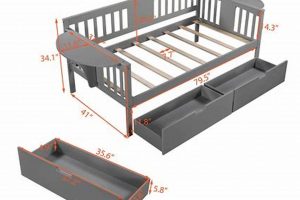
Platform beds, characterized by their solid or slatted surfaces, demand precise dimensional alignment for proper core support. The dimensions of the platform must correspond exactly to the cores length and width to prevent overhang or insufficient support. Overhang can lead to edge sagging and reduced comfort, while insufficient support compromises the cores structural integrity. Dimensional guides are crucial for selecting appropriately sized platform beds.
The correlation between frame compatibility and core dimensions is critical for optimal sleep system performance. Adherence to dimensional specifications minimizes structural problems, enhances support, and extends the lifespan of both the frame and the sleep surface. Utilizing accurate dimensional guides mitigates the risks associated with mismatched frames, ensuring a stable, comfortable, and aesthetically pleasing sleep environment. Deviations from specified dimensions ultimately undermine the value of both the frame and the sleeping surface, leading to compromised sleep quality and premature product failure.
6. International Sizes

Variations in sleep surface dimensions across different countries necessitate comprehensive dimensional guides. The term “International Sizes,” when related to “mattress chart size,” refers to the lack of universal standardization and the resultant need for consumers to navigate differing measurement systems and nomenclature when purchasing bedding or frames.
- Nomenclature Discrepancies
Names applied to specific dimensions differ significantly by region. For example, a “double” in North America may correspond to a “full” elsewhere, or a “king” size in the US is different than a UK or European “king” size. These nomenclature discrepancies introduce confusion for consumers accustomed to a specific terminology. Dimensional guides must accurately translate these terms to facilitate informed purchasing decisions and prevent ordering errors. This directly relates to “mattress chart size” because the chart becomes a cross-reference tool to clarify naming conventions across international markets.
- Metric vs. Imperial Units
The use of metric versus imperial units is a fundamental source of dimensional disparity. North America primarily uses inches and feet, while most other countries employ centimeters and meters. Direct comparisons between dimensions are impossible without accurate conversions.Dimensional charts must provide both metric and imperial measurements to cater to a global audience. This duality is a core function of an effective “mattress chart size” reference, enabling consumers from different regions to accurately interpret and compare specifications.
- Regional Dimensional Standards
Even within the same naming convention, the precise dimensions vary regionally. A “queen” in the United States differs in length and width from a “queen” in Australia.These regional dimensional standards are often dictated by local preferences and manufacturing practices.Dimensional guides must explicitly state the geographic origin of each listed dimension to avoid misinterpretations. Therefore, “mattress chart size” must be geographically contextualized to be accurate.
- Impact on Accessory Compatibility
Dimensional variations directly impact the compatibility of accessories such as sheets, blankets, and bed frames. Bedding manufactured for a European “king” will not properly fit a North American “king”. International travelers and expatriates, in particular, face challenges when sourcing bedding or frames that conform to local dimensions. Dimensional charts are crucial for identifying compatible accessories across different regions and sizes. This is a critical application for “mattress chart size” because mismatched bedding leads to consumer dissatisfaction and additional expense.
In conclusion, the concept of “International Sizes” underscores the importance of comprehensive and geographically specific dimensional guides. These variations necessitate meticulous attention to detail and the provision of both metric and imperial measurements. Effective “mattress chart size” resources enable consumers to navigate a complex landscape of differing standards, preventing costly errors and promoting informed purchasing decisions in the global marketplace.

Shared sleep arrangements necessitate careful consideration of sleep surface dimensions, making “mattress chart size” a critical determinant of sleep quality for co-sleeping individuals. Insufficient surface area leads to compromised personal space, resulting in increased sleep disturbances due to partner movement, temperature regulation differences, and varying sleep schedules. For example, a couple sharing a full-sized bed often experiences restricted movement and increased awareness of each other’s presence, potentially disrupting sleep cycles. The cause-and-effect relationship between inadequate “mattress chart size” and disrupted shared sleep is well-documented in sleep studies, demonstrating a direct correlation between surface area and sleep efficiency. Therefore, “Shared Sleep” as a component of “mattress chart size” considerations is paramount to optimizing comfort and minimizing disturbances.
The practical significance of understanding the relationship between “Shared Sleep” and “mattress chart size” extends to marital satisfaction and overall well-being. Couples who prioritize adequate sleep surface dimensions report higher levels of relationship satisfaction and improved daytime functioning. Conversely, chronic sleep deprivation resulting from inadequate space can contribute to irritability, reduced cognitive performance, and strained interpersonal dynamics. Moreover, certain medical conditions, such as restless legs syndrome or sleep apnea, exacerbate the impact of insufficient surface area on both the affected individual and their sleep partner. Larger dimensions, like those offered by a king-sized or California king-sized model, mitigate these disturbances and promote restorative sleep for both parties. The choice of appropriate surface size, as informed by “mattress chart size,” is therefore a proactive step toward maintaining a healthy and harmonious shared sleep environment.
In summary, the interplay between “Shared Sleep” and “mattress chart size” highlights the importance of selecting a sleep surface that accommodates the needs of all occupants. Overlooking this aspect results in diminished sleep quality, increased partner disturbances, and potential negative impacts on both individual health and relationship dynamics. The challenges associated with selecting an appropriately sized surface underscore the need for informed decision-making, guided by comprehensive dimensional charts and a thorough assessment of individual sleep requirements. The understanding of this connection provides a foundational element for creating restful and restorative shared sleep environments.
Frequently Asked Questions Regarding Sleep Surface Dimensions
This section addresses common inquiries related to sleep surface dimensions and their impact on selection and usage.
Question 1: Why are standardized dimensional guides essential?
Standardized dimensional guides provide consistent reference points for comparing and selecting sleep surfaces. Without these guides, compatibility issues with bedding, frames, and room layouts would increase significantly, leading to consumer dissatisfaction and economic inefficiencies.
Question 2: How do depth variations affect sheet selection?
Depth variations, or thickness, of a sleep surface necessitate careful consideration when selecting sheets. Deeper profiles, often found in pillow-top or multi-layered models, require specialized sheets with deeper pockets to ensure proper fit and prevent slippage.
Question 3: What is the significance of accounting for space requirements?
Accurate space assessment, based on dimensional specifications, is crucial for optimizing room layout and ensuring accessibility. Inadequate space can impede movement, restrict furniture placement, and compromise overall functionality.
Question 4: How do international size differences impact purchasing decisions?
Sleep surface dimensions vary significantly across different countries. Consumers purchasing internationally sourced products must convert measurements and understand regional standards to avoid compatibility issues with domestically produced accessories.
Question 5: What are the consequences of selecting an undersized sleep surface for shared sleep?
Insufficient sleep surface area for co-sleeping individuals can lead to compromised personal space, increased sleep disturbances, and potential negative impacts on relationship dynamics. Selecting an adequately sized surface is crucial for promoting restorative sleep for both partners.
Question 6: How does frame compatibility influence sleep surface longevity?
Precise frame compatibility, adhering to dimensional specifications, ensures uniform support and prevents premature wear of the sleep surface. Mismatched frames create pressure points and compromise structural integrity, reducing the lifespan of both the frame and the sleeping surface.
In summary, understanding dimensional nuances is paramount for informed decision-making, optimal sleep quality, and long-term product satisfaction. Failure to address these dimensions can lead to costly errors and a compromised sleep experience.
The subsequent section provides a comprehensive summary of key considerations when evaluating sleep surface dimensions and their implications.
mattress chart size
The preceding analysis has underscored the importance of “mattress chart size” as a fundamental consideration in optimizing sleep quality and ensuring compatibility with associated bedding and frames. Dimensional guides, offering precise measurements for length, width, and depth, serve as indispensable resources for consumers navigating a complex market of varying standards and international size differences. Accurate utilization of these charts minimizes the risk of costly errors, promotes informed purchasing decisions, and ultimately contributes to a more restful and restorative sleep experience.
Given the direct correlation between sleep surface dimensions and factors such as comfort, support, and longevity, prioritizing the diligent review of “mattress chart size” information represents a prudent investment. Future advancements in bedding technology may introduce further complexities in dimensional standards, necessitating continuous updates and refinements to dimensional guides. Consumers are therefore encouraged to remain vigilant in their pursuit of accurate information and to exercise caution when selecting sleep surfaces and related products. The impact of proper dimensioning extends beyond individual well-being, influencing relationship dynamics and overall quality of life.
![Best RV Queen Size Mattress [Sleep Soundly On the Road] | Organic & Natural Mattress Buyer’s Guide: Non-Toxic Sleep Solutions](https://mattressworldpa.com/wp-content/uploads/2025/07/th-2342-300x200.jpg "Best RV Queen Size Mattress [Sleep Soundly On the Road] Organic & Natural Mattress Buyer’s Guide: Non-Toxic Sleep Solutions")