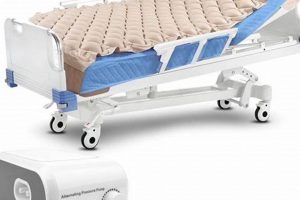
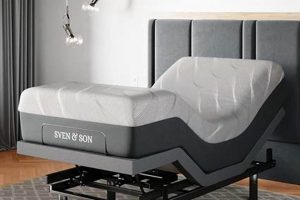
The support surface designed for use on a motorized, articulating bed frame is a specialized product category. These sleeping surfaces must possess flexibility and durability to conform to the various positions the frame can achieve without compromising comfort or structural integrity. A typical example would be a multi-layered foam construction designed to bend at specific points.
Proper support selection is crucial for maximizing the advantages of an adjustable base. The bed’s ability to elevate the head and feet can alleviate pressure points, improve circulation, and enhance sleep quality. However, using an incompatible sleeping surface can negate these benefits, leading to discomfort and potential damage to the product. Historically, innerspring models presented challenges due to their rigid coil systems, driving innovation toward more adaptable materials.
The ensuing discussion will explore factors influencing the selection of a suitable sleep surface for these bases, including material composition, construction methods, and compatibility considerations. Furthermore, it will examine the different types available and the benefits they offer to consumers.
Tips for Selecting a Compatible Sleeping Surface
Choosing the correct sleeping surface is paramount for optimal adjustable base performance and user satisfaction. The following guidelines provide essential considerations for making an informed decision.
Tip 1: Prioritize Flexibility: The support surface must readily conform to the base’s articulation without bunching or excessive resistance. Models with segmented or channeled designs often exhibit superior flexibility.
Tip 2: Evaluate Material Composition: Foam and latex materials generally offer better adaptability than traditional innerspring units. High-density foams provide both support and contouring capabilities.
Tip 3: Consider Thickness: Excessively thick support surfaces may limit the degree of articulation achievable by the adjustable base. A moderate thickness typically provides the best balance of comfort and functionality.
Tip 4: Assess Edge Support: While flexibility is crucial, adequate edge support is necessary for ease of entry and exit, and to prevent the sensation of rolling off the side.
Tip 5: Verify Warranty Compatibility: Confirm that using the selected support surface does not void the adjustable base’s warranty. Some manufacturers stipulate specific material or construction requirements.
Tip 6: Read Customer Reviews: Research user experiences regarding the compatibility of different models with adjustable bases. Pay attention to comments about flexibility, durability, and noise.
Tip 7: Inspect Return Policies: Ensure that the retailer offers a reasonable return policy in case the selected support surface proves unsuitable for the adjustable base.
Adhering to these recommendations helps ensure a comfortable and functional sleep experience, maximizing the benefits of an adjustable bed frame.
The subsequent sections will address specific types of support surfaces best suited for use with these bases, providing a more detailed analysis of their respective characteristics.
1. Flexibility
Flexibility is a paramount characteristic in a sleeping surface intended for use with an adjustable bed frame. The inherent function of an adjustable base involves articulation, requiring the conforming product to bend and reshape without compromising structural integrity or creating pressure points. Inadequate flexibility can result in discomfort, reduced therapeutic benefit from the adjustable base, and potential damage to either the bed frame or the sleeping surface.
The cause and effect relationship is direct: reduced flexibility impedes the adjustable base’s ability to achieve its full range of motion and properly support the user in various positions. For example, a rigid innerspring model might resist bending, causing the base to strain and potentially damaging the motor. Alternatively, it may create uncomfortable gaps between the sleeping surface and the base when elevated. The practical significance of understanding this relationship lies in the informed selection of materials and construction methods conducive to flexibility. Layered foam constructions, segmented designs, and the incorporation of flexible materials like latex are common strategies to enhance flexibility.
Ultimately, the selection of a support surface with adequate flexibility is crucial for maximizing the functionality and longevity of the adjustable bed frame. Furthermore, it ensures the user experiences the intended comfort and therapeutic benefits, such as pressure relief and improved circulation. The challenge lies in balancing flexibility with adequate support, requiring careful consideration of material density, construction techniques, and user preferences.
2. Material Durability
Material durability is a critical factor in determining the long-term suitability of a sleeping surface for use with an adjustable bed frame. The constant articulation and flexing inherent in these systems place significant stress on the materials, necessitating robust construction and resilient components.
- Foam Density and Resilience
Foam-based sleeping surfaces, common choices for adjustable beds, must exhibit high density to resist compression and deformation over time. Low-density foams are prone to sagging and permanent indentations, particularly in areas subject to repeated bending. Resilience, the ability of the foam to recover its original shape after compression, is equally important for maintaining support and preventing premature wear. For instance, high-density memory foam or latex typically exhibits superior durability compared to conventional polyurethane foams.
- Fabric Strength and Stitching Integrity
The outer fabric and its stitching are subject to considerable stress as the sleeping surface conforms to the adjustable base. Weak fabrics or poorly executed seams can tear or unravel, compromising the structure. High-thread-count fabrics, reinforced stitching, and durable binding are essential for withstanding the repeated flexing and movement. For example, a tightly woven knit fabric with double-stitched seams will generally outperform a loosely woven fabric with single-stitched seams.
- Bonding and Adhesive Strength
Multi-layered sleeping surfaces rely on adhesives to bond the different foam layers together. Weak or inadequate bonding can lead to delamination, where the layers separate, causing uneven support and premature failure. The adhesive must be both strong and flexible to accommodate the movement of the layers without cracking or losing adhesion. The quality of the adhesives used directly impacts the product’s lifespan and performance under the stresses of an a
djustable bed frame. - Coil System Integrity (if applicable)
Although less common, some hybrid options incorporate coil systems. For such systems, the gauge (thickness) and temper (heat treatment) of the coils are paramount. Thicker, properly tempered coils resist deformation and maintain their support characteristics over extended use. The coil unit’s construction, including the method of joining the coils and the presence of edge support, also influences its durability. A well-constructed coil system will resist sagging and maintain its shape under the stresses of articulation.
The longevity and performance of a sleeping surface intended for an adjustable bed hinge on the durability of its constituent materials. Selecting a model constructed with high-quality, resilient components ensures the system can withstand the rigors of repeated articulation, providing sustained comfort and support over time. Careful consideration of foam density, fabric strength, bonding integrity, and coil system quality (if applicable) is essential for making an informed purchase decision and maximizing the investment.
3. Thickness Profile

The thickness profile of a support surface intended for use with an adjustable bed frame is a critical design parameter that influences both functionality and comfort. This parameter must be carefully considered to ensure compatibility with the base and optimal user experience.
- Articulation Interference
Excessive thickness can impede the adjustable base’s articulation capabilities. A bulkier product may exhibit greater resistance to bending, limiting the range of motion and potentially stressing the base’s motor. The added bulk can also create pressure points and discomfort, negating the intended benefits of the adjustable frame. A thinner profile generally facilitates easier articulation and minimizes strain on the system.
- Support and Conformity Balance
While thinner models enhance articulation, insufficient thickness can compromise support and conformity. An overly thin product may lack the necessary layers or material density to provide adequate spinal alignment and pressure relief. The ideal thickness profile represents a balance between flexibility and support, ensuring the user receives the intended ergonomic benefits without sacrificing articulation.
- Edge Support Considerations
Thickness also impacts edge support, a crucial factor for ease of entry and exit, as well as preventing the sensation of rolling off the side. Thicker perimeter reinforcements can enhance edge support, but excessive thickness can also detract from articulation. Design strategies such as varying edge thickness or utilizing high-density foam inserts can mitigate this trade-off, providing both edge support and flexibility.
- Heat Retention Properties
The thickness of the support surface influences its thermal properties. Thicker models may retain more heat, potentially leading to discomfort for some users. Materials with enhanced breathability or cooling technologies may be incorporated to counteract this effect. Conversely, thinner models may provide less insulation, which could be advantageous in warmer climates.
The thickness profile is an integral consideration in the design and selection of a support surface for an adjustable bed. Balancing articulation, support, edge stability, and thermal properties is essential for maximizing user comfort and the functionality of the adjustable base. Careful attention to these factors ensures a harmonious integration of the surface and base, optimizing the sleep experience.
4. Support Integrity

Support integrity, in the context of a sleeping surface designed for an adjustable bed, refers to its ability to consistently maintain its intended shape, firmness, and load-bearing capacity across its entire surface area and throughout its lifecycle. This is crucial for providing consistent ergonomic support and preventing premature sagging or deformation, particularly under the dynamic conditions imposed by an adjustable base.
- Core Construction and Material Density
The core construction of the surface, be it foam, coils, or a hybrid system, is the foundation of support integrity. High-density materials, especially in foam cores, resist compression and maintain their shape over extended use. Lower density materials are more prone to sagging, particularly in areas of concentrated pressure. For example, a high-density memory foam core will provide more consistent support than a low-density polyurethane foam core, preventing the formation of body impressions. Coils, if present, should be of a gauge appropriate to the expected load, and properly tempered to retain their spring force.
- Edge Reinforcement Systems
The perimeter of a sleeping surface is often subject to significant stress, particularly during entry and exit. Edge reinforcement systems, such as high-density foam rails or perimeter coils, are designed to maintain edge support and prevent the edges from collapsing or sagging. Without adequate edge support, the sleepable surface area is reduced, and the risk of rolling off the edge is increased. A well-designed edge support system distributes weight evenly and maintains the structural integrity of the product’s perimeter.
- Zoning and Targeted Support
Zoned construction, which involves varying the firmness or material density in different areas of the sleeping surface, is often employed to provide targeted support to different areas of the body. For example, firmer support may be provided in the lumbar region to promote spinal alignment, while softer support is provided in the shoulder and hip regions to relieve pressure points. The effectiveness of zoned support relies on the integrity of the individual zones and their ability to maintain their distinct support characteristics over time. Degradation of zoning can lead to uneven support and discomfort.
- Base Compatibility and Load Distribution
The design of the sleeping surface must be compatible with the adjustable base’s load distribution characteristics. The base’s articulation points and weight-bearing zones should align with the support structure of the sleeping surface to ensure even distribution of pressure. Incompatible designs can lead to localized stress concentrations and premature wear. A surface designed with evenly distributed support elements will withstand the dynamic forces exerted by the adjustable base.
In summary, support integrity is paramount for maximizing the lifespan, comfort, and ergonomic benefits of a sleeping surface designed for use with an adjustable bed. By focusing on robust core construction, edge reinforcement, zoned support, and base compatibility, one can maximize the chances of having a high-quality sleep.
5. Motion Isolation
Motion isolation is a crucial performance characteristic of a sleeping surface, particularly when paired with an adjustable bed frame. The ability to minimize the transfer of movement is essential for undisturbed sleep, especially
for couples or individuals who are easily awakened by disturbances.
- Material Damping Properties
The inherent damping properties of the material used in the sleeping surface significantly influence motion isolation. Materials such as memory foam and latex exhibit superior damping characteristics compared to traditional innerspring systems. These materials absorb energy from movement, reducing the propagation of vibrations across the product. For example, a sleeping surface constructed primarily of memory foam will typically isolate motion more effectively than one composed of interconnected coils. This characteristic is especially important when one user adjusts the bed’s position, minimizing disturbance to the other.
- Construction Methods and Layering
Construction methods, particularly layering techniques, can enhance motion isolation. Multi-layered models with distinct damping layers are more effective at absorbing and dissipating movement. For example, a sleeping surface consisting of a high-density support core topped with a layer of memory foam and a transition layer of responsive foam will often provide superior motion isolation compared to a single-layer foam product. The strategic placement of damping layers minimizes the transmission of movement originating from point of contact.
- Coil System Design (if applicable)
For hybrid designs that incorporate coil systems, the design of the coil unit plays a crucial role in motion isolation. Individually pocketed coils, which are not directly connected to each other, significantly reduce motion transfer compared to interconnected coil systems. Each coil responds independently to pressure, minimizing the ripple effect of movement. The gauge (thickness) and tempering of the coils also influence motion isolation. Softer coils tend to absorb more movement than stiffer coils. The use of pocketed coils is a common strategy for enhancing motion isolation in hybrid surfaces intended for use on adjustable beds.
- Density and Thickness Considerations
The density and thickness of the materials used also contribute to motion isolation. Denser materials generally exhibit better damping properties, while increased thickness provides a greater buffer for absorbing movement. However, excessive thickness can hinder the adjustability of the bed frame and increase heat retention. Therefore, the ideal density and thickness profile represents a balance between motion isolation, support, and thermal comfort. High-density memory foam with a moderate thickness is often a suitable choice for achieving effective motion isolation on an adjustable base.
Motion isolation is a critical attribute when evaluating the suitability of a sleeping surface for an adjustable bed. By prioritizing materials, construction methods, and coil system designs that minimize motion transfer, consumers can enhance sleep quality and minimize disturbances, especially when sharing the bed or utilizing the adjustable features of the base.
6. Base Compatibility
Base compatibility is a foundational consideration in the selection of a sleeping surface intended for use with an adjustable bed frame. The inherent design of these bases necessitates a nuanced understanding of how different sleeping surface characteristics interact with the adjustable mechanisms to ensure optimal performance, longevity, and user satisfaction. The connection between base and product is crucial for realizing the intended ergonomic benefits and avoiding potential damage.
- Dimensional Alignment and Fit
Precise dimensional alignment between the sleeping surface and the adjustable base is essential for proper operation. Overhang or insufficient coverage can impede articulation and create uneven support, potentially leading to discomfort or damage. Standardized sizing conventions facilitate compatibility, but variations in base and product dimensions can necessitate careful measurement and selection. The sleeping surface must fit snugly within the confines of the base without being overly constrained, allowing for free movement and proper articulation. Examples include ensuring a king-size product precisely matches a king-size adjustable base to prevent sagging or gaps.
- Weight Distribution and Load Capacity
Adjustable bases are engineered to support specific weight limits, and the selected sleeping surface must be compatible with the base’s load-bearing capacity. Exceeding the weight limit can strain the motor and articulation mechanisms, potentially leading to premature failure. The weight distribution characteristics of the sleeping surface are also crucial. Uneven weight distribution can create stress concentrations, hindering articulation and causing discomfort. For instance, a very heavy latex product might exceed the capacity of a lighter-duty adjustable base, leading to operational issues.
- Flex Point Synchronization
Advanced adjustable bases often feature pre-programmed articulation patterns and customizable flex points. The sleeping surface must be designed to accommodate these flex points without bunching, creasing, or resisting movement. Some products incorporate segmented designs or flexible materials strategically placed to align with the base’s articulation zones, ensuring smooth and consistent bending. For example, a product with horizontal flex grooves might synchronize perfectly with the base’s bending points, enhancing comfort and minimizing stress on the materials.
- Material Properties and Friction Coefficient
The material properties of the sleeping surface, particularly its friction coefficient, can impact base compatibility. A product with a high friction coefficient may resist movement against the base’s surface, impeding articulation and potentially causing noise or wear. Conversely, a product with a low friction coefficient may slide excessively, leading to instability. Selecting a product with appropriate surface friction ensures smooth articulation and prevents unwanted movement. An example includes a product with a non-slip bottom surface that prevents sliding on the base during adjustment.
These considerations regarding base compatibility underscore the importance of careful selection when pairing a sleeping surface with an adjustable bed frame. The interplay between dimensions, weight, flex points, and material properties dictates the overall performance and longevity of the system. Prioritizing compatibility ensures optimal functionality, prevents damage, and maximizes the ergonomic benefits of the adjustable base.
Frequently Asked Questions
The following addresses common inquiries regarding the selection, compatibility, and maintenance of sleeping surfaces designed for use with adjustable bed frames. These answers provide factual information to aid in informed decision-making.
Question 1: What type of support surfaces are generally recommended for adjustable bed frames?
Foam-based options, including memory foam, latex, and high-density polyfoam, are frequently recommended due to their flexibility and ability to conform to the articulation of the base. Hybrid models with pocketed coils are also suitable if designed with adequate flexibility. Traditional innerspring products are often less compatible due to their rigidity.
Question 2: Does the thickness of the support surface impact its compatibility with an adjustable base?
Yes, excessive thickness can hinder the articulation of the adjustable base and potentially strain the motor
. A moderate thickness, typically between 10 and 14 inches, is generally recommended to balance flexibility and support. Thinner models may lack adequate support, while thicker models may impede articulation.
Question 3: How does motion isolation affect the suitability of a product for an adjustable bed?
Motion isolation is particularly relevant if the bed is shared. Surfaces with good motion isolation, such as memory foam, minimize the transfer of movement when one user adjusts the base, promoting undisturbed sleep for the other user. This is achieved through the material’s damping properties.
Question 4: Can any sleeping surface be used with an adjustable bed frame?
No, not all support surfaces are compatible. Rigid innerspring products may not bend properly and can damage the adjustable base or the sleeping surface itself. The manufacturer’s recommendations should be consulted to ensure compatibility and avoid voiding warranties.
Question 5: What is the importance of edge support in a model designed for an adjustable base?
Adequate edge support facilitates ease of entry and exit and prevents the sensation of rolling off the edge, particularly when the base is in an elevated position. Reinforced edges maintain the sleepable surface area and provide a stable perimeter. However, excessive edge reinforcement can impede articulation, requiring a balance between support and flexibility.
Question 6: How does the warranty differ for a product intended for use with an adjustable base compared to a traditional bed frame?
Warranties may stipulate specific requirements for use with an adjustable base. Some manufacturers may void the warranty if a non-compatible product is used, resulting in damage to the base or the surface. It is essential to review the warranty terms carefully to ensure compliance.
Key takeaways include the importance of selecting a flexible, appropriately thick, and compatible sleeping surface to maximize the benefits of an adjustable bed frame. Consideration should also be given to motion isolation and edge support for optimal comfort and functionality.
The subsequent section will delve into strategies for optimizing sleep quality when using an adjustable bed.
Mattress for Adjustable Bed
The preceding discussion has elucidated the critical factors influencing the selection and performance of a mattress for adjustable bed systems. Key considerations include flexibility, material durability, appropriate thickness, consistent support integrity, effective motion isolation, and, most importantly, documented base compatibility. Neglecting these aspects can compromise the functionality of the adjustable base, diminish user comfort, and potentially lead to premature product failure.
The informed consumer understands that the optimal pairing of a mattress for adjustable bed requires careful evaluation of individual needs and product specifications. Prioritizing compatibility and performance metrics ensures a lasting investment in restorative sleep and overall well-being. Continued research and adherence to manufacturer guidelines will further refine the selection process and maximize the benefits derived from these advanced sleep systems.
![Best Silverado Bed Mattress [Comfort On-The-Go!] | Organic & Natural Mattress Buyer’s Guide: Non-Toxic Sleep Solutions](https://mattressworldpa.com/wp-content/uploads/2025/07/th-7302-300x200.jpg "Best Silverado Bed Mattress [Comfort On-The-Go!] Organic & Natural Mattress Buyer’s Guide: Non-Toxic Sleep Solutions")
![Best Car Air Bed Mattress [Travel Bed Guide] | Organic & Natural Mattress Buyer’s Guide: Non-Toxic Sleep Solutions](https://mattressworldpa.com/wp-content/uploads/2025/07/th-7300-300x200.jpg "Best Car Air Bed Mattress [Travel Bed Guide] Organic & Natural Mattress Buyer’s Guide: Non-Toxic Sleep Solutions")