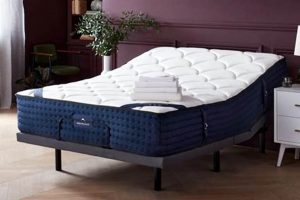
These specialized sleeping surfaces are designed to fit the unique dimensions and safety requirements of elevated beds. They typically feature a lower profile than standard models to ensure adequate headroom and prevent occupants from exceeding safety rail heights. Examples include innerspring, memory foam, and hybrid models manufactured with reduced thickness.
The primary benefit is enhanced safety in a confined vertical space, mitigating the risk of falls. Historically, rudimentary options sufficed, but contemporary designs prioritize comfort and support alongside safety. This evolution reflects a growing understanding of the impact of quality sleep on overall well-being, even within the constraints of a multi-tiered sleeping arrangement.
The subsequent discussion will explore critical factors in their selection, including thickness, construction materials, fire retardancy compliance, and the specific needs of the intended user.
Selection Guidance
The following guidelines assist in choosing appropriate sleeping surfaces for multi-tiered bed frames. These recommendations emphasize safety, comfort, and durability for optimal use.
Tip 1: Prioritize Thickness. Height is a critical factor. Ensure that the selected option, when combined with bedding, remains below the safety rail’s maximum height. Exceeding this limit compromises occupant safety.
Tip 2: Consider Construction Materials. Innerspring, memory foam, and latex offer varying levels of support and comfort. Innerspring provides traditional support, while memory foam conforms to the body. Latex offers a balance of support and resilience.
Tip 3: Verify Fire Retardancy Compliance. Adherence to federal safety standards, specifically 16 CFR Part 1633, is essential. Confirm the product’s compliance to minimize fire hazards.
Tip 4: Evaluate Weight Capacity. Bunk structures have specified weight limits. Select a model that can accommodate the intended user’s weight to prevent structural failure.
Tip 5: Assess Comfort Requirements. Firmness and support are subjective preferences. Consider the occupant’s sleep style and any orthopedic needs when making a selection.
Tip 6: Evaluate Size and Fit. Confirm precise dimensions of the bunk frame. The unit should fit snugly to prevent shifting and potential gaps that could cause injury.
These guidelines prioritize safety, comfort, and long-term performance. Adhering to these recommendations ensures a secure and restful sleeping environment.
The subsequent section will address the care and maintenance requirements for prolonging the lifespan of the sleeping surfaces.
1. Thickness

Thickness is a primary safety consideration. Multi-tiered frames are designed with a specific distance between the upper sleeping surface and the top of the safety rail. Exceeding the allowable height compromises the effectiveness of the safety rail, increasing the risk of falls. Therefore, models with a reduced vertical profile are crucial. For example, a standard innerspring unit might be 8-12 inches thick, whereas its counterpart for a bunk application is often limited to 5-7 inches. The choice directly impacts safety and compliance with manufacturing guidelines.
The reduced thickness must be balanced with adequate support and comfort. While minimizing height, manufacturers employ various strategies to maintain acceptable sleep quality. These strategies involve utilizing higher-density foams, strategically placed coil systems, or hybrid designs that combine different materials. The selection of materials and construction techniques is critical to ensuring support without compromising safety clearances. For instance, a 5-inch memory foam option might offer similar comfort to an 8-inch innerspring model but provide superior safety in the bunk environment.
In summary, thickness serves as a critical determinant of safe use. Its importance necessitates careful consideration of both height limitations and occupant comfort. Selecting an appropriately sized unit is essential to preventing injuries and ensuring compliance with safety standards in multi-tiered sleeping environments. The challenge lies in balancing safety with the need for adequate support, necessitating a thorough understanding of available options and their construction.
2. Support

Support, in the context of sleeping surfaces for multi-tiered frames, refers to the capacity of the unit to maintain proper spinal alignment and distribute body weight evenly. Adequate support is crucial for preventing discomfort, pain, and potential long-term musculoskeletal issues. It is a fundamental factor in ensuring restorative sleep, particularly in the constrained environment of a bunk bed.
- Spinal Alignment
Maintaining correct spinal posture during sleep is paramount. Insufficient support can lead to spinal misalignment, resulting in back pain, neck stiffness, and even nerve compression. For options designed for bunk applications, this often translates to selecting models with appropriate firmness levels that prevent excessive sinking or sagging. A too-soft surface may cause the spine to curve unnaturally, while a too-firm surface may not provide sufficient cushioning at pressure points. Proper alignment ensures the natural curves of the spine are maintained, reducing strain and promoting relaxation.
- Weight Distribution
Even distribution of body weight minimizes pressure points, preventing localized discomfort and improving circulation. Inadequate weight distribution can lead to “hot spots” where concentrated pressure inhibits blood flow, causing tossing and turning. Products incorporating memory foam or strategically placed coils are designed to distribute weight more evenly across the surface. This ensures that no single area of the body bears an excessive load, leading to a more comfortable and restful sleep experience.
- Edge Support
Edge support refers to the stability provided along the perimeter. Weak edge support can cause the sleeper to feel as though they are rolling off the surface, particularly near the edges. In bunk arrangements, where the sleeping area may be more confined, edge support is crucial for maximizing usable space and preventing accidental falls. Reinforced edges, achieved through the use of firmer foam or additional coils, enhance stability and provide a secure sleeping boundary.
- Long-Term Health Implications
Consistent lack of adequate support can have significant long-term health consequences. Chronic back pain, poor posture, and sleep disturbances can negatively impact overall well-being. Investing in a supportive model is a preventative measure that promotes musculoskeletal health and improves sleep quality over time. This is especially pertinent for children and adolescents, whose bodies are still developing and more susceptible to postur
al issues.
The facets of support outlined above are vital to consider when choosing a sleeping surface designed for multi-tiered arrangements. Adequate support directly influences comfort, safety, and long-term health, ensuring that the user experiences restorative sleep within the unique constraints of the bunk environment. Neglecting the importance of support can lead to discomfort, health issues, and a compromised sleep experience, underscoring the necessity of careful selection.
3. Fire Retardancy

Fire retardancy is a critical safety characteristic of these sleeping surfaces. Due to the confined space and potential for limited escape routes associated with multi-tiered beds, the combustibility of the bedding materials poses a significant hazard. Federal regulations mandate that all mattresses sold in the United States meet specific fire safety standards, designed to slow the spread of flames and provide occupants with additional time to evacuate in the event of a fire. The connection between fire retardancy and these sleeping surfaces is therefore not merely a desirable feature but a legally required safety imperative.
Compliance with 16 CFR Part 1633, the federal mattress flammability standard, typically involves incorporating fire-resistant barriers into the construction. These barriers can consist of materials such as treated rayon, silica, or other inherently fire-resistant fabrics. In practice, this means that even if an ignition source, such as a cigarette lighter or a candle, comes into contact with the surface, the spread of flames will be significantly delayed, potentially preventing a small fire from escalating into a life-threatening situation. A real-world example underscores the importance: in residential fires, mattresses are often the first item to ignite, and their rapid combustion can quickly fill a room with toxic smoke and flames, hindering escape and increasing the risk of fatalities. Fire-retardant models mitigate this risk.
In summary, the integration of fire retardancy into sleeping surfaces designed for multi-tiered beds is a crucial and legally mandated safety feature. It directly addresses the increased fire risk associated with confined sleeping spaces by slowing the spread of flames and providing valuable time for occupants to escape. While other factors such as comfort and support are important, fire retardancy remains paramount, representing a fundamental safeguard for life and property within the domestic environment. Disregard for this aspect can have grave consequences, highlighting its non-negotiable importance in the selection process.
4. Weight Capacity
Weight capacity denotes the maximum load a bunk-specific sleeping surface can safely support without compromising structural integrity or user safety. The correspondence between weight capacity and these items is direct and critical. Overloading a unit beyond its stipulated weight limit creates a cause-and-effect scenario: excess stress leads to premature wear, deformation, or outright collapse of the frame and/or the surface itself. For example, a sleeping surface rated for 200 lbs subjected to 300 lbs will likely exhibit accelerated degradation, potentially resulting in failure and injury to the occupant.
Weight capacity is not merely a technical specification; it is a primary safety component. Manufacturers establish these limits based on rigorous testing and material properties. Exceeding these limits disregards engineering parameters, negating any warranties and increasing the likelihood of accidents. In practical application, this necessitates careful consideration of the intended users. A child-rated unit cannot safely accommodate an adult, regardless of apparent initial stability. Failure to adhere to weight restrictions can result in structural compromise, leading to falls or entrapment within the bunk structure itself. This is especially significant in shared sleeping arrangements or when considering future growth of the intended users.
In summary, weight capacity is an indispensable factor in the safe and effective utilization of sleeping surfaces intended for multi-tiered bed frames. Exceeding the stated limits poses significant risks to user safety and structural integrity. This understanding necessitates thorough assessment of the intended users’ weights and adherence to manufacturer specifications. The consequences of neglect can range from accelerated product degradation to severe personal injury, underscoring the importance of respecting these limitations in the broader context of safe sleep environments.
5. Size and Fit

The dimensional compatibility between a sleeping surface and its corresponding bunk frame, often referred to as “Size and Fit,” is paramount for both safety and optimal functionality. Mismatched dimensions can create hazardous gaps or prevent the unit from properly seating within the frame, leading to instability and potential injury. A surface that is too small allows for movement during use, increasing the risk of entrapment between the edge of the surface and the frame rails. Conversely, a surface that is too large may not fit securely, causing bowing or uneven support. A real-world example involves situations where a standard twin-size sleeping surface (39″ x 75″) is mistakenly placed in a European single frame, which often has slightly different dimensions. This discrepancy can result in an unstable and unsafe sleeping arrangement.
Accurate measurements and adherence to standardized sizing conventions are essential in ensuring proper Size and Fit. Most bunk frames adhere to common dimensions (e.g., Twin, Twin XL, Full), but variations exist, particularly among imported or custom-built units. Prior to purchasing a sleeping surface, the internal dimensions of the frame should be precisely measured, accounting for any structural elements that might impede proper seating. Manufacturers typically provide detailed specifications outlining the exact dimensions and tolerances for their products. For instance, a manufacturer might specify a tolerance of +/- 0.5 inches, meaning that the sleeping surface dimensions may deviate slightly from the nominal size. Ignoring these specifications can lead to installation difficulties or compromised safety. Furthermore, the overall height of the sleeping surface, as previously discussed, is intrinsically linked to Size and Fit, as it impacts the effectiveness of the safety rails.
In summary, the correct Size and Fit are non-negotiable elements in the selection and utilization of sleeping surfaces designed for multi-tiered beds. Proper dimensional compatibility prevents hazardous situations, ensures stable support, and maximizes the lifespan of both the sleeping surface and the frame. Challenges arise from dimensional variations between manufacturers and the need for precise measurement. Prioritizing Size and Fit mitigates risks and contributes significantly to creating a safe and comfortable sleeping environment. This seemingly simple attribute is, in fact, a fundamental cornerstone of bunk bed safety and functionality.
6. Durability

Durability, in the context of sleeping surfaces designed for multi-tiered beds, signifies the capacity to withstand prolonged use and maintain its structural integrity and comfort characteristics over time. The connection between durability and these items is paramount due to the demanding conditions they often encounter. These surfaces frequently support children or adolescents, who may engage in activities beyond simply sleeping, such as jumping or playing on the bed. This increased activity level necessitates robust construction and high-quality materials to resist deformation, sagging, and premature wear. A lack of durability translates directly into a reduced lifespan, increased replacement costs, and, potentially, compromised safety. For example, a cheaply constructed innerspring option may experience spring failure or foam compression within a short period, rendering it uncomfortable and incapable of providing adequate support.
The selection of materials significantly impacts durability. High-density foams, reinforced coil systems, and durable fabric covers contribute to extended product lifespan. Specific examples include the use of high-density memory foam, which resists compression better than lower-density alternatives, and individually wrapped coils that minimize motion transfer and prevent sagging. Reinforced seams and durable fabric coverings are crucial for withstanding wear and tear from daily use. Furthermore, proper care and maintenance, such as regular rotation and cleaning, can significantly extend the lifespan. In institutional settings, such as summer camps or hostels, where bunk arrangements are common and usage is high, prioritizing models with enhanced durability is essential for minimizing replacement frequency and ensuring consistent comfort.
In summary, durability is an indispensable attribute of sleeping surfaces intended for multi-tiered bed frames. Its importance stems from the demanding usage patterns and potential for increased wear and tear associated with these arrangements. Choosing models constructed with high-quality materials and employing proper maintenance practices are crucial for maximizing product lifespan, minimizing replacement costs, and ensuring the continued safety and comfort of the user. Neglecting durability considerations can lead to premature product failure, increased expenses, and a compromised sleeping experience. This connection highlights the long-term value of investing in durable sleeping surfaces for multi-tiered applications.
Frequently Asked Questions
This section addresses common inquiries regarding the selection, use, and maintenance of sleeping surfaces specifically designed for multi-tiered arrangements.
Question 1: What is the maximum allowable thickness?
The maximum permissible thickness is dictated by the height of the safety rails. A surface, when combined with bedding, must not exceed the top of the rails. Failure to adhere to this guideline compromises safety.
Question 2: Are specialized models required, or can standard ones be used?
While standard sleeping surfaces may physically fit, specialized models are recommended due to their reduced thickness and adherence to specific safety standards. Standard units may exceed height limitations, negating the protective function of the safety rails.
Question 3: How often should these be replaced?
The replacement frequency is dependent on usage and material quality. Visible signs of wear, such as sagging or deformation, indicate the need for replacement. Regular inspection is advised.
Question 4: What type of construction is most suitable?
The optimal construction depends on individual preferences and needs. Innerspring, memory foam, and latex each offer varying levels of support and comfort. Consider firmness, pressure relief, and spinal alignment when making a selection.
Question 5: How is fire retardancy ensured?
Fire retardancy is achieved through the incorporation of fire-resistant materials that meet federal standards. Verify that the unit complies with 16 CFR Part 1633. Look for certifications and testing information provided by the manufacturer.
Question 6: Can a specific type be used for both the top and bottom tiers?
Yes, the same type can be utilized for both tiers, provided it meets all safety and comfort requirements. However, consider the potential for differences in weight or usage between the occupants of each tier.
In summation, selecting an appropriate option for a multi-tiered bed frame requires careful consideration of thickness, safety standards, individual needs, and product lifespan.
The following section will provide information on proper care and maintenance procedures.
Conclusion
The preceding discussion has explored the essential attributes of a mattress for bunk beds, encompassing safety, support, fire retardancy, weight capacity, size, and durability. These characteristics are not isolated features but interconnected elements that contribute to a secure and comfortable sleeping environment. Choosing appropriately ensures both occupant safety and long-term product performance.
Given the potential for injury associated with multi-tiered bed frames, prioritization of safety and adherence to manufacturer specifications are paramount. Proper selection and maintenance of a mattress for bunk beds represents a responsible investment in the well-being of its users, emphasizing the importance of informed decision-making in the creation of safe sleeping spaces.