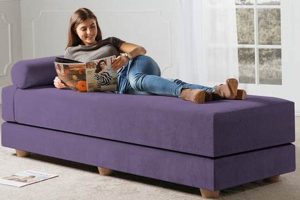
The segment of the furniture market focused on providing new sleeping surfaces for convertible couches constitutes a significant area of consumer interest. These products serve as a direct substitute for worn, damaged, or inadequate factory-provided components within a pull-out or fold-out sleeping platform. For example, an individual might seek a firmer or more supportive core material to improve comfort levels over the existing product.
Selecting an appropriate innerspring, memory foam, or latex construction significantly enhances the utility and lifespan of existing sofa beds. Investing in a high-quality product contributes to improved sleep quality for guests or residents, prevents premature wear and tear on the folding mechanism, and ultimately, provides a more aesthetically pleasing and functional dual-purpose furniture piece. These replacements have evolved over time, incorporating advancements in materials science and ergonomic design to better address consumer needs.
Therefore, considerations pertaining to core material, dimensions, thickness, and overall construction quality are paramount when assessing options. The following sections will explore these elements in detail, providing guidance for informed selection and long-term satisfaction.
Selection Guidance
The process of acquiring a new sleeping surface for a convertible couch requires careful consideration of multiple factors. Following is guidance intended to improve the likelihood of a satisfactory outcome.
Tip 1: Measure Existing Dimensions: Accurately assess the width, length, and thickness of the existing mattress when folded and unfolded. Inaccurate measurements may result in a product that does not properly fit within the sofa bed frame or allow for proper closure.
Tip 2: Consider Core Material: Evaluate different core materials based on individual preferences for firmness, support, and temperature regulation. Options include innerspring, memory foam, latex, and hybrid constructions. Each material exhibits distinct properties that affect sleeping comfort.
Tip 3: Assess Thickness Requirements: Ensure the selected thickness does not exceed the maximum allowance specified by the sofa bed mechanism manufacturer. Excessive thickness may impede proper folding and unfolding, potentially damaging the frame.
Tip 4: Evaluate Density and ILD Ratings: For foam-based mattresses, density and Indentation Load Deflection (ILD) ratings provide insights into durability and firmness levels, respectively. Higher density generally indicates greater longevity, while ILD values correlate with the perceived level of firmness.
Tip 5: Review Cover Material and Construction: Inspect the outer cover for quality stitching, durable fabric, and hypoallergenic properties. Breathable cover materials contribute to improved temperature regulation and reduced moisture retention.
Tip 6: Investigate Warranty and Return Policies: Prior to purchase, thoroughly review the manufacturer’s warranty and return policies. Understanding these terms can provide recourse in the event of manufacturing defects or dissatisfaction with the product’s performance.
Tip 7: Read Customer Reviews: Consult online customer reviews to gain insights into the real-world experiences of other users. Pay particular attention to comments regarding comfort, durability, and customer service responsiveness.
Proper attention to these details will improve the chance of selecting a compatible replacement that meets specific comfort needs and maintains the functionality of the existing convertible couch.
The subsequent section will address maintenance and care practices to maximize the lifespan of the purchased product.
1. Dimensional accuracy

Dimensional accuracy represents a critical factor in selecting a suitable sleeping surface for a convertible couch. The intended replacement must precisely match the internal dimensions of the sofa bed frame to ensure proper functionality. Inadequate measurements can result in a component that fails to fit within the frame, inhibits the folding mechanism, or causes structural damage to the sofa bed. For example, if the replacement is too wide, the sofa may not close completely, rendering the bed unusable as seating. Conversely, if the replacement is too short, gaps may form, compromising support and comfort.
The consequences of dimensional inaccuracies extend beyond mere inconvenience. Ill-fitting components can place undue stress on the folding mechanism, accelerating wear and tear and potentially leading to costly repairs. Furthermore, dimensional discrepancies may compromise the integrity of the support system, resulting in uneven weight distribution and diminished sleeping comfort. Manufacturers typically provide specifications for ideal replacement dimensions, and adhering to these guidelines is paramount. Failure to comply can void warranties and necessitate further expenses associated with procuring a correctly sized alternative.
In summary, dimensional accuracy is non-negotiable when selecting a replacement. Precise measurements are essential for seamless integration with the existing sofa bed frame, preventing functional impairment and ensuring optimal comfort and longevity. Neglecting this critical aspect introduces the risk of structural damage, compromised support, and ultimately, dissatisfaction with the product’s performance.
2. Core material composition

The selection of an appropriate core material represents a pivotal determinant in the overall quality and suitability of a sleeping surface intended for use within a convertible sofa. The core material directly influences factors such as support, comfort, temperature regulation, and durability. In the context of a sofa bed replacement, choosing the correct material is essential to replicating or improving upon the original sleeping experience. For instance, an innerspring core may offer enhanced support and airflow compared to a worn foam core, addressing concerns of sagging or overheating. Conversely, memory foam might be selected to provide superior pressure relief and conforming support for individuals with joint pain. The specific material composition, therefore, directly dictates the functional characteristics of the replacement component.
Different core materials exhibit distinct advantages and disadvantages that must be carefully weighed against individual needs and preferences. Innerspring constructions typically provide greater firmness and resilience, making them suitable for individuals who prefer a more supportive sleeping surface. However, they may be less effective at isolating motion transfer, potentially disrupting sleep for individuals sharing the sofa bed. Memory foam, on the other hand, excels at conforming to the body’s contours, alleviating pressure points and minimizing motion transfe
r. However, some memory foam formulations can retain heat, leading to discomfort in warmer climates. Latex offers a balance between support and conforming comfort, along with natural breathability and hypoallergenic properties. The selection process must therefore account for the intended user, the sleeping environment, and any specific health considerations.
In summary, core material composition is inextricably linked to the performance and satisfaction derived from a replacement sleeping surface for a convertible couch. A thorough understanding of the properties and trade-offs associated with different materials is crucial for making an informed decision. Failure to adequately consider core material composition can lead to discomfort, inadequate support, and premature degradation of the product, ultimately diminishing the value and utility of the sofa bed. Selection of a suitable material, aligned with individual needs and preferences, enhances user satisfaction and extends the lifespan of the furniture piece.
3. Thickness compatibility

Thickness compatibility is a critical determinant in the successful replacement of the sleeping surface within a convertible sofa. The physical dimensions of the intended replacement, particularly its vertical thickness, must align with the mechanical constraints of the sofa bed frame. Deviation from specified thickness parameters can impede functionality and potentially damage the apparatus.
- Folding Mechanism Interference
Excessive thickness can prevent the sofa bed from closing or opening smoothly. The folding mechanism is designed to accommodate a specific range of thicknesses. A component that exceeds this range may cause binding or jamming, requiring excessive force to operate the mechanism, ultimately leading to premature wear or structural failure. For example, attempting to fold a sofa bed with a too-thick component can damage hinges or cause the frame to warp.
- Enclosure Constraints
Sofa beds are designed with a defined cavity to house the mattress when in the sofa configuration. If the component exceeds the available space, the sofa may not close flush, creating an unsightly appearance and potentially interfering with seating comfort. Additionally, the excess pressure can damage the internal components of the sofa. An instance of this would be a sofa bed that cannot fully close, leaving a visible gap or placing undue stress on the closing latch.
- Support System Implications
Thickness can influence the support characteristics of the overall sleeping surface. If a component is too thin, it may not provide adequate support, leading to discomfort or potential back strain. Conversely, if the replacement is too thick, it might create an uneven sleeping surface due to compression limitations within the sofa bed frame. For example, a thin foam mattress might bottom out, providing insufficient support for heavier individuals.
- Material Composition Consideration
Thickness considerations must be evaluated in conjunction with the selected core material. A thinner high-density foam mattress might provide equivalent support to a thicker, lower-density foam construction. Similarly, a thinner innerspring mattress with a robust coil system might outperform a thicker, less supportive foam component. Therefore, selecting an appropriate thickness requires an understanding of the material properties and their impact on overall performance.
The integration of these thickness-related facets directly impacts the utility and longevity of any replacement sleeping surface for a convertible sofa. Selecting a component with compatible dimensions ensures seamless operation, prevents mechanical damage, and promotes optimal sleeping comfort. Consequently, adhering to specified thickness parameters is paramount for maximizing satisfaction and maintaining the functional integrity of the sofa bed.
4. Support system integrity

The structural integrity of the support system is fundamentally linked to the performance and longevity of any replacement sleeping surface within a convertible sofa. The support system directly dictates weight distribution, firmness consistency, and resistance to deformation over time. Proper evaluation of this aspect is therefore paramount in ensuring a satisfactory replacement experience.
- Coil Density and Gauge (Innerspring Systems)
In innerspring components, coil density (number of coils per unit area) and wire gauge (thickness of the wire) are crucial indicators of support system integrity. Higher coil densities provide greater surface coverage and more uniform weight distribution, minimizing pressure points. Thicker wire gauges offer increased resistance to deformation under load, enhancing durability and preventing sagging. For example, a lower gauge spring will deform faster than a higher gauge spring.
- Foam Density and ILD Rating (Foam Systems)
For foam-based support systems, density (mass per unit volume) and Indentation Load Deflection (ILD) ratings are key parameters. Higher density foams exhibit greater resistance to compression and provide more consistent support over time. ILD ratings indicate the firmness of the foam, with higher values corresponding to firmer surfaces. A high-density foam with appropriate ILD prevents premature breakdown. The relationship between density and ILD rating is important.
- Frame Integration and Load Distribution
The manner in which the support system interacts with the sofa bed frame significantly influences its overall stability and load-bearing capacity. A properly integrated support system distributes weight evenly across the frame, minimizing stress concentrations and preventing structural damage. Reinforcements or modifications to the frame may be necessary to accommodate heavier replacement components. Without the proper frame integration, the expected lifespan of a replacement support system will decrease.
- Material Degradation Resistance
The inherent resistance of the support system materials to degradation from factors such as moisture, temperature fluctuations, and repeated compression directly impacts its long-term integrity. Selecting components constructed from durable, high-quality materials is essential for maintaining support performance over time. Resistance to degradation is an important aspect to look into.
These facets of support system integrity underscore their direct influence on the performance of replacement sleeping surfaces for convertible sofas. Appropriate coil density and wire gauge, suitable foam density and ILD rating, and proper frame integration determine the overall suitability and durability of a replacement. Each aspect has a direct impact on the longevity.
5. Cover material durability

The longevity and utility of a sleeping surface designed as a convertible couch replacement are inextricably linked to the robustness of its outer encasement. This protective layer is not merely an aesthetic element; it serves as a primary defense against physical damage, mois
ture infiltration, and the accumulation of allergens or contaminants. A fragile or poorly constructed cover compromises the integrity of the internal components, potentially leading to premature degradation and diminished performance. For instance, a thinly woven fabric is susceptible to tearing, exposing the core material to spills, dust mites, and abrasion. Similarly, a non-water-resistant cover allows liquids to penetrate, fostering mold growth and creating an unsanitary sleeping environment. The selection of a durable cover material is therefore a critical consideration when evaluating suitable sleeping surface replacements.
Practical implications of cover material durability extend beyond the prevention of physical damage. A resilient cover can withstand repeated folding and unfolding, a characteristic inherent to sofa bed usage. Materials such as tightly woven polyester blends or reinforced cotton canvases exhibit superior resistance to abrasion and tearing compared to more delicate fabrics. Furthermore, antimicrobial treatments or waterproof coatings applied to the cover can significantly enhance its protective capabilities. These features are particularly beneficial in environments where the sofa bed is frequently used or exposed to potential sources of contamination. Consider, for example, a sofa bed in a vacation rental property; a durable, easy-to-clean cover minimizes the risk of staining or damage from frequent guest turnover, reducing maintenance costs and ensuring a consistently hygienic sleeping surface.
In conclusion, cover material durability is an indispensable attribute in selecting an effective sleeping surface for convertible couch applications. The selection directly affects the overall lifespan, hygiene, and performance of the component. Failing to prioritize cover material quality invites avoidable damage, diminishes usability, and compromises the hygienic aspects of this type of furniture, thereby undermining the intended benefits of the replacement. The relationship between cover durability and overall product value remains direct and substantial.
Frequently Asked Questions
The following questions and answers address common inquiries regarding the selection and application of replacement sleeping surfaces for convertible couches.
Question 1: What are the primary factors influencing the selection of a replacement?
Key considerations include dimensional compatibility with the sofa bed frame, core material composition (e.g., innerspring, memory foam, latex), thickness constraints imposed by the folding mechanism, support system integrity, and cover material durability.
Question 2: How does the core material impact sleeping comfort?
The core material dictates support levels, pressure relief, temperature regulation, and motion isolation. Innerspring systems provide firmer support, while memory foam conforms to the body’s contours. Latex offers a balance of support and comfort.
Question 3: What are the potential consequences of selecting an incompatible thickness?
Incompatible thickness can impede the folding and unfolding of the sofa bed, potentially damaging the mechanism. It can also prevent proper closure of the sofa or compromise support.
Question 4: How can one assess the support system integrity?
For innerspring systems, evaluate coil density and wire gauge. For foam systems, examine density and Indentation Load Deflection (ILD) ratings. Higher values generally indicate greater support and durability.
Question 5: Why is cover material durability important?
A durable cover protects against physical damage, moisture, and allergens, extending the lifespan of the sleeping surface and maintaining hygiene.
Question 6: Where can compatible replacements be sourced?
Replacements are available through online retailers specializing in furniture components, brick-and-mortar furniture stores, and directly from some sofa bed manufacturers.
These FAQs provide a concise overview of the fundamental considerations involved in selecting appropriate replacements for sofa beds. Careful attention to these factors increases the likelihood of a successful and satisfactory outcome.
The subsequent article section will delve into specific maintenance strategies to maximize the lifespan and performance of the chosen replacement.
Conclusion
The preceding analysis has detailed critical aspects of mattress for sofa bed replacement, from dimensional accuracy to core material composition and cover durability. Each facet contributes to the overall performance and user satisfaction derived from the convertible furniture piece. Proper consideration of these elements ensures compatibility, comfort, and longevity of the replacement. Neglecting these aspects can lead to functional impairment and premature degradation.
Therefore, due diligence in the selection process remains paramount. Prioritizing thorough measurement, informed material selection, and an understanding of the sofa bed’s mechanical constraints optimizes the investment in mattress for sofa bed replacement. Thoughtful selection extends the lifespan of existing furniture, enhances user experience, and ultimately contributes to responsible consumption practices.
![Bed Bug Proofing: Protecting Your Mattress [Guide] | Organic & Natural Mattress Buyer’s Guide: Non-Toxic Sleep Solutions](https://mattressworldpa.com/wp-content/uploads/2025/07/th-7289-300x200.jpg "Bed Bug Proofing: Protecting Your Mattress [Guide] Organic & Natural Mattress Buyer’s Guide: Non-Toxic Sleep Solutions")
![Best Medical Bed Mattress: [Benefit] & Comfort! | Organic & Natural Mattress Buyer’s Guide: Non-Toxic Sleep Solutions](https://mattressworldpa.com/wp-content/uploads/2025/07/th-7285-300x200.jpg "Best Medical Bed Mattress: [Benefit] & Comfort! Organic & Natural Mattress Buyer’s Guide: Non-Toxic Sleep Solutions")