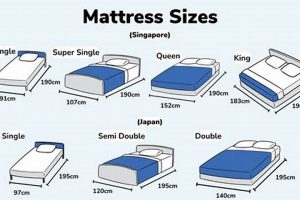
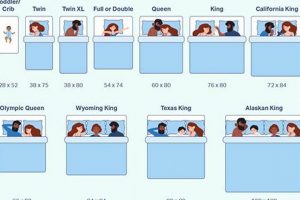
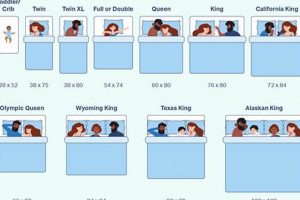
A compilation presenting standard dimensions for various sleeping surfaces. It provides specific measurements, typically in inches or centimeters, detailing the length and width of different mattress types. An example is a table displaying that a Twin mattress measures 38 inches wide by 75 inches long, while a King mattress measures 76 inches wide by 80 inches long.
The utility lies in simplifying the selection process. It allows consumers to easily compare options and choose a size that appropriately fits their sleeping space and needs. Historically, these dimensions evolved to accommodate varying body sizes and bedroom dimensions, eventually becoming standardized for manufacturing efficiency and consumer convenience.
The subsequent sections will elaborate on the specific dimensions of common mattress types, explore considerations for selecting an appropriate size, and discuss potential variations in measurements that may occur.
Guidance on Mattress Dimension Selection
The following guidance aims to provide clarity when evaluating options. Precise understanding of measurements is critical for ensuring a suitable fit within the intended space and accommodating the sleeper(s) comfortably.
Tip 1: Measure the Room. Before reviewing the reference information, accurately measure the bedroom. Ensure sufficient space for the bedframe and for movement around the room.
Tip 2: Consider Sleeper Dimensions. A taller individual will generally require a longer mattress, such as a Twin XL or a King, to prevent discomfort. Review individual height when selecting appropriate sizes.
Tip 3: Evaluate Co-Sleeping Needs. If the sleeping surface will accommodate more than one person, consider larger options like a Queen, King, or California King to ensure sufficient personal space.
Tip 4: Examine Bedframe Compatibility. Confirm that the intended sleeping surface dimensions match the inner dimensions of the bedframe. Discrepancies can lead to instability or damage.
Tip 5: Account for Bedding. When budgeting, consider costs for sheets, comforters, and other bedding accessories; bedding costs often vary based on mattress size.
Tip 6: Research Manufacturer Tolerances. Be aware that slight variations in actual measurements may occur between manufacturers due to production tolerances. Consult product specifications before making a final decision.
Tip 7: Anticipate Future Needs. Select a size that suits long-term needs. Consider changes in sleeping arrangements or living situations that may affect the suitability of the chosen dimension.
Adhering to these guidelines ensures a suitable and comfortable sleeping environment. Careful consideration of these factors during the selection process contributes to a positive purchasing experience.
The subsequent section will conclude by summarizing key considerations and provide resources for further research and exploration.
1. Twin Dimensions

Twin dimensions represent a specific entry within a comprehensive compilation of sleeping surface measurements. The existence of standardized twin sizes is contingent upon the development and adoption of the broader framework. The specifications, typically measuring 38 inches in width and 75 inches in length, serve as a fundamental element of the chart, providing a point of reference for comparative analysis of other sizes.
The inclusion of twin measurements within the resource is essential for several reasons. It caters to a specific demographic, including single sleepers, children, and individuals with limited bedroom space. Additionally, it provides a baseline for understanding the relative scale of other options; for example, the Queen size demonstrates a significant increase in width and length compared to the Twin. Without the inclusion of standard twin measurements, the framework would lack completeness and utility for a significant portion of the consumer base.
In summary, Twin dimensions are an integral component of the resource, fulfilling a specific need and serving as a foundational element for dimensional comparisons. Challenges in this context typically involve adhering to manufacturing tolerances and ensuring consistent measurements across different product lines. The understanding of this individual measurement contributes to a broader comprehension of spatial considerations when selecting a suitable sleeping surface.
2. Full dimensions

Full dimensions, also known as Double dimensions, represent a crucial entry in a compilation of standard sleeping surface measurements. This data provides essential information for consumers and manufacturers alike, facilitating informed decisions and ensuring product compatibility.
- Standard Measurements
The Full mattress typically measures 54 inches in width and 75 inches in length. These specifications are critical for selecting appropriate bedding and ensuring the mattress fits within designated bedframes. Discrepancies from these measurements can lead to discomfort or functional issues.
- Target Demographic
The Full size often serves as a transition between a Twin and a Queen, accommodating single sleepers who desire more space than a Twin offers, or couples who require a more compact option than a Queen. This makes it a versatile choice for guest rooms, smaller apartments, and teenagers.
- Dimensional Comparisons
Compared to a Twin (38″ x 75″), a Full provides significantly greater width. However, compared to a Queen (60″ x 80″), it is narrower and shorter. Understanding these dimensional relationships is essential for choosing the most suitable mattress based on individual needs and spatial constraints.
- Impact on Bedding Selection
The dimensions necessitate specific bedding sizes. Sheets, comforters, and other accessories designed for a Twin or Queen will not properly fit a Full mattress, highlighting the importance of consulting dimensional information when making purchasing decisions.
In summary, Full dimensions play a significant role within the scope of standard sleeping surface measurements. They cater to a specific segment of the market, offering a compromise between the compactness of a Twin and the expansive nature of a Queen. Careful consideration of these dimensions is essential for optimizing sleeping comfort and ensuring compatibility with existing bedroom furniture.
3. Queen dimensions

Queen dimensions represent a critical data point within the comprehensive mattress dimensions chart. The existence of standardized dimensions is a direct cause of the necessity for such a chart. Without consistent and agreed-upon measurements, comparison and selection become significantly more complex. Queen dimensions, typically 60 inches in width and 80 inches in length, serve as a benchmark for assessing suitability for couples or individuals desiring increased sleeping space. The absence of Queen dimensions within the resource would render it incomplete, particularly given the popularity of this size. For example, a couple transitioning from a Full size to a Queen intends to gain additional width for improved comfort. The chart facilitates this decision by providing precise measurements for comparison.
The practical significance of understanding Queen dimensions extends to various applications. Manufacturers rely on these standardized measurements to ensure consistent production and compatibility with bedframes and accessories. Retailers utilize the data for accurate product descriptions and customer guidance. Consumers employ the information to make informed purchasing decisions, minimizing the risk of selecting an unsuitable size. For instance, individuals moving into a new apartment can use the chart to determine whether a Queen-size bed will comfortably fit within the available bedroom space. The chart’s utility stems from its ability to centralize and standardize this essential dimensional information.
In summary, Queen dimensions are an indispensable component of the mattress dimensions chart, serving as a widely adopted standard for both manufacturers and consumers. Challenges related to dimensional tolerances and variations between manufacturers exist, underscoring the importance of consulting detailed product specifications. The chart facilitates informed decision-making, contributing to a more efficient and satisfactory purchasing process. The connection between Queen dimensions and the comprehensive chart highlights the value of standardization in the bedding industry.
4. King dimensions

King dimensions represent a significant data point within a comprehensive mattress sizes chart, illustrating a standardized measurement for a widely available sleeping surface. Its inclusion directly enhances the utility of the resource, providing critical data for informed consumer decisions.
- Standard Measurements
King mattresses typically measure 76 inches in width and 80 inches in length. These dimensions serve as a benchmark for comparing sizes and ensuring compatibility with bed frames and bedroom layouts. Deviation from these standards can result in improper fit and reduced comfort.
- Comparative Analysis
Within a mattress sizes chart, King dimensions allow consumers to readily compare the size to Queen (60″ x 80″), Full (54″ x 75″), and Twin (38″ x 75″) mattresses. This comparative analysis is crucial for selecting a mattress that appropriately accommodates individual or shared sleeping preferences and bedroom space constraints.
- Sub-categories: Standard vs. California King
The chart also clarifies distinctions between Standard King (76″ x 80″) and California King (72″ x 84″) dimensions. While both provide ample space for two adults, the California King offers greater length, suitable for taller individuals. Inclusion of both sets of measurements is vital for comprehensive decision-making.
- Implications for Bedding and Accessories
King dimensions dictate the necessary size for sheets, comforters, and other bedding accessories. The mattress sizes chart inherently connects to these ancillary purchases, as consumers require accurate dimensional information to ensure proper fit and functionality. Inaccurate data within the chart can lead to wasted expenses and dissatisfaction.
In summation, the accurate representation of King dimensions within a mattress sizes chart is critical for consumer convenience and informed purchasing decisions. Clear dimensional information minimizes the risk of selecting an unsuitable sleeping surface, ensuring compatibility with bedroom space and bedding accessories. The chart serves as a central reference point, promoting consistency and standardization within the bedding industry.
5. Cal King dimensions

Cal King dimensions constitute a specific entry within a comprehensive matrix of sleeping surface measurements. The mattress sizes chart serves as a standardized resource, and the inclusion of Cal King dimensions is essential for completeness and accuracy. Without the precise measurements (72 inches wide and 84 inches long), the chart’s utility is diminished for a segment of the population, specifically taller individuals requiring extended length. For example, someone over six feet tall might find a standard King mattress (76 inches wide and 80 inches long) insufficient, leading them to consult the chart for Cal King dimensions.
The practical significance of understanding Cal King dimensions lies in facilitating informed purchasing decisions. The chart allows consumers to compare dimensions and select a mattress that optimally suits their needs and bedroom space. Manufacturers rely on these standardized measurements to ensure consistent production, while retailers utilize the information for accurate product representation. A real-world instance would involve a consumer researching mattress sizes online before visiting a store; the chart enables them to pre-determine if a Cal King will fit their bedroom layout, considering factors like doorframes and furniture placement. The standardized measurements thus minimize the risk of purchasing an unsuitable mattress.
In summary, Cal King dimensions are an integral component of the mattress sizes chart, catering to a particular demographic and contributing to the chart’s overall value. Challenges in maintaining accuracy across different manufacturers exist, underscoring the importance of consulting detailed product specifications. The chart serves as a central reference point, promoting consistency and standardization within the bedding industry and aiding consumers in making well-informed choices. Disregarding the importance of those dimensions means limiting options for those who specifically need that sizes.
6. Height variations

Height variations, in the context of a mattress sizes chart, refer to the disparities in mattress thickness or profile. These variations are relevant as they impact overall comfort, support, and compatibility with bed frames and bedding.
- Impact on Accessibility
Height variations can affect the ease of getting into and out of bed. For individuals with mobility issues, a lower profile mattress may be more accessible, while a taller mattress might be preferable for those who find it difficult to bend. The mattress sizes chart typically does not explicitly list height, requiring consumers to seek this information elsewhere. In real-world scenarios, neglecting height consideration can lead to discomfort or even safety concerns.
- Influence on Support and Comfort
The internal construction and materials used often correlate with height. Thicker mattresses may incorporate multiple layers of foam or coils, potentially enhancing support and pressure relief. Conversely, thinner mattresses might offer less contouring and resilience. While the mattress sizes chart primarily focuses on length and width, understanding the correlation between height and comfort is crucial for informed decision-making. For example, a side sleeper may prefer a higher profile mattress to accommodate shoulder and hip compression.
- Compatibility with Bed Frames and Headboards
Height variations directly affect how a mattress interacts with a bed frame and headboard. A mattress that is too tall may obscure the headboard, while one that is too short may leave an unsightly gap. Some bed frames are designed to accommodate specific mattress heights. The mattress sizes chart does not account for this variable, highlighting the need for consumers to consider overall dimensions, including height, when selecting a mattress and bed frame.
- Effect on Bedding Fit
Mattress height influences the required depth of fitted sheets. Deep-pocket sheets are necessary for thicker mattresses, while standard sheets may suffice for thinner ones. The mattress sizes chart provides length and width, but not height, making it imperative for consumers to seek additional product specifications to ensure proper bedding fit. Failure to do so can result in ill-fitting sheets that slip off the mattress.
Height variations, though not explicitly detailed within the typical mattress sizes chart, play a significant role in overall sleeping comfort and bedroom aesthetics. Consumers are encouraged to supplement the information provided in the chart with additional research to ensure they select a mattress that meets their specific needs and complements their existing bedroom furniture. Consideration of all three dimensions, length, width, and height, is essential for a satisfactory purchasing experience.
7. Frame compatibility

Frame compatibility represents a critical consideration when selecting a sleeping surface, directly linking to the utility and accuracy of a mattress sizes chart. The chart’s dimensions serve as a foundational reference point for ensuring a proper fit between the mattress and its corresponding bed frame.
- Standard Dimensions Alignment
The core function of a mattress sizes chart is to provide standardized length and width measurements for various mattress sizes, such as Twin, Full, Queen, King, and California King. Bed frame manufacturers adhere to these standards. Discrepancies between the chart’s dimensions and the frame’s internal measurements lead to instability, potential damage to the mattress or frame, and compromised sleep quality. For instance, attempting to fit a Queen mattress into a Full-size frame is physically impossible and attempting to do so will lead to product damage.
- Support Structure Considerations
Bed frames are designed with specific support structures, such as slats or a solid platform, that are tailored to distribute weight evenly across the mattress surface. A mismatch between the mattress size and the frame’s support system compromises structural integrity. An undersized mattress on a larger frame lacks adequate support, while an oversized mattress may exert excessive force on the frame, potentially causing it to fail. The chart assists in preventing such mismatches by providing accurate dimensional information for informed selection.
- Headboard and Footboard Integration
Many bed frames incorporate headboards and footboards as aesthetic and functional components. Proper mattress size is essential for achieving a visually balanced and structurally sound integration. A mattress that is too short may leave an unsightly gap between the mattress and headboard, while one that is too tall may obscure the headboard entirely. The mattress sizes chart facilitates informed decision-making, allowing consumers to select a mattress that complements the overall design of the bed frame.
- Platform Bed Compatibility
Platform beds eliminate the need for a box spring by providing direct support to the mattress. Accurate dimensional matching is particularly crucial in this context, as there is no secondary layer to compensate for slight size discrepancies. The mattress sizes chart becomes an indispensable tool for selecting a mattress that precisely fits the platform bed frame, ensuring optimal support and preventing shifting or instability. An incorrectly sized mattress on a platform bed directly impacts sleeping comfort and potentially reduces the lifespan of the mattress.
In summation, the accurate interpretation and application of a mattress sizes chart are paramount for achieving proper frame compatibility. Deviations from standard dimensions, whether in the mattress or the frame, can result in structural instability, compromised comfort, and aesthetic imbalances. By consulting the chart and carefully measuring both the mattress and frame, consumers can ensure a secure and visually appealing sleeping environment. Therefore, it is highly recommended to check a mattress sizes chart.
Frequently Asked Questions About Mattress Sizes
The following section addresses common inquiries regarding standard sleeping surface dimensions, providing clarity and guidance for informed decision-making.
Question 1: Why does the dimensions matter?
Mattress sizes dictate compatibility with bed frames, room space, and bedding. Adhering to standard measurements ensures a proper fit, preventing instability, discomfort, and unnecessary expenses related to ill-fitting accessories.
Question 2: Are mattress sizes consistent across all manufacturers?
While general dimensions are standardized, minor variations may exist due to manufacturing tolerances. Consulting product specifications before purchase is recommended to ensure accurate fitting.
Question 3: What is the difference between a King and a California King mattress?
A standard King mattress measures 76 inches wide and 80 inches long, while a California King mattress measures 72 inches wide and 84 inches long. The California King provides extra length, often preferred by taller individuals, whereas the standard King offers greater width.
Question 4: How does mattress height influence selection?
Mattress height affects accessibility, support, and compatibility with bed frames and bedding. Taller mattresses may require deep-pocket sheets and could obscure headboards if not carefully considered.
Question 5: Can two individuals comfortably sleep on a Full-size mattress?
While possible, a Full-size mattress (54 inches wide) may feel cramped for two adults. A Queen (60 inches wide) or King (76 inches wide) generally provides a more comfortable sleeping experience for couples.
Question 6: Are there specific mattress sizes designed for children?
Twin (38 inches wide) and Twin XL (38 inches wide, 80 inches long) mattresses are commonly used for children and teenagers, offering sufficient space for single sleepers while conserving room space.
In summary, careful attention to standard mattress dimensions is paramount for a positive purchasing experience. Consulting a detailed reference and understanding individual needs ensures optimal comfort and compatibility.
The subsequent section will provide a comprehensive overview, reinforcing key considerations and offering practical advice for selecting the appropriate sleeping surface.
Conclusion
The preceding analysis has underscored the practical importance of the mattress sizes chart. The compilation of standard dimensions serves as a vital resource for both manufacturers and consumers within the bedding industry. Adherence to these standardized measurements facilitates compatibility between mattresses, bed frames, and bedding accessories, minimizing potential purchasing errors and ensuring a satisfactory sleep environment.
In conclusion, the mattress sizes chart is not merely a listing of dimensions; it is a foundational tool for informed decision-making. Its accurate and consistent application is essential for optimizing comfort, maximizing space utilization, and fostering standardization within the market. Continued awareness and utilization of this resource will contribute to a more efficient and consumer-centric bedding industry.

![Buy Best Queen Size Sofa Mattress [Deals Inside] | Organic & Natural Mattress Buyer’s Guide: Non-Toxic Sleep Solutions](https://mattressworldpa.com/wp-content/uploads/2025/07/th-2332-300x200.jpg "Buy Best Queen Size Sofa Mattress [Deals Inside] Organic & Natural Mattress Buyer’s Guide: Non-Toxic Sleep Solutions")