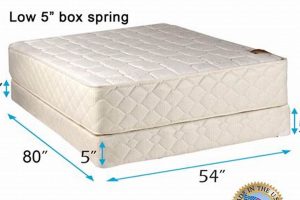
The dimensions of a standard double bed are typically 54 inches wide and 75 inches long. These figures represent the industry-accepted norm for what is commonly referred to as a full-size sleeping platform. For instance, a prospective buyer planning to accommodate two adults should carefully consider whether this surface area adequately meets their spatial requirements.
Understanding the space occupied by this type of bed is crucial for effective room planning and furniture arrangement. Its adoption as a common size reflects a balance between providing sufficient sleeping space for individuals or couples and maintaining a manageable footprint suitable for various bedroom sizes. Historically, it offered an upgrade from a single bed, addressing the need for increased personal space without the larger commitment of a queen or king-size option.
The following discussion will delve into the practical applications of knowing these dimensions, exploring considerations for optimal room placement, and comparing them to alternative mattress sizes available on the market.
Considerations for a Double Bed
Properly utilizing the knowledge of the dimensions of a standard double bed can greatly improve space planning and purchasing decisions.
Tip 1: Room Size Assessment: Before purchasing, meticulously measure the intended room to ensure adequate clearance around the perimeter of the bed. This prevents overcrowding and allows for comfortable movement.
Tip 2: Bedding Selection: When acquiring sheets, comforters, and other bedding items, confirm that they are specifically designed for this size. Incorrect sizing can lead to ill-fitting covers and reduced comfort.
Tip 3: Frame Compatibility: Verify that the bed frame selected is explicitly compatible with the specified dimensions. An incompatible frame may not provide adequate support and could compromise the mattresss integrity.
Tip 4: Weight Distribution: Consider the weight capacity of both the mattress and frame, especially when it is intended for use by multiple individuals. Exceeding weight limits can lead to premature wear and potential structural damage.
Tip 5: Measuring Existing Bedding: If replacing an existing sleeping surface, measure the old mattress to confirm its dimensions match industry standards. This ensures the new purchase aligns with pre-existing bedroom furniture.
Tip 6: Future Considerations: Contemplate long-term needs before committing to a particular size. If co-sleeping arrangements are anticipated, a larger option, such as a queen-sized bed, may prove more suitable.
Effective application of these guidelines will enhance the user’s experience and maximize the utility of the bed within its designated environment.
The succeeding section will provide a comparative analysis of various mattress sizes to facilitate informed consumer choices.
1. Width (54 inches)

The designation of 54 inches as the width within the measurements for a full size mattress is not arbitrary; it is a defining characteristic that directly impacts the mattress’s suitability for its intended users. This dimension establishes the lateral space available to occupants, influencing comfort levels, particularly for couples or individuals who prefer ample room to move during sleep. Deviations from this standard width would, by definition, disqualify a mattress from being classified as a true full-size model. For example, a mattress measuring 52 inches in width, though close, would necessitate distinct bedding requirements and might render existing full-size bed frames incompatible.
The impact of this specific width extends to room planning and furniture selection. Interior designers rely on these standard measurements to accurately estimate space utilization and ensure proportional harmony within a bedroom. Consider a scenario where a shopper mistakenly believes they can fit a queen-size bed (typically 60 inches wide) in a room designed to accommodate a full-size bed. The resulting overcrowding can impede movement, affect accessibility to other furniture, and negatively impact the overall aesthetic. Furthermore, the width directly affects the perceived value proposition: a smaller width than the standard diminishes the space available for sleeping, potentially leading to dissatisfaction among users.
In summary, the 54-inch width is an indispensable component of the measurements for a full size mattress, dictating its practical application and integration within living spaces. Adherence to this standard ensures compatibility with bedding and frames, optimizes room design, and guarantees the expected level of comfort. Failure to acknowledge this dimension can lead to misinformed purchasing decisions and compromised living conditions.
2. Length (75 inches)

The 75-inch length, as a critical element of the dimensions for a full size mattress, establishes its suitability for accommodating individuals of specific heights. It is a primary determinant in providing adequate support and comfort during sleep.
- Accommodating Height
The 75-inch dimension is generally appropriate for individuals up to approximately 5 feet 10 inches in height. Taller individuals may experience discomfort due to their feet extending beyond the mattress edge. This limitation necessitates a careful assessment of personal height before selecting this mattress size. For example, an adult exceeding this height may find a queen or king-size mattress, with greater length, more suitable to prevent restricted movement and potential sleep disruption.
- Spatial Efficiency
The specified length contributes to the spatial efficiency of a bedroom. Compared to longer mattresses, the 75-inch dimension allows for greater maneuverability and placement options within smaller rooms. Consider an apartment dweller who prioritizes open floor space; a full-size mattress with this length may be a more practical choice than a queen or king, without significantly compromising individual comfort, assuming their height is within the acceptable range.
- Bedding Compatibility
Standard bedding sets for full-size mattresses are manufactured to correspond with the 75-inch length. Deviations from this standard can result in ill-fitting sheets and blankets, leading to discomfort and aesthetic inconsistencies. For instance, using queen-size sheets on a double bed will result in excess fabric, which can bunch up and interfere with sleep quality.
- Frame Design and Support
The 75-inch length is a key consideration for the design and construction of bed frames intended for full-size mattresses. Frames must provide adequate support across this length to prevent sagging or uneven weight distribution, which can compromise the lifespan and comfort of the mattress. A frame that is too short will leave a portion of the mattress unsupported, potentially leading to damage and decreased sleep quality.
In conclusion, the 75-inch length is an integral component of measurements for a full-size mattress, directly impacting comfort, spatial utilization, bedding selection, and frame compatibility. Its significance should not be underestimated when assessing whether this mattress size aligns with individual needs and preferences. The implications extend to both the sleeping experience and the overall functionality of the bedroom environment.
3. Thickness (Varies)

Within the comprehensive set of measurements for a full size mattress, the ‘Thickness (Varies)’ specification represents a notable departure from fixed dimensions. Unlike the standardized width and length, thickness is a variable attribute, dependent on construction materials, design features, and intended comfort level.
- Impact on Bed Height and Accessibility
Mattress thickness significantly influences the overall bed height, a critical factor for accessibility. Individuals with mobility limitations or specific height preferences must consider this dimension. For instance, a thicker mattress on a high-profile bed frame might create an excessively elevated sleeping surface, whereas a thinner mattress on a low-profile frame could make it difficult to get in and out of bed. The thickness should, therefore, be evaluated in conjunction with the frame’s height to ensure user comfort and safety.
- Effect on Support and Comfort
The internal composition and thickness of a mattress directly correlate with its support and comfort characteristics. Thicker mattresses often incorporate multiple layers of different materials, such as memory foam, latex, and coil systems, to provide enhanced pressure relief and spinal alignment. In contrast, thinner mattresses may offer less contouring and support, potentially leading to discomfort for some users. The choice should align with individual sleeping preferences and any existing orthopedic considerations.
- Influence on Bedding Selection
While standard sheet sizes are generally designed to accommodate a range of mattress thicknesses, extreme variations may necessitate specialized bedding. Mattresses exceeding a certain thickness, typically 14 inches, often require deep-pocket sheets to ensure a secure and proper fit. Failure to account for this can result in sheets that constantly slip off, leading to frustration and disrupted sleep. It is essential to verify the pocket depth of bedding before purchase to ensure compatibility.
- Visual Aesthetics and Room Proportion
Mattress thickness contributes to the overall visual aesthetic of a bedroom. A thick, luxurious mattress can create a focal point and enhance the sense of opulence, while a thinner mattress may project a more minimalist or modern look. The thickness should be considered in relation to the size and style of the room. A disproportionately thick mattress in a small room can appear overwhelming, while a too-thin mattress in a large room may seem inadequate. Harmonizing the mattress thickness with the surrounding decor is essential for achieving a balanced and visually appealing space.
In conclusion, while the ‘Thickness (Varies)’ specification within the measurements for a full size mattress lacks a fixed value, its implications for comfort, accessibility, bedding compatibility, and room aesthetics are profound. This dimension should be carefully evaluated in conjunction with other factors to ensure the selection of a mattress that effectively meets individual needs and enhances the overall sleep environment.
4. Area (4050 sq. in.)
The area of 4050 square inches, derived from multiplying the width and length dimensions of a full size mattress, is a quantifiable measure that encapsulates the total sleeping surface available. This figure serves as a critical reference point for evaluating the mattress’s suitability for accommodating one or more occupants.
- Defining Occupancy Capacity
The area dictates the realistic capacity of a full-size mattress. While technically capable of accommodating two adults, the resulting space constraints may compromise individual comfort and sleep quality. The 4050 square inches equates to approximately 2025 square inches per person, which may be insufficient for individuals who prefer ample personal space or those who tend to move frequently during sleep. Consider a scenario where two average-sized adults attempt to share a full-size mattress; the limited area can lead to sleep disturbances and reduced overall restfulness.
- Comparison with Alternative Sizes
Understanding the area allows for direct comparisons with other mattress sizes, facilitating informed decision-making based on spatial requirements. For example, a queen-size mattress, with a larger area, provides significantly more space per person, making it a more suitable option for couples. Conversely, a twin-size mattress offers substantially less area, rendering it appropriate only for single occupants. By quantifying the available sleeping surface, prospective buyers can objectively assess which mattress size best aligns with their specific needs and preferences.
- Impact on Weight Distribution and Support
The area influences weight distribution and support characteristics. A larger area generally provides a more even distribution of body weight, minimizing pressure points and promoting spinal alignment. However, the density and composition of the mattress materials also play a crucial role in providing adequate support. The 4050 square inches of a full-size mattress must be adequately supported by the internal structure to prevent sagging or uneven wear, particularly when occupied by multiple individuals. An inadequate support system can lead to discomfort and premature deterioration of the mattress.
- Influence on Bedding and Accessories
The area directly dictates the size requirements for bedding and accessories, such as sheets, comforters, and mattress protectors. Standard full-size bedding sets are designed to fit within the 4050 square inch dimensions, ensuring a proper and secure fit. Deviations from this standard can result in ill-fitting bedding that is either too large or too small, compromising comfort and aesthetics. For example, using queen-size sheets on a double bed will result in excess fabric that can bunch up and interfere with sleep quality.
The specification of 4050 square inches, representing the area available on a measurements for a full size mattress, serves as a critical determinant of its suitability for intended use. Its impact extends beyond mere dimensions, influencing occupancy capacity, comparative sizing, weight distribution, and bedding compatibility. Prospective buyers should carefully consider this quantifiable measure when evaluating whether a measurements for a full size mattress aligns with their specific needs and preferences.
5. Frame Compatibility

Ensuring appropriate frame compatibility is paramount when considering the measurements for a full size mattress. The frame serves as the foundational support system, and its dimensions must precisely correspond with those of the mattress to guarantee structural integrity, prevent premature wear, and optimize user comfort. A mismatch can lead to instability, uneven weight distribution, and a compromised sleep experience.
- Dimensional Correspondence
Accurate dimensional correspondence between the frame and the mattress is the primary determinant of compatibility. A frame designed for a queen-size mattress, for example, will invariably be too large for a measurements for a full size mattress, resulting in unsupported edges and potential sagging. Conversely, a frame that is too small will compress the mattress, distorting its shape and potentially damaging its internal components. Manufacturers typically specify the intended mattress size for each frame model; adherence to these guidelines is crucial for ensuring proper fit and function. Consider the case of a homeowner who inherits an antique bed frame; before purchasing a new mattress, meticulous measurements must be taken to verify compatibility, or the frame may require modification.
- Support Structure Alignment
The support structure of the frame, including slats, springs, or a solid platform, must align correctly with the measurements for a full size mattress to provide uniform support across the entire surface. Gaps or uneven spacing can create pressure points and compromise the mattress’s ability to conform to the user’s body. A frame with inadequate support may cause premature sagging or indentation in specific areas of the mattress, reducing its lifespan and potentially leading to discomfort or back pain. For example, a slatted frame with widely spaced slats may not provide sufficient support for a memory foam mattress, which requires a solid, even surface to maintain its shape and performance.
- Headboard and Footboard Attachment
When the frame incorporates a headboard and/or footboard, their attachment points must align with the dimensions for a full size mattress to ensure a secure and stable connection. Misalignment can result in wobbly connections, potential damage to the headboard or footboard, and an aesthetically unappealing appearance. Furthermore, improperly attached headboards or footboards can pose a safety hazard if they become detached or unstable. Before attaching a headboard to a frame, careful measurements and alignment checks are essential to ensure a seamless and secure connection.
- Weight Capacity Considerations
The weight capacity of the frame must be sufficient to support the combined weight of the mattress and its occupants. Exceeding the weight limit can lead to structural failure, posing a safety risk and potentially damaging the mattress. The frame’s material, construction, and design all contribute to its weight-bearing capacity. A lightweight metal frame, for example, may not be suitable for supporting a heavy latex mattress and two adults. It is imperative to consult the manufacturer’s specifications to verify the frame’s weight limit and ensure that it is adequate for the intended use. A failure to check weight capacity could lead to the frame collapsing under the weight of the mattress and occupants.
In summary, meticulous attention to frame compatibility, ensuring precise dimensional correspondence, adequate support structure alignment, secure headboard/footboard attachment, and sufficient weight capacity, is essential for maximizing the lifespan and performance of a full size mattress. Disregarding these considerations can result in compromised comfort, premature wear, and potential safety hazards.
Frequently Asked Questions
This section addresses common inquiries regarding the dimensions and related considerations for a standard double bed. The information provided aims to clarify specifications and assist in informed purchasing decisions.
Question 1: What are the precise dimensions defining a standard full-size mattress?
A standard full-size mattress measures 54 inches in width and 75 inches in length. These figures represent the industry norm and are crucial for selecting compatible bedding and bed frames.
Question 2: Can a full-size mattress comfortably accommodate two adults?
While technically possible, it is generally recommended for single sleepers or couples who do not require significant personal space. The dimensions may prove restrictive for two adults seeking optimal comfort and undisturbed sleep.
Question 3: How does the thickness of a full-size mattress impact its suitability for different bed frames?
Thickness varies among models and influences overall bed height. It is imperative to ensure that the chosen bed frame can adequately support the mattress’s thickness while maintaining a comfortable height for getting in and out of bed.
Question 4: Are there significant variations in the stated dimensions of full-size mattresses across different manufacturers?
While minor variations may exist, reputable manufacturers adhere closely to the standard dimensions. Significant deviations should raise concerns regarding quality and compatibility with standard bedding.
Question 5: What is the recommended room size for accommodating a full-size bed?
A minimum room size of 10 feet by 10 feet is generally recommended to allow for adequate space around the bed and comfortable movement within the room.
Question 6: Does mattress weight influence bed frame selection when purchasing a full-size mattress?
Yes. The bed frame must possess a weight capacity sufficient to support the mattress and its occupants. Exceeding the frame’s weight limit can compromise its structural integrity and pose a safety hazard.
In summary, a thorough understanding of the dimensions for a full size mattress, including width, length, and thickness, along with considerations for occupancy, room size, and weight capacity, is essential for making an informed and suitable purchase.
The following section will provide a summary of the key considerations discussed within this article.
Measurements for a Full Size Mattress
This discourse has thoroughly examined the measurements for a full size mattress, underscoring the importance of adhering to standard dimensions for optimal functionality. Key considerations included the 54-inch width and 75-inch length, critical for accommodating single sleepers or couples with limited space requirements. Variable mattress thickness, its influence on bed height and support, and its interaction with frame compatibility were also explored. The discussion also emphasized the impact of the 4050 square-inch area on occupancy comfort and weight distribution, in addition to careful selection of a supporting frame to ensure structural integrity and longevity of the sleeping surface. Deviations from industry-accepted dimensions risk compromising comfort, stability, and the overall user experience.
Given the direct correlation between dimensional accuracy and user satisfaction, prospective purchasers are urged to meticulously verify specifications and carefully evaluate the interplay between mattress size, frame design, and intended use. Prioritizing these considerations will lead to a more informed decision and a greater likelihood of securing a sleeping arrangement that effectively meets individual needs and spatial constraints, maximizing the investment in a high-quality sleep environment.
![Best Full Intex Air Mattress: Reviews & Guide [Year] | Organic & Natural Mattress Buyer’s Guide: Non-Toxic Sleep Solutions](https://mattressworldpa.com/wp-content/uploads/2025/07/th-2888-300x200.jpg "Best Full Intex Air Mattress: Reviews & Guide [Year] Organic & Natural Mattress Buyer’s Guide: Non-Toxic Sleep Solutions")