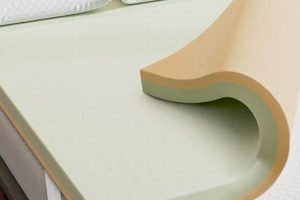
A combination of viscoelastic polyurethane foam and an inflatable sleeping surface creates a unique sleep solution. This configuration seeks to merge the conforming comfort associated with specialized foam with the adjustable support of a pneumatic bed. The foam layer contours to the sleeper’s body, distributing weight and reducing pressure points, while the air chamber provides a customizable firmness level.
This pairing aims to offer enhanced comfort and support compared to traditional air mattresses alone. The foam component contributes to improved spinal alignment and minimized motion transfer, leading to potentially better sleep quality. Historically, air mattresses were primarily used for temporary or camping situations; however, integrating specialized foam aims to elevate them to a more regular sleep solution.
The following sections will delve deeper into the advantages, disadvantages, common applications, and considerations when selecting this type of sleep arrangement. Factors such as foam density, air chamber construction, and overall durability will be examined to provide a comprehensive overview.
Guidance on Optimizing Viscoelastic Foam Integration with Pneumatic Mattresses
The following recommendations address key considerations when utilizing viscoelastic polyurethane foam atop inflatable sleeping surfaces, aimed at maximizing comfort and longevity.
Tip 1: Prioritize Foam Density. Higher density foams offer improved durability and support. A density of 3 lbs/cubic foot or greater is generally recommended for enhanced performance and resistance to compression over time.
Tip 2: Evaluate Air Chamber Construction. Internal coil or beam structures within the air chamber contribute to stability and even weight distribution. Examine the construction method to ensure adequate support and minimize sagging.
Tip 3: Monitor Inflation Levels. Regularly check and adjust the air pressure within the mattress. Maintaining the correct inflation level, as specified by the manufacturer, is crucial for optimal support and to prevent over-stretching of the air chamber.
Tip 4: Employ a Protective Barrier. Utilize a mattress protector to shield both the foam and the air chamber from moisture, spills, and allergens. This barrier helps to prolong the lifespan of the components and maintain hygiene.
Tip 5: Rotate the Foam Layer. Periodically rotating the foam layer, typically every few months, promotes even wear and reduces the risk of permanent body impressions. This practice helps to extend the usable life of the foam.
Tip 6: Consider Foam Thickness. The thickness of the foam layer impacts the level of comfort and pressure relief. A thicker layer, typically 2-4 inches, generally provides superior cushioning and support.
Tip 7: Adhere to Weight Restrictions. Observe the manufacturer’s recommended weight limit for the mattress. Exceeding this limit can compromise the integrity of the air chamber and reduce the effectiveness of the foam layer.
Adhering to these recommendations ensures a more comfortable and durable sleep surface, extending the lifespan of both the foam and the inflatable component.
The subsequent sections will provide detailed information on selecting appropriate foam densities and air chamber designs.
1. Pressure Relief

Pressure relief is a primary consideration when evaluating sleep surfaces. The integration of viscoelastic foam with inflatable mattresses directly addresses this concern by conforming to the sleeper’s body contours, thereby redistributing weight and reducing concentrated pressure points.
- Viscoelastic Conformity
Viscoelastic foam, the core component, exhibits a unique ability to deform under pressure and slowly return to its original shape when the pressure is removed. This property enables the foam to mold to the body’s unique contours, supporting the spine’s natural alignment and minimizing stress on joints and muscles. For example, a side sleeper often experiences pressure buildup in the shoulders and hips; viscoelastic foam can alleviate this by distributing the load over a larger surface area.
- Weight Distribution Dynamics
The combination of viscoelastic foam and an air chamber facilitates dynamic weight distribution. The foam layer mitigates localized pressure, while the air chamber provides adjustable support to maintain overall spinal alignment. Proper weight distribution is crucial for preventing pressure sores and promoting healthy circulation, especially for individuals with limited mobility or chronic pain conditions. Imbalances in weight distribution can lead to discomfort and exacerbate existing musculoskeletal issues.
- Micro-Pressure Point Reduction
The foam’s structure consists of open cells that respond to minute pressure variations. This micro-level adjustment reduces pressure on capillaries and nerves, promoting restful sleep. Consider the textured surface of some foams which are designed to further minimize contact points, enhancing blood flow and reducing the likelihood of tossing and turning during the night.
- Customizable Firmness Integration
The air chamber within the mattress allows for adjustable firmness, working in conjunction with the foam to fine-tune pressure relief. Individuals can increase or decrease the air pressure to achieve the optimal level of support and conformity. This customization ensures that the mattress adapts to individual needs and preferences, accommodating different body types and sleeping positions. A firmer setting might be preferred for back sleepers, while a softer setting can provide more cushioning for side sleepers.
The interaction of these facets demonstrates how integrating viscoelastic foam into inflatable mattresses provides a multi-faceted approach to pressure relief. From the foam’s inherent ability to conform to body contours to the air chamber’s role in customizable support, the design aims to minimize pressure points, enhance weight distribution, and promote restful sleep. The overall effectiveness depends significantly on the quality of materials and the individual’s ability to adjust the firmness to their personal needs.
2. Support Customization

Support customization represents a key attribute within the context of viscoelastic foam integrated with inflatable mattresses. This feature enables users to adjust the firmness and support level, adapting the sleep surface to individual preferences and physiological needs. The air chamber within the mattress is instrumental in achieving this tailored support.
- Air Chamber Inflation Control
The air chamber’s inflation level directly dictates the mattress’s firmness. Increasing the air pressure results in a firmer sleep sur
face, providing greater resistance to compression and enhanced support for individuals who prefer a more rigid feel. Conversely, decreasing the air pressure creates a softer surface with increased give. This adjustability allows users to fine-tune the support level to alleviate specific pressure points or accommodate varying sleep positions. For example, an individual with lower back pain might increase the air pressure to provide additional lumbar support, while a side sleeper might prefer a lower pressure for enhanced shoulder and hip cushioning. - Viscoelastic Foam Density Impact
While the air chamber provides the primary means of support customization, the density of the viscoelastic foam layer also influences the overall feel. Higher density foams offer greater resistance to compression, resulting in a firmer and more supportive surface, even at lower air pressures. Conversely, lower density foams provide a softer and more conforming feel, allowing for greater contouring to the body’s shape. The interplay between foam density and air pressure allows for a nuanced level of support customization, enabling users to achieve a balance between firmness and comfort. The quality of the foam is as important as the adjustability of the air chamber.
- Independent Zone Adjustment (Advanced Models)
Certain advanced models incorporate independent zone adjustment capabilities, allowing users to independently control the air pressure in different sections of the mattress. This feature is particularly beneficial for couples with differing support preferences or for individuals with specific pressure relief needs in certain areas of the body. For instance, one side of the mattress could be inflated to a higher pressure for greater back support, while the other side is set to a lower pressure for softer shoulder cushioning. This level of customization ensures that both partners can enjoy a personalized sleep experience without compromising the other’s comfort.
- Adaptation to Medical Conditions
Support customization provides a practical solution for individuals managing various medical conditions. People suffering from arthritis or fibromyalgia can adjust the mattress firmness to minimize pressure points and alleviate pain. Patients recovering from surgery may require specific support levels to promote healing and prevent further injury. The ability to tailor the mattress’s support level makes it a versatile and adaptable sleep surface for a wide range of medical needs. Consider also, that adjustments should align with professional medical advice for optimal therapeutic benefit.
In summation, the support customization offered by the combination of viscoelastic foam and an adjustable air chamber provides a significant advantage over traditional mattresses. The ability to fine-tune the firmness and support level allows users to achieve a personalized sleep experience tailored to their individual preferences and physiological needs. This adaptability is particularly beneficial for individuals with specific medical conditions or those seeking a higher degree of comfort and pressure relief.
3. Durability Concerns

The integration of viscoelastic foam with inflatable mattresses introduces specific durability concerns stemming from the inherent properties of both materials and their combined usage. Inflatable air chambers are susceptible to punctures, leaks, and seam failures, particularly under sustained weight and pressure. The addition of viscoelastic foam does not inherently mitigate these risks and can, in some cases, exacerbate them. For instance, uneven weight distribution on a compromised air chamber could lead to localized stress points, accelerating degradation of both the air bladder and the overlying foam. Further, repeated inflation and deflation cycles contribute to material fatigue, impacting the long-term integrity of the air chamber.
Viscoelastic foam itself undergoes degradation over time, exhibiting compression set, where the material loses its original shape and resilience. This phenomenon is intensified by exposure to moisture, heat, and ultraviolet radiation. Given that inflatable mattresses are often employed in environments where these factors are prevalent (e.g., camping, guest rooms with inconsistent climate control), the foam layer’s lifespan can be significantly reduced. Moreover, the porous nature of viscoelastic foam makes it prone to absorbing spills and odors, which can compromise its hygienic properties and contribute to structural weakening. The quality of the foam significantly impacts this; lower density foams will degrade more quickly. As an example, an air mattress used frequently in a vacation home and stored improperly during off-seasons will likely exhibit significant foam compression and air leakage within a relatively short timeframe.
In summary, the durability of viscoelastic foam atop an inflatable mattress is contingent on several interconnected factors, including the quality of materials, environmental conditions, and usage patterns. Understanding these factors is crucial for consumers to make informed purchasing decisions and for manufacturers to develop more robust and long-lasting products. Proactive measures, such as using protective mattress covers, maintaining proper inflation levels, and storing the mattress in a controlled environment, can help to mitigate some of these durability concerns and extend the product’s lifespan.
4. Temperature Regulation

Viscoelastic foam, a common component of sleep surfaces, exhibits a characteristic of heat retention due to its dense structure and limited airflow. When integrated with an inflatable mattress, this property can lead to elevated sleeping temperatures, potentially causing discomfort and disrupted sleep. The degree of heat retention depends on several factors, including the density and thickness of the foam layer, the ambient temperature of the room, and the individual’s body heat production. For instance, a high-density viscoelastic foam topper on an inflatable mattress, used in a warm climate, will likely trap heat and create a warmer sleeping environment compared to a lower-density foam alternative in a cooler room. The lack of internal ventilation within the foam structure hinders the dissipation of heat, leading to its accumulation near the body.
To mitigate heat retention, manufacturers employ various strategies, including infusing the foam with cooling gels or incorporating open-cell foam structures. Gel-infused foam is designed to absorb and dissipate heat, providing a cooler surface. Open-cell foam promotes airflow, facilitating heat transfer away from the body. The effectiveness of these strategies varies depending on the specific materials and construction techniques used. Real-world examples show that mattresses incorporating both gel infusion and open-cell technology often exhibit improved temperature regulation compared to traditional viscoelastic foam mattresses. However, even with these advancements, temperature regulation remains a significant challenge, and individual sensitivity to heat varies greatly. Therefore, personal preferences and environmental conditions play crucial roles in determining the suitability of such mattresses for specific individuals.
In conclusion, temperature regulation is a critical consideration when evaluating viscoelastic foam atop inflatable mattresses. While the inherent heat-retentive properties of the foam
can cause discomfort, mitigation strategies such as gel infusion and open-cell structures offer potential solutions. Selecting a mattress with appropriate cooling technologies, considering the ambient environment, and understanding individual thermal preferences are essential for achieving a comfortable sleep experience. Further research and development in foam materials and construction techniques are needed to address the ongoing challenges of temperature regulation in sleep surfaces.
5. Portability Factor

The integration of viscoelastic foam with inflatable mattresses impacts the overall portability of the sleeping solution. While inflatable mattresses are inherently designed for ease of transport and storage when deflated, the addition of viscoelastic foam, particularly in thicker or denser configurations, introduces a trade-off. The foam layer, even when compressed, occupies a substantial volume compared to a deflated air chamber alone. This increased bulk affects the ease with which the mattress can be folded, rolled, and carried. The weight of the foam also contributes to the overall portability challenge. For instance, a queen-sized air mattress with a 4-inch thick, high-density viscoelastic foam topper is considerably more cumbersome to transport than a standard air mattress without the foam layer. This consideration is particularly relevant for individuals seeking a portable sleeping solution for camping, travel, or temporary accommodation in space-constrained environments. The practical significance of this understanding lies in aligning the desired level of comfort with the necessary degree of portability, factoring in the constraints of the intended application.
The design and construction of both the air chamber and the viscoelastic foam layer influence the ease of packing and unpacking the integrated sleeping system. Air mattresses featuring internal coil support structures, although providing enhanced stability during use, often require more meticulous folding to avoid damaging the internal components. Viscoelastic foam, depending on its composition and manufacturing process, can exhibit varying degrees of compressibility. Some foams are more pliable and readily compress for storage, while others resist compression and retain their shape, posing a greater challenge during packing. The presence of a removable foam topper, as opposed to an integrated layer, can offer a degree of flexibility, allowing the air mattress and foam to be transported separately and potentially optimizing space utilization. An example would be someone frequently traveling between residences: a removable foam topper allows the air mattress to be packed compactly and the foam to be transported separately, potentially as luggage.
In conclusion, the portability factor represents a significant consideration when evaluating the combined viscoelastic foam and inflatable mattress. The enhanced comfort and support afforded by the foam layer necessitate a trade-off in terms of ease of transport and storage. Understanding the relationship between foam density, air chamber design, and compressibility is essential for making informed decisions based on the specific needs and constraints of the intended application. Addressing the challenges associated with portability requires careful consideration of material selection, construction techniques, and user expectations, balancing the desired level of comfort with the practical realities of transport and storage.
Frequently Asked Questions About Memory Foam on Air Mattresses
The following section addresses common inquiries regarding the integration of viscoelastic foam with inflatable sleeping surfaces. The information presented aims to provide clarity on the performance, usage, and maintenance of these products.
Question 1: How does the addition of memory foam impact the overall support provided by an air mattress?
The viscoelastic foam layer contributes to enhanced contouring and pressure relief, distributing weight more evenly across the sleep surface. The air chamber provides the primary support structure, adjustable to achieve the desired firmness level. The combination aims to optimize both comfort and spinal alignment.
Question 2: What is the expected lifespan of memory foam when used in conjunction with an air mattress?
The lifespan depends on several factors, including foam density, usage frequency, and environmental conditions. High-density foam, when properly maintained, can last for several years. However, compression set and degradation due to moisture or heat can reduce its longevity. Adherence to manufacturer guidelines is essential.
Question 3: Are memory foam air mattresses suitable for individuals with back pain?
The adjustable firmness of the air chamber, combined with the conforming properties of the viscoelastic foam, can provide customized support for individuals with back pain. However, consultation with a healthcare professional is recommended to determine the optimal firmness level and sleeping position for individual needs.
Question 4: How should a memory foam air mattress be cleaned and maintained?
Regular vacuuming is recommended to remove dust and debris from the foam surface. Spills should be promptly blotted with a clean cloth. The use of a mattress protector is advisable to prevent stains and moisture damage. Avoid harsh chemicals or abrasive cleaners, as these can degrade the foam.
Question 5: Does the addition of memory foam make an air mattress less portable?
Yes, the viscoelastic foam layer increases the bulk and weight of the mattress, reducing its portability compared to a standalone air mattress. Thicker and denser foam layers will have a more significant impact. Consider the intended use and transport requirements when selecting a product.
Question 6: What are the common issues encountered with memory foam air mattresses?
Common issues include air leaks in the air chamber, compression set in the foam layer, and difficulty in temperature regulation due to heat retention in the foam. Proper maintenance and adherence to manufacturer guidelines can help mitigate these issues.
The answers provided offer a foundational understanding of viscoelastic foam integration with inflatable sleeping surfaces. Careful consideration of these factors is essential for informed product selection and responsible usage.
The next section will delve into comparative analysis with alternative sleep surfaces.
Conclusion
The exploration of memory foam on air mattress configurations reveals a complex interplay of comfort, support, durability, and portability considerations. The integration of viscoelastic foam with inflatable air chambers offers a customizable sleep surface aimed at pressure relief and spinal alignment. However, the long-term performance and suitability of these products are contingent upon material quality, environmental conditions, and diligent maintenance. Durability concerns related to air leaks and foam degradation necessitate careful product selection and adherence to manufacturer guidelines.
Given the trade-offs inherent in this design, prospective purchasers are encouraged to critically evaluate their individual needs and priorities. Further advancements in materials science and manufacturing processes hold the potential to enhance the performance and longevity of memory foam on air mattress systems, addressing existing limitations and expanding their applicability across a broader range of use cases.
![Best Camper Queen Memory Foam Mattress [Sleep Better!] | Organic & Natural Mattress Buyer’s Guide: Non-Toxic Sleep Solutions](https://mattressworldpa.com/wp-content/uploads/2025/07/th-4110-300x200.jpg "Best Camper Queen Memory Foam Mattress [Sleep Better!] Organic & Natural Mattress Buyer’s Guide: Non-Toxic Sleep Solutions")