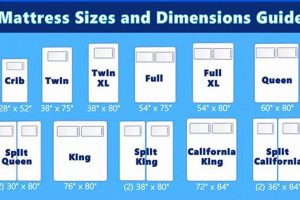
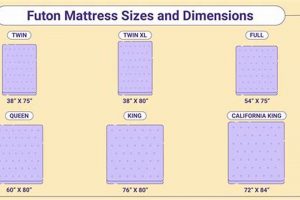
This particular bedding configuration offers dimensions that fall between those of a standard queen and a king-size mattress. It provides additional width compared to a typical queen, offering greater sleeping space, but remains narrower than a king, potentially fitting more readily into smaller bedrooms. As an example, a mattress of this type might measure approximately 66 inches wide and 80 inches long.
The principal advantage of utilizing this specific mattress dimension lies in the enhanced individual space it affords sleepers. This can lead to improved sleep quality due to reduced partner disturbance. Historically, demand for such sizing arose from consumers seeking a compromise between the compactness of a queen and the luxurious space of a king, particularly in urban living environments where bedroom square footage can be limited.
The subsequent sections will detail the availability of linens suited to this less common mattress size, considerations for selecting appropriate bed frames, and comparisons with other standard mattress dimensions, allowing for a comprehensive understanding of its suitability for varied sleep needs and spatial constraints.
Considerations for Optimal Utilization
This section offers advice to aid in maximizing the benefits of this specific mattress dimension, addressing key areas for consumer consideration.
Tip 1: Frame Selection: Ensure compatibility of the bed frame with the mattress dimensions. Custom frames or those designed for queen-size mattresses may require modification or specific adaptation to provide adequate support.
Tip 2: Linen Acquisition: Due to limited availability of specifically sized sheets, consider purchasing oversized queen linens or custom-made options to ensure proper fit and avoid slippage.
Tip 3: Room Measurement: Prior to purchase, meticulously measure the intended bedroom space. This ensures that the bed will fit comfortably, leaving sufficient room for movement and other furniture.
Tip 4: Weight Distribution: If co-sleeping, consider the combined weight of the sleepers. A heavier combined weight may necessitate a more robust mattress construction to prevent sagging or premature wear.
Tip 5: Mattress Type: Explore various mattress types, such as memory foam, innerspring, or hybrid models, to determine which provides the optimal level of support and comfort for individual needs.
Tip 6: Trial Period: If possible, take advantage of in-home trial periods offered by mattress retailers. This allows for assessment of comfort and suitability over a longer duration than a brief in-store evaluation.
Adhering to these suggestions will facilitate a more informed purchase and optimize the long-term satisfaction associated with this specific mattress dimension.
The subsequent discussion will explore the potential disadvantages, addressing common concerns related to availability and cost.
1. Wider than queen
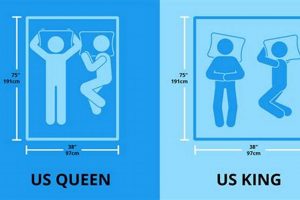
The defining characteristic that differentiates the Olympic queen mattress dimension from the standard queen lies in its increased width. While a standard queen typically measures 60 inches in width, the Olympic queen extends to approximately 66 inches. This seemingly minor difference of six inches provides a notably expanded sleeping surface for occupants. The consequence of this increased width is enhanced individual sleeping space, particularly beneficial for couples or individuals who prefer additional room to move during sleep. The “wider than queen” element is not merely a descriptive label but a fundamental component defining the very purpose of the Olympic queen: to offer more space than a standard queen without the full commitment to the larger footprint of a king-size mattress. This specific dimensional increase influences purchasing decisions, impacting bed frame and linen selections, as well as room space planning. The added width directly correlates with improved sleeping comfort for those sharing the bed. A real-world example highlights its appeal to couples where one or both partners are restless sleepers, as the increased space minimizes the transfer of motion and disturbance.
The practical significance of understanding this dimensional distinction is multifaceted. Consumers must be cognizant of the implications for bedding accessories. Standard queen-size sheets, for instance, will not adequately fit an Olympic queen mattress, necessitating the purchase of oversized queen sheets or potentially custom-made options. Similarly, bed frames intended for standard queen mattresses may not provide proper support or aesthetic appeal to an Olympic queen. The “wider than queen” attribute is therefore not an isolated feature but a catalyst for a chain of purchasing considerations. These considerations might include enhanced frame support, specialized linen purchases or additional costs associated with bespoke items.
In summary, the defining “wider than queen” dimension of the Olympic queen mattress directly influences sleeping comfort, purchase considerations, and logistical planning. It offers an intermediate size option that seeks to balance space constraints with the desire for greater individual sleeping area. The increased width necessitates careful frame and linen selection. Understanding this dimension, therefore, is key to a successful adoption of the Olympic queen size and its benefits. Challenges around linen availability could be a downside of the bed. Future consumers may want to consider whether bespoke linen costs are worth the additional space the bed provides.
2. Narrower than king

The characteristic “narrower than king” is intrinsically linked to the definition of the Olympic queen mattress size. It establishes its position within the spectrum of available mattress dimensions, specifically as a compromise between a standard queen and a full king. A king-size mattress typically spans 76 inches in width, whereas the Olympic queen measures approximately 66 inches. This 10-inch difference is not arbitrary; it is a deliberate design choice to offer additional sleeping space without necessitating the larger room dimensions required for a king. For example, an individual residing in an apartment with limited bedroom space might find a king-size bed impractical, while the Olympic queen provides a viable alternative offering greater width than a standard queen, while still being manageable within spatial constraints. The reduced width directly impacts the overall footprint, influencing furniture placement and room aesthetics.
The practical significance of recognizing this “narrower than king” attribute extends to logistical considerations. Selecting the Olympic queen avoids potential issues associated with maneuvering a wider king-size mattress through doorways or up staircases. Furthermore, it reduces the cost associated with purchasing king-size bedding, which is generally more expensive than queen or oversized queen options. A concrete illustration involves couples transitioning from a standard queen to a larger mattress. They might select the Olympic queen to experience the enhanced sleeping space without the substantial investment and spatial demands of a king. Moreover, this dimensional characteristic contributes to a sense of proportion within smaller bedrooms. A king-size bed might overwhelm a compact space, whereas the Olympic queen maintains a better visual balance.
In summary, the defining aspect of “narrower than king” establishes the niche occupied by the Olympic queen mattress size. It represents a deliberate design decision to cater to consumers seeking additional width without the spatial or financial commitment associated with a king-size bed. Understanding this relationship is crucial for informed purchasing decisions, allowing individuals to optimize comfort within the constraints of their living spaces and budgets. Challenges, however, exist in finding bedding to fit, and it is important that a bedframe can accommodate this. It is a good middle ground, especially for smaller rooms.
3. Sixty-six inch width

The “sixty-six inch width” serves as the defining dimensional specification of the Olympic queen mattress size. Its presence dictates the bed’s classification, differentiating it from both the standard queen (60 inches) and the king (76 inches). The sixty-six-inch measurement is, therefore, not merely a numerical value, but a critical component that determines the mattress’s practical application and its suitability for specific user needs and spatial constraints. For example, a couple seeking more sleeping space than a standard queen provides, but lacking the room for a king, might find the Olympic queen and its sixty-six-inch width an ideal compromise. The dimension directly influences the degree of comfort and freedom of movement experienced by sleepers, particularly when shared between two individuals. Furthermore, it dictates the necessary bed frame dimensions and impacts the availability and cost of appropriately sized linens.
The practical significance of understanding the “sixty-six inch width” lies in its implications for purchasing decisions and long-term user satisfaction. Consumers must be aware that standard queen-size sheets will be insufficient, necessitating the acquisition of oversized or custom bedding. Similarly, bed frames must be carefully selected to ensure adequate support and stability for the wider mattress. In a real-world scenario, imagine a consumer purchasing an Olympic queen mattress without prior knowledge of its unique width. They might subsequently encounter difficulties sourcing suitable bedding or discover that their existing bed frame is incompatible, leading to frustration and additional expense. The knowledge of this dimension, therefore, is critical for avoiding such pitfalls.
In conclusion, the “sixty-six inch width” is an indispensable attribute of the Olympic queen mattress size, directly influencing its practicality, user experience, and purchase considerations. It serves as the primary differentiator that defines its position within the range of available mattress dimensions. A lack of awareness regarding this specific measurement can lead to complications during the acquisition of bed frames and linens. Understanding this parameter allows individuals to make well-informed decisions and maximize the benefits of the Olympic queen mattress size. However, the challenges surrounding linen purchase needs to be considered carefully.
4. Eighty inch length

The “eighty inch length” represents a significant dimensional component that defines the overall sleeping surface of an Olympic queen mattress size. It dictates the distance from head to foot, influencing comfort, suitability for different body types, and spatial considerations within a bedroom. Understanding its role is essential for informed decision-making when selecting this particular mattress dimension.
- Suitability for Taller Individuals
The eighty-inch length provides adequate legroom and overall body support for individuals of average to above-average height. In comparison to shorter mattress lengths, such as those found in full-size beds, this dimension ensures that taller users do not experience discomfort due to feet extending beyond the mattress edge. For instance, a person measuring 6 feet (72 inches) in height will have a reasonable margin of space, promoting restful sleep.
- Impact on Bedroom Space Planning
The eighty-inch length contributes to the overall footprint of the bed within a bedroom. When planning room layout, it is crucial to consider this dimension in conjunction with the sixty-six-inch width to ensure adequate space for movement and other furniture. A smaller bedroom may feel cramped if the eighty-inch length is not appropriately accounted for, potentially hindering accessibility and comfort.
- Compatibility with Bed Frames
Bed frames intended for queen-size mattresses typically accommodate an eighty-inch length. However, it is essential to verify compatibility, particularly with platform beds or those featuring headboards and footboards, to ensure a proper fit. Discrepancies in frame dimensions can lead to instability or prevent the mattress from resting securely within the frame.
- Influence on Sheet Selection
Standard queen-size sheets are generally designed to accommodate an eighty-inch mattress length. However, the extra width of the Olympic queen may necessitate deeper pocket sheets to ensure a secure and comfortable fit. Selecting sheets with insufficient depth can result in slippage and an uneven sleeping surface.
The eighty-inch length is an intrinsic parameter of the Olympic queen mattress size, influencing both user comfort and practical considerations. Careful attention to this dimension, in conjunction with the width, is crucial for optimizing bedroom space, selecting appropriate bed frames, and acquiring properly fitting linens. Its selection can be contrasted with a california king, which while being 4 inches narrower, adds 4 inches of length. It is important to understand the space one requires prior to purchase.
5. Custom linen needs

The procurement of appropriately sized linens represents a significant consideration when acquiring an Olympic queen mattress. This mattress dimension, which is not a standard size, presents unique challenges for consumers seeking properly fitting sheets, blankets, and other bedding accessories. Addressing these custom needs is paramount to ensuring optimal comfort and a satisfactory sleeping experience.
- Limited Availability of Pre-Made Linens
The primary challenge stems from the restricted availability of pre-made linens specifically designed for the Olympic queen size. Standard queen-size sheets are invariably too small to adequately cover the mattress, while king-size sheets are excessively large and prone to bunching. This necessitates exploring alternative sourcing options, such as specialty bedding retailers or online marketplaces that offer a wider selection of less common sizes.
- Increased Cost of Custom-Sized Bedding
Opting for custom-made linens often entails a higher cost compared to purchasing readily available standard sizes. The bespoke nature of the order necessitates individual tailoring, which translates to increased labor and material expenses. Consumers must factor this potential price increase into their overall budget when considering an Olympic queen mattress.
- Necessity for Precise Measurements
Accurate measurements are crucial when ordering custom-sized linens. Precise dimensions of the Olympic queen mattress, including width, length, and depth, must be provided to the manufacturer to ensure a proper fit. Failure to provide accurate measurements can result in ill-fitting sheets that compromise comfort and aesthetics.
- Considerations for Fabric Selection
When commissioning custom linens, fabric selection becomes a more critical decision. Beyond aesthetics, factors such as thread count, material composition (e.g., cotton, linen, silk), and weave affect comfort, durability, and ease of care. Careful consideration should be given to these aspects to ensure the chosen fabric aligns with individual preferences and lifestyle.
The complexities surrounding linen acquisition for the Olympic queen underscore the importance of thorough research and planning prior to purchase. While the enhanced sleeping space offered by this mattress dimension can be appealing, consumers must be prepared to address the challenges and potential expenses associated with sourcing custom-sized bedding. The long-term comfort and satisfaction derived from the Olympic queen hinge significantly on resolving these unique linen needs.
6. Frame compatibility crucial

The necessity for appropriate bed frame compatibility is a pivotal element in realizing the full benefits of an Olympic queen mattress. Given its non-standard dimensions, a mismatch between mattress and frame can lead to structural instability, compromised comfort, and accelerated wear. Therefore, careful assessment of frame specifications is paramount prior to purchase.
- Adequate Support Systems
An appropriate frame must provide sufficient support across the entire mattress surface. The additional width of an Olympic queen, compared to a standard queen, necessitates a frame designed to accommodate the increased span. Insufficient support can cause sagging, uneven weight distribution, and premature deterioration of the mattress core. Platform beds, for instance, require a solid or closely spaced slat system to prevent structural compromise. A lack of proper support can nullify the mattress’s intended comfort and ergonomic benefits.
- Dimensional Precision
Frame dimensions must closely align with those of the Olympic queen mattress (approximately 66 inches wide by 80 inches long). Overly large frames can allow the mattress to shift and slide, while frames that are too small will restrict proper expansion and potentially damage the mattress edges. Precise dimensional matching ensures a secure and stable fit, optimizing comfort and preventing premature wear on both the mattress and frame. The use of measuring tools prior to frame and mattress purchase is thus crucial.
- Headboard and Footboard Integration
The integration of headboards and footboards introduces additional compatibility considerations. The design and attachment points of these elements must be suitable for the Olympic queen’s specific dimensions. Mismatched headboards or footboards may create unsightly gaps, compromise structural integrity, or interfere with the proper placement of bedding. Careful evaluation of design compatibility is, therefore, essential for achieving a cohesive and aesthetically pleasing bedroom environment.
- Weight Capacity Considerations
The frame’s weight capacity must exceed the combined weight of the mattress and its occupants. Exceeding the frame’s weight limit can lead to structural failure, posing safety risks and potentially damaging both the mattress and surrounding furniture. Careful consideration of weight capacity is particularly important for platform beds or frames with minimalist support systems. The manufacturer’s specifications should be consulted to ensure adequate weight-bearing capability.
The aforementioned facets underscore the crucial interrelationship between frame selection and the Olympic queen mattress size. A comprehensive approach to frame compatibility, encompassing support systems, dimensional precision, headboard/footboard integration, and weight capacity, is vital for maximizing the comfort, longevity, and safety associated with this bedding configuration. Failure to address these factors can lead to compromised sleep quality, accelerated wear, and potential structural failures. Careful planning and precise measurements form the foundation of optimal frame selection.
Frequently Asked Questions
This section addresses common inquiries and clarifies key aspects regarding the Olympic queen mattress size, providing information for prospective purchasers.
Question 1: What distinguishes an Olympic queen mattress from a standard queen?
The primary difference lies in the width. An Olympic queen measures approximately 66 inches wide, whereas a standard queen is 60 inches wide. The length remains consistent at 80 inches.
Question 2: Are standard queen-size sheets compatible with an Olympic queen mattress?
No, standard queen-size sheets are generally too narrow to adequately cover an Olympic queen mattress. Oversized queen or custom-made sheets are typically required.
Question 3: Where can linens specifically designed for an Olympic queen mattress be sourced?
Linens may be found at specialty bedding retailers, online marketplaces offering a wider range of sizes, or through custom bedding manufacturers.
Question 4: Will any standard queen-size bed frame accommodate an Olympic queen mattress?
Not necessarily. While the length is comparable, the increased width may require a frame designed for the specific dimensions of an Olympic queen or a frame that offers adjustable support.
Question 5: Is an Olympic queen mattress a cost-effective alternative to a king-size mattress?
While potentially less expensive than a king-size mattress, the overall cost may be comparable when factoring in the expense of custom linens and potentially a new bed frame.
Question 6: Is an Olympic queen mattress suitable for all bedroom sizes?
An Olympic queen is suitable for bedrooms where a standard queen feels too small, but a king would overwhelm the space. Careful measurement of the room is essential before purchase.
In summary, the Olympic queen offers a middle ground between standard queen and king sizes. However, the unique dimensions necessitate careful consideration of linen and frame compatibility.
The subsequent section will delve into a comparative analysis, juxtaposing the Olympic queen against other popular mattress sizes.
Olympic Queen Mattress Size
This analysis has explored the dimensional characteristics, advantages, and challenges associated with the Olympic queen mattress size. It has established that this particular dimension, positioned between a standard queen and a king, offers increased sleeping space, albeit with unique considerations related to linen acquisition and bed frame compatibility. The exploration highlighted the importance of precise measurements, thoughtful purchasing decisions, and an awareness of the potential cost implications associated with this non-standard size.
Ultimately, the suitability of an Olympic queen mattress hinges on individual needs and circumstances. Prospective buyers must weigh the benefits of increased sleeping space against the practical challenges of finding appropriately sized accessories. A thorough evaluation of spatial constraints, budget considerations, and a willingness to address non-standard bedding requirements is paramount to a satisfactory purchase. The decision should stem from understanding specific preferences.