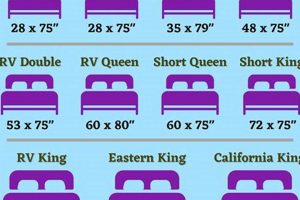
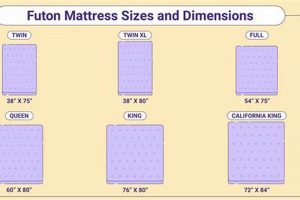
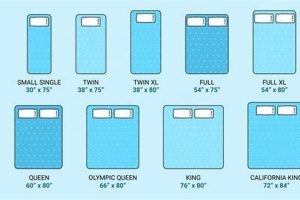
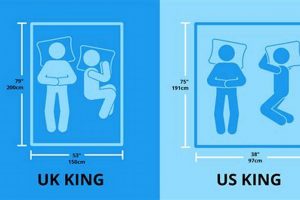
Measurements for recreational vehicle sleeping surfaces designed to accommodate two adults in relative comfort typically fall into specific size categories. One common option approximates the dimensions of a standard queen-sized bed, albeit often with adjustments to length or width to better suit the spatial constraints inherent in camper design. This results in variations from the traditional 60 inches by 80 inches, potentially becoming slightly shorter or narrower.
Selecting an appropriately sized sleeping platform is essential for ensuring restful sleep while traveling. Optimizing interior space is a key consideration in RV design, impacting maneuverability and storage capacity. A properly fitted mattress maximizes available room while providing adequate comfort, which enhances the overall travel experience and contributes to the enjoyment of outdoor activities during excursions.
The following sections will detail the typical variations encountered in camper sleeping surfaces, examine the materials commonly used in their construction, and provide guidance on selecting a mattress that balances comfort, durability, and spatial efficiency within the unique confines of a recreational vehicle.
Optimizing comfort within the limited space of a recreational vehicle requires careful consideration of mattress dimensions. The following tips offer guidance in selecting a suitable queen-sized sleeping surface for campers.
Tip 1: Measure Available Space Accurately: Prior to purchase, meticulously measure the designated sleeping area within the camper. Account for any obstructions such as wheel wells or built-in cabinetry that may impinge upon the available space. Precise measurements are critical to ensure a proper fit.
Tip 2: Prioritize Thickness Based on Sleeping Style: Mattress thickness significantly impacts comfort and support. Side sleepers generally benefit from thicker mattresses to provide adequate cushioning for pressure points, while back or stomach sleepers may find thinner, firmer options more suitable.
Tip 3: Consider Mattress Material for Climate Control: Material composition affects temperature regulation and moisture wicking. Memory foam can retain heat, potentially leading to discomfort in warmer climates. Latex or hybrid mattresses often offer better breathability for enhanced cooling.
Tip 4: Research Manufacturer Specifications Carefully: Actual dimensions may vary slightly from advertised specifications. Scrutinize manufacturer websites and product documentation to confirm precise measurements, construction details, and warranty information.
Tip 5: Assess Weight Restrictions: Recreational vehicles often have weight restrictions that must be observed to maintain safety and performance. Consider the weight of the mattress when making a selection, particularly when upgrading from a lighter, factory-installed option.
Tip 6: Factor in Ease of Handling: Moving and installing a mattress within the confined space of a camper can be challenging. Consider the mattress’s weight and flexibility to ensure it can be maneuvered easily into position. Some mattresses can be compressed and rolled for convenient transport.
Tip 7: Evaluate Edge Support: Strong edge support prevents sagging and increases the usable surface area of the mattress. This is particularly important in campers where space is limited and users may need to sit on the edge of the bed.
Selecting a queen-sized mattress for a camper involves a careful balance of comfort, dimensions, and practical considerations. Accurate measurements, informed material choices, and attention to weight restrictions are essential for maximizing satisfaction and ensuring a restful sleep experience on the road.
The next section will address the most common problems associated with the installation of camper mattresses.
1. Standard Length Deviation

Standard length deviation in recreational vehicle sleeping surfaces, specifically within the context of “queen size camper mattress dimensions,” refers to the variations observed in the length of these mattresses compared to standard residential queen-sized mattresses. This deviation arises due to the need to optimize space within the often-constrained interiors of campers and RVs.
- Space Optimization Imperative
Recreational vehicles prioritize efficient space utilization. The standard 80-inch length of a residential queen mattress may be impractical, leading manufacturers to shorten the mattress to create more usable space within the camper. This adjustment facilitates easier movement, increases storage capacity, and improves the overall livability of the vehicle.
- Wheel Well and Structural Accommodation
Interior structures, particularly wheel wells, often dictate the maximum dimensions of sleeping platforms. To accommodate these structural elements, mattress length is frequently reduced. Precise measurements are therefore essential to ensure the mattress fits correctly within the designated space without interfering with the vehicle’s infrastructure.
- Impact on Sleep Comfort and Support
While length reduction optimizes space, it can potentially compromise comfort, particularly for taller individuals. A shorter mattress may result in feet hanging off the end or necessitate a bent sleeping posture. Selecting a mattress with adequate support characteristics becomes critical to mitigate the discomfort associated with reduced length.
- Market Availability and Customization Options
The prevalence of length deviations has led to a specialized market for RV mattresses. Consumers may encounter difficulties finding standard queen-sized mattresses that fit their specific camper dimensions. This often necessitates exploring custom mattress options, which can offer a tailored fit but may also incur higher costs and longer lead times.
In summary, understanding the “Standard Length Deviation” in “queen size camper mattress dimensions” is crucial for recreational vehicle owners. The trade-off between spatial efficiency and sleeping comfort must be carefully considered, with attention paid to individual height, structural limitations within the vehicle, and the availability of both standard and custom mattress solutions.
2. Width Compatibility Issues

Width compatibility issues concerning “queen size camper mattress dimensions” frequently stem from the need to integrate standard sleeping surfaces into the non-standard spaces of recreational vehicles. While a standard queen mattress measures 60 inches in width, camper interiors often present obstructions, such as wheel wells, built-in storage units, or supporting structures, that reduce the available width. This discrepancy can prevent a standard queen from fitting properly, necessitating either a narrower mattress or modifications to the existing camper structure.
The ramifications of ignoring width compatibility extend beyond simple fit. A mattress that is too wide may require forceful compression, leading to premature wear and tear or structural damage to the camper’s bed frame. Conversely, a mattress that is too narrow will result in wasted space and potentially create instability, affecting sleep quality and safety. Manufacturers often produce “short queen” or RV queen mattresses to address these constraints, offering reduced dimensions in both length and width. Consumers must exercise caution in verifying the actual measurements of these specialized mattresses to ensure accurate compatibility with their camper’s specific requirements. An example of this is a mattress advertised as “queen,” but with actual measurements of 58 inches wide by 74 inches long.
In conclusion, addressing width compatibility issues is paramount when selecting a “queen size camper mattress dimensions.” Precise measurement of the available space, careful consideration of potential obstructions, and awareness of specialized RV mattress options are essential to ensuring a proper fit, maximizing comfort, and preventing damage to both the mattress and the recreational vehicle. A lack of proper dimensions results not only in a poor fit, but increased safety concerns when camping.
3. Thickness Impact on Comfort

The thickness of a recreational vehicle mattress, specifically within the context of “queen size camper mattress dimensions,” exerts a substantial influence on sleep comfort and overall user satisfaction. A mattress that is insufficiently thick may fail to provide adequate support, leading to pressure points, discomfort, and disrupted sleep. Conversely, an excessively thick mattress may limit headroom within the camper, create difficulties with ingress and egress, and contribute to an overall sense of confinement. Therefore, careful consideration of mattress thickness is essential when selecting a sleeping surface for a recreational vehicle.
The relationship between thickness and comfort is further mediated by factors such as body weight, sleeping position, and preferred firmness. Individuals with higher body weights typically require thicker mattresses to prevent bottoming out and maintain proper spinal alignment. Side sleepers often benefit from increased mattress thickness to alleviate pressure on the shoulders and hips, while back sleepers may find thinner, firmer mattresses more supportive. Material composition also plays a crucial role; for instance, a thinner mattress composed of high-density foam may offer comparable support to a thicker mattress made of lower-density materials. Practical application demands assessing the camper’s existing space to ensure that the selected mattress fits well without obstructing windows, doors or other fixtures. Considering this will make the overall camping experience more enjoyable.
In conclusion, the selection of an appropriate mattress thickness for “queen size camper mattress dimensions” represents a critical balance between comfort, support, and spatial constraints. A comprehensive assessment of individual needs, camper dimensions, and material properties is essential to optimizing sleep quality and maximizing the usability of the recreational vehicle. The selection of mattress thickness goes beyond just being able to fit into a space. It involves considerations about safety, overall health and a restful night. Therefore, its significance cannot be overlooked.
4. Corner Shape Variations

Corner shape variations in “queen size camper mattress dimensions” represent a subtle yet significant factor in ensuring proper fit and maximizing usable space within recreational vehicles. Standard mattresses typically feature square corners, however, the often-irregular shapes of camper bed platforms necessitate alternative designs. Rounded or beveled corners are frequently incorporated to accommodate wheel wells, cabinetry, or other structural elements that intrude upon the rectangular space. The absence of such adaptations can result in a mattress that either fails to fit entirely or leaves unusable gaps, compromising both comfort and storage efficiency. A real-world example can be seen in many older RVs with curved walls and integrated furniture. A square cornered mattress would require extensive modification to fit, or simply not fit at all, making rounded corners a critical design element.
The practical significance of understanding corner shape variations lies in avoiding costly mistakes during mattress selection. Attempting to force a square-cornered mattress into a space designed for rounded corners can damage both the mattress and the camper’s interior. Moreover, neglecting to account for corner shapes can lead to inefficient use of space, reducing storage capacity and hindering movement within the vehicle. Manufacturers often provide detailed diagrams illustrating corner radii and overall dimensions, enabling consumers to make informed purchasing decisions. Furthermore, custom mattress services offer the option to create mattresses with precisely tailored corner shapes, ensuring an optimal fit for even the most unconventional camper layouts. Without these details, RV owners face the danger of purchasing items that lack compatibility.
In conclusion, corner shape variations are an indispensable component of “queen size camper mattress dimensions” that demand careful attention. Recognizing the impact of corner design on fit, space utilization, and structural integrity is paramount for optimizing comfort and functionality within recreational vehicles. While seemingly minor, these variations play a crucial role in achieving a seamless and efficient integration of the sleeping surface into the overall camper layout.
5. Weight Considerations

The weight of a recreational vehicle mattress, particularly within the parameters of “queen size camper mattress dimensions,” represents a critical factor influencing vehicle performance, fuel efficiency, and overall safety. Excessive weight can negatively impact handling, increase fuel consumption, and potentially exceed the vehicle’s load-bearing capacity, leading to structural damage or hazardous driving conditions. Therefore, careful attention to mattress weight is paramount when selecting a sleeping surface for a camper.
- Impact on Fuel Efficiency
Increased weight directly correlates with decreased fuel efficiency. A heavier mattress adds to the overall load, requiring the engine to expend more energy to propel the vehicle. This translates into higher fuel costs and reduced range, particularly on extended trips. Selecting a lighter mattress can contribute to significant fuel savings over time. For instance, a difference of 30 pounds between two queen-sized mattresses may not seem significant, but over thousands of miles, the added fuel consumption becomes substantial.
- Vehicle Load Capacity and Safety
Recreational vehicles have specified weight limits that must not be exceeded. Exceeding the Gross Vehicle Weight Rating (GVWR) can compromise braking performance, stability, and handling, increasing the risk of accidents. A heavy mattress contributes to the overall weight, potentially pushing the vehicle beyond its safe operating limits. Regularly weighing the vehicle and accounting for all cargo, including the mattress, is essential for maintaining safety. Ignoring this consideration can lead to tire blowouts, suspension damage, and even structural failures.
- Effect on Handling and Stability
Excessive weight, particularly if concentrated in one area, can negatively affect the vehicle’s handling and stability. A heavy mattress placed high within the camper can raise the center of gravity, making the vehicle more susceptible to swaying and tipping, especially in windy conditions or during sudden maneuvers. Distributing weight evenly and selecting a lighter mattress can improve handling and enhance driving confidence. This is particularly critical for larger RVs or those traveling on uneven terrain.
- Material Composition and Weight Trade-offs
The weight of a mattress is directly influenced by its material composition. Traditional innerspring mattresses tend to be heavier than foam or latex options. Memory foam mattresses offer a balance of comfort and weight, while latex mattresses can be relatively heavy depending on their density. When comparing “queen size camper mattress dimensions,” it’s crucial to evaluate the weight of each material type in relation to its comfort and durability characteristics. Choosing a lighter material may require compromising on certain comfort features, necessitating a careful evaluation of priorities.
In summary, “weight considerations” are an integral component of selecting a “queen size camper mattress dimensions” for recreational vehicles. By carefully evaluating the impact of mattress weight on fuel efficiency, vehicle load capacity, handling, and stability, owners can make informed decisions that prioritize safety, performance, and overall driving experience. Neglecting these weight related aspects can lead to serious safety and financial consequences during travel.
6. Material Compression Rates

Material compression rates, when considered alongside “queen size camper mattress dimensions,” represent a critical performance characteristic that significantly impacts the long-term comfort, support, and durability of a recreational vehicle sleeping surface. The rate at which a mattress material compresses under load determines its ability to maintain its original shape and provide consistent support over time. Variations in compression rates among different materials and construction methods directly influence the overall lifespan and user satisfaction with the mattress.
- Impact on Support Longevity
Materials with high compression rates exhibit a greater tendency to flatten or sag over time, leading to diminished support and the development of pressure points. This is particularly relevant for “queen size camper mattress dimensions,” where two occupants may place considerable and uneven loads on the mattress. Mattresses with low compression rates maintain their original firmness and support characteristics for a longer duration, providing a more consistent and comfortable sleeping experience. For example, a memory foam mattress with a high compression rate might initially feel comfortable but could develop noticeable indentations within a year or two of regular use, while a latex mattress with a low compression rate would retain its shape and support for several years.
- Influence on Conformity and Pressure Relief
The compression rate also affects the mattress’s ability to conform to the body’s contours and relieve pressure points. Materials that compress too readily may bottom out under heavier body parts, resulting in discomfort and potential spinal misalignment. Conversely, materials that resist compression excessively may feel too firm and fail to provide adequate cushioning. An optimal compression rate allows the mattress to adapt to the individual’s body shape, distributing weight evenly and minimizing pressure on sensitive areas. A “queen size camper mattress dimensions” should ideally exhibit a compression rate that balances support and conformity for both occupants, regardless of their individual weights or sleeping positions.
- Effect on Airflow and Temperature Regulation
Material compression rates can indirectly influence airflow and temperature regulation within the mattress. Highly compressed materials tend to restrict airflow, potentially leading to heat buildup and discomfort, particularly in warmer climates. Materials with lower compression rates allow for greater air circulation, promoting ventilation and helping to dissipate heat. The choice of materials for “queen size camper mattress dimensions” should consider the impact of compression rates on temperature regulation, especially for individuals prone to overheating during sleep. Open-cell foam structures and breathable fabrics can further mitigate the effects of compression on airflow.
- Correlation with Material Density and Durability
Material density is often correlated with compression rates and overall durability. Higher-density materials typically exhibit lower compression rates and greater resistance to wear and tear. However, higher density can also translate to increased weight, which may be a concern for recreational vehicles with weight restrictions. Selecting a “queen size camper mattress dimensions” requires a careful trade-off between material density, compression rate, weight, and cost. Investing in a mattress with a proven track record of low compression and high durability can ultimately save money in the long run by reducing the need for frequent replacements.
In summation, material compression rates are a paramount consideration when evaluating “queen size camper mattress dimensions” for recreational vehicles. By understanding the impact of compression on support, conformity, airflow, and durability, consumers can make informed decisions that optimize comfort, longevity, and overall value. A mattress with a carefully engineered compression rate, tailored to the specific needs of recreational vehicle occupants, represents a worthwhile investment in a restful and supportive sleep experience.
7. Edge Support Integrity

Edge support integrity, when considered in the context of “queen size camper mattress dimensions,” refers to the structural reinforcement along the perimeter of the mattress. This reinforcement is essential for maintaining stability, preventing sagging, and maximizing the usable sleep surface, particularly within the confined spaces of recreational vehicles.
- Prevention of Edge Collapse
Inadequate edge support results in a noticeable collapse along the mattress perimeter when weight is applied. This collapse reduces the available sleep surface, making the mattress feel smaller and more restrictive. For “queen size camper mattress dimensions,” where space is already limited, the loss of edge support can significantly diminish comfort, especially for individuals who sleep near the edge of the bed or utilize the edge for support when sitting. Consistent edge collapse leads to premature wear and tear on the mattress, shortening its lifespan and reducing its overall value. Without edge support, the weight of occupants can damage or collapse the side walls.
- Enhancement of Stability and Balance
Strong edge support provides a stable and balanced sleep surface, preventing a feeling of rolling off the mattress. This is particularly important in recreational vehicles, where uneven terrain or vehicle movement can further destabilize the sleeping environment. Robust edge support ensures that occupants feel secure and supported throughout the night, minimizing disruptions and promoting restful sleep. It also allows occupants to use the edges when entering and exiting a camper bed, particularly in situations of limited space.
- Maximization of Usable Sleep Surface
Effective edge support expands the usable sleep surface of “queen size camper mattress dimensions” by allowing occupants to fully utilize the mattress, edge-to-edge, without experiencing a sensation of instability or roll-off. This is especially beneficial for couples sharing a smaller sleeping space. By minimizing edge sagging, the mattress effectively provides a larger and more comfortable sleep area. For example, a mattress with poor edge support may only offer an effective sleeping surface of 54 inches wide, rather than the full 60 inches of a queen size, significantly impacting the comfort of two occupants.
- Contribution to Overall Mattress Durability
Edge support integrity contributes to the overall durability and longevity of “queen size camper mattress dimensions.” By reinforcing the perimeter, edge support prevents the mattress from losing its shape and structural integrity over time. This prolongs the lifespan of the mattress and reduces the need for frequent replacements. Mattresses with reinforced edges are better equipped to withstand the rigors of travel and the varying conditions encountered in recreational vehicle use. By preventing sagging and structural damage, edge support becomes a critical factor in maximizing the value and lifespan of a camper mattress. A mattress is a long-term investment, and quality edge support ensures a great return.
In conclusion, edge support integrity is a critical consideration when selecting “queen size camper mattress dimensions” for recreational vehicles. Its impact on stability, usable sleep surface, and overall mattress durability cannot be overstated. Prioritizing mattresses with robust edge support ensures a more comfortable, secure, and long-lasting sleeping solution for recreational travel, significantly enhancing the overall experience.
Frequently Asked Questions
The following section addresses common inquiries regarding sleeping surfaces in recreational vehicles, specifically focusing on the constraints and considerations surrounding queen-sized mattresses.
Question 1: Are “queen size camper mattress dimensions” identical to standard residential queen mattress dimensions?
No. While the term “queen size” suggests a correspondence with standard residential mattresses, camper mattresses often exhibit variations in length and width to accommodate the spatial limitations inherent in recreational vehicle design. It is crucial to obtain precise measurements from the manufacturer before purchasing.
Question 2: What is the typical length deviation observed in “queen size camper mattress dimensions?”
The length deviation is generally a reduction from the standard 80 inches of a residential queen mattress. Camper mattresses may range from 72 to 75 inches in length to fit within the confines of the sleeping area. These alterations aim to maximize usable space within the recreational vehicle.
Question 3: How does mattress thickness impact the suitability of “queen size camper mattress dimensions?”
Thickness directly affects comfort and spatial constraints. Thicker mattresses offer enhanced cushioning but may reduce headroom. The optimal thickness depends on individual preferences, sleeping position, and the available vertical space within the camper.
Question 4: Are corner shape variations a significant consideration when selecting “queen size camper mattress dimensions?”
Yes. Many camper bed platforms incorporate rounded or beveled corners to accommodate structural elements or maximize space utilization. Failure to account for corner shapes can result in a poor fit or wasted space.
Question 5: How does mattress weight influence the selection of “queen size camper mattress dimensions?”
Weight impacts fuel efficiency, vehicle load capacity, and handling. A heavier mattress contributes to increased fuel consumption and may compromise vehicle stability. Selecting a lighter mattress is generally advisable, provided it does not sacrifice comfort or support.
Question 6: What materials are commonly used in “queen size camper mattress dimensions,” and how do they differ in performance?
Common materials include innerspring, memory foam, and latex. Innerspring mattresses are often heavier and less conforming. Memory foam offers pressure relief but may retain heat. Latex provides a balance of support, durability, and breathability. The selection depends on individual preferences and budget considerations.
In summary, selecting a suitable sleeping surface for a recreational vehicle requires careful consideration of dimensions, thickness, corner shapes, weight, and material properties. Precise measurements and a thorough understanding of individual needs are essential for optimizing comfort and functionality.
The next section will provide resources for finding appropriate mattresses.
Queen Size Camper Mattress Dimensions
The preceding exploration has underscored the nuanced considerations inherent in selecting a “queen size camper mattress dimensions.” From length deviations dictated by spatial constraints to the critical interplay of thickness, weight, and material composition, optimizing sleeping comfort in a recreational vehicle demands precision and informed decision-making. The importance of edge support and the impact of compression rates on long-term durability further highlight the complexities involved.
Therefore, prospective recreational vehicle owners must prioritize thorough measurement, meticulous research, and a clear understanding of their individual needs. The proper selection of “queen size camper mattress dimensions” not only ensures restful sleep but also contributes to the overall safety, efficiency, and enjoyment of the travel experience. Investment in a well-suited mattress represents a significant commitment to well-being on the road, demanding due diligence and careful consideration of all relevant factors.