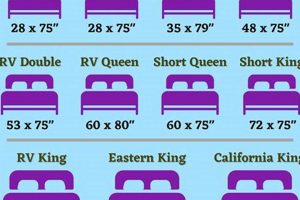
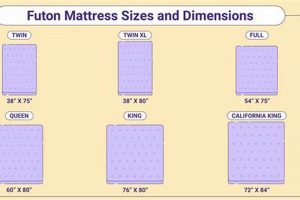
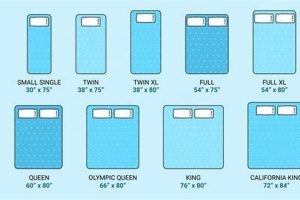
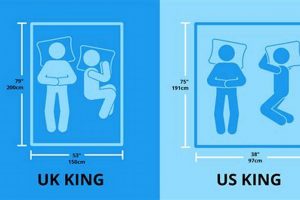
The measurements of sleeping surfaces in recreational vehicle bunk areas are varied, and understanding these sizes is fundamental for ensuring comfort and safety. These measurements, typically expressed in inches, dictate the suitability of a mattress for a particular bunk space. For example, a common size might be 28 inches wide by 75 inches long, although deviations are prevalent depending on the vehicle’s manufacturer and model.
Selecting a correctly sized mattress impacts the overall user experience, contributing to improved sleep quality during travel. Insufficient space can lead to discomfort and restricted movement, while an ill-fitting mattress may pose safety hazards. Historically, manufacturers have offered diverse configurations to maximize sleeping capacity within the constraints of a vehicle’s interior. Recognizing the significance of appropriate mattress size is vital for optimizing both comfort and safety.
The subsequent sections will address common size variations, methods for accurately measuring bunk spaces, considerations for selecting appropriate mattress materials, and strategies for optimizing sleeping comfort within recreational vehicle bunk areas.
RV Bunk Mattress Dimensions
Optimizing the sleeping arrangements in a recreational vehicle requires careful attention to the specified area. The following considerations facilitate informed decisions regarding the purchase or customization of mattresses.
Tip 1: Accurate Measurement is Crucial: Prior to purchasing any mattress, meticulously measure the length, width, and depth of the bunk area. Account for any obstructions or irregularities in the space. Disregarding this step could result in a mattress that does not fit, leading to wasted resources and compromised comfort.
Tip 2: Standard Sizes vs. Custom Options: While several standard sizes exist, it may be necessary to opt for a custom-made mattress. Standard sizes include, but are not limited to, 28″ x 75″, 30″ x 72″, and 35″ x 79″. Compare the dimensions of your bunk to available standard sizes. If deviation is significant, customization is advisable.
Tip 3: Consider Mattress Thickness: Bunk areas often have limited vertical space. A thicker mattress may reduce headroom and create difficulty entering or exiting the bunk. Carefully assess the available vertical clearance before selecting a mattress with considerable thickness. Lower profile options exist to maximize space.
Tip 4: Material Selection Impacts Comfort: The material composition of the mattress influences its comfort level and suitability for different climates. Memory foam conforms to the body, offering pressure relief, while innerspring mattresses provide greater support and airflow. Consider the typical use environment and desired level of comfort when making material choices.
Tip 5: Assess Weight Restrictions: Bunk beds typically have weight restrictions that must be adhered to. Exceeding the specified weight capacity can compromise the structural integrity of the bunk and pose a safety hazard. Obtain the weight limit from the manufacturer and select a mattress that, in conjunction with the occupant, remains within this limit.
Tip 6: Evaluate Accessibility for Linen Changes: Tight spaces can complicate the process of changing bed linens. Consider the ease with which sheets and blankets can be installed and removed given the dimensions of the bunk and the surrounding area. Prioritize mattresses with removable, washable covers to facilitate cleaning and maintenance.
These considerations offer a comprehensive guide to the complexities involved in selecting appropriately sized and suitable mattresses for recreational vehicle bunk areas, thus maximizing utility and safety.
The concluding section will discuss strategies for maintaining the mattress and optimizing sleeping conditions within the constraints of a recreational vehicle bunk environment.
1. Length

The dimension of length, when applied to recreational vehicle bunk mattresses, constitutes a primary factor determining user comfort and suitability of fit. A mattress with insufficient length restricts the occupant’s ability to fully extend, leading to disrupted sleep and physical discomfort. Conversely, excessive length creates fitting issues within the bunk space, potentially obstructing access and egress. The accurate assessment of the length of the sleeping area is, therefore, paramount to selecting a mattress of appropriate size.
In practical scenarios, disregarding length leads to negative outcomes. For instance, attempting to fit a 75-inch mattress into a 72-inch bunk area necessitates either forcing the mattress, which damages both the mattress and the bunk structure, or accepting a compromised sleeping surface. Furthermore, an under-sized mattress can create dangerous gaps between the mattress and the bunk frame, posing a risk of entrapment. Therefore, confirming the precise length dimensions of the bunk area before mattress selection is a critical safety measure.
In summary, length stands as a defining characteristic of recreational vehicle bunk mattress measurements. Its correct evaluation and application is central to ensuring comfort, safety, and optimal space utilization. Failing to prioritize length as a key parameter directly impacts the functionality and habitability of the recreational vehicle’s sleeping quarters.
2. Width

Width, in the context of recreational vehicle bunk sleeping surfaces, represents a critical measurement impacting both user comfort and spatial efficiency. The dimension of width directly influences the available sleeping area, determining the degree of freedom for occupants. This aspect necessitates careful consideration during mattress selection.
- Occupant Comfort and Mobility
The mattress width directly dictates the comfort level for the user. Insufficient width restricts movement during sleep, potentially causing discomfort and restlessness. Inadequate width may also necessitate a rigid sleeping posture, exacerbating physical stress. For example, a narrow bunk width of 24 inches is unlikely to accommodate an adult comfortably, while a width of 30 inches or greater typically provides sufficient space for adequate rest.
- Spatial Optimization within the RV
The width of the bunk mattress significantly impacts the overall spatial planning within the recreational vehicle. A wider mattress maximizes the available sleeping area, but reduces the usable space within the vehicle’s interior. Therefore, careful balancing of sleeping comfort against overall space efficiency is required. The optimal mattress width should be selected to ensure comfortable sleeping arrangements without excessively compromising the vehicle’s livable area.
- Adherence to Weight Distribution Guidelines
Bunk bed weight limits are influenced by both the length and width of the supported area. Excessive mattress width, especially when combined with considerable length or material density, can contribute to exceeding the specified weight restrictions. Exceeding these limitations may compromise structural integrity and user safety. Therefore, careful consideration of the mattress’s width in relation to permissible weight loads is paramount.
- Compatibility with Bedding and Linens
Mattress width affects the selection and fit of appropriate bedding and linens. Standard sheet sizes are designed to accommodate mattresses of certain widths. A mattress with non-standard width may necessitate custom-made linens, increasing cost and logistical complexity. Therefore, choosing a mattress width that aligns with commonly available bedding sizes simplifies maintenance and reduces expenditure.
The considerations outlined demonstrate the multifaceted nature of width in the context of recreational vehicle bunk configurations. Successful integration of this measurement involves careful balancing of comfort, spatial optimization, safety, and practical considerations related to bedding compatibility. Neglecting any of these aspects can compromise the overall functionality of the recreational vehicle’s sleeping arrangements.
3. Thickness

Thickness, as a critical component of recreational vehicle (RV) bunk measurements, influences comfort, space utilization, and safety. It directly impacts the vertical space available within the bunk and, consequently, the occupant’s ability to sit upright or move freely. For example, a thicker mattress, while potentially offering increased cushioning, reduces headroom, potentially creating a claustrophobic environment. Conversely, an excessively thin mattress may compromise support, leading to discomfort and potential musculoskeletal issues. The interrelation between thickness and the other two measurements (length and width) defines the overall volume of the sleeping surface, affecting the weight distribution and stability of the bunk structure.
The selection of mattress thickness involves several practical considerations. In RVs with low bunk ceilings, a thinner mattress maximizes headroom. If a standard bunk has around 25 inches of vertical space, a 4-inch mattress might be a superior choice to an 8-inch one. Furthermore, thickness affects the compatibility with bunk rails; mattresses exceeding the rail height may compromise the safety of the occupant, especially children, by increasing the risk of falling. Bunk weight restrictions must also be considered, as thicker mattresses typically weigh more. For example, a high-density foam mattress with substantial thickness will have a greater weight, potentially exceeding permissible limits.
In conclusion, thickness is an integral aspect of RV bunk measurements, critically affecting comfort, safety, and spatial considerations. Appropriate thickness selection necessitates evaluating headroom, bunk rail height, and weight restrictions. Optimizing thickness ensures a balance between comfortable sleeping conditions and a safe, functional bunk area within the constraints of the RV’s interior design. Failing to carefully consider mattress thickness can lead to a compromised sleeping experience or a potential safety hazard.
4. Weight capacity

Weight capacity functions as a critical parameter directly influenced by the measurements of recreational vehicle bunk sleeping surfaces. The length, width, and thickness of a mattress collectively determine its volume and material density, thereby affecting its overall weight. This weight, when combined with the weight of the bunk occupant(s), must not exceed the manufacturer’s specified weight limit for the bunk structure. Failure to adhere to this limit can compromise the structural integrity of the bunk, leading to potential collapse and injury. An example of cause and effect can be the selection of an oversized or over-dense memory foam mattress. The substantial mass increase, particularly with two occupants, causes stress on the bunk frame, exceeding weight capacity and leading to catastrophic failure. Therefore, a comprehensive understanding of mattress dimensions is indispensable to adhering to weight capacity restrictions.
Consider a scenario where an RV bunk is rated for a maximum weight of 200 pounds. If the intended occupants are two children weighing 75 pounds each, the mattress cannot exceed 50 pounds. Selecting a mattress with dimensions that necessitate high-density materials, such as a thick memory foam model, could easily surpass this weight limit, creating a dangerous situation. Conversely, a thinner, lighter mattress constructed from lower-density foam may comply with the weight limit while still providing acceptable comfort. Furthermore, the concentration of weight is also a crucial consideration; a wider mattress distributes weight more evenly across the bunk supports, reducing stress compared to a narrower, denser mattress with the same total weight. Therefore, all dimensions must be considered holistically to manage weight capacity effectively.
In summary, weight capacity is intrinsically linked to recreational vehicle bunk surface dimensions. Understanding the relationship between mattress length, width, thickness, and material density is vital for ensuring the safety and structural integrity of the bunk. Challenges arise when balancing comfort with weight restrictions, necessitating careful material selection and dimension optimization. Ultimately, adherence to weight capacity limits is paramount and should be a primary consideration during RV bunk mattress selection.
5. Material Composition

The constitution of materials directly dictates the properties of a recreational vehicle bunk sleeping surface. The interplay between the nature of the chosen materials and the dimensions of the mattress governs comfort, durability, weight, and safetyfactors of paramount importance in the confined spaces typical of RV bunks.
- Density and Support Characteristics
The density of materials like memory foam or latex significantly influences the support provided by the mattress. Higher density materials offer increased resistance and contouring, potentially improving spinal alignment and pressure relief. For example, a high-density memory foam mattress with specific length, width, and thickness dimensions will provide a firmer, more supportive sleep surface compared to a low-density foam of the same dimensions. This is crucial for occupant well-being, particularly on longer trips where consistent support is vital.
- Weight Implications
Different mattress materials possess varying weights per unit volume. Material density directly translates to the overall weight of the recreational vehicle bunk mattress. For example, a latex mattress, known for its durability and support, is generally heavier than a polyurethane foam mattress of comparable dimensions. Considering the weight restrictions often imposed on RV bunks, selecting lighter materials, even if at the expense of some comfort, may be necessary to ensure structural integrity.
- Thermal Properties
The material composition affects the thermal properties of the mattress, influencing occupant comfort in diverse climates. Open-cell foam structures, such as those found in some memory foam formulations, promote air circulation and reduce heat retention. In contrast, closed-cell foam structures tend to trap heat. A mattress dimensioned for a particular bunk should, therefore, take into account material breathability to maintain a comfortable sleeping temperature. This is especially important in RVs lacking sophisticated climate control systems.
- Flammability and Safety Standards
Regulations governing the flammability of mattresses necessitate the use of specific materials or treatments to mitigate fire hazards. The material composition of the mattress, therefore, directly influences its compliance with safety standards. For example, mattresses may incorporate fire-resistant barriers or be constructed from inherently flame-resistant materials like certain types of wool. Dimensions that comply with legal standards can create a fire safety concern if material composition disregards flammability tests.
In conclusion, the link between material selection and recreational vehicle bunk mattress measurements is multifaceted. The optimal combination of dimensions and material properties requires careful consideration of factors spanning comfort, structural integrity, climate, and safety regulations. Deviation from this balanced approach compromises the suitability of the sleeping surface in the confined and often variable environment of a recreational vehicle.
6. Accessibility

The ease of entering and exiting a recreational vehicle bunk sleeping surface is intricately linked to the dimensions of the mattress. This “Accessibility” factor directly influences the user experience, particularly for children, the elderly, or individuals with mobility limitations. Mattress dimensions, therefore, play a crucial role in determining the usability of the bunk area.
- Mattress Height and Step-Over Height
The vertical distance from the bunk base to the top of the mattress influences the step-over height required to access the sleeping surface. A thicker mattress increases this distance, potentially creating a challenging or hazardous entry point. Conversely, a thinner mattress lowers the entry point, but may compromise comfort and support. The optimal height necessitates balancing ease of access with adequate support and comfort. Consider the presence of a ladder; high step-over heights necessitate careful selection of ladder design and placement.
- Available Headroom and Maneuverability
The vertical clearance above the mattress directly affects maneuverability within the bunk. An excessively thick mattress reduces headroom, potentially restricting movement and creating a feeling of confinement. This is especially pertinent for upper bunks where headroom may already be limited. Mattress length and width further influence accessibility by determining the available space for occupants to turn or adjust their sleeping position.
- Proximity to Entry Points
The positioning of the mattress in relation to the bunk’s entry point affects accessibility. A mattress that extends too close to the entry may obstruct access, especially in confined spaces. Recessed mattresses, where a portion of the bunk base extends beyond the mattress edge, can facilitate easier entry and exit. Attention must be paid to the placement of any safety rails, ensuring they do not impede access while still fulfilling their protective function.
- Linen Management and Maintenance
The dimensions of the mattress impact the ease of changing linens and performing routine maintenance. A thicker mattress, coupled with limited bunk space, can complicate the process of fitting sheets and blankets. Similarly, cleaning and rotating the mattress becomes more challenging in constricted environments. Accessibility considerations, therefore, extend beyond initial entry and exit to encompass ongoing maintenance tasks.
These facets collectively underscore the importance of assessing “Accessibility” when determining appropriate recreational vehicle bunk surface dimensions. A holistic approach considers the interplay between mattress height, headroom, entry point proximity, and linen management to optimize usability for all potential occupants. Failing to address accessibility concerns diminishes the comfort, safety, and overall utility of the bunk sleeping area.
Frequently Asked Questions
The following questions address common concerns regarding the selection and utilization of mattresses specifically designed for recreational vehicle (RV) bunk spaces. The information provided seeks to clarify misunderstandings and offer practical guidance based on the constraints of space and safety inherent in RV environments.
Question 1: Are recreational vehicle bunk mattress dimensions standardized?
No, they are not. While some common sizes exist (e.g., 28″ x 75″, 30″ x 72″), the exact measurements can vary significantly based on the RV manufacturer, model, and floor plan. Precise measurement of the bunk area is essential prior to purchasing a mattress.
Question 2: What factors influence the selection of recreational vehicle bunk mattress dimensions?
Several factors are pertinent. Available space, occupant size and weight, bunk weight capacity, and desired comfort level all influence the decision. Additionally, consideration should be given to the ease of linen changes and the accessibility of the bunk itself.
Question 3: Is it possible to use a standard residential mattress in a recreational vehicle bunk?
Generally, it is not advisable. Residential mattresses are often too large and heavy for RV bunks, potentially exceeding weight limits and creating safety hazards. Furthermore, standard mattresses may not fit the typically non-standard dimensions of RV bunks.
Question 4: What are the weight restrictions for recreational vehicle bunks, and how do mattress dimensions play a role?
Weight restrictions vary based on the bunk’s construction and the RV manufacturer’s specifications. Mattress length, width, thickness, and material density contribute to the overall weight placed on the bunk structure. Exceeding the weight limit can lead to structural failure and potential injury. Therefore, careful consideration of mattress dimensions and material is crucial for compliance.
Question 5: How does mattress thickness influence the suitability of a recreational vehicle bunk mattress?
Mattress thickness impacts headroom within the bunk and the step-over height required for entry and exit. An excessively thick mattress reduces available vertical space, potentially creating discomfort. The mattress thickness should be selected to balance comfort with accessibility and safety considerations.
Question 6: Can recreational vehicle bunk mattress dimensions be customized?
Yes, customization is possible. Given the variability in bunk sizes, custom-made mattresses may be necessary to ensure a proper fit. Several manufacturers specialize in creating mattresses tailored to the specific dimensions of RV bunks, providing optimal comfort and support.
In summation, understanding the nuances of recreational vehicle bunk mattress dimensions is vital for ensuring safety, comfort, and optimal space utilization. Accurate measurement, consideration of weight limits, and appropriate material selection are key steps in the process.
The subsequent section will address maintenance and care strategies for RV bunk mattresses, focusing on prolonging their lifespan and ensuring a hygienic sleeping environment.
RV Bunk Mattress Dimensions
This exploration has underscored the critical role of precise measurements in recreational vehicle bunk configurations. Factors such as length, width, thickness, material composition, weight capacity, and accessibility have been identified as fundamental considerations. A thorough understanding of these elements ensures both occupant comfort and structural safety within the confined spaces of RV bunks.
Prioritizing accurate assessment and informed selection of rv bunk mattress dimensions is not merely a matter of convenience, but a prerequisite for responsible RV ownership and usage. Attention to these details promotes safety, enhances the travel experience, and contributes to the longevity of the vehicle itself. Continued vigilance regarding these dimensional parameters is, therefore, strongly advised.