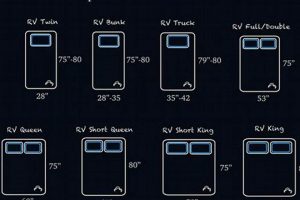
A table outlining dimensions for recreational vehicle sleeping platforms is a reference tool. This resource provides specific length and width measurements associated with various types of RV beds, enabling consumers to select appropriate bedding. An example entry could be a “Short Queen” listing, with dimensions of 60 inches wide and 75 inches long.
The value of dimension guides for RV mattresses lies in simplifying the purchase process. They prevent errors when selecting aftermarket mattresses, ensuring a proper fit within the confined space of an RV bedroom. Historically, standardized sizing has been limited in the RV industry, creating the need for accessible and clear guides to navigate these variations.
The subsequent sections will delve into common recreational vehicle mattress dimensions, considerations for selecting the appropriate size, and guidance on finding resources for further information.
Guidance on RV Mattress Dimensions
The following are key considerations when determining the appropriate mattress size for a recreational vehicle.
Tip 1: Measure the Existing Sleeping Platform: Obtain precise measurements of the current bed frame or designated sleeping area. Inaccuracies in these initial dimensions will compound errors in subsequent mattress selection.
Tip 2: Account for Obstructions: Identify any permanent fixtures or protrusions within the RV bedroom that might limit available space. Wheel wells, cabinets, and slide-out mechanisms can affect mattress fit.
Tip 3: Consider Available Headroom: Evaluate vertical space between the mattress surface and the ceiling, particularly in overhead bunk areas. Insufficient headroom can lead to discomfort.
Tip 4: Review Mattress Type Constraints: Be mindful of the dimensional limitations associated with specific mattress constructions. Memory foam and innerspring mattresses, for example, may have slight variations due to their internal components.
Tip 5: Compare to Standard RV Sizes: Cross-reference measured dimensions with established recreational vehicle mattress sizes (e.g., Short Queen, Three-Quarter). This comparison aids in identifying a suitable, readily available option.
Tip 6: Prioritize Sleep Comfort Preferences: Thickness can impact comfort, particularly in tighter RV spaces. Balance dimension constraints with individual sleep requirements, considering thinner mattresses for overhead bunks or customized comfort options.
Accurate measurements and careful consideration of space constraints are critical for optimal mattress selection. Failure to do so may result in incompatibility, requiring costly returns or alterations.
The ensuing paragraphs will address frequently asked questions related to this topic, providing additional clarity and practical advice.
1. Standard Dimensions

The term “Standard Dimensions” within the context of recreational vehicle mattresses refers to pre-defined, commonly available mattress sizes that are cataloged within a dimension guide. These established sizes simplify the replacement or upgrade process by offering readily accessible alternatives to custom-made options.
- Common Size Designations
Designations such as “Short Queen,” “Full,” and “Twin” are standard labels used to identify specific mattress measurements. These designations are not always uniform across manufacturers, necessitating precise dimensional verification. For instance, a “Short Queen” typically measures 60 inches wide by 75 inches long, but slight variations may exist.
- Industry Size Variations
Despite the presence of standard designations, the RV industry exhibits considerable dimensional variability. This is often due to the constraints of RV floor plans and the customization undertaken by individual manufacturers. A consequence is that the dimensions assigned to a seemingly “standard” size may deviate by several inches, underscoring the need for precise measurement.
- Impact on Bedding Selection
The existence of standard dimensions facilitates the selection of appropriate bedding, such as sheets and mattress protectors. Bedding manufacturers typically produce items to fit standard mattress sizes. However, when dealing with RV mattresses, particularly those that are not precisely standard, bedding fit may be problematic, potentially requiring alterations or custom orders.
- Efficiency in Replacement
The availability of standard mattress dimensions streamlines the replacement process. Consumers can readily identify and purchase mattresses that closely match their existing sleeping platform, reducing the need for custom-built solutions. This efficiency translates to cost savings and reduced lead times, particularly when compared to bespoke mattress fabrication.
Understanding the nuances of standard dimensions within recreational vehicle mattresses is crucial for informed decision-making. While these dimensions offer a degree of convenience and availability, the inherent variability within the industry necessitates diligent measurement and comparison to ensure compatibility. Failure to do so can lead to ill-fitting mattresses, compromised comfort, and unnecessary expense.
2. Custom Sizes

The concept of “Custom Sizes” in the context of dimension guides for recreational vehicle mattresses represents a deviation from standardized measurements. These individualized dimensions address the diverse range of sleeping platform configurations found within RVs, often necessitated by space constraints or specific design choices.
- Addressing Non-Standard Dimensions
Many recreational vehicles feature sleeping areas that do not conform to industry-standard mattress sizes. This discrepancy arises from manufacturers’ efforts to maximize usable space or accommodate unique floor plans. A dimension guide must, therefore, acknowledge the prevalence of non-standard measurements and provide guidance on obtaining custom-sized mattresses.
- Measuring Irregular Shapes
Custom RV mattress sizes frequently involve shapes beyond simple rectangles or squares. Angled corners, cut-outs for wheel wells, and tapered designs are common. Effectively utilizing a dimension guide requires understanding how to accurately measure these irregular shapes to ensure proper mattress fit.
- Material Considerations for Customization
When ordering a custom-sized mattress, material selection becomes increasingly important. The chosen material must be amenable to cutting and shaping without compromising its structural integrity or comfort properties. Dimension guides may offer insights into material suitability for custom applications.
- Cost and Availability Implications
Opting for a custom-sized recreational vehicle mattress typically entails higher costs and longer lead times compared to purchasing a standard size. Dimension guides can indirectly address these implications by informing consumers about the potential challenges and expenses associated with customization, allowing them to make informed decisions.
The relationship between dimension guides and custom-sized recreational vehicle mattresses lies in the guide’s capacity to inform and empower consumers facing non-standard sleeping platform dimensions. By understanding how to accurately measure irregular shapes, considering material constraints, and anticipating cost implications, individuals can effectively navigate the process of acquiring a custom-fit mattress for their RV.
3. Mattress Thickness

Mattress thickness, represented within recreational vehicle mattress dimension documentation, is a critical parameter influencing both comfort and spatial efficiency. The listed dimensions, generally presented in tables, typically include length, width, and thickness. Thickness dictates the overall volume occupied by the sleeping surface, impacting headroom, storage space beneath the mattress, and the ability to navigate the RV interior. For example, a thicker mattress may provide superior cushioning but could obstruct access to overhead storage compartments or create an uncomfortably confined space in overhead bunks.
The integration of mattress thickness into size specifications allows consumers to make informed purchasing decisions. A mattress dimension guide that omits thickness provides incomplete information, potentially leading to selection errors. Consider a scenario where an RV owner replaces a 6-inch thick mattress with a 10-inch model based solely on length and width. The increased thickness could render bedside tables unusable or impede the opening of nearby doors. Therefore, thickness is not merely an aesthetic consideration but a functional dimension that must be evaluated in conjunction with length and width dimensions.
In summary, mattress thickness constitutes an integral element of comprehensive dimension guides for recreational vehicle sleeping platforms. Its inclusion enables accurate space planning, prevents functional obstructions, and ensures compatibility with the RV’s interior design. The dimension documentation serves as a practical resource, facilitating informed mattress selection and mitigating potential spatial conflicts within the confined environment of a recreational vehicle.
4. Platform Compatibility

The concept of platform compatibility directly relates to dimension guides for RV mattresses. This term encompasses the alignment between the physical dimensions of the mattress and the supporting structure, be it a bed frame, bunk platform, or built-in RV bed base. A mismatch can lead to instability, discomfort, and accelerated wear of both the mattress and platform.
- Dimensional Accuracy and Support
Precise adherence to dimensions listed in a dimension guide ensures that the mattress adequately fills the available space on the platform. Overhangs create uneven support, while significant gaps allow movement and shifting, both reducing sleep quality and potentially damaging the mattress over time. A short queen mattress (60″ x 75″) placed on a full-size platform (54″ x 75″) will leave a 6-inch gap in width, demonstrating the problem.
- Weight Distribution Considerations
Platform construction varies significantly in RVs, ranging from lightweight wooden frames to more robust metal supports. Dimension guides indirectly inform weight distribution considerations by enabling the selection of a mattress size appropriate for the platform’s structural capacity. Overloading a platform designed for a thinner, lighter mattress with a thicker, denser model can lead to structural failure.
- Ventilation and Moisture Control
Proper platform compatibility promotes adequate ventilation around the mattress. A mattress that completely fills the platform space without allowing airflow can trap moisture, fostering mold growth and reducing mattress lifespan. Some RV platforms incorporate slats or other features to enhance ventilation; matching the mattress size to these features is essential.
- Securing Mechanisms and Movement
In moving vehicles, securing the mattress to the platform is crucial. Many RV platforms incorporate lips, straps, or other mechanisms to prevent shifting during transit. A mattress that is significantly smaller than the platform may be difficult to secure effectively, increasing the risk of movement and potential damage. Dimension guides, therefore, indirectly contribute to safety and security.
Platform compatibility is a non-negotiable aspect of RV mattress selection. A thorough understanding of platform construction and accurate referencing of dimension guides are necessary to ensure optimal support, longevity, and safety. Disregarding these factors can result in compromised sleep quality and accelerated degradation of the mattress and supporting structure.
5. Dimension Accuracy

Dimension accuracy, in the context of recreational vehicle mattress dimension documentation, is paramount. It dictates the degree to which the measurements listed reflect the actual physical size of the mattress. Any deviation impacts fit, comfort, and overall functionality within the confined space of an RV.
- Source Measurement Methodology
The methodology employed to derive the dimensions listed on the chart directly affects accuracy. Measurements sourced from manufacturer specifications may differ from those obtained through independent verification. Reliance on a single source, without cross-referencing, increases the risk of inaccuracies. For instance, published dimensions might reflect pre-compression measurements for foam mattresses, differing from their expanded state.
- Tolerance and Acceptable Variance
No manufacturing process is perfectly precise; therefore, all mattresses exhibit some degree of dimensional variance. The tolerance, or acceptable range of deviation from the stated dimensions, is a critical factor. Dimension charts should ideally specify the tolerance levels for each listed measurement. A mattress labeled as 60″ wide might, in reality, measure 59.5″ or 60.5″, which may or may not be acceptable depending on the specific application and the platform dimensions.
- Impact of Material Properties
The inherent properties of mattress materials influence dimensional stability. Foam, for instance, is more susceptible to compression and expansion with temperature changes than innerspring systems. Dimension charts that fail to account for material-specific variations may provide misleading information. A high-density memory foam mattress might exhibit less dimensional change over time compared to a low-density variant.
- Consequences of Inaccurate Dimensions
Inaccurate dimensions on the chart can lead to several adverse outcomes. Purchasing a mattress that is too large will result in fitment issues, potentially requiring modification or return. A mattress that is too small will create gaps, compromising support and comfort. In either scenario, the consumer incurs unnecessary expenses and inconvenience. A dimension chart with consistently inaccurate measurements undermines its utility and trustworthiness.
The integrity of a recreational vehicle mattress dimension guide hinges on the accuracy of the listed measurements. Vigilance in measurement methodology, explicit specification of tolerance levels, consideration of material properties, and awareness of the potential consequences of inaccuracies are essential for creating a reliable and useful resource for consumers.
Frequently Asked Questions Regarding RV Mattress Sizes
This section addresses common inquiries concerning recreational vehicle mattress dimensions and their implications for selection and fitment.
Question 1: Why are recreational vehicle mattress dimensions often non-standard?
The prevalence of non-standard sizes in recreational vehicles stems from manufacturers’ efforts to maximize usable space and accommodate diverse floor plans within limited confines. This necessitates a departure from conventional mattress dimensions commonly found in residential settings.
Question 2: Where can accurate measurements for recreational vehicle mattress sizes be obtained?
Accurate measurements are best obtained by physically measuring the existing sleeping platform within the RV. Manufacturer specifications and online dimension guides should be cross-referenced, but physical measurement remains the most reliable method.
Question 3: What is the impact of mattress thickness on recreational vehicle sleeping arrangements?
Mattress thickness directly affects headroom, access to overhead storage, and overall comfort within the RV. Thicker mattresses may provide enhanced cushioning but can constrict space, particularly in overhead bunks or compact sleeping areas. Prioritize dimension limitations with individual sleep needs.
Question 4: How does one ensure platform compatibility when selecting a recreational vehicle mattress?
Platform compatibility is achieved by verifying that the mattress dimensions precisely match the supporting structure. Overhangs and gaps should be minimized to ensure proper support and prevent accelerated wear. Inspect the platform’s construction and weight capacity.
Question 5: What factors contribute to inaccuracies in recreational vehicle mattress dimension guides?
Inaccuracies may arise from variations in manufacturer specifications, inconsistent measurement methodologies, and the inherent tolerances associated with mattress materials. Verify listed dimensions before purchase.
Question 6: What are the cost implications of selecting a custom-sized recreational vehicle mattress?
Custom-sized mattresses typically incur higher costs due to specialized fabrication processes and limited production volumes. Extended lead times should also be anticipated. Obtain quotes from multiple vendors and factor potential alterations.
In summary, careful measurement, cross-referencing of resources, and consideration of spatial constraints are essential for successful recreational vehicle mattress selection.
The following section will offer final considerations and recommendations.
Concluding Remarks
This discourse has established the significance of dimension guides in recreational vehicle mattress selection. The accuracy and comprehensive nature of a guide directly influences the consumer’s ability to procure a mattress that aligns with the specific spatial constraints and platform configurations unique to RVs. Dimensions, construction, and variance levels are critical considerations to ensure a proper fit. Ignoring any of these concepts can lead to unnecessary expenditures and discomfort.
The RV industry will continue to demand reliable dimension resources as vehicle designs evolve. Emphasis on precise measurement practices and standardized data reporting will be paramount to facilitating informed consumer decisions and minimizing fitment errors. Continued attention to this matter will ultimately enhance the end-user experience and streamline mattress replacement processes within the recreational vehicle sector.
![Best Queen Size Adjustable Mattress [Deals] | Organic & Natural Mattress Buyer’s Guide: Non-Toxic Sleep Solutions](https://mattressworldpa.com/wp-content/uploads/2025/07/th-2362-300x200.jpg "Best Queen Size Adjustable Mattress [Deals] Organic & Natural Mattress Buyer’s Guide: Non-Toxic Sleep Solutions")

![RV Comfort: Custom Size Mattress for RVs [Guide] | Organic & Natural Mattress Buyer’s Guide: Non-Toxic Sleep Solutions](https://mattressworldpa.com/wp-content/uploads/2025/07/th-2359-300x200.jpg "RV Comfort: Custom Size Mattress for RVs [Guide] Organic & Natural Mattress Buyer’s Guide: Non-Toxic Sleep Solutions")