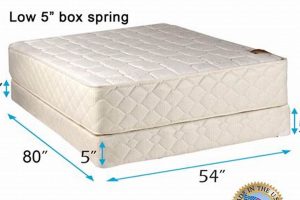
The dimensions of a standard double bed are approximately 54 inches wide and 75 inches long. This configuration offers an individual sleeper ample space while remaining compact enough for smaller bedrooms. As an example, consider a guest room that needs to accommodate two adults; a double bed is often a suitable compromise between space efficiency and sleeping comfort.
Choosing a bed of this scale presents several advantages. Its affordability often makes it a practical choice for budget-conscious consumers. Furthermore, its moderate footprint makes it versatile for various living situations, from apartments to starter homes. Historically, this bed size has served as a common standard, balancing individual space needs with room size limitations.
Understanding these spatial parameters is fundamental when selecting bedding, coordinating bedroom furniture, and planning room layout. Subsequent sections will explore specific use cases, alternative bed sizes, and factors to consider when making a purchasing decision.
Considerations for Selecting a Double Bed
The following recommendations are intended to guide the selection process, ensuring a comfortable and well-suited sleeping arrangement. Careful consideration of these points can optimize satisfaction and longevity of the chosen bed.
Tip 1: Measure the Room Dimensions: Before purchasing, accurately measure the bedroom to confirm that the bed will fit comfortably, allowing for adequate walking space and placement of other furniture. A scaled drawing can be beneficial in visualizing the final arrangement.
Tip 2: Assess Sleeper Size and Needs: Account for the size and sleeping habits of the individuals who will be using the bed. Taller individuals may find the length restrictive, while couples may require a larger sleeping surface to avoid disturbances.
Tip 3: Evaluate Mattress Construction and Materials: Different mattress types, such as memory foam, innerspring, or hybrid, offer varying levels of support and comfort. Research the characteristics of each type and select one that aligns with personal preferences and any specific physical requirements.
Tip 4: Consider Frame Stability and Support: The bed frame should provide adequate support for the mattress and sleepers, preventing sagging or premature wear. Opt for a sturdy frame constructed from durable materials.
Tip 5: Check for Noise and Motion Transfer: Certain bed frames and mattress types are prone to squeaking or transferring motion between sleepers. Test the bed, if possible, to assess its noise level and motion isolation properties.
Tip 6: Investigate Warranty and Return Policies: Review the manufacturer’s warranty and the retailer’s return policy before making a purchase. This provides recourse in case of defects or dissatisfaction with the product.
Tip 7: Factor in Cost and Budget: Establish a budget and compare prices from different retailers. Keep in mind that quality and durability often justify a higher initial investment, leading to long-term savings.
Implementing these steps can promote a more informed and advantageous acquisition. Prioritizing these aspects contributes to a better sleep experience and overall satisfaction.
The subsequent segment will delve into comparisons between different sizes, exploring the trade-offs and advantages of each.
1. Width (Approximately 54 inches)

The width of a standard double bed, at approximately 54 inches, constitutes a primary dimensional component defining its overall size. This measurement directly affects the suitability of the bed for single sleepers or couples. The spatial constraint imposed by this dimension limits the comfort level for two adults sharing the bed, often leading to increased sleep disturbances due to limited personal space. For instance, two adults with average shoulder width may experience restricted movement during sleep, affecting sleep quality.
The approximate 54-inch width has practical significance in room planning and design. It allows for efficient utilization of space in smaller bedrooms, providing a balance between bed size and usable floor area. For example, in an apartment with limited square footage, a double beds width allows for the inclusion of other essential furniture without overcrowding the space. However, the width also necessitates careful consideration of bedding purchases. Fitted sheets must precisely match this dimension to ensure proper fit and avoid slipping during use.
In summation, the 54-inch width is an intrinsic characteristic dictating the occupancy capacity and spatial efficiency of a standard double bed. While offering a compromise between space conservation and sleeping area, its limited width requires careful assessment of individual or shared sleeping needs. Its influence extends to room layout and bedding selection, thereby emphasizing its importance as a defining element of the bed’s overall usability.
2. Length (Approximately 75 inches)

The length dimension, approximating 75 inches, is a critical component defining the overall size of a standard double bed. This measurement directly impacts the bed’s suitability for accommodating individuals of varying heights. Specifically, it determines the extent to which a sleeper’s body can be fully supported without the discomfort of feet extending beyond the mattress edge. For example, an individual exceeding approximately 6 feet in height may find a standard double bed inadequate, potentially leading to disrupted sleep patterns due to constrained legroom.
This dimensional characteristic also influences practical aspects of bedroom design and functionality. The 75-inch length must be considered when arranging furniture within a room, ensuring adequate space for circulation and preventing obstruction of doorways or access points. In instances of smaller bedrooms, careful consideration of this length is essential to maximize usable floor space. Furthermore, standard bedding, such as sheets and comforters, are manufactured to correspond with this specific dimension, ensuring a proper fit and preventing excess material from dragging on the floor.
In summary, the 75-inch length of a standard double bed is an indispensable element governing comfort and spatial efficiency. Its suitability for a particular individual is contingent upon their height, while its impact on room layout necessitates meticulous planning. Understanding this dimensional parameter contributes to informed purchasing decisions and optimizes the overall functionality of the sleeping environment.
3. Surface Area (4,050 square inches)
The approximate surface area of a standard double bed, measuring 4,050 square inches, represents a key determinant of its occupancy capacity and overall footprint. This figure encapsulates the combined effect of width and length dimensions, directly influencing the bed’s suitability for accommodating one or two individuals. An understanding of this value informs decisions regarding comfort, room planning, and bedding selection.
- Individual Sleeper Space
The 4,050 square inches provide a quantifiable measure of the space available to a single occupant. This area allows for unrestricted movement and varied sleeping positions, promoting a more restful experience. For example, an individual accustomed to sprawling during sleep may find this area adequate, whereas a smaller bed could feel restrictive.
- Shared Occupancy Considerations
When shared by two individuals, the available area is effectively halved. This reduction can impact comfort, particularly if both sleepers require ample personal space or are prone to restlessness. The 4,050 square inches translates to approximately 2,025 square inches per person, a figure to consider when evaluating potential disturbances during sleep. This surface is less ideal for more than one person.
- Room Layout Implications
The surface area dictates the physical space occupied by the bed within a bedroom. A larger area necessitates more careful planning of furniture arrangement to ensure adequate circulation and prevent overcrowding. The 4,050 square inches must be factored into room measurements, allowing for sufficient clearance around the bed for access and movement. Failing to account for this area can lead to an uncomfortably cramped environment.
- Bedding and Accessory Selection
The specified surface area directly influences the dimensions of bedding required for a proper fit. Sheets, blankets, and comforters must be appropriately sized to cover the entire mattress without excessive overhang or inadequate coverage. Precise measurements corresponding to the 4,050 square inches ensure optimal aesthetics and functionality, preventing slipping or exposure of the mattress.
In summary, the 4,050 square inch surface area is a foundational metric for evaluating the practical implications of a standard double bed. It affects both the individual sleeping experience and the overall utilization of space within a bedroom. Careful consideration of this value allows for informed purchasing decisions and optimized room design, enhancing comfort and functionality.
4. Weight (Varies by Material)

The weight of a standard double bed, variable based on its construction materials, is a significant factor influencing its handling, support requirements, and overall suitability for specific applications. This aspect is intrinsically linked to the spatial dimensions, impacting ease of relocation and the type of bed frame necessary for adequate support.
- Material Composition and Density
The constituent materials including innerspring coils, memory foam, latex, and wood or metal frames exhibit varying densities, directly impacting the total mass. For instance, a double bed constructed primarily of high-density memory foam will typically weigh more than one using primarily innerspring coils. This difference in weight dictates the effort required for moving or repositioning the bed.
- Impact on Frame Selection
The weight of the mattress necessitates careful consideration of the bed frame’s structural integrity. A heavier mattress requires a more robust frame capable of providing adequate support, preventing sagging or premature wear. Failure to match the frame’s load-bearing capacity to the mattress weight can lead to instability and potential damage. For example, a lightweight metal frame may not be suitable for a heavy memory foam mattress.
- Influence on Floor Load
The combined weight of the bed, mattress, and occupants exerts a load on the floor. In buildings with structural limitations, such as older constructions or upper-floor apartments, this load must be considered to avoid exceeding weight-bearing capacities. The weight of the bed, varying by material, contributes to this overall load, necessitating assessment of floor strength.
- Ease of Relocation and Handling
The weight directly impacts the ease with which the bed can be moved or transported. Heavier mattresses require more manpower and specialized equipment, such as dollies, for relocation. This is particularly relevant for individuals who frequently move or rearrange their living spaces. The choice of mattress material, therefore, influences the practical considerations of mobility.
In conclusion, the weight, varying based on material composition, is a pivotal attribute intrinsically linked to the dimensions of a standard double bed. Its influence extends from frame selection and floor load considerations to ease of relocation. Understanding the weight characteristics of different materials facilitates informed decision-making, optimizing both functionality and longevity of the sleeping arrangement.
5. Thickness (Varies by type)

The vertical dimension, or thickness, of a standard double bed mattress is a critical attribute that exhibits considerable variability contingent upon the materials used and its intended design. While the horizontal measurements (width and length) define the sleeping surface, the thickness influences comfort, support, and compatibility with bed frames and bedding.
- Impact on Support and Comfort
Mattress thickness directly affects the layering and arrangement of internal components, which in turn influences its support characteristics. Thicker mattresses often accommodate more substantial comfort layers, such as memory foam or pillow tops, providing enhanced cushioning and pressure relief. Conversely, thinner mattresses may prioritize firm support over plush comfort. For example, a memory foam mattress with a 12-inch profile will generally offer a softer feel than a similarly constructed mattress with an 8-inch profile.
- Compatibility with Bed Frames
The mattress thickness influences its suitability for different bed frame styles. Low-profile bed frames necessitate thinner mattresses to maintain a reasonable overall bed height, preventing difficulty in getting in and out of bed. Conversely, platform beds or those with recessed side rails may require thicker mattresses to achieve a visually balanced aesthetic and optimal sleeping height. A mattress that is too thin for a specific frame can result in an uncomfortable sleeping surface and detract from the overall appearance of the bed.
- Influence on Bedding Fit
Mattress thickness dictates the pocket depth required for fitted sheets. Thicker mattresses necessitate sheets with deeper pockets to ensure a secure and wrinkle-free fit. Using standard sheets on an overly thick mattress can result in the sheets slipping off the corners, compromising comfort and requiring frequent adjustments. For example, a 14-inch mattress typically requires sheets with a pocket depth of at least 16 inches to accommodate the additional height.
- Weight and Handling Considerations
While not solely determined by thickness, a thicker mattress often correlates with increased weight due to the greater volume of materials used in its construction. This increased weight can impact ease of handling during setup, relocation, or rotation. Understanding the relationship between thickness and weight aids in planning for transportation and installation, particularly for individuals with physical limitations.
In summation, the thickness of a standard double bed mattress is a nuanced attribute that significantly impacts comfort, support, bed frame compatibility, and bedding selection. Its variability necessitates careful consideration of individual preferences and practical constraints to ensure a harmonious and functional sleeping environment. Selecting a mattress with an appropriate thickness, in conjunction with the established horizontal dimensions, optimizes the overall usability and aesthetic appeal of the bed.
Frequently Asked Questions
The following addresses common inquiries and misconceptions regarding the dimensions and practical implications of a standard double bed.
Question 1: What are the precise measurements defining the spatial boundaries of a standard double bed?
The standard dimensions are approximately 54 inches in width and 75 inches in length. These figures are subject to minor variations based on manufacturer and construction.
Question 2: Is a double bed an adequate sleeping arrangement for two adults?
While accommodating two adults is physically possible, the relatively constrained width (54 inches) may result in reduced sleeping comfort and potential disturbances. For couples seeking greater individual space, a larger bed such as a queen or king is generally recommended.
Question 3: How does the length dimension (75 inches) impact suitability for taller individuals?
The 75-inch length may prove insufficient for individuals exceeding approximately six feet in height. The lack of adequate legroom can lead to discomfort and disrupted sleep. For taller sleepers, an extended-length mattress (such as a twin XL or queen) may be a more appropriate choice.
Question 4: Does mattress thickness significantly influence comfort and support?
Yes, mattress thickness plays a critical role in determining overall comfort and support. Thicker mattresses typically incorporate more substantial comfort layers, providing enhanced cushioning and pressure relief. However, the ideal thickness is subjective and contingent upon individual preferences and sleeping positions.
Question 5: How does the weight of a standard double bed impact frame selection and handling?
The weight, variable based on materials, directly influences frame selection. A heavier mattress necessitates a more robust frame capable of providing adequate support and preventing sagging. Furthermore, weight impacts ease of handling during setup, relocation, or rotation.
Question 6: Are the spatial dimensions of a standard double bed universally consistent across all manufacturers?
While the industry generally adheres to the aforementioned dimensions, slight variations may exist. It is advisable to verify the precise measurements with the manufacturer or retailer prior to purchasing bedding or planning room layout.
Understanding these fundamental aspects facilitates informed decision-making and promotes optimal utilization of a standard double bed within a specific context.
The subsequent segment will examine alternative bed sizes and their respective advantages and disadvantages.
The Definitive Role of Standard Double Bed Dimensions
This exploration of the size of a full size mattress has illuminated its key characteristics. It balances space efficiency and individual sleeping area. With approximate dimensions of 54 inches in width and 75 inches in length, its suitability depends on individual needs, particularly height and occupancy. Its surface area, weight, and thickness also contribute to its functionality and compatibility with bedroom design. Each dimension has a pivotal role for selection.
Further research and consideration of personal needs will optimize any purchase decision. Understanding its attributes promotes informed decision-making. Future advancements in sleep technology may offer enhanced solutions, but the fundamental considerations outlined remain relevant to sleeping arrangements.