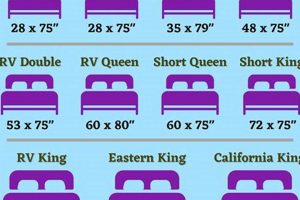
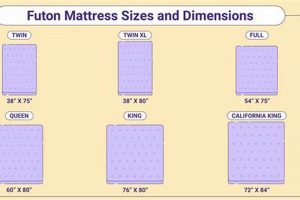
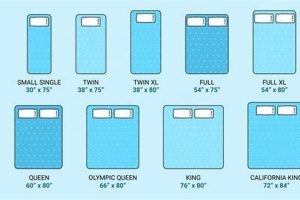
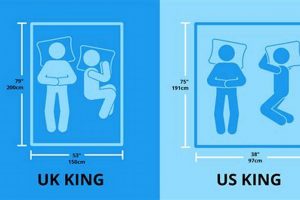
A split queen mattress consists of two separate mattresses, each measuring approximately 30 inches wide and 80 inches long. When placed side-by-side, these two mattresses create the overall dimensions equivalent to a standard queen size, which is 60 inches wide and 80 inches long. This configuration allows for individual customization and adjustment on each side of the bed.
The advantage of this design lies in accommodating differing comfort preferences and needs within a shared sleeping space. Individuals can select the firmness or type of mattress that suits them best, promoting individualized sleep experiences. Historically, split mattresses have been used to mitigate motion transfer between sleep partners and to facilitate the use of adjustable bed frames.
Understanding these measurements and the resulting bed configuration is essential when considering bedding, bed frames, and the overall suitability of this mattress type for specific lifestyle requirements and sleeping arrangements. Subsequent discussions will delve into the practical implications and potential applications of this unique sleep solution.
Considerations for Split Queen Mattresses
Selecting a mattress that caters to individual needs within a shared sleeping space requires careful deliberation. The following points provide guidance for prospective purchasers of divided queen mattresses.
Tip 1: Evaluate Individual Sleep Needs: Determine the preferred firmness level and material type (e.g., memory foam, innerspring, latex) for each individual user. This assessment is crucial for selecting two mattresses that provide optimal comfort and support.
Tip 2: Confirm Adjustable Bed Frame Compatibility: Verify that the chosen adjustable bed frame is specifically designed for split queen mattresses. Standard queen frames will not accommodate the separate mattress sections effectively.
Tip 3: Assess Motion Isolation Properties: While the split design inherently minimizes motion transfer, consider mattresses constructed with materials known for their superior motion isolation capabilities, such as memory foam or individually wrapped coils.
Tip 4: Measure Available Space: Ensure the bedroom dimensions can comfortably accommodate a bed that is 60 inches wide and 80 inches long, with sufficient clearance for movement around the bed.
Tip 5: Account for Sheet and Bedding Requirements: Split queen mattresses necessitate the use of fitted sheets designed specifically for this configuration. Standard queen-size sheets will not provide an adequate fit. Additionally, consider using individual comforters or blankets to further personalize the sleep experience.
Tip 6: Review Warranty and Return Policies: Carefully examine the warranty terms and return policies for both the mattresses and the adjustable bed frame, paying particular attention to stipulations related to split mattress configurations.
Careful attention to these considerations will contribute to a more informed purchasing decision, optimizing comfort and satisfaction with a split queen mattress setup.
The subsequent section will explore common misconceptions and address frequently asked questions pertaining to the use and maintenance of split queen mattresses.
1. Individual mattress width
The individual mattress width is a defining characteristic of the split queen configuration, directly influencing its suitability for particular sleeping arrangements and bed frame compatibility. Understanding this dimension is critical for both purchase decisions and overall sleep experience.
- Customized Comfort Zones
Each individual mattress in a split queen setup measures approximately 30 inches in width. This allows each sleep partner to select a mattress with a firmness and material composition tailored to their individual preferences. For example, one partner might prefer a firm innerspring mattress, while the other opts for a softer memory foam option. This individualization is a primary benefit, accommodating diverse sleep needs within a shared bed.
- Adjustable Base Functionality
The 30-inch width is essential for compatibility with adjustable bed frames designed for split queen mattresses. These frames allow independent elevation and articulation of each side of the bed, enabling customized sleeping positions for each partner. The specified width ensures that each mattress section fits securely and functions correctly within the frame’s mechanisms.
- Sheet and Bedding Requirements
The individual mattress width dictates the need for specialized fitted sheets designed specifically for split queen configurations. Standard queen-size sheets will not adequately cover the mattresses, resulting in improper fit and potential discomfort. Awareness of this dimensional requirement prevents frustration and ensures a proper and comfortable bedding arrangement.
- Motion Isolation Properties
While the split design inherently reduces motion transfer, the mattress material’s properties amplify this effect. Coupled with the individual width design, materials such as memory foam or latex further minimize disturbances between partners, which allows undisturbed sleep. Choosing materials enhances the benefits of the 30-inch individual width for sleep quality.
In summary, the 30-inch individual mattress width is a fundamental aspect of split queen mattresses, driving its capacity for personalized comfort, adjustable bed compatibility, specialized bedding requirements, and enhanced motion isolation. Consideration of this dimension is crucial for making an informed decision about whether a split queen mattress meets individual sleeping needs and preferences.
2. Combined width overall

The combined width represents a critical dimension when considering split queen mattress configurations. It defines the total horizontal space occupied by the bed and directly affects bedroom layout, frame compatibility, and overall user experience.
- Total Sleeping Surface
The two mattresses, each 30 inches wide, when placed adjacently, establish a unified sleeping surface measuring 60 inches in width. This dimension is identical to a standard queen-size mattress. The aggregate provides adequate space for two adults, aligning with the established expectations for bed sizes. This equivalence simplifies the transition for individuals accustomed to the standard queen.
- Bed Frame Compatibility
Though the individual mattresses require a specialized adjustable base, the combined width dictates the outer dimensions of the bed frame needed to support the complete system. Frames designated as “split queen” must accommodate the 60-inch width to ensure proper support and alignment. Using a frame that is too small or too large compromises both stability and aesthetics.
- Spatial Planning in the Bedroom
The 60-inch width is a significant factor in space planning within a bedroom. Prior to purchase, careful measurement of the available space is required to guarantee the bed does not obstruct walkways, interfere with other furniture, or impede door operation. Consideration of the combined width mitigates potential ergonomic and logistical challenges.
- Sheets and Bedding Selection
Although specialized fitted sheets are needed for the individual mattresses, the overall width influences the selection of top sheets, comforters, and bedspreads. Bedding designed for a standard queen-size mattress generally fits the combined width of a split queen setup. However, personal preference might dictate the need for oversized bedding to ensure adequate coverage and aesthetic appeal.
Therefore, the combined width is a primary consideration in evaluating the suitability of this mattress configuration. Its alignment with standard queen dimensions provides a familiar sleeping surface. Appropriate bed frame and careful spatial planning considerations and optimized bedding selection ensure the split queen mattress arrangement integrates seamlessly into the bedroom and provides an improved sleep experience.
3. Individual mattress length
Within the context of split queen mattress dimensions, the individual mattress length is a critical, yet often overlooked, component. The length of each individual mattress comprising a split queen is typically 80 inches. This dimension directly influences the overall suitability of the bed for taller individuals and the practicalities of fitting it within standard bedroom spaces. A shorter length would compromise comfort for those of average or above-average height, while a significantly longer length might present spatial challenges in smaller rooms. The consistency of the 80-inch length across both mattresses ensures that the combined sleeping surface provides a unified and uninterrupted length for two individuals.
For instance, consider a scenario where one sleep partner is 6’2″ tall. The 80-inch length provides adequate legroom, preventing discomfort or restricted movement during sleep. Conversely, if the individual mattress length were shorter, say 75 inches, this individual would likely experience restricted leg extension and disrupted sleep. Adjustable bed frames designed for split queen mattresses also rely on this consistent length to function correctly. Deviation from this standard could result in misalignment of the bed frame components and impaired functionality. The significance of the 80-inch length is amplified by the individualized adjustability of these bed frames, as inconsistent lengths would prevent synchronized adjustments and negate the benefits of the split design.
In conclusion, the individual mattress length of 80 inches is an integral and non-negotiable dimension within the specifications of split queen mattresses. It directly impacts the sleeping comfort of individuals, the functionality of compatible adjustable bed frames, and the practical considerations of bedroom space utilization. Any alteration to this dimension would fundamentally compromise the intended purpose and benefits of the split queen mattress design, highlighting its importance in the broader context of mattress dimensions and user experience.
4. Total sleeping surface

The total sleeping surface of a split queen mattress is a direct outcome of its component dimensions and significantly influences the overall comfort and usability of this bed configuration. It represents the combined area available for sleep and rest, impacting the freedom of movement and perceived spaciousness.
- Combined Mattress Width and Area
The split queen design, consisting of two mattresses each 30 inches wide, yields a total width of 60 inches when placed side-by-side. Combined with the standard 80-inch length, this results in a total sleeping surface area equivalent to that of a standard queen mattress: 4,800 square inches. This area dictates the room available for two sleepers, balancing individual space with overall compactness suitable for many bedrooms.
- Impact on Sleep Partner Proximity
The dimensions of the total sleeping surface determine the proximity between sleep partners. While the split configuration aims to minimize motion transfer and allow individual adjustments, the combined width dictates the closeness. This can influence feelings of connectedness and comfort, with some preferring more individual space while others value physical closeness during sleep.
- Influence on Bedding and Accessories
Despite the individual mattresses requiring specialized fitted sheets, the overall dimensions of the total sleeping surface influence the choice of top sheets, comforters, and bedspreads. These items are typically selected based on standard queen-size dimensions, ensuring adequate coverage and aesthetic harmony within the bedroom setting. Understanding the area helps guide choices that enhance comfort and visual appeal.
- Relevance to Bedroom Spatial Planning
The dimensions of the total sleeping surface are a primary consideration in bedroom layout and spatial planning. The bed’s footprint impacts the arrangement of other furniture, traffic flow, and overall room functionality. Precise knowledge of the combined dimensions enables informed decisions about bed placement and the allocation of space for other essential furnishings.
In summary, the total sleeping surface of a split queen mattress is a multifaceted characteristic determined by the individual mattress dimensions. It significantly impacts sleep partner dynamics, influences bedding choices, and dictates spatial planning considerations within the bedroom. These factors collectively shape the user experience and underscore the importance of carefully assessing the dimensions of a split queen before making a purchasing decision.
5. Adjustable base compatibility

Adjustable base compatibility is a crucial determinant when considering split queen mattress dimensions. The split queen design, characterized by two separate mattresses of specific dimensions (typically 30 inches wide and 80 inches long each), necessitates a specialized adjustable base. Standard adjustable bed frames engineered for conventional queen mattresses are incompatible, as they lack the independent support mechanisms required for each individual mattress section. This incompatibility arises because standard frames are designed to elevate and articulate a single, contiguous surface, not two independently movable ones. Using a standard frame with a split queen mattress can result in uneven support, compromised adjustability, and potential damage to both the mattresses and the frame itself.
For example, a couple with differing sleep preferences, such as one partner requiring elevated leg support for circulation and the other preferring a flat sleeping surface, can only achieve these individual adjustments with a properly matched adjustable base. The specialized base allows each side of the bed to be independently raised or lowered, accommodating varying comfort needs. Attempting to use a single-piece frame would negate this functionality, forcing both partners to conform to the same sleeping position. Furthermore, the structural integrity of the split queen mattress relies on the adjustable base’s design. The base provides essential support along the perimeter and throughout the mattress surface, preventing sagging and ensuring proper weight distribution. A mismatched frame fails to deliver this support, potentially shortening the mattress’s lifespan and diminishing its overall comfort.
Therefore, understanding the precise dimensions of each mattress section and ensuring compatibility with a specifically designed adjustable base is paramount. This compatibility is not merely a matter of convenience but a prerequisite for realizing the intended benefits of a split queen mattress: individualized comfort, independent adjustability, and optimized sleep quality. Failure to acknowledge this connection undermines the entire purpose of the split queen design, highlighting the need for careful selection and informed purchasing decisions.
6. Sheet size requirements
Proper sheet selection is inextricably linked to split queen mattress dimensions, necessitating adherence to specific size guidelines to ensure both fit and comfort. The unique configuration of this mattress type demands a departure from standard bedding norms.
- Fitted Sheet Dimensions for Individual Mattresses
Split queen mattresses consist of two separate units, each typically measuring 30 inches in width and 80 inches in length. Standard queen-size fitted sheets, designed for a single 60-inch wide mattress, are unsuitable. Consequently, two fitted sheets, each conforming to the 30×80 inch dimensions, are required to properly encase each mattress individually. Failure to use appropriately sized fitted sheets results in inadequate coverage and potential slippage during use.
- Top Sheet and Blanket Compatibility
While fitted sheets must adhere to the individual mattress dimensions, top sheets, blankets, and comforters generally follow standard queen-size dimensions (approximately 90×102 inches for a top sheet). The overall width and length of the combined mattresses align with a traditional queen, allowing for the use of standard bedding items for the upper layers. However, individual preferences may dictate the selection of oversized options to ensure adequate draping and coverage.
- Potential for Specialized Bedding Sets
Certain manufacturers offer complete bedding sets specifically designed for split queen mattresses. These sets typically include two fitted sheets tailored to the individual mattresses, along with a queen-size top sheet and coordinating pillowcases. Purchasing a dedicated set streamlines the bedding acquisition process and ensures compatibility across all components. However, the availability of such sets may be limited, requiring independent sourcing of individual items.
- Elastic Band Reinforcement and Sheet Suspenders
Given the potential for fitted sheet slippage on individual split queen mattresses, some users employ elastic band reinforcement or sheet suspenders to maintain a secure fit. These accessories attach to the corners of the fitted sheets and underneath the mattress, preventing movement and ensuring a smooth sleeping surface. While not a mandatory requirement, these enhancements can improve overall comfort and prevent the need for frequent readjustment.
In summary, while top layers of bedding for split queen mattresses can generally adhere to standard queen sizes, the fitted sheets are a distinct consideration. A proper fit not only influences comfort but also affects the overall functionality and long-term care of the split queen mattress setup.
Frequently Asked Questions
This section addresses common inquiries regarding the dimensional aspects of split queen mattresses, providing clarity and facilitating informed purchasing decisions.
Question 1: What are the exact measurements of each individual mattress in a split queen set?
Each mattress typically measures 30 inches in width and 80 inches in length. These dimensions, when combined, equate to the overall size of a standard queen mattress (60 inches wide and 80 inches long).
Question 2: Do standard queen-size sheets fit a split queen mattress?
No. Standard queen-size fitted sheets are designed for a single mattress and will not properly fit the two individual mattresses of a split queen. Two fitted sheets, each sized to fit the individual 30×80 inch mattresses, are required.
Question 3: Is a specialized bed frame required for a split queen mattress?
Yes, specifically if an adjustable base is desired. Standard bed frames designed for single mattresses will not accommodate the independent movement of each split queen mattress section. A split queen adjustable base is essential to achieve independent adjustability.
Question 4: Does the combined sleeping surface of a split queen mattress differ from a standard queen?
No. The combined sleeping surface retains the exact dimensions of a standard queen mattress: 60 inches wide and 80 inches long. The difference lies in the division of this surface into two separate units.
Question 5: How does the split design impact motion transfer between sleep partners?
The split design inherently reduces motion transfer, as movements on one side of the bed are less likely to disturb the other. Selecting mattresses with materials known for motion isolation, such as memory foam, further minimizes disruptions.
Question 6: Are there specific weight restrictions associated with split queen adjustable bases?
Yes. Adjustable bases have weight capacity limits, which should be carefully considered. The combined weight of the mattresses and both sleep partners must not exceed the base’s specified weight limit to ensure proper functionality and prevent damage.
Understanding these dimensional aspects is critical for proper bed selection and optimal sleep. Failure to consider these factors may result in compatibility issues and diminished sleep quality.
The subsequent section will delve into real-world applications and user testimonials regarding split queen mattress configurations.
Conclusion
The preceding exploration of “split queen mattress dimensions” has underscored the importance of precise measurements in achieving optimal sleep solutions. A clear understanding of individual mattress width and length, combined sleeping surface, and adjustable base compatibility is crucial for consumers. Proper fitted sheet selection, dictated by the unique requirements of the split design, further contributes to user satisfaction and overall bed functionality.
Failure to consider these dimensional specifications can lead to compromised comfort, reduced functionality, and ultimately, a suboptimal sleep experience. Therefore, diligent attention to “split queen mattress dimensions” remains paramount when evaluating the suitability of this mattress configuration for individual needs and preferences, ensuring a long-term investment in restful and restorative sleep.