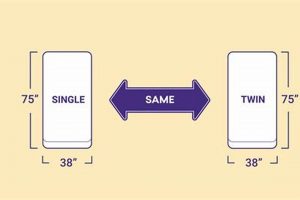
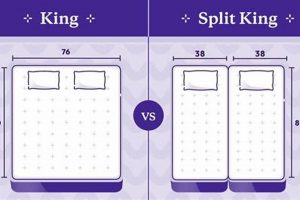
The comparison between two common mattress sizes centers on their dimensions and suitability for different users. One option offers a narrower sleeping surface, typically measuring around 38 inches wide and 75 inches long. The other provides a wider sleeping area, generally around 54 inches wide and 75 inches long. This difference in width is the primary distinction.
The selection between these mattress dimensions impacts sleeping comfort and space efficiency. The narrower option is often preferred for children’s rooms, dormitories, or smaller bedrooms where space is limited. The wider option offers increased room for a single sleeper to move around comfortably or may accommodate occasional co-sleeping with a child. Historically, standard mattress sizes have evolved to accommodate changing living spaces and individual sleep preferences.
The subsequent discussion will delve into the specific advantages and disadvantages of each size, exploring their respective applications for various users and room sizes. Factors such as cost, available bedding options, and the sleeper’s individual needs will also be considered to facilitate informed decision-making regarding mattress selection.
Considerations for Selecting a Mattress Size
Careful evaluation of individual needs and spatial constraints is essential when determining the appropriate mattress size for optimal sleep and room utilization.
Tip 1: Assess the Sleeper’s Size and Sleeping Habits: Individuals who tend to move frequently during sleep, or those with larger body frames, may benefit from the additional width afforded by the larger option.
Tip 2: Evaluate Room Dimensions: Measure the available floor space to ensure that the selected mattress size allows for comfortable movement around the room and placement of other furniture.
Tip 3: Consider the Intended Use: If the mattress is primarily intended for a single child or adolescent, the narrower option may be sufficient. For adults or guest rooms, the wider option generally provides greater comfort.
Tip 4: Factor in Budgetary Constraints: Generally, the narrower option is often less expensive, both in terms of initial purchase price and the cost of associated bedding.
Tip 5: Anticipate Future Needs: If there is a possibility of co-sleeping with a child or pet in the future, the wider option may provide more flexibility.
Tip 6: Research Available Bedding Options: Ensure that bedding is readily available and affordable for the chosen mattress size. Uncommon sizes may require specialized or more expensive bedding.
Tip 7: Consider Long-Term Comfort: Investing in a larger, more comfortable mattress can improve sleep quality and overall well-being over the lifespan of the product.
By carefully weighing these considerations, individuals can make an informed decision that optimizes sleep quality and maximizes the functionality of their living space.
The following sections will further explore the specific benefits and drawbacks of each mattress size to provide a comprehensive understanding of their respective applications.
1. Dimensions

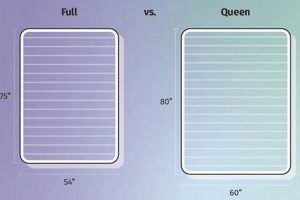
The fundamental distinction between these common mattress types resides in their dimensions. A twin mattress typically measures approximately 38 inches in width and 75 inches in length. A full mattress, conversely, expands to approximately 54 inches in width while maintaining the same 75-inch length. This 16-inch difference in width constitutes the primary dimensional divergence, influencing suitability for various individuals and spatial configurations. For instance, a compact bedroom or studio apartment may more readily accommodate a twin mattress, while a full mattress provides a broader sleeping surface for individuals desiring more personal space or occasionally co-sleeping with a small child.
The dimensional aspect directly impacts the perceived comfort and functionality. A smaller individual, particularly a child or smaller adult, might find the twin mattress sufficient for comfortable sleep. However, a taller or broader individual may feel constricted on the narrower surface, leading to restless sleep and potential discomfort. The additional width of the full mattress mitigates this issue, providing increased freedom of movement and accommodating a wider range of body sizes. Consider a college student living in a small dorm room. The limited space makes a twin mattress a practical necessity. Conversely, a single adult in a larger apartment might opt for a full mattress for enhanced sleeping comfort.
In summary, the dimensional differences between these mattress options are paramount. This characteristic determines space efficiency, comfort level, and overall suitability. Choosing a mattress requires careful consideration of the sleeper’s size, sleeping habits, and the available room dimensions. Neglecting the dimensional aspect can lead to suboptimal sleep quality and inefficient space utilization. The choice significantly impacts long-term satisfaction with the purchase, underscoring the importance of a well-informed decision.
2. Space Requirements

Space requirements are a crucial determinant in the selection process between a twin and a full mattress. The physical dimensions of each mattress type directly influence the amount of floor space occupied, thus dictating the suitability for different room sizes and layouts. A twin mattress, owing to its smaller footprint, requires less floor area, making it a preferable option for smaller bedrooms, dorm rooms, or rooms shared by multiple occupants. Conversely, a full mattress demands a larger area, necessitating a more spacious room to accommodate it comfortably without significantly impeding movement or restricting furniture placement. Neglecting space requirements can lead to a cramped and uncomfortable living environment.
The impact of mattress size on room aesthetics and functionality is considerable. For example, fitting a full mattress into a small room designed for a twin can result in a cluttered space with limited walking area and reduced storage options. Conversely, placing a twin mattress in a large room can create an imbalance, making the room feel sparsely furnished and lacking in visual appeal. Practical application involves precisely measuring the room dimensions and considering the placement of other essential furniture items, such as dressers, desks, and nightstands, before deciding on the mattress size. This ensures optimal space utilization and enhances the overall room ambiance.
In summary, understanding the spatial implications of each mattress size is paramount. Mismatched mattress and room sizes lead to compromised functionality and aesthetic imbalances. Prioritizing space requirements during the mattress selection process ensures efficient use of available space, enhances room functionality, and contributes to a more comfortable and visually appealing living environment. Thus, Space Requirements are a fundamental component in choosing between the options, influencing comfort and usability.
3. Single vs. Occasional Double
The suitability of either a twin or a full mattress is fundamentally linked to its intended occupancy: single versus occasional double use. A twin mattress is optimally designed for individual sleepers. Its dimensions comfortably accommodate one person and are particularly well-suited for children, teenagers, or adults with smaller frames who sleep alone. A full mattress, while also suitable for a single sleeper, offers additional width that accommodates occasional co-sleeping or provides a more spacious sleeping area for individuals who prefer extra room to move during the night. The intended use case is a primary determinant of the appropriate mattress choice. For instance, a guest room intended for single occupancy would be well-served by a twin mattress. A room intended for a child who may occasionally have a parent sleep with them during illness would benefit from a full mattress.
The choice between these mattress sizes directly impacts comfort and practicality when considering occasional double occupancy. A twin mattress becomes significantly cramped and uncomfortable for two adults, leading to disrupted sleep and potential discomfort. A full mattress provides a more viable, though not ideal, solution for occasional co-sleeping. It offers sufficient space for two smaller individuals to share the bed for a limited period without severe discomfort. However, regular co-sleeping would necessitate a larger mattress size, such as a queen or king. Consider a scenario where a parent occasionally sleeps with a young child who experiences nightmares. A full mattress provides adequate space for this temporary arrangement. However, regular co-sleeping would require a larger mattress to ensure restful sleep for both individuals.
In summary, the intended occupancy serves as a critical filter when choosing between a twin and a full mattress. A twin is optimally suited for consistent single use, while a full offers a degree of flexibility for occasional double occupancy. This understanding contributes to informed decision-making, ensuring that the selected mattress provides adequate comfort and functionality for its intended purpose. Disregarding this aspect can lead to compromised sleep quality and dissatisfaction with the purchase. Therefore, the intended use case, specifically single versus occasional double, is a vital consideration during mattress selection. This is crucial when deciding between twin mattress vs full.
4. Cost Efficiency

Cost efficiency is a significant factor influencing the choice between a twin and a full mattress. The cause-and-effect relationship is straightforward: mattress size directly correlates with material usage and manufacturing costs, impacting the final price. Generally, a twin mattress is less expensive than a full mattress. This cost differential stems from the reduced material requirements in its production. Bed frames and bedding accessories for a twin are similarly less expensive. The importance of cost efficiency is amplified for consumers operating under budgetary constraints or furnishing multiple rooms, such as in dormitories or children’s bedrooms. Purchasing several twin mattresses instead of full mattresses can result in considerable savings. For example, a non-profit organization furnishing a homeless shelter might opt for twin mattresses due to budgetary limitations, prioritizing quantity over individual sleeping space.
The practical significance of understanding cost efficiency extends beyond the initial purchase price. Bedding, such as sheets, comforters, and mattress protectors, are consistently cheaper for twin mattresses. The longevity and maintenance costs should also be considered. While both mattress types offer comparable lifespans with proper care, replacement costs are relevant. Furthermore, consider the potential for future needs. If there’s an anticipated need for a larger sleeping surface, the long-term cost of initially purchasing a twin and subsequently upgrading to a larger size may exceed the initial investment in a full mattress. A young family furnishing a child’s room might face this scenario, initially opting for a twin and later needing a full as the child grows.
In summary, cost efficiency presents a compelling consideration. A twin mattress typically offers a lower initial investment and reduced ongoing expenses for bedding. However, overlooking future needs and the potential long-term benefits of a larger sleeping surface can negate these initial savings. Therefore, informed decision-making requires a comprehensive evaluation of budgetary constraints, long-term requirements, and the overall value proposition of each mattress size. Balancing cost efficiency with practical needs ensures a financially sound and functionally suitable mattress choice.
5. Age/Size Appropriateness

The appropriateness of a twin or full mattress is fundamentally linked to the age and physical dimensions of the intended sleeper. A cause-and-effect relationship exists: Smaller children and adolescents typically find a twin mattress sufficiently comfortable and adequately sized, while larger adolescents and adults often require the increased sleeping surface of a full mattress. The importance of age and size as determining factors stems from their direct impact on sleep quality and comfort. An undersized mattress can lead to restricted movement, discomfort, and disrupted sleep, affecting overall well-being. For example, a young child transitioning from a crib to a bed will generally find a twin mattress perfectly suitable. Conversely, a taller teenager or adult may experience a feeling of confinement on a twin, leading to restlessness and difficulty achieving restful sleep.
Practical application of this understanding involves assessing the sleeper’s height, weight, and sleeping habits. Individuals who tend to move frequently during sleep or those with broader shoulders will benefit from the additional width afforded by a full mattress. Consideration should also be given to growth potential. A rapidly growing adolescent may quickly outgrow a twin mattress, necessitating a premature upgrade to a larger size. For instance, a college student of average height may find a twin adequate for a dormitory setting, prioritizing space efficiency. However, a taller student or one who values personal space would likely find a full mattress more conducive to comfortable sleep. Room size also influences this decision; a smaller room might necessitate a twin despite the sleeper’s preference for a larger sleeping surface.
In summary, age and size appropriateness is a critical consideration when choosing between a twin and a full mattress. Failing to account for these factors can lead to compromised sleep quality and discomfort. Informed decision-making requires a careful evaluation of the sleeper’s physical attributes, sleeping habits, and growth potential, balanced against room size limitations and budgetary constraints. Prioritizing age and size appropriateness ensures a more comfortable and restful sleep experience, ultimately contributing to improved overall health and well-being. The correlation between the sleepers parameters and twin mattress vs full is a complex concept with numerous factors.
6. Bedding Availability

The practical relevance of bedding availability significantly impacts the choice between a twin and a full mattress. Bedding refers to sheets, blankets, comforters, mattress protectors, and other accessories necessary for a comfortable and hygienic sleep environment. The causal relationship arises from standardized sizing. Common mattress dimensions directly influence the variety, accessibility, and price of compatible bedding. Twin-sized bedding is typically more readily available and offered at a lower price point compared to full-sized bedding. This is primarily attributable to higher production volumes and broader market demand for twin bedding, a consequence of its prevalence in children’s rooms, dormitories, and other space-constrained environments. Failing to consider bedding availability may lead to difficulties in sourcing suitable linens or incurring higher costs, thereby diminishing the overall value proposition.
The practical implications of this understanding are numerous. For instance, a budget-conscious consumer furnishing a child’s bedroom may find the affordability and wide selection of twin bedding a compelling advantage. Conversely, someone furnishing a guest room with a full mattress might encounter fewer options and higher prices, potentially affecting the overall budget allocated to room furnishings. Furthermore, individuals seeking specialized or high-end bedding may find a more extensive selection available for twin mattresses due to their widespread use. Another use case involves college students moving into dormitories. Limited space often dictates the use of twin mattresses, and the ready availability of affordable bedding is a significant benefit. This can then become a reason to choose twin mattress vs full as the best option.
In summary, the factor of bedding availability constitutes a crucial element in the decision-making process. The broader availability and lower cost of twin bedding can be a decisive factor for budget-minded consumers or those furnishing multiple rooms. The challenges include potentially limiting oneself to a smaller sleeping surface solely based on bedding economics. Careful consideration should balance the benefits of readily available and affordable bedding against individual comfort preferences and spatial constraints. This consideration guarantees informed mattress selection in the context of twin mattress vs full, ultimately optimizing cost-effectiveness and user satisfaction.
Frequently Asked Questions
The following addresses common inquiries regarding the comparative benefits and drawbacks of two common mattress sizes.
Question 1: What are the precise dimensional differences?
A twin mattress typically measures 38 inches wide by 75 inches long. A full mattress measures 54 inches wide by 75 inches long. The primary difference lies in the 16-inch increase in width offered by the full mattress.
Question 2: When is a twin mattress most appropriate?
A twin mattress is generally suitable for children, adolescents, or single adults with smaller frames. It is also a practical choice for rooms with limited space, such as dormitories or small bedrooms.
Question 3: What are the advantages of a full mattress?
A full mattress provides a wider sleeping surface, offering increased comfort for single sleepers who prefer more room to move or for occasional co-sleeping. It is generally more suitable for adults than a twin mattress.
Question 4: Does mattress size impact cost?
Yes. Twin mattresses are typically less expensive than full mattresses due to reduced material usage. Bedding for twin mattresses is also generally more affordable.
Question 5: How does room size factor into the decision?
Room size is a critical consideration. A smaller room may only comfortably accommodate a twin mattress, while a larger room can easily accommodate a full mattress without feeling cramped. Careful measurement of the available space is recommended.
Question 6: Is bedding readily available for both mattress sizes?
Bedding is generally available for both mattress sizes. However, twin-sized bedding is often more readily available and offered at a lower price point than full-sized bedding.
The appropriate mattress size is dependent on individual needs, spatial constraints, and budgetary considerations. Careful assessment of these factors facilitates an informed decision.
Further exploration of specific mattress types and materials may provide additional insight into optimizing sleep quality and comfort.
Concluding Assessment
The preceding analysis illuminates the critical distinctions between the twin and full mattress options. Key considerations encompass dimensions, spatial requirements, intended occupancy, cost efficiencies, sleeper age/size appropriateness, and bedding availability. Informed decision-making necessitates a careful evaluation of these factors within the context of individual needs and constraints.
Selecting the optimal mattress size directly impacts sleep quality, space utilization, and budgetary allocation. Therefore, a comprehensive understanding of the attributes discussed herein is paramount. Continued awareness of advancements in sleep technology and evolving personal needs will further refine the mattress selection process.