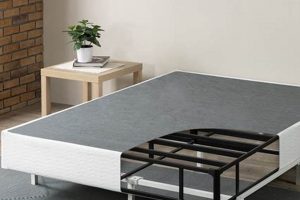
This type of sleeping arrangement features two single-sized beds; one is positioned at a standard height, while the other is stored underneath and can be easily rolled out for use. This design often includes the supportive surface for immediate use.
The value of such a bed lies in its space-saving efficiency, particularly beneficial in smaller homes or rooms. Historically, similar designs have offered practical solutions for accommodating guests or maximizing limited living areas. Its advantage also includes providing a ready-to-use extra sleeping space without permanently occupying additional floor area.
The following sections will delve into the factors to consider when selecting this style of bed, including frame materials, mattress types, and intended use cases, along with maintenance tips to ensure longevity.
Essential Considerations for This Type of Bed
Selecting the correct model requires careful consideration of space, use, and long-term value. The following points offer guidance.
Tip 1: Frame Material Evaluation: Assess the durability of the frame. Solid wood or reinforced metal frames offer superior support and longevity compared to less robust materials. Consider the weight capacity to ensure it meets anticipated needs.
Tip 2: Mattress Depth Compatibility: Verify the clearance between the upper bed frame and the lower trundle frame when selecting mattresses. Overly thick mattresses may prevent the trundle from smoothly rolling under the primary bed.
Tip 3: Roll-Out Mechanism Quality: Examine the smoothness and sturdiness of the roll-out mechanism. Wheels should glide effortlessly and be constructed from a material that won’t damage flooring. Locking mechanisms, if present, should function reliably.
Tip 4: Space Assessment: Measure the available space in the room to ensure adequate clearance for both the primary bed and the extended trundle. Account for furniture placement and ease of movement around the expanded bed.
Tip 5: Intended Use Determination: Consider the frequency of use. For occasional guests, a less expensive model may suffice. For regular use, invest in a more durable and comfortable option.
Tip 6: Storage Considerations: Some frames incorporate storage drawers. Evaluate whether the added storage is a necessary feature based on spatial requirements.
Tip 7: Safety Features: If the bed is for a child, ensure the frame has rounded edges and non-toxic finishes.
Careful attention to these details ensures a practical and lasting selection.
The subsequent sections will explore maintenance practices to extend the lifespan of the bed and mattresses.
1. Space-saving design

The space-saving design inherent in a twin trundle bed with mattress is a primary attribute that dictates its practicality and suitability for specific living environments. This design directly addresses spatial limitations, offering a dual sleeping solution within the footprint of a single bed. This efficiency holds significant relevance for optimizing limited square footage.
- Vertical Space Maximization
The trundle design capitalizes on unused vertical space beneath the primary bed. This prevents the need for an additional, fully extended bed frame when an extra sleeping surface is required. A practical example is its use in shared children’s rooms where floor space is limited but overnight guests are common.
- Multifunctional Room Adaptability
These beds allow rooms to adapt to diverse needs. During the day, the room functions without the visual or physical obstruction of a second bed. When needed, the trundle is deployed, transforming the space into a temporary sleeping area. This is applicable in home offices or guest rooms that serve multiple purposes.
- Simplified Storage Solutions
The integrated design consolidates the storage and deployment of an extra bed. Traditional solutions, such as folding cots or inflatable mattresses, often require separate storage space and assembly. The trundle bed eliminates these additional storage requirements.
- Aesthetic Integration
When not in use, the trundle bed is concealed, maintaining a clean and uncluttered aesthetic within the room. This contributes to a more organized and visually appealing living space, particularly beneficial in smaller apartments or homes where space is at a premium.
These facets of space-saving design converge to enhance the overall utility and value of a twin trundle bed with mattress. Its capacity to efficiently utilize available space contributes significantly to its desirability as a practical and versatile sleeping solution. This design is particularly relevant in settings where optimizing spatial efficiency is paramount.
2. Mattress compatibility

Mattress compatibility represents a critical component influencing the overall functionality and user satisfaction associated with a twin trundle bed. The dimensions and thickness of the mattress designated for the lower, roll-out portion of the bed must adhere to specific constraints to ensure smooth operation. Incompatibility can lead to operational difficulties, such as the inability to fully retract the trundle beneath the primary bed frame, compromising space-saving benefits.
The cause-and-effect relationship is evident: an oversized mattress obstructs the trundle’s intended movement. This underscores the importance of adhering to manufacturer specifications regarding maximum mattress height. For instance, a common scenario involves a user selecting a plush, thicker mattress that exceeds the allowable clearance, thereby preventing the trundle from fully sliding under the main bed. Practical significance extends to user convenience; forcing the trundle closed can damage the frame and impede smooth roll-out in subsequent uses. Selection should prioritize matching mattress dimensions to the specific trundle bed model.
Proper mattress compatibility ensures the twin trundle bed operates as intended, maximizing its space-saving capabilities and enhancing user experience. Failure to consider this factor can negate the advantages offered by this type of bed, resulting in functional limitations and potential damage. Therefore, careful attention to mattress dimensions is crucial during the purchasing process.
3. Frame construction

Frame construction directly impacts the functionality and lifespan of a twin trundle bed. The frame supports the weight of both the primary bed and the roll-out trundle, therefore, the ma
terials and design directly influence stability and durability. For instance, a frame constructed from solid hardwood will generally provide more robust support than one made from particleboard, leading to a longer lifespan and reduced risk of structural failure. Metal frames offer a different set of advantages, such as resistance to pests and warping. In a real-world scenario, a family utilizing a trundle bed daily for several years would experience significantly fewer issues with a well-constructed frame versus a poorly constructed one, resulting in less maintenance and a lower total cost of ownership over time.
The roll-out mechanism is a critical element of frame construction. This mechanism allows the trundle bed to be easily deployed and retracted. The quality of the wheels, the smoothness of the tracks, and the overall design of the mechanism are all influenced by the materials and construction techniques employed. A poorly designed or constructed mechanism can lead to difficulty in operating the trundle, damage to flooring, or even complete failure of the system. For example, plastic wheels on a low-quality frame might crack under the weight of a mattress and occupant, while a frame with poorly aligned tracks could bind, making it difficult to roll the trundle in and out.
In summary, frame construction is fundamental to the performance and longevity of a twin trundle bed. Selecting a model with a sturdy frame, appropriate materials, and a well-designed roll-out mechanism is essential for ensuring its safe and reliable operation. Neglecting this aspect during the purchase process can lead to costly repairs, functional limitations, and a shortened lifespan for the bed. Therefore, a thorough assessment of frame construction is paramount when considering a twin trundle bed with mattress.
4. Roll-out mechanism
The roll-out mechanism is an integral component of any twin trundle bed, dictating its ease of use and overall functionality. This mechanism facilitates the deployment and retraction of the secondary bed from its storage position beneath the primary frame. Its design directly influences the user’s experience and the longevity of the bed. A poorly designed or constructed roll-out system can result in difficulties in operation, potential damage to flooring, and accelerated wear on the bed frame. For example, a mechanism with substandard wheels may bind or fail to roll smoothly, requiring excessive force to operate, potentially leading to structural stress and eventual breakdown. The absence of a reliable locking mechanism, if intended in the design, could also pose safety concerns, particularly when the trundle bed is used by children.
Variations in roll-out mechanisms range from simple, caster-based systems to more sophisticated designs incorporating sliding tracks or spring-assisted deployment. The choice of mechanism often depends on the overall construction quality of the trundle bed and its intended price point. Higher-quality systems typically employ durable materials such as steel or reinforced polymers for the wheels and tracks, ensuring smooth and consistent operation over an extended period. Furthermore, the design of the mechanism must consider the weight distribution of the mattress and occupant to prevent uneven wear or premature failure. Real-world applications reveal that trundle beds with robust roll-out mechanisms require less maintenance and offer a more seamless user experience, thereby maximizing the space-saving benefits they are designed to provide.
In conclusion, the roll-out mechanism is a critical determinant of a twin trundle bed’s utility and lifespan. Its reliable and efficient operation is essential for realizing the space-saving potential and convenience offered by this type of bed. Careful consideration should be given to the quality of the mechanism’s components and overall design during the purchasing process to ensure a satisfactory and lasting product. Compromising on this aspect can lead to operational frustrations and ultimately diminish the value proposition of the twin trundle bed with mattress.
5. Guest accommodation
The provision of sleeping arrangements for guests is a primary consideration in many households, and the twin trundle bed with mattress presents a specific solution to this need. Its design caters to the occasional or planned hosting of individuals, offering a dedicated sleeping space without permanently occupying additional floor area.
- Space Optimization for Visitors
The inherent space-saving design enables hosts to accommodate guests in rooms with limited square footage. This is particularly relevant in apartments, smaller homes, or rooms serving multiple functions, such as home offices or play areas. The trundle bed remains concealed when not in use, preserving the room’s primary function.
- Ready-to-Use Sleeping Solution
Unlike inflatable mattresses or folding cots that require setup and inflation, the twin trundle bed offers a readily available sleeping surface. This reduces the preparation time and effort involved in accommodating guests, enhancing the convenience for both host and visitor.
- Dedicated Sleeping Space
Providing a dedicated bed, rather than temporary or makeshift arrangements, contributes to the guest’s comfort and sense of privacy. This demonstrates consideration on the part of the host, fostering a more positive guest experience. The inclusion of a designated mattress further enhances comfort levels.
- Versatile Accommodation Options
The twin trundle configuration is suitable for accommodating children, single adults, or pairs who are comfortable sharing a relatively small sleeping area. This versatility makes it a practical choice for families or individuals who frequently host guests with varying accommodation requirements.
In summary, the twin trundle bed with mattress offers a functional and space-efficient solution for guest accommodation. Its design prioritizes convenience, space optimization, and the provision of a dedicated sleeping space, thereby enhancing the overall guest experience and simplifying the hosting process.
Frequently Asked Questions
This section addresses common inquiries regarding the selection, use, and maintenance of this type of bed. The following questions aim to provide clarity and informed decision-making.
Question 1: What mattress thickness is optimal for a trundle bed?
Mattress thickness is dictated by the available clearance beneath the primary bed frame. Consult the manufacturer’s specifications for the maximum allowable mattress height to ensure smooth trundle operation. Exceeding this limit may hinder retraction.
Question 2: Which frame material provides the greatest durability?
Solid hardwood and reinforced steel frames generally offer superior durability compared to composite materials. These materials are more resistant to wear, weight, and potential damage from frequent use.
Question 3: How often should the roll-out mechanism be lubricated?
Lubrication frequency depends on usage. Inspect the mechanism regularly and apply a silicone-based lubricant if the wheels or tracks exhibit stiffness or resistance. This maintains smooth operation and prevents premature wear.
Question 4: Can any twin-size mattress be used on a trundl
e bed?
While most twin-size mattresses are dimensionally compatible, thickness limitations apply to the trundle portion. Ensure the chosen mattress adheres to the maximum height specified for the trundle frame.
Question 5: What is the weight capacity of a typical trundle bed frame?
Weight capacity varies depending on the frame material and construction. Consult the manufacturer’s specifications to determine the maximum weight the frame can safely support. Exceeding this limit can compromise structural integrity.
Question 6: How can damage to flooring be prevented when using a trundle bed?
Select models with non-marking wheels made from materials such as rubber or polyurethane. Regularly inspect the wheels for debris and ensure they are clean and free-rolling to minimize friction and potential scratches.
These answers provide foundational knowledge for making informed decisions about twin trundle beds with mattresses. Prioritizing frame integrity, appropriate mattress selection, and consistent upkeep will yield the greatest benefit.
The concluding section will summarize the essential advantages of a twin trundle bed with mattress.
In Summary
This exploration has outlined the essential characteristics and considerations pertaining to the twin trundle bed with mattress. Key aspects include space-saving design, the criticality of mattress compatibility, frame construction quality, the roll-out mechanism’s functionality, and its efficacy in guest accommodation. The interplay of these elements dictates the overall utility and longevity of the product. Selecting a suitable model necessitates careful assessment of these factors to ensure alignment with specific needs and spatial constraints. Rigorous attention to detail during the selection process, combined with diligent maintenance, will yield the greatest benefit and extend the lifespan of the chosen bed.
The long-term value of the twin trundle bed with mattress is realized through informed decision-making and consistent care. Recognizing the nuances of its design and construction allows for a practical and sustainable solution to space limitations and accommodation requirements. Ongoing awareness of these elements will ensure continued satisfaction and optimal performance.
![Best Deals on Spring Twin Mattress [Sleep Soundly] | Organic & Natural Mattress Buyer’s Guide: Non-Toxic Sleep Solutions](https://mattressworldpa.com/wp-content/uploads/2025/07/th-5174-300x200.jpg "Best Deals on Spring Twin Mattress [Sleep Soundly] Organic & Natural Mattress Buyer’s Guide: Non-Toxic Sleep Solutions")
![Best Serta Mattress Twin [Sizes & Deals] Today! | Organic & Natural Mattress Buyer’s Guide: Non-Toxic Sleep Solutions](https://mattressworldpa.com/wp-content/uploads/2025/07/th-5173-300x200.jpg "Best Serta Mattress Twin [Sizes & Deals] Today! Organic & Natural Mattress Buyer’s Guide: Non-Toxic Sleep Solutions")
![Best Travel Trailer Twin Mattress [Guide] Comfort On Wheels! | Organic & Natural Mattress Buyer’s Guide: Non-Toxic Sleep Solutions](https://mattressworldpa.com/wp-content/uploads/2025/07/th-5171-300x200.jpg "Best Travel Trailer Twin Mattress [Guide] Comfort On Wheels! Organic & Natural Mattress Buyer’s Guide: Non-Toxic Sleep Solutions")