A futon mattress is a versatile piece of furniture typically employed as both a seating and sleeping surface. Its size specifications are critical for ensuring compatibility with futon frames and for determining the appropriateness of the mattress for intended users and spaces. These measurements define the overall footprint and usable area offered by the mattress.
Proper sizing ensures comfort and functionality. A mattress that is too small may not provide adequate support or sleeping space. Conversely, one that is too large may not fit the frame correctly, potentially leading to damage or instability. Understanding these measurements allows for informed purchasing decisions and optimal utilization of the futon.
The subsequent sections will detail the common size variations, factors influencing sizing choices, and considerations for measuring accurately to guarantee satisfaction.
Considerations for Determining Futon Mattress Size
Selecting the appropriate size requires careful attention to various factors. Accurate measurement of the futon frame and anticipated usage are essential for a satisfactory outcome.
Tip 1: Measure the Frame: Prior to purchasing a mattress, meticulously measure the interior dimensions of the futon frame. This ensures the mattress will fit securely without being too loose or overly compressed.
Tip 2: Consider the Room Size: Assess the available space in the room where the futon will be placed. Account for the mattress’s dimensions when the futon is in both its upright (sofa) and reclined (bed) positions.
Tip 3: Evaluate User Needs: Determine the primary purpose of the futon. If it will be used primarily as a bed for one or two people, a full or queen size mattress might be necessary. For occasional seating or single-person use, a twin or full may suffice.
Tip 4: Account for Mattress Thickness: Thicker mattresses generally offer greater comfort, but can also impact the overall height of the futon when used as a sofa. Consider the balance between comfort and seating height.
Tip 5: Factor in Coverings: The addition of a futon cover will slightly increase the overall dimensions of the mattress. Allow for this extra bulk when determining the ideal size.
Tip 6: Check Manufacturer Specifications: Mattress sizes can vary slightly between manufacturers. Always review the specific dimensions provided by the manufacturer before making a purchase.
Tip 7: Anticipate Potential Shrinkage: Some futon mattresses, particularly those made from natural materials, may experience slight shrinkage over time. Consider purchasing a mattress that is initially slightly larger to compensate.
Careful consideration of these factors will contribute to the selection of a mattress size that provides optimal comfort, functionality, and longevity.
The following section will address the standard sizes and their specific applications in greater detail.
1. Standard sizes (Twin, Full, Queen)

Common sizes provide a general framework, variations exist to suit individual preferences and spatial constraints. The subsequent exploration emphasizes correlations between standard designations and actual measurements, highlighting implications for consumer choices.
- Twin Futon Mattresses
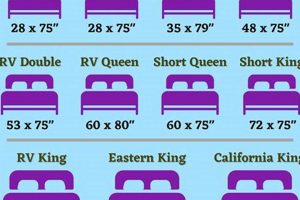
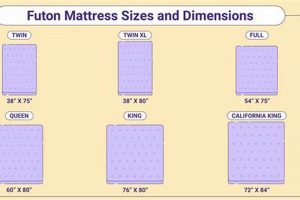
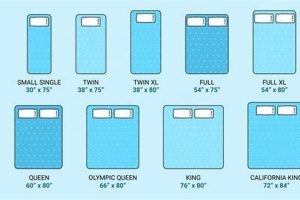
Typically measures approximately 39 inches wide and 75 inches long. This size accommodates one individual comfortably and is well-suited for smaller rooms or studio apartments. It is frequently employed for children’s rooms or as a guest bed where space is limited.
- Full Futon Mattresses
Extends to roughly 54 inches in width and maintains the 75-inch length. This offers additional sleeping space, comfortably accommodating one adult or two smaller individuals. Full-size models are prevalent in guest rooms and smaller living spaces due to their versatility.
- Queen Futon Mattresses
Expands further to approximately 60 inches wide and 80 inches long. Providing generous sleeping space for two adults, a queen-size model is often chosen for master bedrooms or larger living areas where comfort and ample room are prioritized. The increased dimensions necessitate a sturdier frame and a larger footprint within the room.
Variations in the exact figures are possible based on the manufacturer and intended use of the product. Prior to making a selection, validating exact measurements is essential to guarantee proper frame compatibility and user satisfaction.
2. Thickness variations

Thickness significantly impacts the functionality and comfort of a futon mattress. While length and width define the sleeping surface area, thickness determines the level of support, cushioning, and overall user experience. It also influences the futon’s appearance when used as a sofa and its ease of folding and unfolding.
- Impact on Support and Comfort
A thicker mattress generally provides greater support and pressure relief. Individuals seeking enhanced comfort, particularly those with back pain or other musculoskeletal issues, often prefer mattresses with increased thickness. Thicker options may incorporate multiple layers of different materials to optimize support and cushioning.
- Influence on Futon Frame Mechanics
The thickness of the mattress can affect the ease with which the futon frame converts between sofa and bed positions. Overly thick mattresses may be difficult to fold and unfold, potentially placing strain on the frame mechanism. Conversely, very thin mattresses may not adequately fill the frame, resulting in a loose or unstable structure.
- Relationship to Material Composition
Mattress thickness is often correlated with the type and quantity of materials used in its construction. Thicker mattresses may contain more batting, foam, or innerspring components compared to thinner models. The specific materials used also affect the mattress’s overall firmness and durability.
- Effect on Aesthetics and Seating Height
Thickness can dramatically alter the visual appeal of the futon when configured as a sofa. A thicker mattress raises the seating height, which may be desirable for some users but uncomfortable for others. The overall proportions of the futon should be considered to ensure a balanced and aesthetically pleasing appearance.
Consequently, understanding thickness variations is crucial when assessing mattress size specifications. Thickness complements length and width to deliver a complete understanding of a futon mattress’s suitability for diverse needs.
3. Weight capacity

Weight capacity is a critical parameter directly influenced by the dimensions and construction of a futon mattress. It represents the maximum load a mattress can support without compromising structural integrity or user safety. Understanding this relationship is paramount for selecting a mattress suitable for its intended occupants and usage.
- Surface Area and Weight Distribution
Larger mattresses, characterized by increased length and width, inherently distribute weight over a greater surface area. This distribution reduces stress on individual points within the mattress structure, potentially increasing the overall weight capacity. However, this benefit is contingent on the uniform strength and resilience of the mattress materials across the entire surface.
- Thickness and Internal Support Systems
Mattress thickness often correlates with internal support systems, such as innerspring coils or dense foam layers. Thicker mattresses with robust internal components generally exhibit higher weight capacities compared to thinner mattresses with minimal support. The composition and arrangement of these internal structures play a crucial role in determining the mattress’s ability to withstand sustained pressure.
- Material Density and Durability
The density and durability of the materials used in mattress construction significantly affect weight capacity. High-density foam, reinforced batting, and tightly woven fabrics contribute to enhanced load-bearing capabilities. Conversely, low-density or fragile materials may compromise the mattress’s ability to support weight, leading to premature wear or structural failure.
- Frame Integration and Support
The dimensions of a mattress must align with the corresponding futon frame to ensure adequate support. An undersized mattress may not receive sufficient support, concentrating weight on specific frame members. An oversized mattress may experience excessive compression, potentially exceeding its weight capacity. Proper frame integration is essential for optimizing mattress performance and longevity.
Therefore, selecting a futon mattress involves careful consideration of both its dimensions and its specified weight capacity. Ensuring that the mattress is appropriately sized for the frame and capable of supporting the intended occupants is crucial for safety, comfort, and the prolonged functionality of the furniture.
4. Folded dimensions

The folded dimensions of a futon mattress represent a critical aspect of its overall utility, intrinsically linked to its unfolded, standard measurements. This characteristic dictates the space occupied when the futon is configured as a sofa, directly impacting its suitability for rooms with limited square footage. The relationship between the unfolded dimensions and the resulting folded profile is a function of mattress thickness, material flexibility, and the design of the futon frame itself. For instance, a thick mattress with a dense core will generally exhibit larger folded dimensions than a thinner, more pliable alternative. Consequently, understanding these folded measurements is as crucial as knowing the standard length, width, and depth when evaluating a potential purchase, particularly in environments where space optimization is paramount.
The practical significance of knowing the folded dimensions extends beyond mere space management. In smaller apartments or multi-functional rooms, the ability to accurately predict the footprint of the futon in its sofa configuration allows for effective furniture arrangement and unimpeded movement. Examples include studios where the futon serves as the primary seating during the day and a bed at night, or guest rooms that double as home offices. In these settings, a futon with minimal folded dimensions maximizes usable space and enhances overall room functionality. Furthermore, inaccurate estimates of the folded profile can lead to logistical challenges, such as difficulty maneuvering the futon through doorways or integrating it into pre-existing furniture layouts.
In summary, the folded dimensions are not merely an ancillary detail but a fundamental consideration intricately tied to the utility and practicality of a futon mattress. Accurate assessment of these measurements, in conjunction with standard specifications, ensures that the furniture seamlessly integrates into the intended environment, optimizing space utilization and enhancing overall user experience. Overlooking this aspect can result in compromised functionality and logistical complications, underscoring the importance of thorough pre-purchase evaluation.
5. Material impact

The composition of a futon mattress exerts a significant influence on its dimensions, affecting both its initial size and its long-term dimensional stability. The characteristics of the materials utilized in construction, including density, elasticity, and compressibility, directly correlate to the overall measurements and performance of the product.
- Foam Density and Thickness
The type and density of foam employed dictate the mattress’s thickness and overall support level. High-density foams resist compression, maintaining the mattress’s dimensions over time. Low-density foams compress more easily, resulting in a reduction in thickness and potential sagging, thereby altering the intended dimensions. For example, a futon mattress using high-density memory foam will likely retain its specified thickness longer than one using conventional polyurethane foam.
- Fiber Batting and Compression
The type and amount of fiber batting, such as cotton, polyester, or wool, impact the mattress’s initial thickness and its ability to maintain that thickness under repeated use. Natural fibers like cotton tend to compress over time, leading to a gradual decrease in thickness and potentially affecting the overall dimensions. Synthetic fibers, such as polyester, offer greater resistance to compression but may not provide the same level of breathability or comfort.
- Innerspring Coil Gauge and Configuration
For futon mattresses incorporating innerspring systems, the gauge (thickness) and configuration of the coils significantly influence the mattress’s support and durability. Higher-gauge coils offer greater resistance to compression and maintain the mattress’s shape and dimensions more effectively. The arrangement of the coils, whether individually pocketed or interconnected, also affects weight distribution and dimensional stability.
- Cover Fabric and Dimensional Stability
The cover fabric, its weave density, and its elasticity play a crucial role in maintaining the overall dimensions of the mattress. A tightly woven, non-stretch fabric helps prevent the internal materials from shifting or compressing unevenly, thus preserving the intended shape and dimensions. A loose-weave or overly elastic fabric may allow for greater material displacement, potentially leading to distortion and alterations in the specified measurements.
The interplay between these materials dictates the ultimate dimensions and longevity of the futon. The choice of materials should align with the desired balance of comfort, durability, and dimensional stability to ensure consistent performance over the lifespan of the futon.
Frequently Asked Questions About Mattress Dimensions
The following addresses typical inquiries regarding size specifications of this particular type of mattress. Answers are provided to offer clarity and promote informed decision-making.
Question 1: What are the standard sizes available?
Common dimensions include Twin (approximately 39″ x 75″), Full (approximately 54″ x 75″), and Queen (approximately 60″ x 80″). These designations provide a general guideline, however, actual figures may vary by manufacturer.
Question 2: How does thickness influence comfort?
Increased thickness typically equates to enhanced support and pressure relief. Thicker models often incorporate multiple layers of varying densities to optimize the sleeping or seating experience.
Question 3: Does material composition affect the overall dimensions?
Yes, the types of materials utilized impact both the initial dimensions and the long-term dimensional stability. High-density foams and tightly woven fabrics resist compression, maintaining the intended size over time.
Question 4: How critical is measuring the frame prior to purchase?
Accurate measurement of the frame’s interior is paramount. This step ensures that the selected mattress fits securely without being either too loose or overly compressed, both of which can compromise structural integrity.
Question 5: What considerations are relevant when assessing weight capacity?
Weight capacity is influenced by the surface area, thickness, and material density. Verify the specified load-bearing capability to ensure it adequately supports intended occupants, contributing to both safety and longevity.
Question 6: Why are folded dimensions important?
Folded measurements dictate the space occupied when the futon is configured as a sofa. This is especially relevant in smaller rooms where optimizing available space is a priority. Accurate estimates prevent logistical issues and facilitate efficient furniture arrangement.
Understanding these key aspects facilitates informed choices and promotes satisfaction.
The subsequent sections will further elaborate on related topics to provide a comprehensive understanding.
Conclusion
This exposition has thoroughly examined what are the dimensions of a futon mattress, elucidating their pivotal role in functionality, comfort, and compatibility. From the standard sizes to the influence of materials and thickness, a comprehensive understanding of these measurements is crucial for informed decision-making. Accurate assessments of frame dimensions, user requirements, and weight capacity are essential to optimize the performance and longevity of the furniture.
As the need for versatile and space-saving furniture solutions continues to grow, diligent attention to these specifications will ensure that futons remain a practical and valuable asset. Thoughtful selection based on a solid comprehension of “what are the dimensions of a futon mattress” empowers consumers to maximize utility and minimize potential challenges.