



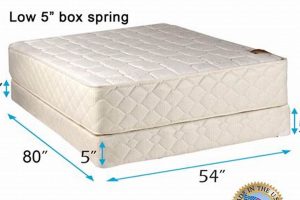
A standard full mattress, frequently referred to as a double mattress, offers specific dimensions suitable for accommodating one or two individuals. The standardized width is typically 54 inches, and the standardized length is 75 inches. These measurements are considered industry norms and serve as a basis for compatible bedding and bedroom furniture. Variations may occur due to manufacturing tolerances, but the nominal values remain constant.
The selection of a mattress with appropriate dimensions is crucial for maximizing sleeping comfort and optimizing bedroom space. The standardization allows manufacturers to provide correctly fitting accessories like sheets, mattress protectors, and bed frames. Historically, the “full” size represented a step up from single mattresses, intended to comfortably fit two adults; however, contemporary preferences often favor larger sizes for shared sleeping arrangements.
Understanding the standard size allows for informed decision-making when comparing mattresses, purchasing bedding, and planning room layouts. Further considerations include the overall thickness, materials used, and construction method of the mattress, all of which contribute to the overall sleeping experience.
Tips Regarding Full Mattress Dimensions
The following recommendations provide practical guidance on understanding and utilizing the dimensions of a standard full mattress.
Tip 1: Measure Bedroom Space Accurately: Before purchasing, precisely measure the available space in the bedroom. Account for surrounding furniture and ensure adequate room for movement around the bed.
Tip 2: Confirm Bed Frame Compatibility: Verify the bed frame’s internal dimensions. Frames designed for full mattresses must align with the 54-inch by 75-inch standard to avoid gaps or instability.
Tip 3: Check Bedding Size Charts: When purchasing sheets, comforters, or mattress protectors, consult the manufacturer’s sizing chart to guarantee compatibility with the stated dimensions.
Tip 4: Consider Sleeper Height: Individuals taller than average should assess whether the 75-inch length provides sufficient legroom. Alternative longer mattress sizes might be more appropriate.
Tip 5: Evaluate Weight Capacity: Full mattresses possess specific weight limits. Exceeding these limits can compromise the mattress’s structural integrity and longevity.
Tip 6: Examine Mattress Depth: The thickness of the mattress, while not directly influencing the standard width and length, affects the overall bed height and the fit of fitted sheets.
Tip 7: Account for Foundation Type: The type of foundation, such as a box spring or platform, will impact the overall height of the bed. Ensure that the resulting height is comfortable and ergonomically sound.
Adhering to these considerations ensures a functional and comfortable sleep environment that maximizes the utility of a standard full mattress.
These tips facilitate informed purchase decisions, contributing to long-term satisfaction.
1. Width

The dimension of fifty-four inches specifying the width of a full mattress is a critical element defining its classification and usage. This standardized measurement directly addresses the question of “what are the measurements for a full size mattress,” establishing a key parameter for compatibility and appropriateness.
- Occupancy and Comfort
The 54-inch width dictates the mattress’s suitability for accommodating one or two sleepers. While adequate for a single adult, it may represent a confined space for two, influencing comfort levels during sleep. Its role is crucial when evaluating personal space requirements.
- Bed Frame Compatibility
A 54-inch width necessitates a correspondingly sized bed frame. Deviations from this standard can result in improper mattress support, potential damage, and compromised structural integrity. Confirming bed frame compliance is essential.
- Bedding Availability
Standardized bedding, such as sheets, comforters, and mattress protectors, is manufactured to accommodate the 54-inch width. This dimension ensures proper fit and prevents issues such as excessive bunching or inadequate coverage. Availability of suitable bedding is directly linked to this standardized measurement.
- Bedroom Space Considerations
The 54-inch width contributes to the overall footprint of the mattress within the bedroom. Consideration of this dimension is crucial for space planning and ensuring adequate room for movement. It influences the practical arrangement and usability of the room.
The 54-inch width, therefore, functions as a foundational aspect in characterizing a full mattress, dictating its practical applications and ensuring compatibility across various related elements. Understanding its significance provides clarity regarding “what are the measurements for a full size mattress,” promoting informed decision-making and optimal utilization.
2. Length

The 75-inch length represents a fundamental dimension defining a full mattress and directly addresses the query “what are the measurements for a full size mattress.” This measurement significantly impacts the suitability of the mattress for individuals of varying heights and dictates the overall sleeping experience.
- Sleeper Accommodation
The 75-inch length determines the maximum height of an individual who can comfortably occupy the mattress. Individuals exceeding this height may experience discomfort due to restricted legroom or feet extending beyond the mattress edge. This measurement directly affects the sleeper’s ergonomic positioning.
- Bed Frame Constraints
A bed frame designed for a full mattress must accommodate the 75-inch length precisely. Discrepancies between the mattress and frame dimensions can lead to instability, uneven weight distribution, and premature wear of both the mattress and frame. Accurate frame compatibility is crucial.
- Sheet Fit and Coverage
Fitted sheets intended for a full mattress are manufactured to conform to the 75-inch length. Inaccurate dimensions can result in either insufficient coverage, exposing the mattress, or excessive fabric bunching, creating discomfort and aesthetic issues. Proper sheet fit is dependent on this standardized length.
- Spatial Optimization
The 75-inch length contributes significantly to the mattress’s overall footprint within a room. When planning room layout, consideration of this dimension is crucial to ensure adequate space for movement and to prevent overcrowding. Effective spatial utilization necessitates awareness of this length parameter.
These considerations underscore the significance of the 75-inch length in relation to “what are the measurements for a full size mattress.” This standardized measurement influences user comfort, structural integrity, bedding compatibility, and spatial planning, highlighting its practical importance in mattress selection and usage.
3. Area

The specification of forty-one square feet representing the area of a full mattress directly correlates with its dimensions and subsequently informs the understanding of “what are the measurements for a full size mattress.” This area is derived from multiplying the width (54 inches, or 4.5 feet) by the length (75 inches, or 6.25 feet) of the mattress. Thus, the area is not an independent characteristic but a computed value contingent on the established dimensions. An inaccurate area calculation would indicate a deviation from the standard width and length, thereby invalidating the classification of the mattress as a standard full size. For example, a mattress with dimensions resulting in an area significantly different from forty-one square feet would likely not fit standard full-size bed frames or accommodate standard full-size bedding, leading to practical inconveniences.
The area provides a concise metric for comparing the overall sleeping surface of different mattress sizes. For instance, contrasting the area of a full mattress with that of a queen mattress (approximately 46.7 square feet) highlights the difference in available space. This information can be useful in making purchasing decisions based on individual spatial requirements and bedroom dimensions. Moreover, area calculations are crucial in manufacturing quality control. Mattress manufacturers utilize area measurements to ensure dimensional accuracy, preventing discrepancies that could affect product usability and customer satisfaction. Variations from the standardized area might suggest manufacturing defects or inconsistencies in material usage.
In summary, the designated area of forty-one square feet serves as a derived confirmation of the width and length, components of “what are the measurements for a full size mattress.” This figure is crucial for assessing size comparisons, ensuring bed frame and bedding compatibility, and maintaining manufacturing standards. Deviations from this area should prompt further investigation into the dimensional accuracy of the mattress.
4. Depth (varies)
While the length and width dimensions of a full mattress are standardized, the depth, or thickness, is variable. This variability introduces considerations critical to fully understanding “what are the measurements for a full size mattress.” The depth does not define the mattress size classification but influences its overall profile and interaction with related components. For example, a full mattress may have a depth ranging from 8 inches to 14 inches or more, depending on its construction and materials. Deeper mattresses often incorporate multiple layers of foam or padding for increased comfort, while thinner mattresses may prioritize support and cost-effectiveness. The depth impacts the overall height of the bed when placed on a foundation, which in turn affects the ease of getting in and out of bed. A mattress that is too deep, combined with a high foundation, may result in an uncomfortably elevated sleep surface.
The mattress depth also affects the selection of appropriate bedding. Standard fitted sheets are typically designed to accommodate a specific range of mattress depths. If the mattress is significantly deeper than the sheet’s pocket depth, the sheet may not fit securely, leading to slippage and discomfort. Conversely, sheets with excessively deep pockets may bunch or wrinkle on a thinner mattress. Retailers often specify the pocket depth of fitted sheets to assist consumers in making informed purchasing decisions. In addition to fitted sheets, mattress protectors and toppers must also be selected with appropriate depth dimensions to ensure a snug and functional fit.
In summary, while the width and length define the footprint of a full mattress, the depth, although variable, significantly impacts the overall user experience. Understanding the range of possible depths and its implications for bed height, bedding compatibility, and personal comfort is essential for comprehensively understanding “what are the measurements for a full size mattress.” Consumers should consider the depth dimension alongside length and width to ensure a harmonious and functional sleep setup.
5. Weight (varies)

The weight of a full-size mattress, while variable, is indirectly connected to its standard dimensions. While the phrase “what are the measurements for a full size mattress” primarily refers to length and width, the internal composition dictating weight is a critical consideration. A denser mattress, constructed with heavy materials like high-density memory foam or innerspring coils, will inherently weigh more than a mattress utilizing lighter materials. Therefore, the dimensions establish the boundaries within which these weight-contributing materials are contained, influencing the overall mass of the product. This weight variation, while not a direct measurement, impacts logistical considerations, such as transportation, installation, and the support requirements of the bed frame. For example, a lighter full-size mattress may be manageable for a single individual to move, while a heavier model may necessitate two or more persons or specialized equipment.
The support capabilities of the bed frame are directly affected by the mattress weight. A frame designed for lighter mattresses may be structurally inadequate for a heavier full-size mattress, potentially leading to damage or collapse. This is especially pertinent for platform beds or those with slat systems. Retailers often specify maximum weight capacities for bed frames, highlighting the importance of matching the frame’s structural integrity to the mattress weight. Furthermore, the internal construction of the mattress, influencing its weight, also contributes to its performance characteristics. Heavier mattresses tend to offer enhanced support and durability, while lighter options may prioritize affordability or ease of handling. Understanding the weight variations within the full-size mattress category allows consumers to make informed decisions aligned with their individual needs and physical capabilities.
In summary, while “weight (varies)” is not a direct dimensional component of “what are the measurements for a full size mattress,” it is inextricably linked through the internal materials and construction constrained by the standard dimensions. This weight variance impacts transportation, installation, bed frame selection, and overall performance. Therefore, consumers should consider the weight, along with the length, width, and depth, to comprehensively evaluate a full-size mattress’s suitability for their specific circumstances. Addressing the variable weight contributes to a more holistic understanding of mattress characteristics, ensuring a functional and satisfactory sleep environment.
Frequently Asked Questions
This section addresses common inquiries regarding the dimensions of a standard full mattress, providing clarification and technical details. This information is crucial for consumers seeking to purchase or utilize mattresses effectively.
Question 1: Is there a standardized measurement for “what are the measurements for a full size mattress?”
The standard dimensions for a full mattress are 54 inches in width and 75 inches in length. These dimensions are generally consistent across manufacturers, although minor variations may occur due to manufacturing tolerances.
Question 2: Are there alternative terms used to describe a full mattress?
A full mattress is often referred to as a double mattress. Both terms denote the same standard size of 54 inches by 75 inches.
Question 3: Does the depth of a mattress influence “what are the measurements for a full size mattress?”
While depth, or thickness, is a measurement of the mattress, it does not alter the core width and length dimensions of 54 inches and 75 inches. Depth is a separate characteristic that affects overall bed height and the fit of bedding accessories.
Question 4: How do the dimensions of a full mattress compare to those of a twin mattress?
A twin mattress is smaller than a full mattress, typically measuring 38 inches in width and 75 inches in length. The primary difference is the reduced width, making a full mattress more suitable for single adults seeking additional sleeping space.
Question 5: Should the stated dimensions of a full mattress be verified prior to purchase?
It is advisable to verify the dimensions with the manufacturer or retailer, particularly when purchasing online. While standard dimensions exist, slight variations may occur, and accurate measurements ensure compatibility with bed frames and bedding.
Question 6: How does the weight of a full mattress relate to its stated dimensions?
The weight of a full mattress is influenced by its internal composition and materials, not directly by its standard width and length dimensions. Denser materials contribute to a heavier mattress, while lighter materials result in a lower weight. Weight is an independent factor impacting transportation and bed frame support requirements.
These responses address common questions, offering practical insights into understanding and verifying the dimensions of a standard full mattress.
The subsequent section offers best practice regarding mattress care.
Dimensions of a Full Mattress
This exploration of “what are the measurements for a full size mattress” clarifies that the standard dimensions are fixed at 54 inches in width and 75 inches in length. These established measurements serve as essential parameters, dictating bed frame compatibility, bedding selection, and overall suitability for intended occupants. Any deviation from these standards necessitates careful evaluation to ensure a functional and comfortable sleep environment.
Accurate understanding of these dimensions empowers informed decision-making in mattress selection and facilitates proper planning of bedroom space. Recognizing the implications of these measurements is critical for achieving optimal sleep and ensuring long-term satisfaction with the purchased product. Prioritizing dimensional accuracy safeguards against incompatibility issues and promotes a well-integrated and comfortable sleeping space.



![Best Tri Fold Full Mattress [Deals!] Sleep Solution | Organic & Natural Mattress Buyer’s Guide: Non-Toxic Sleep Solutions](https://mattressworldpa.com/wp-content/uploads/2025/07/th-2881-300x200.jpg "Best Tri Fold Full Mattress [Deals!] Sleep Solution Organic & Natural Mattress Buyer’s Guide: Non-Toxic Sleep Solutions")