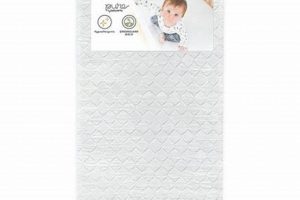
The dimensions of a typical infant bed mattress are designed to ensure a snug and safe fit within the crib frame. This specified measurement is intended to minimize the risk of entrapment or gaps between the mattress and crib sides. A mattress intended for use in a standard-sized crib generally measures approximately 28 inches in width and 52 inches in length.
Adherence to prescribed measurements is vital for infant safety. Historically, variations in crib and mattress dimensions led to hazardous situations. Standardization aims to mitigate these risks, providing parents with confidence in the product’s safety and suitability for their child. This uniformity also simplifies the process of purchasing fitted sheets and other bedding accessories.
Understanding the dimensional requirements for a baby’s sleep environment forms the foundation for selecting appropriate bedding and establishing a secure sleep space. Further considerations, such as mattress firmness and material composition, are also important factors in promoting a safe and comfortable sleep environment for infants.
Guidance Regarding Crib Mattress Dimensions
Selecting the correct mattress dimensions for an infant’s crib is crucial for ensuring safety and preventing potential hazards.
Tip 1: Verify Internal Crib Dimensions. Before purchasing a mattress, precisely measure the interior dimensions of the crib. Compare these measurements against the stated dimensions to confirm a proper fit.
Tip 2: Adhere to Regulatory Standards. Ensure that the chosen mattress complies with relevant safety standards and certifications established by regulatory bodies. This verification confirms that the product has undergone testing and meets minimum safety requirements.
Tip 3: Minimize Gaps. After placing the mattress in the crib, meticulously check for gaps between the mattress edges and the crib frame. Any gap exceeding two fingers’ width presents a potential entrapment hazard and necessitates the selection of a mattress with more appropriate dimensions.
Tip 4: Assess Mattress Firmness. Select a mattress that provides adequate firmness. A firmer mattress reduces the risk of suffocation compared to softer alternatives. The mattress should retain its shape and not conform excessively to the infant’s body.
Tip 5: Consider Mattress Weight and Handling. Evaluate the mattress weight to ensure ease of handling during sheet changes and cleaning. A lighter mattress simplifies these tasks while still providing adequate support.
Tip 6: Regularly Inspect the Mattress. Routinely examine the mattress for signs of wear and tear, such as tears, sagging, or indentations. Replace the mattress if any significant damage is detected.
Tip 7: Utilize Fitted Sheets Properly. Always use fitted sheets that are specifically designed for crib mattresses. Ensure a snug fit to prevent the sheet from becoming loose and posing a suffocation risk.
Adhering to these recommendations promotes a safer sleep environment for infants and minimizes the potential for accidents or injuries. Prioritizing correct measurements, firmness, and regular inspection contributes to responsible infant care.
These guidelines offer essential knowledge for parents and caregivers seeking to establish a safe and secure sleep space for their child. Subsequent sections will address the importance of choosing appropriate mattress materials and understanding long-term mattress maintenance.
1. Width dimension

The width dimension of an infant’s sleep surface is a critical parameter in the context of crib mattress dimensions. It significantly influences the safety and functionality of the sleep environment.
- Lateral Support and Stability
The width dictates the lateral space available to the infant while sleeping. An appropriately sized width provides sufficient room for movement while preventing the child from becoming wedged against the crib sides. A mattress that is too narrow can create hazardous gaps. For example, the prescribed width ensures adequate stability for the infant as they transition between sleep positions, minimizing the risk of rolling into a potentially unsafe area of the crib.
- Compatibility with Crib Structure
The width must be precisely matched to the interior width of the crib frame. This compatibility is vital to preventing large gaps between the mattress and crib sides, where an infant could become trapped. Regulatory standards exist to ensure that this width meets specified minimum dimensions to mitigate this risk. The appropriate width guarantees the mattress is securely housed within the crib structure, contributing to a stable and secure sleeping environment.
- Ergonomic Considerations for Caregivers
The width also influences caregiver ergonomics when placing the infant into or lifting them out of the crib. A width that is too excessive may require awkward or strained movements from caregivers, potentially increasing the risk of injury. A standard width, however, provides a manageable space for caregivers to interact with the infant without undue physical strain.
- Material Distribution and Support
The width of the mattress dictates how materials are distributed across the sleep surface, impacting the level of support provided. A width that is not properly calibrated may result in uneven weight distribution, potentially leading to discomfort or pressure points for the infant. A mattress that adheres to standard width specifications ensures consistent support across the entire sleep surface.
In conclusion, the width dimension of a crib mattress plays a central role in ensuring infant safety, compatibility with the crib structure, caregiver ergonomics, and optimal material distribution. These considerations underscore the importance of adhering to established standards for crib mattress width in order to create a secure and supportive sleep environment for infants. Its proper implementation mitigates potential hazards and contributes to responsible infant care practices.
2. Length dimension
The length dimension constitutes an integral component of a standard crib mattress size, directly impacting infant safety and comfort within the confines of a crib. The established length dimension, typically around 52 inches, serves to prevent potential hazards associated with excessive movement within the crib. A mattress significantly shorter than this prescribed length introduces gaps between the mattress end and the crib structure, posing a risk of infant entrapment. Conversely, a mattress exceeding the specified length may not fit properly within the crib, leading to bending or warping of the mattress, compromising its structural integrity, and creating an uneven sleep surface. As an example, if a mattress length is just two inches short of the standard dimension, an infant could potentially roll into the resulting gap, increasing the risk of suffocation or other injury. Understanding the length dimensions role within standard crib mattress dimensions is crucial for selecting a mattress that provides a safe and secure environment for the developing infant.
Practical applications of this understanding extend beyond mere product selection. Caregivers can employ this knowledge to routinely assess the fit of the mattress within the crib, ensuring that no significant gaps have developed over time due to mattress compression or crib wear. Moreover, awareness of the standardized length dimension facilitates informed decision-making when choosing compatible bedding, such as fitted sheets, that are designed to conform precisely to the mattress dimensions. For example, when selecting fitted sheets, if the sheet’s dimensions deviate greatly from a standard length and width, it may be too tight or too loose, creating a potential hazard. Manufacturers are often required to adhere to safety regulations specifying acceptable tolerances for mattress dimensions. These regulations serve to minimize dimensional inconsistencies and safeguard infant well-being.
In summary, the length dimension is a non-negotiable element of a standard crib mattress size. It contributes significantly to infant safety by minimizing entrapment risks and ensuring a stable, uniform sleep surface. Challenges related to dimensional accuracy can be mitigated through adherence to regulatory standards and conscientious product selection. Understanding the connection between length dimension and overall crib mattress size ultimately translates into a more secure and developmentally supportive environment for the infant, promoting healthier sleep patterns and reducing the likelihood of adverse incidents. The safety benefits underscore the importance of precise measurements in infant bedding.
3. Thickness consideration

Mattress thickness is a key element within the broader context of standard crib mattress dimensions. Its influence extends to both safety and functionality, particularly in relation to crib rail height and overall stability. A mattress that is too thick may reduce the effective height of the crib rails, potentially allowing a child to climb out. Conversely, a mattress that is too thin may compromise support and comfort, impacting sleep quality. The prescribed mattress thickness aims to strike a balance between these competing factors. For example, standard crib mattresses typically fall within a thickness range of 5 to 6 inches, a range designed to comply with safety regulations pertaining to crib rail height. This standard thickness helps to ensure that the crib rails extend sufficiently above the mattress surface to prevent accidental falls.
Practical applications of the understanding of thickness considerations are varied. Before purchasing a mattress, the distance between the top of the mattress and the top of the crib rail when the mattress is in its lowest position should be measured. This measurement ensures that the rail height meets minimum safety standards. Caregivers can also use this knowledge to identify signs of mattress compression or degradation. If the mattress thickness diminishes significantly over time, the effective rail height may be reduced, necessitating a mattress replacement. When combined with other factors, this knowledge becomes an important part of infant safety. For instance, if an infant is showing signs of being able to climb, the mattress thickness should be re-evaluated in combination with observation.
In summary, mattress thickness is a critical dimension within the scope of what constitutes a standard crib mattress. It contributes to infant safety by maintaining adequate crib rail height and ensuring sufficient support. Challenges related to mattress thickness can be mitigated through adherence to regulatory standards and consistent monitoring of mattress condition. Understanding the connection between thickness and overall crib mattress dimensions is important for caregivers seeking to establish a secure and comfortable sleep environment. Proper consideration to the height is an essential safety consideration.
4. Corner radius

The corner radius, while often overlooked, represents a pertinent aspect of crib mattress design, directly influencing the overall fit and safety within a standard-sized crib. Its conformity to established standards is crucial for minimizing potential hazards associated with gaps between the mattress and crib frame.
- Minimizing Gap Formation
The corner radius dictates the curvature of the mattress corners. A corner radius that deviates significantly from the crib’s internal corner curvature can create gaps, increasing the risk of infant entrapment. A properly sized corner radius ensures a snug fit against the crib’s corners, effectively mitigating this risk. For example, a sharply angled mattress corner in a crib designed for rounded corners could leave a substantial gap, posing a safety hazard. Conversely, an excessively rounded corner may prevent the mattress from fully occupying the crib’s corner space.
- Compatibility with Fitted Sheets
The mattress corner radius also influences the fit and function of fitted sheets. Fitted sheets are typically designed to accommodate a specific range of corner radii. If the mattress corner radius is incompatible with the sheet’s design, the sheet may fit poorly, potentially becoming loose and posing a suffocation risk. The degree of curvature in the corner of the mattress must be compatible to the way in which a sheet may fit. A fitted sheet that is too tight may also put undue stress on mattress materials, potentially shortening its lifespan.
- Manufacturing Precision and Tolerances
Maintaining consistent corner radii across mattress production requires precise manufacturing processes. Tolerances in corner radius dimensions must be tightly controlled to ensure uniformity and compliance with safety standards. Variations in corner radius can lead to inconsistencies in fit and increase the likelihood of gap formation. Consistent dimension promotes overall quality in the end product.
- Impact on Overall Mattress Dimensions
The corner radius, in conjunction with the mattress length and width, collectively determines the overall footprint of the sleep surface within the crib. An improperly sized corner radius can effectively alter the usable sleep surface area. Even a small variance in corner radius can influence the overall comfort and safety. This impact emphasizes the importance of adhering to established standards for all mattress dimensions, including corner radius.
In conclusion, the corner radius is an essential, albeit often subtle, element of a standard crib mattress size. Its correct implementation minimizes gap formation, ensures compatibility with fitted sheets, and contributes to overall mattress uniformity and safety. Awareness of this dimension reinforces the importance of precise measurements and adherence to established standards in crib mattress design and manufacturing.
5. Weight Capacity

Weight capacity, while not a direct dimensional attribute of a standard crib mattress, is a crucial performance parameter intricately linked to its overall size and construction. It dictates the mattress’s ability to provide adequate support and maintain its structural integrity over time, thereby influencing infant safety and comfort.
- Support and Sagging Prevention
Weight capacity is directly related to the materials and construction techniques employed in manufacturing the mattress. A higher weight capacity indicates a more robust internal structure, better able to resist sagging or deformation under the weight of the infant. For example, a mattress with a low weight capacity may develop indentations or lose its firmness prematurely, compromising its support and potentially creating an uneven sleeping surface, which could be hazardous. This characteristic impacts longevity and safety.
- Material Durability and Longevity
The weight capacity rating provides an indication of the durability of the materials used in the mattress. Mattresses designed to support higher weights typically utilize denser foams, stronger coil systems, or more resilient fiber fillings. These materials are better equipped to withstand prolonged use and maintain their structural integrity over extended periods. For instance, a mattress constructed with high-density foam and reinforced edges will generally exhibit a higher weight capacity and longer lifespan than one made with lower-quality materials. This affects the cost-effectiveness in the long term.
- Compliance with Safety Standards
Many safety standards for crib mattresses incorporate weight capacity requirements. Manufacturers are often obligated to test their mattresses to ensure they can safely support a specified weight without compromising their structural integrity or posing a safety hazard. These standards are in place to protect infants from potential risks associated with mattress failure. As an illustration, regulatory bodies often stipulate minimum weight capacity thresholds that mattresses must meet to be deemed safe for infant use, and must be appropriately labeled for the consumer.
- Influence on Crib Compatibility
While a standard crib mattress size is intended to fit within a standard crib frame, the weight capacity can indirectly influence crib compatibility. An excessively heavy mattress, designed for a very high weight capacity, may place undue stress on the crib frame, particularly if the frame is not designed to support such weight. Therefore, it is important to consider the weight of the mattress in conjunction with the crib’s weight capacity specifications. A mattress with a weight capacity that is appropriate for the anticipated use, and compatible with the crib frame, contributes to a safer sleep environment.
The weight capacity is a significant factor that, while not a physical dimension, is inextricably linked to standard crib mattress dimensions. It reflects the quality of materials, the robustness of construction, and the overall suitability of the mattress for infant use. Consideration of weight capacity, alongside standard dimensional parameters, contributes to informed purchasing decisions and promotes a safe and comfortable sleep environment for infants. It should be considered when making a purchase.
6. Regulatory Compliance

Adherence to regulatory standards constitutes a cornerstone in ensuring the safety and suitability of crib mattresses. Governing bodies establish specific criteria to mitigate risks associated with infant sleep environments. Compliance with these regulations is essential for manufacturers and provides assurance to consumers regarding product safety.
- Mandatory Dimensional Requirements
Regulatory standards often stipulate precise dimensional tolerances for crib mattresses. These requirements aim to minimize gaps between the mattress and the crib frame, thereby preventing infant entrapment. For example, regulations may specify the acceptable range for mattress length and width, typically around 28 inches by 52 inches, with allowable deviations measured in fractions of an inch. Non-compliance can result in product recalls and legal repercussions.
- Flammability Standards
Regulations pertaining to flammability are critical for mitigating fire hazards associated with crib mattresses. These standards typically mandate that mattresses meet certain flame resistance criteria, often involving exposure to open flame tests. For instance, mattresses may be required to withstand a specified duration of exposure to a small open flame without igniting or propagating the flame. Meeting these standards reduces the risk of fire-related injuries to infants.
- Chemical Emission Limits
Regulatory bodies often impose limits on the permissible levels of volatile organic compounds (VOCs) and other potentially harmful chemicals emitted by crib mattresses. These limits aim to protect infants from exposure to substances that may pose health risks, such as respiratory irritation or allergic reactions. An example is the limitation of formaldehyde emissions to a specific threshold, measured in parts per million. Compliance ensures a healthier indoor air quality in the infant’s sleep environment.
- Labeling and Certification Requirements
Regulations typically mandate specific labeling requirements for crib mattresses, including information about materials used, compliance with safety standards, and manufacturer contact information. Certifications from independent testing organizations provide further assurance of product safety and adherence to regulatory criteria. An example is the inclusion of a certification mark indicating that the mattress meets the standards set by a recognized certification body. These labels serve as a verifiable marker of compliance and consumer confidence.
These multifaceted regulatory requirements collectively reinforce the importance of adhering to standardized dimensions and safety protocols in the manufacturing of crib mattresses. Compliance not only protects infants from potential hazards but also fosters consumer trust and confidence in the safety of these products. Meeting regulatory standards is a fundamental aspect of responsible manufacturing and a critical component of ensuring infant well-being.
Frequently Asked Questions
This section addresses common queries regarding standard crib mattress dimensions, providing essential information for ensuring infant safety and proper product selection.
Question 1: Why are precise crib mattress dimensions crucial?
Precise dimensions minimize gaps between the mattress and the crib frame. Gaps pose a significant entrapment hazard for infants, potentially leading to suffocation or injury. Standardized dimensions mitigate this risk.
Question 2: What are the generally accepted dimensions for a standard crib mattress?
A standard crib mattress typically measures approximately 28 inches in width and 52 inches in length. Deviations from these dimensions may compromise safety.
Question 3: Is mattress thickness a critical dimension?
Yes, mattress thickness is an essential factor. It must be considered in relation to the crib rail height to prevent the infant from climbing out. Regulatory standards often specify acceptable thickness ranges.
Question 4: What role does mattress corner radius play?
The corner radius influences how snugly the mattress fits within the crib corners. A properly sized radius minimizes gap formation and ensures compatibility with fitted sheets.
Question 5: Does mattress weight capacity relate to the dimensions?
While not a direct dimensional attribute, weight capacity indicates the mattress’s ability to maintain its structural integrity under load. It reflects the quality of materials and construction and impacts the mattress’s longevity and safety.
Question 6: How does regulatory compliance affect mattress dimensions?
Regulatory standards often mandate specific dimensional tolerances for crib mattresses. Compliance ensures that mattresses meet minimum safety requirements and reduces the risk of hazardous conditions.
Understanding these key aspects of standard crib mattress dimensions is vital for responsible infant care and promoting a secure sleep environment.
The subsequent section will delve into the importance of selecting appropriate mattress materials and construction methods for optimal infant health and safety.
The Significance of Standardized Crib Mattress Dimensions
This discussion has underscored the importance of adhering to established measurements when selecting a crib mattress. These dimensions, encompassing width, length, thickness, and corner radius, are not arbitrary; they are directly linked to infant safety and well-being. Maintaining dimensional accuracy minimizes the risk of entrapment, suffocation, and other hazards associated with improperly fitted mattresses.
The commitment to upholding standards remains paramount. Vigilance in product selection and adherence to safety regulations are essential for fostering a secure sleep environment for infants. The dimensions are a critical factor that necessitates careful consideration to promote infant safety.

![Best Organic Crib Mattress Protector [Safe Sleep] | Organic & Natural Mattress Buyer’s Guide: Non-Toxic Sleep Solutions](https://mattressworldpa.com/wp-content/uploads/2025/07/th-1363-300x200.jpg "Best Organic Crib Mattress Protector [Safe Sleep] Organic & Natural Mattress Buyer’s Guide: Non-Toxic Sleep Solutions")