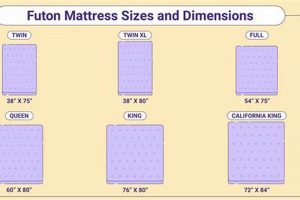
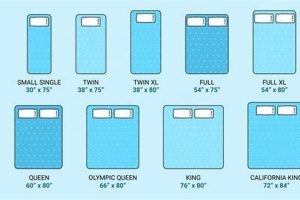
The standard measurements of a double bed, often referred to as a full bed, are typically 54 inches wide and 75 inches long. These dimensions offer a sleeping surface suitable for a single adult or, potentially, two smaller individuals. Understanding these measurements is crucial for selecting appropriate bedding, ensuring a comfortable fit for sheets, comforters, and other accessories.
The popularity of this bed size stems from its balance between space efficiency and sleeping area. It provides more width than a twin bed, making it a comfortable choice for individuals who prefer more room to stretch out. Historically, the double bed became a standard offering as homes grew larger, allowing for bedrooms that could accommodate more spacious sleeping arrangements. Its benefits include accommodating single sleepers who desire extra space and offering a cost-effective option compared to larger sizes like queen or king.
Therefore, when planning a bedroom layout or purchasing a new bed, knowing the specific measurements is essential for informed decision-making. This allows for accurate planning of the room’s furniture arrangement and ensures that the chosen bed fits comfortably within the available space, promoting both functionality and aesthetic appeal.
Tips Regarding Full-Size Mattress Dimensions
The following tips provide guidance when considering a full-size mattress, ensuring accurate space planning and optimized comfort.
Tip 1: Measure the Bedroom Space Accurately: Before purchasing, measure the bedroom to ensure adequate space. Consider leaving at least two feet of clearance around the bed for comfortable movement.
Tip 2: Account for Bed Frame Dimensions: Remember that the bed frame will add to the overall footprint. Factor this extra dimension into your space calculations.
Tip 3: Consider the Sleeper’s Height: For individuals taller than 5’9″, the 75-inch length may feel constricting. Evaluate whether a longer mattress, such as a queen, would be more suitable.
Tip 4: Evaluate Weight Capacity: Confirm the mattress’s weight capacity, especially if it will be used by more than one person. Exceeding the weight limit can compromise its integrity and longevity.
Tip 5: Check Doorway and Stairwell Widths: Ensure that the mattress can physically fit through doorways and up stairwells during delivery. Consider the dimensions when maneuvering the mattress into the room.
Tip 6: Account for Bedding Thickness: Be aware of how tall of a mattress you plan to have when purchasing bed sheets. Sheets must have appropriate depth to fit snugly.
Adhering to these tips will facilitate a smoother purchase and ensure the mattress fits appropriately within the intended space, maximizing comfort and functionality.
Careful consideration of these factors enables a more informed decision-making process when choosing this size mattress.
1. Standard width

The measurement of 54 inches defines the width of a standard full-size mattress, representing a key dimension that dictates its suitability for various sleeping arrangements and bedroom sizes. This width directly influences the comfort level for a single sleeper and the feasibility of accommodating two individuals.
- Impact on Single Sleeper Comfort
The 54-inch width offers a single sleeper ample room to move and change positions throughout the night without feeling constrained. This is particularly beneficial for individuals who are accustomed to spreading out while sleeping. A narrower mattress might lead to feelings of restriction, potentially disrupting sleep quality.
- Suitability for Two Sleepers
While a full-size mattress can accommodate two adults, the 54-inch width translates to only 27 inches per person, which is less than a twin-size bed offers per sleeper. This can result in a cramped sleeping arrangement, potentially leading to discomfort and disrupted sleep for both individuals. Considerations should be made for personal space preferences.
- Bedroom Space Considerations
The 54-inch width plays a critical role in determining the bed’s footprint within a room. In smaller bedrooms, a full-size mattress might occupy a significant portion of the available space, limiting the placement of other furniture and potentially creating a feeling of confinement. Careful measurement and space planning are essential.
- Bed Frame and Bedding Compatibility
Knowing the standard width is essential for selecting a compatible bed frame and appropriately sized bedding. Purchasing a frame that is not designed for a 54-inch mattress can lead to instability and premature wear. Similarly, properly sized sheets and blankets are necessary for a comfortable and aesthetically pleasing sleeping environment.
In summary, the standard 54-inch width of a full-size mattress is a pivotal measurement that affects comfort, space utilization, and compatibility with bed frames and bedding. Its implications should be carefully evaluated based on individual sleeping preferences, bedroom dimensions, and the number of occupants to ensure a satisfactory sleeping experience.
2. Standard length

The 75-inch length constitutes a critical component when defining the full dimensions. This measurement dictates the mattress’s suitability for accommodating individuals of varying heights. The length, coupled with the width, determines the overall surface area and influences comfort and space utilization within a bedroom. A mismatch between a sleeper’s height and the mattress length can lead to discomfort, as legs may extend beyond the mattress edge. For instance, individuals taller than 5’9″ (69 inches) might find this length restrictive, potentially disrupting sleep quality.
The standard length also dictates compatibility with bed frames designed for this size. A frame intended for a longer mattress, such as a queen, will not properly support the full-size mattress, potentially causing instability and accelerated wear. Conversely, attempting to fit a longer mattress into a 75-inch frame is not feasible. Therefore, accurate knowledge of this dimension is paramount when selecting both the mattress and its corresponding frame. The 75-inch measurement is also a consideration during transportation and delivery, influencing the maneuverability of the mattress through doorways and stairwells.
In summary, the 75-inch standard length represents a crucial element in determining the overall usability and comfort of a full-size mattress. Its relationship to sleeper height, frame compatibility, and logistical considerations during delivery underscores its importance in the purchasing and setup process. Overlooking this dimension can lead to issues ranging from discomfort to physical incompatibility, highlighting the need for precise measurement and informed decision-making.
3. Surface area calculation

The surface area calculation of a full-size mattress directly relates to its dimensions, influencing its suitability for various sleeping arrangements and room sizes. Determining this area provides a quantifiable measure of the usable sleeping space.
- Calculation Methodology
Surface area is calculated by multiplying the width and length of the mattress. For a full-size mattress, this equates to 54 inches (width) multiplied by 75 inches (length), resulting in a total surface area of 4,050 square inches. This calculation provides a clear metric for comparing different mattress sizes.
- Impact on Occupancy
The calculated surface area influences the comfort level of single or multiple occupants. A larger surface area provides more room for movement and reduces the feeling of confinement, promoting better sleep quality. Conversely, a smaller surface area may lead to discomfort, especially for restless sleepers or couples.
- Space Planning Implications
Knowing the surface area allows for accurate space planning within a bedroom. The total area occupied by the mattress, when combined with bed frame dimensions, determines the remaining usable floor space. This is crucial for determining furniture placement and ensuring adequate room for movement.
- Comparison to Other Sizes
Calculating the surface area facilitates comparisons with other mattress sizes. For instance, a queen-size mattress has a larger surface area, providing more room for occupants. Comparing surface areas enables informed decisions based on individual space requirements and sleeping preferences.
In summary, the surface area calculation, derived directly from a full-size mattress’s dimensions, is a fundamental metric influencing comfort, space planning, and comparative analysis with other mattress sizes. It provides a quantifiable basis for informed decision-making when selecting a mattress suitable for specific needs and room constraints.
4. Frame compatibility

Frame compatibility is directly contingent upon the measurements of a full-size mattress, ensuring proper support, stability, and preventing premature wear. An understanding of these dimensions is critical when selecting a frame.
- Proper Support
A correctly sized frame supports the mattress evenly, preventing sagging or uneven wear. A frame too small will not adequately bear the mattress’s weight, while one too large may leave gaps, leading to instability. A full-size mattress, being 54 inches wide and 75 inches long, requires a frame designed to precisely accommodate these dimensions.
- Structural Integrity
Incompatibility between the mattress and frame can compromise the structural integrity of both. An ill-fitting frame may place undue stress on specific areas of the mattress, reducing its lifespan. Similarly, the frame itself may be subjected to excessive strain, leading to damage or failure. The 54×75 inch specification must be adhered to maintain structural balance.
- Safety Considerations
An improperly fitted mattress can pose safety hazards. Gaps between the mattress and frame can create pinch points, while instability may lead to the bed collapsing. Accurate frame compatibility minimizes these risks, providing a secure and stable sleeping surface. The established dimensions serve as a benchmark for safe integration.
- Aesthetic Alignment
Beyond functionality, frame compatibility also impacts the aesthetic appeal of the bed. A properly sized frame presents a visually balanced and cohesive appearance. Conversely, an ill-fitting frame can detract from the overall aesthetic, creating a sense of imbalance or disarray. Harmonizing the dimensions is essential for a pleasing visual outcome.
In summary, the dimensional relationship between a full-size mattress and its corresponding frame is paramount for ensuring support, structural integrity, safety, and aesthetic alignment. Deviation from the specified 54×75 inch requirement can lead to a range of issues, underscoring the need for careful consideration and precise matching when selecting a bed frame.
5. Shipping constraints

The dimensions of a full-size mattress, specifically its width of 54 inches and length of 75 inches, directly impose limitations on its transport and delivery. These measurements, along with the mattress’s thickness and weight, dictate whether it can be maneuvered through standard doorways, hallways, and stairwells. Constraints arise when these dimensions exceed the available clearance, necessitating alternative delivery methods or precluding delivery altogether in some circumstances. For example, older homes with narrow doorways or apartment buildings with tight staircases may present significant challenges. Failure to account for these dimensional constraints can result in delivery refusal, necessitating returns and incurring additional costs.
Furthermore, the shipping costs associated with a full-size mattress are often influenced by its dimensions. Larger items typically incur higher shipping fees due to the increased space they occupy within a delivery vehicle and the greater effort required for handling. In densely populated urban areas, additional logistical considerations, such as parking restrictions and building access limitations, can further complicate the delivery process and contribute to increased shipping expenses. Consequently, retailers and consumers must carefully assess these factors to ensure a smooth and cost-effective delivery.
In conclusion, the physical dimensions of a full-size mattress serve as fundamental constraints on its shipping and delivery. These dimensional limitations directly impact logistical planning, transportation methods, and associated costs. Overlooking these constraints can lead to significant complications, emphasizing the need for accurate measurement and careful consideration of accessibility factors before purchase. Accurate awareness and planning are essential for a successful delivery outcome.
Frequently Asked Questions
This section addresses common inquiries regarding the standard measurements of a full-size mattress, providing clear and concise answers to aid in informed decision-making.
Question 1: What are the precise measurements of a full-size mattress?
A full-size mattress typically measures 54 inches in width and 75 inches in length. These dimensions are considered standard within the industry, though slight variations may occur depending on the manufacturer.
Question 2: How do the dimensions of a full-size mattress compare to those of a twin mattress?
A twin mattress is narrower and shorter than a full-size mattress. Twin mattresses generally measure 38 inches wide and 75 inches long, making them significantly smaller in surface area.
Question 3: Is a full-size mattress suitable for two adults?
While a full-size mattress can accommodate two adults, it may feel cramped, as each individual only has 27 inches of width. This is less than the width afforded to a single sleeper on a twin mattress. Consider a queen or king-size mattress for more comfortable accommodation of two adults.
Question 4: What is the optimal room size for a full-size mattress?
The optimal room size depends on individual preferences and additional furniture requirements. However, a minimum room size of 10 feet by 10 feet is generally recommended to allow for comfortable movement around the bed.
Question 5: How do I ensure that a bed frame is compatible with a full-size mattress?
Verify that the bed frame is specifically designed to accommodate a 54-inch by 75-inch mattress. Check the frame’s product specifications or consult with the manufacturer to confirm compatibility before purchase.
Question 6: Are there any variations in the dimensions of full-size mattresses across different manufacturers?
While the 54-inch by 75-inch dimensions are considered standard, minor variations may exist between manufacturers. It is advisable to check the specific measurements of the mattress before purchasing bedding or a bed frame.
These frequently asked questions offer a comprehensive overview of the dimensional aspects of a full-size mattress, enabling consumers to make well-informed decisions tailored to their specific requirements.
This concludes the FAQ section. The following segment delves into comparative analyses of full-size mattresses relative to other standard mattress sizes.
Conclusion
The preceding exploration of the dimensional characteristics of a full-size mattress elucidates several critical factors. Precise measurements, standardized at 54 inches in width and 75 inches in length, are paramount for informed decision-making. These dimensions dictate compatibility with bed frames, influence shipping logistics, and determine the suitability of the mattress for single or dual occupancy, impacting comfort and spatial efficiency. Understanding these dimensions, therefore, is not merely a matter of preference, but a necessary prerequisite for a successful purchase and optimal utilization.
Given the significant impact of these measurements on various aspects of mattress selection and usage, due diligence in verifying these specifications is strongly encouraged. Consideration of these factors will contribute to a more informed and satisfactory outcome, maximizing both value and comfort. A lack of attention to these details can lead to avoidable complications and compromise the overall sleep experience. Therefore, precise assessment and informed selection are essential.