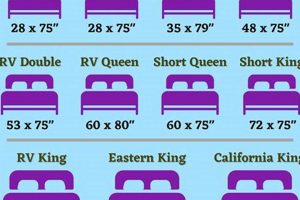
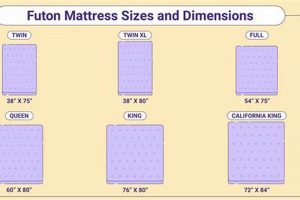
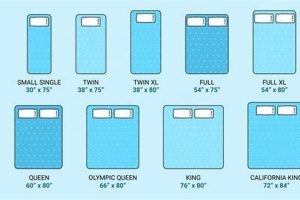
The standard size of an air mattress marketed as “queen” typically measures approximately 60 inches in width and 80 inches in length. The height can vary significantly depending on the model, ranging from around 8 inches for basic models to over 20 inches for more luxurious, elevated options. These measurements provide a general guideline, and slight variations may occur between different manufacturers.
Understanding these measurements is important for several reasons. First, it allows consumers to ensure the air mattress will fit in the intended space, whether it’s a guest room, camping tent, or living room. Second, the dimensions influence the type of bedding needed, such as fitted sheets and mattress protectors. Historically, the adoption of standardized mattress sizes, including queen, has simplified the process of purchasing compatible linens and bedroom furniture.
Considering these factors, the following discussion will delve into the specifics of how these dimensions impact comfort, storage considerations, and the overall suitability of a queen size air mattress for various applications.
Tips Regarding Queen Size Air Mattress Dimensions
When selecting a queen size air mattress, awareness of its dimensions is crucial for optimal usage and satisfaction. The following tips provide guidance for making informed decisions based on these measurements.
Tip 1: Verify Available Space: Prior to purchasing, measure the intended space where the air mattress will be used. Account for the full 60-inch width and 80-inch length, plus a few extra inches for maneuvering around the inflated mattress. This is particularly important in smaller rooms or tents.
Tip 2: Consider Height Preferences: Air mattress height varies significantly. Lower-profile models (8-12 inches) are often easier to get in and out of, while taller models (18+ inches) provide a bed-like experience. Evaluate the physical needs of potential users when selecting a height.
Tip 3: Choose Appropriate Bedding: Standard queen-size sheets are designed to fit a mattress with the aforementioned dimensions. However, deeper pocket sheets may be necessary for taller air mattresses to ensure a secure fit and prevent slipping.
Tip 4: Factor in Storage Considerations: While deflated, an air mattress is significantly smaller. However, the deflated bulk still requires storage space. Consider the deflated size and weight when choosing a model, particularly if storage space is limited.
Tip 5: Account for Perimeter Space: When inflated, air mattresses expand slightly beyond their stated dimensions. Ensure there is adequate space around the mattress to prevent contact with walls or furniture, which could lead to damage or discomfort.
Tip 6: Use Mattress Protectors: Protecting the air mattress with a properly sized protector is advisable. Ensure the protector fits the dimensions snugly to prevent shifting and maintain the mattress’s integrity over time.
Understanding the dimensions of a queen size air mattress allows for better planning, comfort, and overall usability. Careful consideration of these tips ensures a positive experience for both the user and the intended environment.
With these tips in mind, the subsequent sections will cover aspects such as comfort considerations and factors to consider during purchase.
1. Width (approx. 60 inches)

The width of a queen size air mattress, typically around 60 inches, is a primary dimensional aspect defining its suitability for single or double occupancy. It directly impacts user comfort and spatial requirements within a given environment.
- Sleeping Capacity
A 60-inch width generally accommodates two average-sized adults comfortably. While one person has ample space, two individuals may experience a degree of closeness, especially if either is accustomed to a larger sleeping surface. This measurement is a key consideration for couples or those sharing a sleeping space.
- Spatial Footprint
The 60-inch width dictates the amount of floor space the inflated air mattress will occupy. In smaller rooms or tents, this measurement becomes critical for ensuring adequate space for movement and avoiding obstruction of pathways or furniture. Accurate width assessment prevents overcrowding and promotes usability of the surrounding area.
- Bedding Compatibility
Standard queen-size sheets are designed to fit a mattress with a width of approximately 60 inches. Deviation from this measurement, even slightly, can lead to ill-fitting sheets that slip off or are difficult to secure. Maintaining dimensional adherence simplifies bedding selection and ensures a neat and comfortable sleeping surface.
- Weight Distribution
While not directly a dimensional attribute, the 60-inch width influences weight distribution across the air mattress. A wider mattress may distribute weight more evenly than a narrower one, potentially enhancing comfort and reducing localized pressure points. This becomes particularly relevant when two individuals are using the mattress simultaneously.
In summary, the 60-inch width is a fundamental aspect in determining the practicality and comfort of a queen size air mattress. Its relationship to sleeping capacity, spatial considerations, bedding compatibility, and weight distribution makes it a crucial specification to consider before purchase.
2. Length (approx. 80 inches)
The length of a queen size air mattress, standardized at approximately 80 inches, plays a critical role in accommodating users of varying heights and directly influences overall sleep comfort. Its adherence to this dimension ensures compatibility with standard bedding and affects the spatial dynamics of its placement.
- Accommodation of Height
The 80-inch length is designed to comfortably accommodate most adults up to approximately 6’6″ in height. Individuals exceeding this height may find their feet extending beyond the mattress edge, potentially leading to discomfort. Assessing user height is crucial for determining the suitability of this dimension.
- Spatial Considerations
This length dimension contributes significantly to the overall footprint of the air mattress when inflated. When planning placement within a room or tent, the 80-inch measurement must be factored in to ensure adequate space for movement around the mattress and prevent obstruction of other furnishings or pathways. Inadequate consideration of length can lead to cramped conditions.
- Bedding Compatibility
Standard queen size sheets are manufactured to fit mattresses with a length of approximately 80 inches. Variations in this dimension, even minor ones, can result in sheets that are too tight or too loose, compromising the integrity of the sleep surface and potentially affecting comfort. Consistency with this standard facilitates easy procurement of properly fitting bedding.
- Support and Weight Distribution
The 80-inch length influences the distribution of weight along the mattress surface. A longer mattress provides greater surface area for weight to be dispersed, potentially reducing pressure points and enhancing overall comfort. This consideration is particularly relevant when the mattress is used by two individuals or by individuals with specific support needs.
These facets highlight the integral connection between the standardized 80-inch length of a queen size air mattress and its practical implications for user comfort, spatial planning, bedding compatibility, and weight distribution. Adherence to this dimension promotes optimal usability and ensures a more satisfactory sleep experience.
3. Height (variable, 8-25+ inches)
The height of a queen size air mattress, which varies significantly from approximately 8 to over 25 inches, is a critical dimension influencing user accessibility, comfort, and the overall perceived quality of the product. This variable dimension differentiates basic models from those designed to mimic the experience of a traditional bed.
- Ease of Access
Lower profile air mattresses (8-12 inches) provide easier access, particularly beneficial for individuals with mobility limitations or children. The reduced height minimizes the effort required to get in and out of bed, reducing the risk of falls or strain. In contrast, taller models may require a step stool for some users.
- Simulation of Traditional Bed
Air mattresses with greater height (18+ inches) are designed to emulate the feel and appearance of a conventional mattress. This elevated height improves comfort by providing better support and reducing the sensation of sleeping on the floor. The increased distance from the floor also minimizes exposure to drafts and temperature variations.
- Bedding Compatibility and Aesthetics
The height of the air mattress dictates the type of bedding required. Standard queen size sheets may fit lower profile models adequately, but taller mattresses often necessitate deep-pocket sheets to ensure a secure and aesthetically pleasing fit. Discrepancies in height can result in exposed mattress sides or sheets that constantly slip off.
- Storage Considerations
While deflated, the height of an air mattress contributes to its overall storage volume. Thicker, taller models may occupy more storage space than thinner ones, even when deflated. This is a practical consideration for users with limited storage capacity.
The variable height of a queen size air mattress directly impacts the user experience, influencing accessibility, comfort, aesthetics, and storage requirements. Selection of an appropriate height is a crucial step in ensuring satisfaction with the chosen product.
4. Deflated Storage Size

The deflated storage size of a queen size air mattress is a critical factor often overlooked, yet it directly influences its practicality for users with limited space. It represents the volume the mattress occupies when not in use and impacts storage convenience.
- Material Composition and Thickness
The type and thickness of the material significantly affect the deflated storage size. Air mattresses constructed from thicker, more durable PVC or reinforced materials generally require more storage space than those made from thinner, lighter materials. The trade-off is durability versus ease of storage, necessitating a balanced consideration. For instance, a high-gauge PVC mattress will typically fold into a larger and heavier package than a thinner, nylon-reinforced model.
- Internal Construction and Folding Capacity
The internal structure of an air mattress, such as the presence of I-beams or coil systems, affects its ability to be compactly folded. Mattresses with simpler internal designs tend to fold more easily and into a smaller package. Complex internal structures may resist tight folding, increasing the overall deflated size. This should be assessed against the required support and comfort features.
- Included Accessories and Packaging
Many queen size air mattresses include integrated pumps or come with separate carry bags. These accessories, while convenient, add to the overall storage footprint. An air mattress with a built-in pump will invariably take up more space when deflated and stored compared to a model without one. The dimensions of the carry bag itself should be considered, as it dictates the minimum storage space needed.
- Deflation Efficiency and Remaining Air Volume
The effectiveness of the deflation process can influence the final storage size. Even after deflation, some air mattresses retain a residual amount of air within their internal chambers, preventing them from being compressed into the smallest possible volume. Mattresses with more efficient deflation mechanisms, like two-way valves or integrated pumps with deflation capabilities, tend to achieve a smaller deflated size. Failure to fully deflate the mattress negates any space-saving advantages.
In summary, the deflated storage size is an important consideration when choosing a queen size air mattress, particularly for users with limited storage options. The material composition, internal construction, included accessories, and deflation efficiency all contribute to the final stored volume. A careful evaluation of these factors ensures that the air mattress is not only comfortable when in use but also practical to store when deflated.
5. Weight Capacity

The weight capacity of a queen size air mattress is intrinsically linked to its dimensions, specifically width, length, and height, influencing its structural integrity and user safety. The larger the surface area afforded by the dimensions, the greater the potential for supporting weight, but this is contingent upon the materials used and the internal construction methods employed. A queen size air mattress, with its standard width and length, is typically designed to accommodate the combined weight of two adults. However, exceeding the stated weight capacity can lead to seam stress, material fatigue, and ultimately, mattress failure, compromising the user’s comfort and safety. The height of the mattress can also contribute, as taller models may exhibit greater instability if overloaded, increasing the risk of tipping or collapse.
Manufacturers conduct various tests to determine the weight capacity, taking into account factors such as material tensile strength, weld integrity, and the effectiveness of the internal support system, which can range from I-beams to coil structures. These tests provide a guideline for users, but it is incumbent upon them to adhere to the recommendations. For instance, a queen size air mattress might be rated for 600 pounds. If two adults weighing 250 pounds each use the mattress, they are within the specified limit. However, adding a child or placing heavy items on the mattress could push the load beyond the safe threshold. Real-life examples of over-stressed air mattresses include bulging seams, air leakage, and complete structural breakdown, all of which can be attributed to exceeding the weight limitations imposed by the mattress’s dimensions and construction.
Therefore, understanding the relationship between the dimensions and the weight capacity of a queen size air mattress is of paramount importance. While the dimensions provide a framework for size and user space, the weight capacity dictates the safe operational limits. Disregarding these limits poses significant risks, potentially shortening the lifespan of the product and, more critically, endangering the user. Selecting an air mattress with an appropriate weight capacity, based on anticipated usage, is a crucial step in ensuring a safe and comfortable sleep experience.
Frequently Asked Questions
This section addresses common inquiries regarding the dimensions of queen size air mattresses, providing factual and pertinent information to aid in informed decision-making.
Question 1: What are the standard width and length measurements for a queen size air mattress?
The standard dimensions are approximately 60 inches in width and 80 inches in length. These measurements are generally consistent across different manufacturers, though minor variations may occur.
Question 2: How does the height of a queen size air mattress affect its overall dimensions and suitability?
The height is variable, typically ranging from 8 to over 25 inches. Lower-profile models are easier to access, while taller models more closely mimic the feel of a traditional bed. The height impacts bedding compatibility and storage considerations.
Question 3: What is the approximate storage size of a deflated queen size air mattress?
The deflated storage size depends on the material thickness, internal construction, and presence of integrated pumps. Generally, it will be a volume roughly equivalent to a large duffel bag, but specific dimensions vary.
Question 4: Does the advertised size of a queen size air mattress always precisely match its actual inflated dimensions?
While manufacturers strive for accuracy, slight variations may occur due to manufacturing tolerances and material elasticity. It is advisable to allow for a few extra inches beyond the stated dimensions when planning placement.
Question 5: How does the weight capacity relate to the dimensions of a queen size air mattress?
The dimensions establish the surface area, but the weight capacity is determined by material strength and internal construction. Exceeding the weight capacity can compromise the structural integrity of the mattress, regardless of its size.
Question 6: Are standard queen size sheets guaranteed to fit all queen size air mattresses?
Standard queen size sheets are designed to fit mattresses with a width of 60 inches and a length of 80 inches. However, deeper pocket sheets may be necessary for taller air mattresses to ensure a secure fit.
These FAQs provide a foundational understanding of the dimensional aspects of queen size air mattresses. A clear comprehension of these points facilitates more informed purchasing decisions.
The following section will discuss essential buying considerations when purchasing a queen size air mattress.
Conclusion
The preceding exploration has elucidated the multifaceted significance of the dimensions of a queen size air mattress. The standard width and length provide a framework for accommodating users, while the variable height influences comfort and accessibility. Deflated storage size dictates practicality, and the weight capacity defines safety limits. Understanding these dimensional aspects is critical for selecting a model that aligns with specific needs and constraints.
Informed decision-making, predicated on a thorough understanding of the dimensional characteristics of a queen size air mattress, is essential for ensuring user satisfaction and product longevity. Future advancements in materials and construction may lead to modifications in these dimensions, yet the fundamental principles of accommodation, practicality, and safety will remain paramount. Prospective buyers are encouraged to carefully consider these factors to optimize their purchasing decisions.